

The first weeks of Matric 2026 are the most important you will spend this year: they set the tone for everything that follows, from assessment strategies and portfolio choices to mental-health routines and post‑school planning. What starts as a flurry of ceremonies and social milestones now needs to become a disciplined, realistic plan — one that balances ambition with wellbeing and that turns one-off effort into sustainable habits. This feature unpacks practical, evidence‑backed steps that learners and parents can take right now to start the year strong and stay ahead of the pack.
The National Senior Certificate (NSC) — commonly referred to as “Matric” — remains the decisive credential at the end of secondary schooling in South Africa. For many learners the NSC determines not only the immediate experience of matric year but also access to tertiary study pathways, bursaries, and employment options. Universities and colleges still rely heavily on APS scores (Admission Point Scores) and subject-specific requirements when deciding offers, which makes early and steady progress essential.
Matric 2026 will follow the familiar NSC rhythm of school‑based assessment (portfolios, tasks and projects), externally set components (Common Assessment Tasks and final exams) and practical/portfolio assessments in selected subjects. That combined assessment model means the final NSC mark is often a mosaic built from months of evidence rather than a single terminal exam. Understanding how those pieces fit together — and where they can be improved — is the single best lever for improving outcomes this year.
Practical template (simple):
Matric 2026 will demand consistent work, but it rewards systems more than panic. Start with clear, measurable goals; treat portfolio work as high‑value; use active learning rather than passive re‑reading; and make mental health as important as marks. The habits you build in these opening weeks — planners that get used, feedback loops with teachers, short but intense study blocks, and honest APS tracking — will compound through the year. Above all, remember that this year is both an endpoint and a hinge: protect your wellbeing, plan pragmatically, and use every task as a step toward the future you want.
Source: thestar.co.za Matric 2026: How to start the year strong and stay ahead
 Background
The National Senior Certificate (NSC) — commonly referred to as “Matric” — remains the decisive credential at the end of secondary schooling in South Africa. For many learners the NSC determines not only the immediate experience of matric year but also access to tertiary study pathways, bursaries, and employment options. Universities and colleges still rely heavily on APS scores (Admission Point Scores) and subject-specific requirements when deciding offers, which makes early and steady progress essential.Matric 2026 will follow the familiar NSC rhythm of school‑based assessment (portfolios, tasks and projects), externally set components (Common Assessment Tasks and final exams) and practical/portfolio assessments in selected subjects. That combined assessment model means the final NSC mark is often a mosaic built from months of evidence rather than a single terminal exam. Understanding how those pieces fit together — and where they can be improved — is the single best lever for improving outcomes this year.
Overview: Where to focus in the opening weeks
Most successful matric strategies share the same five priorities in the opening weeks:- Set measurable academic targets (including realistic APS goals).
- Build a visible, enforceable routine (daily study blocks, weekly reviews).
- Map every assessment and portfolio deadline onto a planner.
- Establish a feedback loop with teachers and peers.
- Put mental‑health and recovery time into the timetable.
Goal‑setting and APS: make the entrance requirements real
APS scores still shape most tertiary offers. APS is a points conversion of final subject marks used by many institutions to assess applicants. Because each university and each course sets its own APS thresholds (and some treat subjects like Life Orientation differently), the single most powerful action is to identify target institutions and programmes now and map the exact APS and subject requirements.- Identify three realistic target programmes: one stretch (ambitious), one likely (realistic), and one safe (solid fallback).
- Translate percentage goals into APS points for your best six subjects and check minimum subject requirements (for example, many engineering and health programmes require a minimum mark in Mathematics or Physical Sciences).
- Track progress monthly: record test marks, teacher comments and averaged projected marks to see whether you are on track for your target APS.
Practical template (simple):
- Column A: Subject
- Column B: Current test average (%)
- Column C: Target final % (for APS goal)
- Column D: APS points equivalent (for target)
- Column E: Actions (remedial lessons, extra past papers, teacher consult)
Planning to avoid burnout: routines and calendars
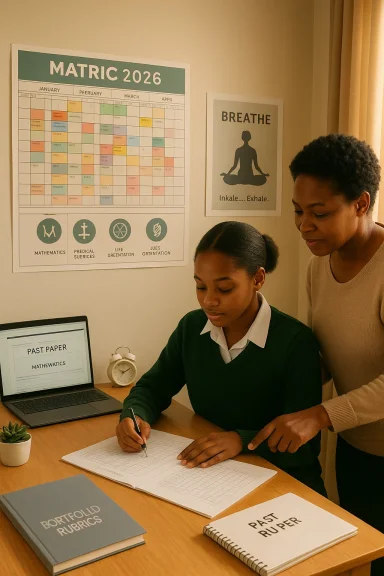
A planner is not a magic wand, but it is the backbone of consistent effort. The difference between nervous cramming in October and steady confidence in October is visible planning done in February and March.- Use a monthly wall planner for major deadlines: test dates, assignment due dates, portfolio submission windows, and official common assessment dates.
- Combine it with a daily routine: short, focused study blocks (45–60 minutes) with 10–15 minute breaks; sleep windows; exercise and social time.
- Build micro‑habits: review notes for 15 minutes after school, write one summary paragraph per subject each day, or teach one concept to a parent or friend.
Portfolio pieces: treat them like high‑value assets
For many subjects the work you submit during the year — assignments, practicals, portfolios — forms a significant portion of the final NSC mark. That makes portfolio items one of the most strategic places to invest time.- Start early: use the opening weeks to clarify portfolio criteria and marking rubrics with each teacher.
- Plan resubmissions: where subjects allow revisions, schedule time after feedback to strengthen work.
- Select strategically: some subjects permit you to submit your highest scoring pieces; think of portfolio pieces like investments — diversify quality across items and prioritise those with the highest mark potential.
- Avoid plagiarism: treat authentic evidence as non‑negotiable. Using generative AI or copying another learner’s work for submission can lead to penalties and lost marks.
The AI and plagiarism risk: use tools wisely, don’t outsource the thinking
Generative AI tools are everywhere and they can be useful for research, brainstorms or clarifying difficult concepts. But in an assessment context they present two risks: (1) if you submit AI‑generated content as your own work it is plagiarism, and (2) AI outputs can be factually wrong or misleading.- Use AI tools for brainstorming, for generating study questions or for rephrasing difficult passages only when you declare and critically assess the output.
- Do not use AI to produce final answers for portfolio sections or assignments unless your teacher explicitly permits and documents this.
- Keep drafts, notes and process evidence for portfolio pieces — that trace of your work makes it easier to demonstrate authenticity if required.
Active learning: techniques that actually move the needle
Passive re‑reading is comfortable but weak. Replace it with active learning strategies that produce durable recall and deeper understanding.- Summarise and teach: write a 200‑word summary of a topic and teach it aloud to a family member.
- Flashcards: well‑made flashcards with spaced repetition are exceptionally useful for languages, definitions, formulas and dates.
- Past papers: practise under exam conditions and then annotate why you lost marks. That corrective feedback loop is the most exam‑prep efficient use of time.
- Peer study groups: keep them small (2–4 learners), focused, and structured (pick a topic, assign tasks, test each other).
Mental wellbeing: not optional, central
Matric stress is real — for learners and parents. One of the most predictive variables for sustained performance is consistent sleep and manageable stress, not heroic all‑night study binges.- Use focused study blocks and scheduled recovery time; regular exercise and a reliable sleep schedule are non‑negotiable.
- Adopt short, practical stress tools: breathing exercises, journaling, short walks, or a 10‑minute digital‑free unwind before bed.
- If anxiety becomes debilitating, seek help from school counsellors early — don’t wait until deadlines pile up.
Life Orientation: a neglected asset
Life Orientation is often treated as an afterthought, but it carries significant marks and practical benefits: the subject includes school‑based assessment, a Common Assessment Task (CAT), a physical education task and community service components. For many institutions and residence applications, a strong Life Orientation result is useful and sometimes explicitly considered.- Plan the Life Orientation portfolio and CAT deliberately; it is task‑driven and therefore winnable with good organisation.
- Ensure community service is meaningful and documented — reflective work is part of the assessment.
- Aim for distinction where feasible — the subject is accessible with methodical effort.
Reviewing Grade 11 content: plug the weak spots now
A surprising number of matric anxieties come from knowledge gaps left from Grade 11. Use the opening months to audit and patch key topics in subjects like Mathematics, Physical Sciences and first‑language and additional languages.- Make a short Grade‑11 checklist for each subject that maps the “must‑know” topics and the most common exam question types.
- Use targeted peer tutoring or structured study groups to address those topics.
- Request extra help from teachers during periods of low workload; early intervention is far cheaper in time and stress than crisis remediation later.
Post‑matric planning: don’t wait until results day
Early, active exploration of tertiary pathways reduces anxiety and improves decision quality. Treat post‑matric planning as a parallel task, not a postscript to exams.- Attend Open Days (virtual or in person) early in the year; talk to admissions staff and departmental reps.
- Investigate bridging or extended programmes for highly selective degrees if your APS is marginal.
- Keep a rolling list of scholarship and bursary deadlines — many close mid‑year.
A first 90‑day operational plan (what to do, day by day)
Below is a compact, sequenced plan to convert the advice above into action during the first three months of Matric 2026.- Days 1–7: Baseline and Goals
- Create the APS tracking sheet with family and teacher input.
- Identify 3 target programmes and list exact APS/subject requirements.
- Assemble the year planner (digital + wall copy) and insert all known school assessment dates.
- Days 8–21: Routines and First Review Cycle
- Implement daily study blocks and two weekly review sessions (self and parent check‑in).
- Meet each subject teacher to confirm portfolio rubrics and submission dates.
- Start a subject notebook with a "Grade 11 topics checklist".
- Days 22–45: Portfolio Production and Feedback Loop
- Produce the first portfolio draft for each subject with at least one revision cycle scheduled.
- Begin weekly past‑paper practice for two priority subjects.
- Join/create a focused peer study group for subjects where you need most improvement.
- Days 46–75: Consolidation and Mental‑health Check
- Review test results and adjust APS projections; revise targets if necessary.
- Book a school counsellor session if stress/anxiety is rising.
- Ramp up practice exams under timed conditions for all core subjects.
- Days 76–90: Triage and Tactical Moves
- Prioritise subjects with the biggest APS impact and schedule targeted tutoring.
- Confirm any extra or repeat assessment opportunities with teachers.
- Review post‑matric applications and note critical June–August deadlines.
Tools and systems that make a difference
A small set of consistent tools will deliver outsized returns when used properly.- Wall planner + digital calendar: physical visibility plus reminders.
- APS tracker: simple spreadsheet to convert percentages to APS and track projections.
- Subject folders: keep past papers, corrected tests and teacher feedback together.
- Spaced repetition app or flashcards: for language and formula recall.
- A “feedback” notebook: each time you get a test back, write one thing to keep and one thing to change.
Systemic risks and equity concerns — honest appraisal
Matric 2026 is not played on a level field. Some learners have access to extra tuition, quiet study spaces and reliable internet; others do not. There are also systemic threats that affect fairness:- Exam security: past incidents have shown the risks of leaked papers and misuse of digital tools. Schools and exam authorities are actively strengthening controls, but leaks and collusion create uneven advantages.
- AI‑assisted dishonesty: the growing availability of generative AI increases the risk of undetected academic misconduct and has prompted tighter institutional policies.
- Digital divide: equitable access to past papers, practice platforms and tutors remains unequal; learners in under‑resourced schools need system‑level support and creative local solutions.
Where schools and parents should tighten up
- Schools: publish assessment rubrics early, offer structured after‑school subject clinics, and be explicit about AI and plagiarism rules.
- Parents: focus praise on effort and improvement, not only marks; create a supportive environment for sleep and study; and help with logistics like transport to extra lessons or Open Days.
- Learners: document your working process, ask for feedback often, and treat every assignment as an opportunity to close a gap.
Common questions learners and parents ask (and short answers)
- Should I skip social events to study? No: selective social time and recovery are crucial. Protect high‑quality study time, but schedule and enjoy key life‑cycle events — balance matters for sustained performance.
- Are past papers really worth it? Yes — practising past papers under timed conditions is among the highest‑return study methods for NSC exams.
- Can I rely on AI to write my assignments? Not for submitted assessment work. Use AI for ideas and clarification only, and always validate outputs and cite or disclose use if required.
- How important is Life Orientation? More important than most learners believe. It carries marks and includes task‑based assessment that is achievable with planning.
Final rundown: what to do in the next week
- Build your APS tracking sheet and set target programmes.
- Add every known test, CAT and portfolio deadline to a wall planner and digital calendar.
- Meet each subject teacher and collect rubrics; note submission and resubmission policies.
- Create a simple daily routine with two 45–60 minute study blocks and guaranteed sleep windows.
- Begin one focused past‑paper session for the subject you find hardest.
- Book one session with a school counsellor or trusted mentor to discuss stress management techniques.
Matric 2026 will demand consistent work, but it rewards systems more than panic. Start with clear, measurable goals; treat portfolio work as high‑value; use active learning rather than passive re‑reading; and make mental health as important as marks. The habits you build in these opening weeks — planners that get used, feedback loops with teachers, short but intense study blocks, and honest APS tracking — will compound through the year. Above all, remember that this year is both an endpoint and a hinge: protect your wellbeing, plan pragmatically, and use every task as a step toward the future you want.
Source: thestar.co.za Matric 2026: How to start the year strong and stay ahead
