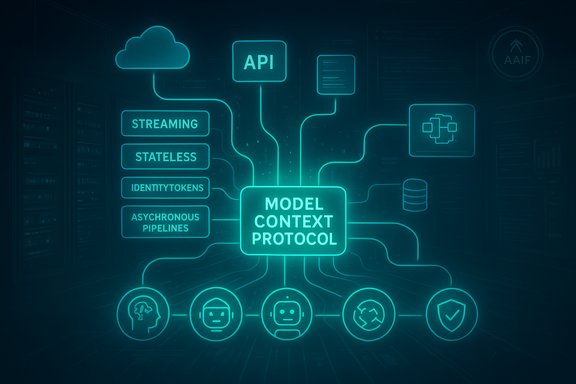
Anthropic’s donation of the Model Context Protocol (MCP) to a new, Linux Foundation–backed Agentic AI Foundation (AAIF) marks a coordinated industry push to wire AI agents into the same kind of open, interoperable plumbing that made the web scale — and it forces enterprise IT teams to confront both an opportunity and a set of practical security, governance, and operational questions they can no longer postpone.
The last 18 months have seen an accelerated move from model-first conversations to agent-first deployments: cloud vendors, AI platform companies, and large enterprises are building task-specific, autonomous agents that act on behalf of users, orchestrate workflows, and connect to internal systems. A cluster of widely used projects — a protocol for exposing tools and data to models, a lightweight project-level instruction format for coding agents, and a local‑first agent framework — are now being placed under neutral governance so they can evolve as shared infrastructure, rather than proprietary features.
That shift is framed by optimistic market forecasts. Industry analysts project rapid adoption of agentic features across business applications, and platform vendors are responding by baking interoperability standards and connectors into developer and enterprise tooling. For IT leaders, this moves the debate away from whether agents will be used to how they will be safely, reliably, and economically integrated.
Governments and regulators are watching. Standards that affect cross‑border data flow, automated decision‑making, and critical infrastructure will attract regulatory scrutiny. Enterprises operating globally must therefore design agent deployments that can adapt to divergent regulatory requirements.
The formation of a foundation to steward MCP and related projects is a net positive for enterprises that want predictable, maintainable agent ecosystems — provided enterprises remain active participants in governance. Without enterprise voices in the room, standards risk drifting toward vendor priorities and leaving production engineering teams to cope with emergent risks.
Source: CIO Dive Big tech takes steps to build open standards for agentic AI
 Background
The last 18 months have seen an accelerated move from model-first conversations to agent-first deployments: cloud vendors, AI platform companies, and large enterprises are building task-specific, autonomous agents that act on behalf of users, orchestrate workflows, and connect to internal systems. A cluster of widely used projects — a protocol for exposing tools and data to models, a lightweight project-level instruction format for coding agents, and a local‑first agent framework — are now being placed under neutral governance so they can evolve as shared infrastructure, rather than proprietary features.That shift is framed by optimistic market forecasts. Industry analysts project rapid adoption of agentic features across business applications, and platform vendors are responding by baking interoperability standards and connectors into developer and enterprise tooling. For IT leaders, this moves the debate away from whether agents will be used to how they will be safely, reliably, and economically integrated.
What is the Model Context Protocol (MCP)?
A universal connector for agents and tools
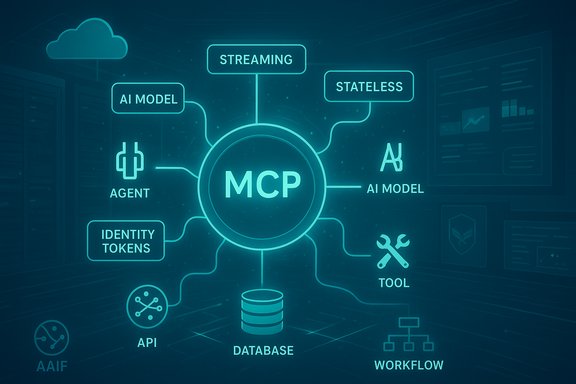
At its core, the Model Context Protocol (MCP) is a machine‑readable standard that lets AI models discover and call tools — from simple APIs and database queries to complex, stateful services — in a uniform way. MCP describes how tools announce themselves, how clients request tool execution, and how results and telemetry are returned. The goal is to make tool integration predictable and maintainable so agents can access capabilities without bespoke adapters for each model or vendor.Why MCP matters for enterprise IT
- MCP removes repetitive engineering work: one MCP server can expose many tools and be linked to multiple agents and models.
- It enables dynamic tool discovery: agents can learn about new capabilities without pushing code changes.
- It centralizes governance points: an MCP server is a control plane for what tools agents can access and how those actions are audited.
Protocol mechanics and recent enhancements
Recent protocol releases emphasize enterprise-grade features such as:- Asynchronous operations and statelessness to support long-running or background workflows.
- Server identity and authentication models to bind tool actions to verified endpoints.
- Streamable transports for lower latency and richer interaction patterns, with legacy SSE being deprecated in favor of more robust streaming options.
- SDKs and tooling in major languages to simplify server and client development.
The Agentic AI Foundation (AAIF): neutral stewardship or industry capture?
What the AAIF is intended to do
The AAIF is being positioned as a neutral home for shared agent infrastructure: protocols, registries, SDKs, and reference implementations. The idea is familiar to any IT professional who’s watched standards win out over proprietary forks: a neutral steward can provide governance, testing frameworks, and a community-driven roadmap that reduces fragmentation and helps buyers adopt compatible solutions.Founding contributions and industry support
Three technical projects have been contributed into the AAIF as anchor projects:- A protocol for tool and context exposure for agents (MCP).
- A lightweight, repository-level instruction format that tells coding agents how to behave on a project.
- A pluggable, local‑first agent framework that integrates models, tools, and MCP-based connectors.
Governance trade-offs to watch
The AAIF lives under Linux Foundation stewardship, which brings established, vendor‑neutral governance models. But a neutral legal structure doesn’t eliminate power dynamics. Vendors who donate projects retain influence through maintainership, feature roadmaps, and their implementations of the standards. For IT procurement and architecture teams, that means:- Certification and compliance mechanisms will be critical to ensure multiple implementations remain compatible.
- Neutrality checks are needed to avoid de facto lock‑in to any vendor’s flavor of the standard.
- Community participation must be encouraged within enterprises so that practical, production‑grade requirements shape the spec.
How major vendors are positioning MCP and agent standards
Platform adoption is already underway
Enterprise tooling vendors and cloud providers are integrating MCP and agent standards into their stacks:- Some development platforms and IDE‑level agents now accept MCP-based connectors, allowing coding assistants to read project context and perform repository actions.
- Large cloud vendors have announced native MCP support in platform tooling and SDKs, and some have integrated MCP into agent orchestration UIs.
- Enterprise-grade agent management products are shipping MCP clients to let operators attach agents to corporate tools via a managed gateway.
Vendor messaging: openness as a competitive strategy
Public statements from platform providers emphasize that open standards reduce friction for enterprise adoption while still enabling vendors to monetize higher-level services such as hosting, observability, and certified connectors. In practice, enterprises should expect:- Vendor-managed registries and marketplaces for validated MCP servers and connectors.
- Premium services around security, compliance, and observability layered on top of the open protocol.
- Continued competition around model quality, reasoning, and ecosystem breadth — not around the basic plumbing itself.
Enterprise implications: benefits, risks, and migration realities
Clear benefits for IT and business teams
- Faster time to value: Standardized connectors shorten integration cycles and simplify maintenance.
- Flexible model choice: MCP enables multi‑model deployments; enterprises can route tasks to different LLM providers or on‑prem inference without rewriting connectors.
- Operational control: Central MCP servers become choke points where policies, whitelists, and telemetry can be applied consistently.
Real and material risks
- Expanded attack surface: Each MCP server and connector is a channel by which an agent can act — misconfiguration or compromised connectors can enable data exfiltration or unauthorized actions.
- Supply‑chain and dependency risks: Agent behavior depends on tool descriptions and the integrity of registries; poisoned or malicious tool metadata is a new class of risk.
- Governance and auditability gaps: Without strong identity, traceability, and policy enforcement, it becomes difficult to answer who instructed an agent and why.
- Rapid change and churn: The protocol and public registries are evolving quickly; early adopters face frequent updates and compatibility headaches.
Implementation hurdles in the real world
- Identity and authentication must be integrated with enterprise identity providers and service meshes.
- Network design must account for secure routing between internal MCP servers, cloud agents, and third‑party connectors.
- Observability — session tracing, audit logs, policy decisions — requires new instrumentation and operator workflows.
- Legal and compliance teams must understand the changing locus of control when an agent acts on behalf of users.
Security and governance: design patterns for safe agent operation
Core security controls to adopt
- Zero‑trust access: Every agent action should be authenticated and authorized using short‑lived credentials and explicit scopes.
- Action allowlisting and destructive hints: Tools that can modify state should be flagged and require extra confirmation or human‑in‑the‑loop approval.
- Telemetry and immutable audit trails: Record inputs, tool outputs, and all decision steps that led to an external action for incident response and compliance.
- Network isolation and egress controls: MCP server endpoints should be placed behind strict network controls and inspected for anomalous calls.
- Supply‑chain verification: Registry entries and tool descriptions must be signed and verified before execution.
Governance processes that matter
- Define an agent charter for each class of agent (purpose, allowed data, acceptable failure modes).
- Maintain an agent inventory and lifecycle plan: deployment, testing, periodic review, and retirement.
- Integrate agents into existing compliance workflows and risk assessments.
- Establish incident playbooks for agents that misbehave or cause data leaks.
Operational pattern: piloting MCP in a large organization
A practical three‑phase rollout
- Pilot (3–6 months)
- Deploy an internal MCP server that exposes a small set of non‑sensitive actions.
- Run agents in a monitored sandbox with strict allowlists and telemetry.
- Validate end‑to‑end traceability and role‑based access controls.
- Scale (6–12 months)
- Extend MCP servers to more teams and add integrations to controlled internal APIs.
- Integrate with identity providers and SIEM for centralized logging.
- Introduce staged human approvals for destructive actions.
- Operationalize (12+ months)
- Migrate production agents to hardened MCP registries with certification.
- Participate in foundation governance and track spec updates.
- Build organizational capabilities: agent ops, governance boards, and testing labs.
Checklist for pilot success
- Minimal viable set of tools published to MCP.
- Observability and replayable session logs working end-to-end.
- Documented approval and emergency disable processes.
- Clear measure of business impact for the pilot (time saved, error reduction).
The competitive and geopolitical dimension
Standardizing agent interoperability has global economic implications. Open protocols lower the barrier to entry for new developers and startups, but they also concentrate influence in the hands of the projects and companies that lead the standards. Early technical leadership can translate into normative power: if widely adopted standards embed certain assumptions about identity, telemetry, or default permissions, those assumptions become hard to unpick later.Governments and regulators are watching. Standards that affect cross‑border data flow, automated decision‑making, and critical infrastructure will attract regulatory scrutiny. Enterprises operating globally must therefore design agent deployments that can adapt to divergent regulatory requirements.
Vendor lock‑in: myth or real concern?
Open standards mitigate classic lock‑in because the connector surface becomes consistent. However, lock‑in can reappear at higher layers:- Proprietary marketplaces for certified MCP servers and connectors can create economic lock‑in.
- Specialized observability, governance, and policy tooling that integrate deeply with vendor ecosystems may be costly to replace.
- Enterprises should insist on portability guarantees: exportable action definitions, open SDKs, and clear compatibility testing.
What IT leaders should do now
- Treat agent standards as an architectural imperative: add MCP‑capable architectures to roadmaps and cloud‑migration plans.
- Start with non‑critical automation pilots to learn the operational model without putting sensitive data at risk.
- Invest in the people and processes for agent ops: security, compliance, test automation, and human‑in‑the‑loop controls.
- Demand interoperability SLAs and portability clauses in vendor contracts.
- Participate in the standards community: contribute real‑world use cases and raise enterprise requirements early so they can be baked into the foundation’s roadmaps.
A straightforward adoption playbook (5 steps)
- Inventory candidate automation use cases and classify risk.
- Stand up an internal MCP server and registry for sandboxed tools.
- Build or acquire an MCP client in your agent orchestration platform.
- Implement identity, allowlists, and telemetry before adding powerful actions.
- Expand usage iteratively while hardening governance and testing.
The outlook: standards accelerate adoption, but governance defines outcome
Open standards and neutral stewardship lower the friction for enterprise adoption of agentic AI. They make it easier for companies to build robust, multi‑model, and multi‑tool workflows. That potential, however, comes with a proximate set of responsibilities: secure the new attack surfaces, update governance and audit models, and ensure interoperability does not morph into control by a few dominant vendors.The formation of a foundation to steward MCP and related projects is a net positive for enterprises that want predictable, maintainable agent ecosystems — provided enterprises remain active participants in governance. Without enterprise voices in the room, standards risk drifting toward vendor priorities and leaving production engineering teams to cope with emergent risks.
Conclusion
The industry’s push to codify an “agentic stack” — protocol, registry, format, and frameworks — is an important milestone. It signals a move from piecemeal connectors to a world where agents can reliably discover, authenticate, and invoke actions across organizational boundaries. For Windows‑centric and enterprise IT teams, the immediate task is pragmatic: adopt a staged, secure approach to MCP adoption; insist on portability and auditability; and treat agent governance as a first‑class concern in operational architectures. When engineers, security teams, and procurement align around interoperable standards — and when governance keeps pace with deployment — organizations can realize the productivity gains of agentic AI while keeping risk manageable.Source: CIO Dive Big tech takes steps to build open standards for agentic AI