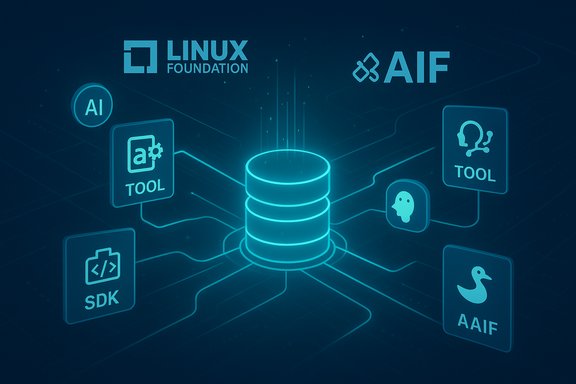
Anthropic has donated the Model Context Protocol (MCP) to a new Agentic AI Foundation (AAIF) housed as a directed fund under the Linux Foundation, and the move—announced December 9, 2025—marks a deliberate attempt by leading AI vendors to place the plumbing of agentic AI under neutral, community-led stewardship.
One year after launching MCP as an open standard for connecting large language models and agentic systems to external tools and data, Anthropic moved the project into neutral hands: the Linux Foundation’s newly created Agentic AI Foundation. The AAIF launches with three founding project contributions—the Model Context Protocol (MCP) from Anthropic, goose from Block (an agent framework), and AGENTS.md from OpenAI (a lightweight contextual spec for code agents)—and with public support from major cloud and platform providers including Google, Microsoft, Amazon Web Services (AWS), Cloudflare, and Bloomberg.
Anthropic’s announcement lists several adoption milestones and technical advances leading into the donation: a public registry for MCP servers, a spec update released November 25 that adds asynchronous operations, stateless modes, server identity mechanisms and extensions, official SDKs in primary languages, and new runtime features in the Claude developer stack (Tool Search and Programmatic Tool Calling). Anthropic also highlights ecosystem uptake—platform integrations and a large number of MCP server endpoints—while committing that MCP’s maintainer and governance model will remain community-driven after the transfer.
This article gives Windows-focused developers and IT professionals a deep dive into what MCP and the AAIF mean for the agentic-AI landscape, verifies available technical claims where possible, analyzes strengths and risks, and offers pragmatic guidance for teams preparing to build or harden agentic systems.
Instead of bespoke, per-integration code, MCP proposes:
For Windows developers, the immediate win is better cross-tool compatibility inside Visual Studio Code and Azure-based workflows. Teams that target multiple platforms for redundancy or vendor negotiation will particularly benefit.
Key governance questions to watch as AAIF matures:
At the same time, centralizing a protocol under a foundation backed by major vendors shifts the debate from purely technical design to governance, trust and security. The AAIF and MCP must be transparent about governance rules, registry trust mechanisms, and security baselines to prevent the very fragmentation and vendor lock-in the initiative seeks to avoid.
For Windows developers, IT teams and enterprise architects, the immediate priority is pragmatic: treat connectors as first-class software artifacts, require strong identity and least-privilege for connector operations, adopt private registries for sensitive workloads, and participate in AAIF and MCP governance where possible. The promise of a common connectivity layer is real—but realizing it safely will require rigorous engineering, mature governance and continued public scrutiny.
Source: Anthropic https://www.anthropic.com/news/dona...nd-establishing-of-the-agentic-ai-foundation/
 Background / Overview
One year after launching MCP as an open standard for connecting large language models and agentic systems to external tools and data, Anthropic moved the project into neutral hands: the Linux Foundation’s newly created Agentic AI Foundation. The AAIF launches with three founding project contributions—the Model Context Protocol (MCP) from Anthropic, goose from Block (an agent framework), and AGENTS.md from OpenAI (a lightweight contextual spec for code agents)—and with public support from major cloud and platform providers including Google, Microsoft, Amazon Web Services (AWS), Cloudflare, and Bloomberg.Anthropic’s announcement lists several adoption milestones and technical advances leading into the donation: a public registry for MCP servers, a spec update released November 25 that adds asynchronous operations, stateless modes, server identity mechanisms and extensions, official SDKs in primary languages, and new runtime features in the Claude developer stack (Tool Search and Programmatic Tool Calling). Anthropic also highlights ecosystem uptake—platform integrations and a large number of MCP server endpoints—while committing that MCP’s maintainer and governance model will remain community-driven after the transfer.
This article gives Windows-focused developers and IT professionals a deep dive into what MCP and the AAIF mean for the agentic-AI landscape, verifies available technical claims where possible, analyzes strengths and risks, and offers pragmatic guidance for teams preparing to build or harden agentic systems.
What is the Model Context Protocol (MCP)?
The problem MCP solves
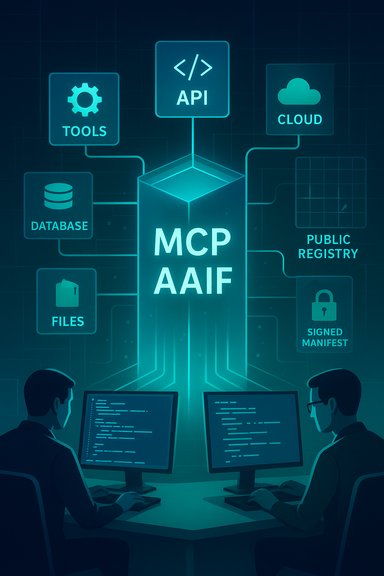
Modern agentic systems—coding assistants, automated workflow agents, enterprise bots—need to connect models to the external world: databases, issue trackers, web APIs, filesystems and other tools. Historically these integrations were ad hoc, inconsistent, and costly in model context tokens. MCP is a network protocol and specification that standardizes how models discover, describe and call external services (called “MCP servers” or connectors).Instead of bespoke, per-integration code, MCP proposes:
- A standardized tool/connector schema that describes available actions and input/output shapes.
- A discovery and registry mechanism so agents can find services.
- An interoperable calling model so multiple LLM platforms can use the same connector definitions.
Recent technical advances announced
Anthropic and the MCP project announced a set of important technical changes and adjacent features in late November / early December 2025:- Asynchronous operations: connectors can report results asynchronously rather than blocking model inference, enabling long-running tasks and better resource utilization.
- Statelessness: connectors can be invoked without relying on long-lived server-side session state, improving scalability and easing horizontal scaling.
- Server identity: mechanisms to authenticate and assert the identity of connector servers—critical for supply-chain and man-in-the-middle protections.
- Official extensions and SDKs: language SDKs and formal extension points for richer metadata, permissioning and telemetry.
- Registry: a community-driven public registry for discovering MCP servers and connectors.
- Advances in tooling for models: Anthropic’s Claude ecosystem introduced Tool Search (deferred tool-loading and dynamic discovery) and Programmatic Tool Calling (run orchestration code to call tools outside the model’s context) to mitigate token bloat and reduce latency.
Verification: What we can confirm — and what we cannot
- The formation of the Agentic AI Foundation (AAIF) under the Linux Foundation and the commitment of Anthropic, OpenAI and Block as founding contributors, with visible support from Google, Microsoft, AWS, Cloudflare and Bloomberg, was publicly announced December 9, 2025. This organizational formation and the founding project contributions are verifiable from multiple vendor announcements and independent coverage.
- The technical additions to MCP (asynchronous ops, statelessness, server identity, official extensions) and the Claude developer features (Tool Search and Programmatic Tool Calling) are described in official platform and engineering notes and are reflected in developer documentation and release notes.
- The claim that MCP is in use across major platforms—for example, integrations with ChatGPT/ChatGPT Apps, Microsoft Copilot, Visual Studio Code, Cursor and Gemini—appears consistently in vendor materials and press coverage. Several major LLM platforms have publicly signaled MCP support or MCP-derived connector compatibility.
- The quantitative figures reported by Anthropic—specifically “more than 10,000 active public MCP servers” and “97M+ monthly SDK downloads across Python and TypeScript”—originate from Anthropic’s official announcement and the MCP project blog. Those numbers are cited repeatedly in press coverage, but they are metrics reported by the project maintainers; independent third-party telemetry to fully validate these exact counts is not publicly available at this time. These figures should be treated as vendor-supplied metrics and are flagged here as claims that the community should verify independently if those numbers materially affect procurement, risk assessment, or compliance decisions.
Why the move to the Linux Foundation matters
Neutral stewardship and long-term sustainability
The Linux Foundation brings well-established, vendor-neutral governance models and an infrastructure for sustaining projects that become foundational to industry (Kubernetes, Node.js, PyTorch, etc.. Moving MCP into a Linux Foundation-directed fund (the AAIF) aims to:- Remove single-vendor control and reduce perceived vendor lock-in.
- Provide a governance chassis suitable for many stakeholders: enterprises, cloud providers, independent maintainers, and security researchers.
- Encourage broader community contributions and a formal process for standards evolution.
Caveats and governance realities
A foundation’s neutrality depends on its charter, membership model, and project governance rules. The AAIF is a directed fund—a structure that can be efficient for bootstrapping an initiative but can also create tiers of influence tied to founders and sponsors. The Linux Foundation has deep experience balancing corporate membership with community interests, but the structure, bylaws, and voting/maintainer rules the AAIF adopts will materially determine whether MCP remains truly community-led.The technical promise: easier, scalable agents
Improved developer ergonomics
- Dynamic discovery (Tool Search) allows agents to keep tool definitions out of the model context until needed. For developers, this means building systems with thousands of connectors without swallowing the model’s context window.
- Programmatic Tool Calling reduces round-trip overhead by letting agents produce executable orchestration code that runs outside the model and invokes connectors efficiently.
- Stateless connectors and asynchronous operations let teams design connectors that scale horizontally and handle long-running workloads (data exports, batch processes) without blocking agent inference.
Cross-platform interoperability
With multiple major model platforms (public clouds and prominent LLM vendors) adopting MCP-compatible connectors, developers can realistically aim for write-once, run-across integrations: define connectors once, reuse across ChatGPT, Claude, Gemini, Copilot, and local agent frameworks that implement MCP.For Windows developers, the immediate win is better cross-tool compatibility inside Visual Studio Code and Azure-based workflows. Teams that target multiple platforms for redundancy or vendor negotiation will particularly benefit.
Security and operational risks: the hidden costs of connective tissue
Standardizing connectivity expands capabilities—but it also concentrates risk. Here are the principal failure modes and mitigations developers and security teams must consider.1) Connector as attack surface
- Risk: A malicious or compromised connector can exfiltrate secrets, inject commands, or misrepresent outputs to an agent.
- Mitigations:
- Strong server identity and attestation (mutual TLS, signed manifests, verifiable provenance).
- Permission and scope enforcement in connector definitions (least privilege, ephemeral credentials).
- Connector vetting, code signing, and reproducible builds for published connector images.
2) Agent-level privilege escalation and "toxic agent" flows
- Risk: Autonomous agents with access to multiple connectors may chain capabilities to perform unexpected actions (data scraping, destructive writes).
- Mitigations:
- Runtime policy enforcement and allow-lists per agent (capability gating).
- Rate limiting, command-review workflows, and human-in-the-loop escalation for high-risk actions.
- Behavioral monitoring and anomaly detection for agent decision patterns.
3) Supply-chain and registry trust
- Risk: A public registry for MCP servers centralizes discovery but becomes a potential vector for poisoning or malicious entries.
- Mitigations:
- Registry governance: signed entries, publisher verification, reputation signals, and automated vulnerability scanning.
- Enterprise-grade mirrors and private registries for sensitive deployments.
4) Data protection and compliance
- Risk: Agents accessing PII, health, or financial records across connectors can create cross-border compliance problems.
- Mitigations:
- Data locality controls, context sanitization, and policy-aware connectors that enforce redaction or local processing.
- Integration with enterprise DLP (data loss prevention) and identity platforms (SSO, Azure AD, Okta).
5) Over-centralization and vendor influence
- Risk: The presence of hyperscalers and major model vendors as founding AAIF supporters raises questions about the real neutrality of standards.
- Mitigations:
- Transparent governance, community seats, public RFC processes, and mandatory conflict-of-interest disclosures.
- Clear rules for IP, licensing, and project maintainer selection.
Practical guidance for Windows teams and developers
For developers building MCP connectors or agentic workflows
- Treat connectors as code and follow software supply-chain best practices:
- Code reviews, reproducible builds, container signing, CI/CD that embeds security scanning.
- Use private registries and enterprise mirrors for any connectors that handle sensitive data.
- Design connectors for fine-grained permissioning and limited credential scope; prefer ephemeral tokens and short-lived credentials.
- Implement observability: connector-level logs, correlation IDs, and audit trails for every connector call.
For IT and security teams
- Start threat-modeling agentic use cases: enumerate connectors that could touch sensitive systems and apply a higher bar for approval.
- Layer controls:
- Identity and access management (Azure AD conditional access, SSO).
- Network segmentation (connector access only from approved runtime environments).
- Runtime policy engines to intercept and approve high-risk actions.
- Run penetration testing and red-team exercises focused on chained connector abuse.
For procurement and architects
- Don’t treat MCP support as sufficient on its own—require documentation of connector governance, signing, SLSA-based supply-chain practices, and support SLAs.
- Prefer vendors and cloud providers that offer secure, auditable MCP hosting and enterprise-grade registries.
- Plan for multi-cloud and hybrid scenarios. MCP’s promise of cross-platform connectors should be validated in staging environments before wide rollout.
Governance, openness and the politics of stewardship
The AAIF’s launch is a pragmatic compromise: the industry needs shared standards but also wants to align them with production realities and commercial incentives. The Linux Foundation brings operational maturity and familiar governance tooling, but community vigilance is still necessary.Key governance questions to watch as AAIF matures:
- How will maintainers be chosen, and how will the community influence roadmaps?
- What licensing and IP agreements will govern MCP and associated projects?
- Will there be mandatory security baselines for connectors published in the public registry?
- How will AAIF handle vendor conflicts of interest—especially where founding members also run major model platforms that benefit from ecosystem standardization?
Competitive and strategic implications
For enterprises and cloud providers
Adoption of MCP can lower integration costs, increase portability, and accelerate production agent deployments. Cloud providers gain an opportunity to offer managed MCP registries and hardened connector hosting as commercial add-ons, which can be a revenue stream while still operating within a neutral spec.For smaller tool vendors and open-source projects
MCP lowers barriers to entry: a well-defined connector lets small SaaS vendors appear in a broad ecosystem without bespoke adapter work for every LLM platform. However, they must also meet higher security and compliance standards to participate in enterprise registries.Geopolitics and internationalization
Agentic AI architectures that rely on remote connectors raise cross-border data transfer issues and could be affected by export controls, national security reviews, and regional data sovereignty laws. Neutral governance helps, but technical controls for data residency and access must be first-class features.What's next — adoption signals and the roadmap
The near-term indicators to watch:- Enterprise registries and private mirrors offered by cloud providers and security vendors.
- A growing catalog of audited connectors for enterprise SaaS (CRM, ERPs, ticketing, CI/CD) and self-hosted services.
- Formalized vulnerability disclosure processes and security baselines for connectors.
- Continued evolution of agent runtime features (e.g., richer programmatic tool calling, deterministic sandboxing, and safer default policies).
Conclusion
Donating the Model Context Protocol to a Linux Foundation–backed Agentic AI Foundation is an important industry step toward making agentic AI interoperable, auditable and enterprise-ready. The technical improvements announced—deferred tool loading, programmatic tool calling, asynchronous ops, stateless connectors and server identity—address real engineering limits that were preventing agents from scaling safely and economically.At the same time, centralizing a protocol under a foundation backed by major vendors shifts the debate from purely technical design to governance, trust and security. The AAIF and MCP must be transparent about governance rules, registry trust mechanisms, and security baselines to prevent the very fragmentation and vendor lock-in the initiative seeks to avoid.
For Windows developers, IT teams and enterprise architects, the immediate priority is pragmatic: treat connectors as first-class software artifacts, require strong identity and least-privilege for connector operations, adopt private registries for sensitive workloads, and participate in AAIF and MCP governance where possible. The promise of a common connectivity layer is real—but realizing it safely will require rigorous engineering, mature governance and continued public scrutiny.
Source: Anthropic https://www.anthropic.com/news/dona...nd-establishing-of-the-agentic-ai-foundation/