

Every organisation that rushed to deploy meeting transcriptions, copilots, and automated workflows now faces the same uncomfortable question: are those tools actually improving judgment and outcomes, or just generating more artifacts to measure activity with?
The first wave of AI in unified communications focused on convenience: faster notes, draft emails, and search across documents. Vendors promoted uptake by pointing to headline numbers — Zoom reported more than one million AI-generated meeting summaries within weeks of launching its AI Companion, and Microsoft’s WorkLab research found that Copilot users report saving roughly eleven minutes a day once the habit forms. Those figures capture scale and the promise of efficiency, but they do not capture whether decisions improved, whether context survived automation, or whether a single polished summary silently replaced necessary human checks.
What organisations need now is a different class of monitoring: Human-AI collaboration metrics that measure trust, delegation, recovery, and the health of hybrid workflows — not just clicks, minutes, and feature adoption. This article explains the metrics that matter, why traditional usage KPIs mislead, and how IT leaders can implement a low-friction, high-signal measurement strategy that protects outcomes and human judgment.
A packed calendar could mean strong alignment — or decision avoidance. Faster responses could signal clarity — or fear of being overlooked. High usage of an AI summary feature can reflect convenience — or a dangerous habit of treating produced text as the definitive record. When AI agents propose actions, escalate tasks, or trigger workflows downstream, measuring activity without measuring judgement is like checking the speedometer while ignoring that the driver has fallen asleep.
Instead:
Good human-AI collaboration measurement is pragmatic, systemic, and humane. It emphasises trust metrics (overrides and confirmation), recovery metrics (MTTD/MTTR), delegation health, and governance visibility. Build your dashboards to surface composite signals, not single-number scorecards. Use them to redesign the system — the prompts, the handoffs, the review gates — and never to surveil or punish individuals.
If you adopt that posture, your hybrid teams won’t just be “using” AI. They’ll be working with it — and that’s the only definition of success that matters.
Source: UC Today Human-AI Collaboration Metrics to Measure: Is Your Hybrid Team Really Working? - UC Today
 Background / Overview
The first wave of AI in unified communications focused on convenience: faster notes, draft emails, and search across documents. Vendors promoted uptake by pointing to headline numbers — Zoom reported more than one million AI-generated meeting summaries within weeks of launching its AI Companion, and Microsoft’s WorkLab research found that Copilot users report saving roughly eleven minutes a day once the habit forms. Those figures capture scale and the promise of efficiency, but they do not capture whether decisions improved, whether context survived automation, or whether a single polished summary silently replaced necessary human checks.What organisations need now is a different class of monitoring: Human-AI collaboration metrics that measure trust, delegation, recovery, and the health of hybrid workflows — not just clicks, minutes, and feature adoption. This article explains the metrics that matter, why traditional usage KPIs mislead, and how IT leaders can implement a low-friction, high-signal measurement strategy that protects outcomes and human judgment.
Why traditional UC metrics fail in an agentic world
Traditional unified communications (UC) metrics were built for coordination, not judgement. They measure activity:- Meeting counts and calendar load
- Message volumes and response latency
- Feature enablement and sign-on rates
A packed calendar could mean strong alignment — or decision avoidance. Faster responses could signal clarity — or fear of being overlooked. High usage of an AI summary feature can reflect convenience — or a dangerous habit of treating produced text as the definitive record. When AI agents propose actions, escalate tasks, or trigger workflows downstream, measuring activity without measuring judgement is like checking the speedometer while ignoring that the driver has fallen asleep.
The human-AI collaboration metrics that actually matter
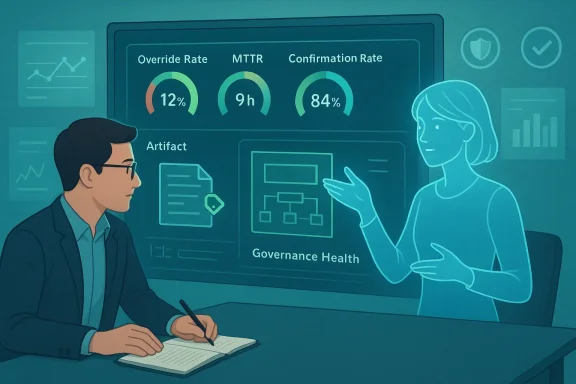
Below are the categories and specific metrics organisations should instrument to understand whether their hybrid teams are working — and to detect failure modes early.Human override rates
- What it measures: the percentage of AI suggestions, summaries, or auto-generated actions that a human edits, rejects, or replaces before the artifact becomes the official record.
- Why it matters: overrides are a direct proxy for human attention and skepticism. Early, elevated override rates are healthy: humans are validating outputs and stress-testing the model. A later drop in overrides paired with increased downstream corrections signals automation bias — people trusting confident AI outputs without checking them.
- How to interpret trends:
- Declining overrides + stable rework/corrections = genuine quality improvement.
- Declining overrides + rising downstream rework = signal of risk (automation bias; psychological safety issues).
- Implementation notes: capture overrides with metadata — who overrode, why (category tag), and time-to-override — then correlate with outcome metrics (customer complaints, reopened tickets).
Decision confirmation rates
- What it measures: the share of AI-generated decisions that receive an explicit human confirmation step before execution (e.g., “Approve and send,” “Assign to ticket,” “Publish summary”).
- Why it matters: confirmation rates separate convenience from accountability. AI can speed drafting, but when actions carry legal, financial, or compliance risk, a human confirmation step preserves accountability.
- Practical thresholds: treat confirmation as mandatory for high-risk decision classes (customer refunds, contract changes, HR outcomes), optional for low-risk drafting steps. Track per-decision-type confirmation rates and flag falling rates in high-risk categories.
Error recovery time (mean time to detect & correct AI errors)
- What it measures: the time between an erroneous AI artifact being created and its correction or mitigation across systems.
- Why it matters: accuracy percentages are blunt instruments; rapid detection and containment are the real safety valve. At scale, a single bad summary can propagate through tickets, dashboards, and audits — so recovery speed matters more than marginal accuracy improvements.
- How to operationalise:
- Log error reports that reference AI artifacts.
- Measure mean time to detect (MTTD) and mean time to remediate (MTTR) by artifact type.
- Prioritise automated alerts for artifacts that trigger downstream workflows.
Delegation quality & autonomy fit
- What it measures: how well AI decides when to act autonomously versus when to escalate to humans; includes context completeness when escalating.
- Why it matters: poor delegation creates two risks — over-delegation, where AI acts in judgment-sensitive contexts (customer disputes, compliance) and under-delegation, where humans do repetitive cleanup work AI could safely handle.
- Signals to track:
- Escalation frequency and rationale (confidence scores, uncertainty flags).
- Context completeness score (does the escalated item include raw sources, rationale, and recommended options?).
- Decision latency for escalations: long latencies point to poor context or unclear ownership.
Process conformance & workaround signals
- What it measures: how often users follow the intended, governed workflow versus creating manual workarounds (parallel notes, shadow summaries, external copy-outs).
- Why it matters: a rising rate of workarounds is an early indicator of poor AI fit, friction, or trust gaps. Workarounds are costly and create governance blind spots.
- How to detect:
- Duplicate records across systems (parallel record creation).
- Export/copy patterns (are meeting transcripts being pasted into consumer tools?).
- Frequency of “side documents” created outside sanctioned storage.
Shadow AI & governance health
- What it measures: prevalence of unapproved AI use in sensitive workflows and the traceability/provenance of AI artifacts.
- Why it matters: shadow AI fuels risk — data leakage, regulatory noncompliance, and inconsistent artifacts. But it also signals unmet needs and demand.
- Governance checks:
- Track the top destinations for exported transcripts and summaries.
- Maintain an inventory of active AI agents, plugins, and copilots with named sponsors and documented scopes.
- Monitor data transfers from sanctioned to unsanctioned tools.
Human stability & cognitive load
- What it measures: post-adoption review burden and the mental cost of interacting with AI (AI rework ratio, context reconstruction frequency).
- Why it matters: time saved is meaningful only if it reduces cognitive load and preserves wellbeing. A system that produces lots of false-positives or incomplete summaries can increase review work and burnout.
- Metrics to collect:
- AI rework ratio: proportion of artifacts that require minor edits vs full rewrites.
- Context reconstruction frequency: how often a user needs to reopen original recordings/documents to understand AI outputs.
- Employee wellbeing indicators (voluntary surveys, attrition/absence correlated with AI workload).
Record integrity & artifact quality
- What it measures: how often AI-generated artifacts are disputed, corrected, or edited after distribution.
- Why it matters: meeting summaries, transcripts, and action-item lists can become contractual evidence or trigger compliance checks. Labels and lifecycle policies matter: is this a draft, an archival record, or an actioned fact?
- Governance controls:
- Ensure artifacts are labelled (draft vs record).
- Implement TTL (time-to-live) or review gates for artifacts before they’re declared official.
- Track reversal rates for action items created from AI outputs.
Fair access & unequal influence
- What it measures: distribution of AI features and capability by role, region, or seniority; correlation with performance or mobility gaps.
- Why it matters: unequal access shifts power and narrative control. Teams with AI enrichments can move faster and dominate knowledge flows; others fall behind or resort to shadow AI.
- Practical checks:
- Distribution maps of feature enablement by team and geography.
- Correlations between AI access and measurable outcomes (promotion, productivity proxies).
- Training and enablement uptake rates.
How to implement an effective measurement program (without turning it into surveillance)
Metrics can either tune a system or weaponise it. The difference is governance and intent. Follow these operational steps to get meaningful, ethical metrics that improve hybrid team outcomes.- Define outcome-level objectives first.
- Example: reduce reopened customer tickets by 30% within six months; or reduce legal escalations originating from AI summaries to zero.
- Map AI artifacts to outcomes.
- Connect meeting summaries, action item creation, and automated ticketing flows to specific KPIs you care about.
- Instrument with privacy and proportionality.
- Measure at system or team level; avoid attributing raw metrics to individuals for punitive reasons.
- Build composite signals, not single-number scorecards.
- Combine override trends, MTTR, and workaround frequency into a governance health index.
- Set clear thresholds tied to process changes, not punishments.
- If the governance health index drops below X, trigger a UX review and retraining, not disciplinary action.
- Close the loop with product and policy changes.
- Use metric insights to redesign UI flows (e.g., make confirmation explicit in high-risk paths), update prompts, or add escalation context.
Recommended KPIs and how to interpret them
- System-level override rate (weekly) — target: stable, explained by task type
- Interpret as attention signal; investigate if declines coincide with higher correction rates.
- Confirmation rate for high-risk actions (daily/weekly) — target: near-100% for regulated activities
- Use as a hard control for operational risk.
- Mean time to detect/correct AI error (MTTD/MTTR) — target: as short as possible; set SLAs by artifact criticality
- Prioritise detection automation where corrections are costly.
- AI rework ratio — target: majority minor edits, <10% full rewrites
- High full-rewrite rates mean the model is producing untrustworthy artifacts.
- Shadow AI incidence (monthly) — target: trending down
- If it increases, treat it as an unmet need and redesign sanctioned tooling to be faster/more flexible.
- Parallel record count (per 100 meetings) — target: decline over time
- Use as a proxy for trust in official artifacts.
- Fair access index (feature coverage by role/region) — target: equitable coverage for roles that need it
- Correlate with performance and mobility indicators.
Practical dashboarding and data sources
Collecting and presenting these metrics need not be invasive. Typical data sources and signals include:- App logs (who requested a summary, who edited it)
- Workflow triggers (automatic ticket creation, escalation events)
- Version history (artifact edits, timestamps, user IDs)
- Export logs (copy/out destinations, plugin usage)
- Support and complaint channels (tickets referencing AI artifacts)
- Short employee surveys for subjective trust and cognitive load
- Top panel: governance health index and trend (30/60/90 days)
- Second panel: critical containment metrics (MTTR, confirmed high-risk actions)
- Third panel: adoption vs. trust map (feature adoption correlated with override and rework rates)
- Alerts: threshold breaches (e.g., confirmation rate below X in a regulated category)
Vendor and real-world signals: what the market shows
Vendors are in different stages of translating scale into governance patterns. Two public vendor data points illustrate the opportunity and the risk.- Zoom reported that its AI Companion generated over one million meeting summaries quickly after launch, demonstrating massive adoption of automated summaries as a work artifact. That scale highlights why organisations must measure artifact health: at one million summaries, even a 0.5% error rate would surface in thousands of meetings and multiply through dependent workflows.
- Microsoft’s WorkLab research on Copilot users found a tipping point they call the 11-by-11: roughly eleven minutes a day of time savings for eleven weeks is enough for users to form an AI habit and report downstream improvements in productivity and work-life balance. The finding is useful as a behaviour benchmark, but it does not absolve organisations from tracking confirmation, overrides, and recovery — time saved without oversight can still lead to poor outcomes.
Common failure modes and how metrics reveal them
- Failure mode: automation bias (trust without validation).
- Metric signal: falling override rates with rising reopened tickets or disputed summaries.
- Fix: reintroduce explicit confirmation for mid/high-risk actions and increase visibility of provenance.
- Failure mode: shadow AI and data leakage.
- Metric signal: spike in exports to unsanctioned domains and parallel records.
- Fix: reduce friction in sanctioned tools, add transparent provenance metadata, and provide safe, approved sandboxes for experimentation.
- Failure mode: over-delegation into judgment-heavy contexts.
- Metric signal: low escalation frequency in high-risk categories; high action reversal rate.
- Fix: add mandatory escalation rules and richer context handoffs for decision review.
- Failure mode: increased cognitive load despite time savings.
- Metric signal: high AI rework ratio and increased context reconstruction frequency.
- Fix: model prompt and UI changes to produce richer, verifiable artifacts; invest in focused training and prompt libraries.
Designing for psychological safety and honest telemetry
If metrics are used as a stick, they'll generate false negatives. The single most important organisational design rule is: do not tie these metrics directly to individual performance evaluations. When people fear repercussions, they stop being candid — overrides vanish from logs, workarounds go underground, and the data becomes useless.Instead:
- Use metrics for product and process improvement, not punishment.
- Make measurement transparent: explain what is collected, why, and how it will be used.
- Offer teams dashboards and remediation playbooks so they can self-correct.
- Keep a human-in-the-loop incident response for governance breaches, not an automated punitive pipeline.
Quick-start checklist for IT and UC leaders
- Inventory all AI agents and copilots; assign a named human sponsor to each.
- Define risk tiers (low / medium / high) for actions AI may propose.
- Implement confirmation gates on high-risk actions and logging for all edits/overrides.
- Instrument MTTD/MTTR for AI-originated artifacts and set SLAs.
- Monitor shadow AI exports and parallel record creation monthly.
- Run an 11-week pilot with explicit governance metrics; compare adoption vs. trust signals.
- Use findings to redesign flows (UI changes, prompts, or policy) rather than punish teams.
Conclusion: measure judgment, not volume
Adoption curves and time-saved headlines are seductive. They provide defensible metrics for procurement and vendor success, but they do not prove that an organisation’s decisions are better, safer, or more resilient. In an agentic collaboration world, the real KPI is whether humans remain meaningfully in the loop — confirming decisions where needed, catching and correcting errors quickly, and delegating intelligently.Good human-AI collaboration measurement is pragmatic, systemic, and humane. It emphasises trust metrics (overrides and confirmation), recovery metrics (MTTD/MTTR), delegation health, and governance visibility. Build your dashboards to surface composite signals, not single-number scorecards. Use them to redesign the system — the prompts, the handoffs, the review gates — and never to surveil or punish individuals.
If you adopt that posture, your hybrid teams won’t just be “using” AI. They’ll be working with it — and that’s the only definition of success that matters.
Source: UC Today Human-AI Collaboration Metrics to Measure: Is Your Hybrid Team Really Working? - UC Today
