

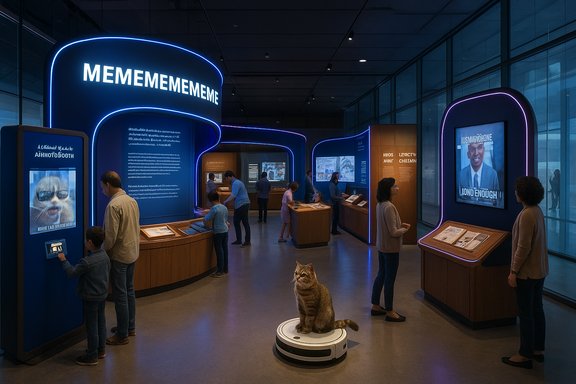
When the doors of the Media Majlis Museum at Northwestern University in Qatar closed on December 4, 2025, for the final time on its three‑month run, the exhibition that had opened on September 1 — titled Memememememe — left behind more than a stack of postcards and a set of press photographs; it left a provocation: that memes, those ephemeral packets of humor and outrage that populate our phones and feeds, deserve sustained, scholarly attention as engines of cultural change. Seen from the vantage point of a university museum that defines itself at the intersection of media, journalism and public scholarship, Memememememe was both a gallery show and a laboratory. Curated by Jack Thomas Taylor (curator of art, media, and technology) with assistant curator Amal Zeyad Ali, the exhibition was explicitly designed to slow things down — to turn the instant bite of internet culture into objects, installations and scenarios that could be inspected, questioned and argued about. That curatorial ambition was stated plainly in the show’s framing: rather than presenting memes as mere shareable jokes, the museum invited visitors to measure memes along four conceptual axes — mass, length, time and volume — and to consider what it means when a tiny cultural unit suddenly circulates at planetary scale. Practical details anchor the story: Memememememe was the Media Majlis Museum’s tenth exhibition and formed part of the museum’s fifth‑anniversary programme. It ran from September 1 through December 4, 2025, open Sunday through Thursday from 10:00 a.m. to 8:00 p.m., and it welcomed thousands of visitors over its run, including students, academics, media practitioners and members of Doha’s expanding arts community. Local reporting and the museum’s own accounts place the opening as a crowded, celebratory event — more than 400 guests at the launch, with subsequent public programmes and commissioned writings accompanying the art. If you walked into the Media Majlis during these months, you would have noticed an unusual choreography. Shepherd Studio’s scenography emphasized circulation: pathways that looped and overlapped, screens that curved and refracted images, and pockets of interactivity that forced you to decide whether you were an observer, a participant or a co‑author of whatever social script the work proposed. That design choice was not decorative: it was the exhibition’s argument embodied. Memes do not sit still; they travel, mutate and recombine. The gallery’s circulation mirrored that kinetic logic. The roster of works mixed established names and emerging voices, and the combination gave the show a pleasing, sometimes disorienting variety. Among the highlights reported by press and museum notes was The Roomba Cat — a sculpture by Franco and Eva Mattes that placed a cat atop a functioning robot vacuum, letting the animal roam the gallery and transforming a familiar domestic affect into moving performance. Other works examined meme anatomies or provided tools for spectatorship: Seohyo’s armatures of memes, Orkhan Mammadov’s Curved Screen, Andreas Refsgaard’s AI photobooth and Adnan Aga’s Narrative Laundry were singled out as pieces that encouraged playful, but also reflective, engagement with the mechanisms of circulation and remix. The show also presented seven newly commissioned works — by Alia Leonardi, Anne Horel, Cem A., Eman Makki, Mauro C. Martinez, Orkhan Mammadov and Seo Hyojung — that took digital memory, identity and collective emotion as their subject. Why museumize memes? That is the curatorial question that animates the exhibition and, in a larger sense, the debate about how cultural institutions respond to digital life. Museum director Alfredo Cramerotti and NU‑Q’s dean Marwan M. Kraidy framed the enterprise as academic and civic: placing memes in a gallery, they argued, creates a space in which instant reactions can be turned into evidence‑based inquiry. “Memememememe turned a familiar part of digital life into a catalyst for real inquiry,” Kraidy told visitors and journalists, noting that the Museum’s role is to provoke conversation as much as to collect objects. Cramerotti echoed that note, arguing that a “seemingly lighthearted” subject reveals deeper cultural work when treated with the instruments of museum practice. Concretely, the exhibition’s structure — its four measures — encouraged visitors to ask particular questions. Mass asked: how many people see or participate in a meme? Length asked: how far does it travel across communities and languages? Time asked: what is a meme’s half‑life — does it vanish the next morning or does it persist as cultural currency? Volume asked: how much intensity, repetition or amplification is required before a meme affects politics, reputations, or institutions? These are not neutral metrics; they map directly onto concerns about virality, disinformation, cultural translation and the ethics of online circulation. In practice, the artworks and installations staged moments that made these theoretical distinctions tangible: interactive booths produced instant photomemes that visitors could send to their phones; sculptural assemblages rendered the physical traces of digital forms; commissioned films tracked the afterlife of memes across time zones. Beyond the objects, Memememememe aimed to model a research posture toward everyday practices. The museum mounted public programmes — talks, workshops and artist conversations — that connected art practice to media studies, computational methods and regional cultural histories. Northwestern Qatar emphasized evidence‑based storytelling and outreach to communities in Doha and Education City; the exhibition’s organisers hoped that a museum setting could encourage not just critics, but also practitioners, to reflect on how memes shape public argument and civic imagination. In short, the show was designed to be a crossroads between artistic provocation and scholarly method. That bridge — between humor and political life — is crucial because memes operate in a saturated cultural ecology where attention is scarce and meaning is fluid. Memes often look trivial: a captioned image, a short clip, a repeatable template. But their cultural role is rarely reducible to joke‑making alone. They aggregate sentiments, distill complex positions into a single frame, and can serve as both a pressure valve and a vector for mobilisation. Treating them as cultural barometers aligns with scholarship on memes as shorthand for public sentiment — a kind of rapid cultural telemetry. That argument is not unique to the Media Majlis; social‑media scholars and practitioners increasingly treat meme streams as data to be read, interrogated and, when necessary, regulated. The files in conversation about meme dynamics highlight how these short forms compress grievances and amplify affect in ways that influence corporate, political and social behaviour.
At the same time, there is a risk in exposing memes to the museum gaze: the moment of institutional attention can reify what is, by design, ephemeral. The act of selection — which memes are worthy of display, which artists get commissioned, whose language and contexts are foregrounded — always carries a politics. Memes that are viral in one linguistic or cultural community may appear opaque or offensive when translated poorly; satire can be flattened into literalism; coded forms of speech risk being misread when abstracted from their lived contexts. The curators were alert to these hazards and the exhibition included critical framing and interpretive materials designed to surface context and provenance, not simply aesthetic effect. Visitors’ reactions were varied and instructive. For many younger visitors, the experience doubled as both mirror and lesson: they recognised modes and templates but were invited to trace the longer arcs of circulation and to think through the consequences of remix culture. Older visitors, or those less steeped in meme literacies, sometimes found the framing clarifying — the gallery made visible processes that typically pass by in a blur on their feeds. Public programmes that paired artists with media scholars produced especially lively exchanges: questions about authorship, responsibility and the archival ethics of capturing a living, mutating practice dominated panels and Q&A sessions. NU‑Q’s reporting and local press coverage noted the museum’s success in sparking conversation, while also underscoring the experimental nature of placing digital vernacular forms inside a physical museum. The commissioned works deserve a closer look because they illustrate how artists translate the logic of memetic culture into material form. Andreas Refsgaard’s AI photobooth, for example, allowed visitors to produce image‑based “memes” generated through machine learning processes; the photobooth made visible the algorithmic labor behind seemingly spontaneous images and raised questions about consent and ownership in AI‑assisted meme production. Adnan Aga’s Narrative Laundry performed a different gesture: it set up a domestic, low‑tech apparatus that folded and rehung printed memes, turning the circulation back into a tactile ritual and prompting viewers to reflect on authenticity and repetition. Orkhan Mammadov’s Curved Screen played with form and attention, arranging moving images so they curved away from a center, physically modeling how digital attention bends and refracts across platforms. Each commission approached the meme as phenomenon — not as content to be catalogued — but as habit, instrument and ecological agent. Institutional context matters. The Media Majlis Museum is not a neutral clearinghouse. It is the first university museum dedicated to journalism and media in the Arab world, and it sits physically and intellectually within Education City, near the Qatar National Library and cultural institutions that are part of Doha’s strategy to make itself a regional arts hub. The museum’s curatorial choices therefore index a particular ambition: to situate local and regional media cultures within global conversations about digital life. That ambition shapes programming choices — the museum foregrounded voices from Qatar, the Gulf and the wider Global South alongside international contributors — and it matters for how audiences interpret the works. A meme that functions as an inside joke in one context may carry political valence in another; the Media Majlis’s location and remit required attention to those disjunctions. There are wider stakes in staging a show about memes in 2025. Democracies, commercial platforms, and cultural institutions are all wrestling with the challenge of how to manage information flows that are increasingly mediated by algorithms and attention economies. Memes can catalyse political narratives just as they can create community rituals; in some cases they have influenced elections or policy debates, and in others they have served as relief valves during moments of collective stress. Placing memes in a museum context is one way of insisting that these small cultural units are not merely entertainment but part of the infrastructure of public life; they matter for media literacy, platform policy, and civic education. NU‑Q’s programing around the exhibition — public talks, publications in English and Arabic, and online content — aimed to leverage that civic angle rather than simply aestheticise internet culture. As Memememememe concluded, the museum and its partners signalled that the conversation would continue into 2026. The show’s closure was celebrated as a milestone: it marked the institution’s tenth exhibition and its fifth anniversary; it also created a template for how university museums might address fast‑moving cultural phenomena without surrendering analytical depth to the ephemeral logic of the digital feed. Local news outlets and the Qatari press reported on the museum’s plans to expand programming in the coming year, indicating that the Memememememe project will inform future commissions, teaching modules and public programmes. If there are lessons to be drawn from this experiment, several stand out. First, museum frameworks can productively slow down internet culture and encourage forms of literacy that platform interfaces rarely provide: provenance, context, lineage and critique. Second, curators must be nimble cultural translators: choosing which works to commission and which networks to bring into conversation is as consequential as the artworks themselves. Third, the act of museumization should be reflexive; curatorial apparatus — labels, wall texts, and public programmes — must acknowledge what is lost in translation as often as what is gained. Finally, there is the simple but important civic claim: memes matter. They are a vernacular form that can express dissent, solidarity, parody and grief, sometimes all at once. Recognising that complexity is an essential step in building healthier media infrastructures. Memememememe’s three‑month run has closed, but its ripples are likely to persist in conversations inside and outside NU‑Q. For students and scholars of media, the show offered concrete teaching material: artworks that can be discussed in seminars on digital culture, public programmes that can be revisited as civic exercises, and a curatorial model for how to study ephemeral media forms without reducing them to either moral panic or celebratory nostalgia. For the public, the show was an invitation to look more closely at the forms that habitually structure our attention. And for museums, especially those housed in universities, Memememememe suggested a path for how to convene publics around timely, contested, and wildly popular cultural practices. Reporting on the exhibition — from Qatar Tribune to QNA and NU‑Q’s own communications — emphasised both attendance and ambition: thousands visited, dozens of artists were shown, and the conversation about memes in the museum context had only just begun. Those are measurable outcomes; the more interesting questions are longer term. Will more museums take up similar projects? Will platforms, civic educators and cultural institutions incorporate the kinds of metrics (mass, length, time, volume) that Memememememe proposed? And crucially, will the practice of treating everyday digital culture as an object of public inquiry become more widespread in the Global South and beyond? Memememememe didn’t answer those questions — it posed them, materially and pedagogically. For readers who want to follow up: NU‑Q’s Media Majlis maintains an online presence with an archive of exhibitions and programming notes that document Memememememe’s curatorial essays, commissioned texts and event schedule. Those resources provide useful primary material for anyone researching how museums and universities respond to digital culture in the mid‑2020s. And as the museum itself remarked, the project was never meant to be a final verdict; it was an opening move in an ongoing cultural conversation about how we remember, remix and govern the shared forms that now travel faster than any single policy or editorial decision. (Reporting assembled from Media Majlis and Northwestern Qatar communications, coverage in Qatar Tribune and QNA, and contextual literature on meme culture and institutional engagement. For commentary on memes as shorthand for public sentiment and their effects on corporate and product discourse, see the analytical threads and files that examine how meme cultures amplify technical or policy grievances in rapid‑feedback loops.
Source: Qatar Tribune https://www.qatar-tribune.com/artic...s-exhibition-on-power-of-memes-concludes/amp/
