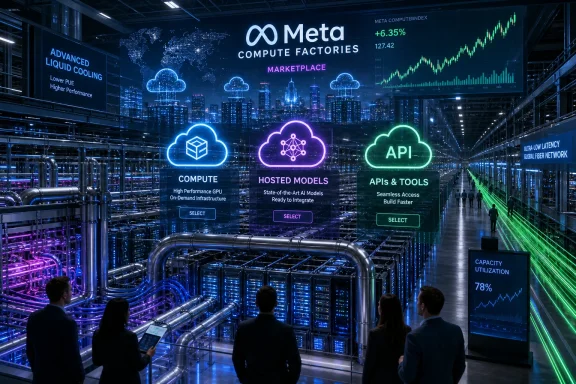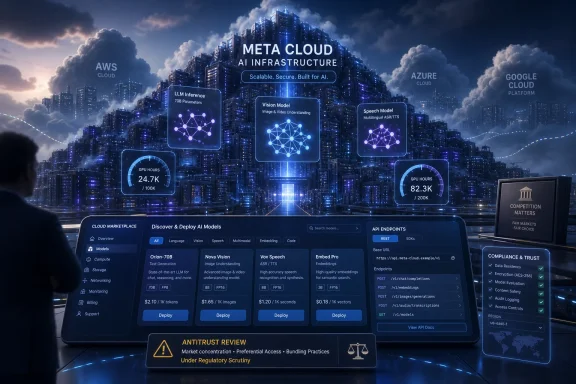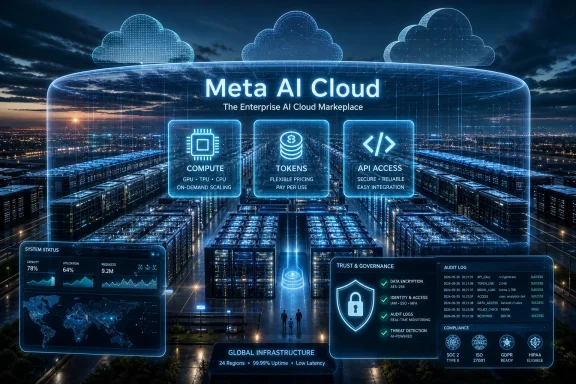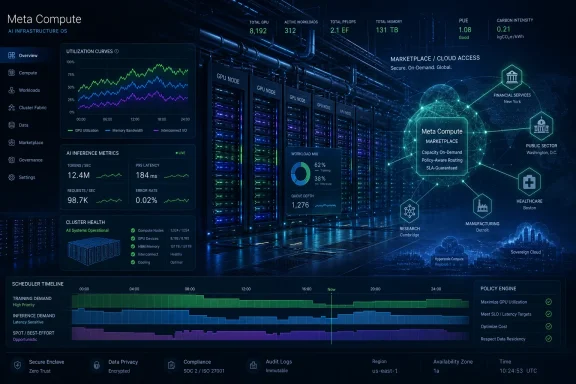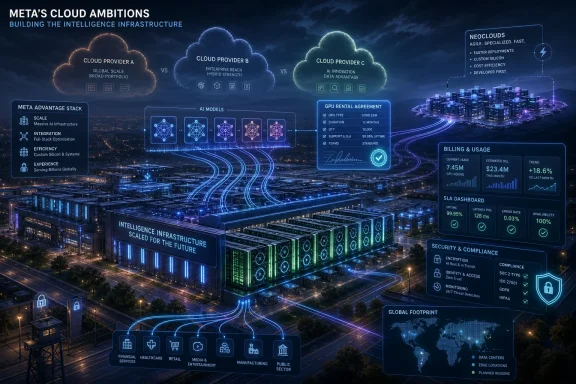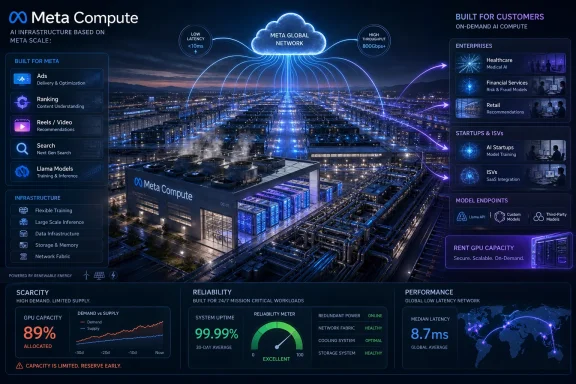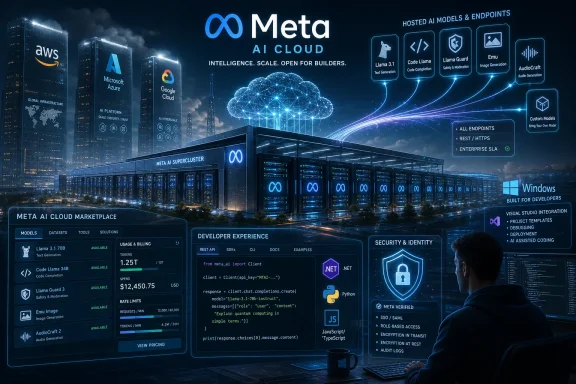
Meta is reportedly developing a cloud infrastructure business inside its Meta Compute organization to sell outside customers access to AI computing capacity and possibly its own models, a July 1 Bloomberg report said, placing the Facebook parent in more direct competition with AWS, Microsoft Azure, and Google Cloud. The rumor was enough to send Meta shares sharply higher, because Wall Street heard something it has been waiting to hear for two years: a revenue story attached to the AI spending binge. But the more important story is not that Meta may become “another cloud.” It is that the AI boom is turning every company with enough GPUs, power contracts, and data-center discipline into a potential infrastructure merchant.
Meta has spent the AI cycle in a strange position. It is one of the few companies on Earth with the money, scale, and engineering talent to build frontier-scale AI infrastructure, yet unlike Microsoft, Amazon, or Google, it has not had a mature cloud business to sell that infrastructure back to the market. Its compute has mostly been a private factory for recommendation systems, advertising tools, Meta AI, Llama, and the company’s broader attempt to keep Facebook, Instagram, WhatsApp, and its hardware ambitions relevant in an AI-first software world.
That made Meta’s AI spending look more exposed than its rivals’. Microsoft can tell investors that Azure demand is capacity constrained. Amazon can point to AWS as the profit engine that funds almost everything else. Google can connect its AI infrastructure to both Google Cloud and its own consumer services. Meta, by contrast, has had to argue that gigantic data-center spending will eventually improve ad targeting, engagement, model quality, developer adoption, and new consumer experiences.
A cloud business changes that pitch. It does not erase the risk, but it gives Meta a cleaner answer to the question investors keep asking: where is the direct return on all this steel, silicon, fiber, and electricity? If the company can rent surplus GPU capacity or package model access for developers and enterprises, then some portion of the AI buildout stops looking like a pure internal cost center.
The phrase excess compute does a lot of work here. In ordinary cloud economics, idle capacity is the enemy. In AI infrastructure, it is even more painful, because the hardware is expensive, power-hungry, and prone to rapid depreciation as new accelerator generations arrive. A GPU cluster that sits underused is not a strategic asset; it is an invoice with fans.
That is why the market reaction matters. Investors did not merely cheer a possible new product line. They cheered the possibility that Meta has found a financial valve for the most uncomfortable part of the AI story: the lag between building capacity and proving that the capacity can earn its keep.
That is the moat Meta would have to confront. Enterprise customers do not merely buy raw cycles; they buy boring promises. They want uptime commitments, predictable billing, regional availability, audit paperwork, integration with existing identity systems, private networking, incident response, and someone to call when a deployment melts down on a Sunday morning. Meta knows scale, but cloud customers know pain.
The likely first version of a Meta cloud business would therefore be narrower than Azure or AWS. It would probably resemble the newer GPU-cloud and AI-inference providers more than a full-stack enterprise cloud. The product could be compute capacity for training and inference, possibly wrapped with model access, developer APIs, and managed environments tuned for Meta’s AI stack.
That would still be significant. The AI cloud market is not waiting for another general-purpose hyperscaler clone. It is hungry for scarce accelerator capacity, especially when startups, research labs, and enterprise AI teams cannot get the clusters they want from the big three at the time or price they want. If Meta can offer credible capacity at scale, it does not need to replace AWS to matter.
The awkward part is that Meta would be entering a market where its rivals are also its reference points. Amazon has Bedrock. Microsoft has Azure AI Foundry and the deep OpenAI relationship that helped define the enterprise AI boom. Google has Vertex AI, Gemini, TPUs, and a long history of machine-learning infrastructure. Meta’s advantage would be less about enterprise incumbency and more about whether it can make its compute and models attractive enough to overcome buyer hesitation.
AI has dragged the industry back toward the physical world. The most important strategic questions now involve GPUs, custom accelerators, data-center campuses, high-bandwidth memory, liquid cooling, power availability, grid interconnection queues, and networking fabrics. Models matter, but the ability to train and serve them at scale increasingly depends on who can assemble enough physical capacity.
That is why Meta’s reported move feels both surprising and inevitable. The company did not build its infrastructure to become a cloud vendor. It built it because AI became a fight over scale, and Meta could not afford to rent its future from rivals forever. Once that infrastructure exists, however, the line between internal capability and external business starts to blur.
This is the same logic that has pulled other AI infrastructure players into the market. If a company builds a massive compute base for its own purposes and then discovers that external demand is intense, selling access becomes an obvious temptation. It is not always a sign of weak internal demand. Sometimes it is simply the economics of matching bursty workloads to expensive fixed assets.
For WindowsForum readers, the shift is worth watching because it changes the vendor map that IT departments have spent a decade memorizing. Cloud strategy used to be a three-body problem with AWS, Azure, and Google Cloud, plus a handful of specialists. AI infrastructure is creating a more jagged market, where model labs, chip companies, social platforms, and dedicated GPU clouds all have reasons to sell pieces of the stack.
That does not mean every company should be treated like a hyperscaler. It does mean procurement teams may soon face credible AI capacity offers from vendors they would never have considered for ordinary workloads. Meta is the most visible example because it has a familiar consumer brand and enormous balance sheet. But the pattern is bigger than Meta.
But Microsoft should still pay attention. The strategic risk is not that a Fortune 500 CIO moves the whole Windows estate to Meta. The risk is that AI workloads become less naturally attached to the clouds where enterprise workloads already live. If a developer team can get better pricing, faster access, or stronger model performance elsewhere, AI architecture may become more multi-provider by default.
That would complicate Microsoft’s preferred story. Azure has benefited from the idea that AI adoption is an extension of existing enterprise cloud adoption. If your identity, data, applications, and governance are already in Microsoft’s ecosystem, Azure AI becomes the path of least resistance. Copilot, Fabric, GitHub, Windows, Microsoft 365, and Azure are meant to reinforce one another.
Meta’s reported move attacks that gravitational pull at the edge. It says, in effect, that AI compute and model access may be purchased as a specialized utility rather than as a feature of a broader cloud relationship. That is not a full replacement for Azure, but it is a wedge.
The same applies to AWS and Google Cloud. The incumbent clouds can absorb competition better than smaller players can, but they are also trying to persuade customers that their platforms are the safest long-term homes for AI development. A well-funded outsider offering large-scale compute and model APIs gives customers another bargaining chip, especially in a capacity-constrained market.
For Microsoft customers, the practical result could be more hybrid AI architectures. Data may remain in Azure. Identity may remain in Entra ID. Business workflows may remain tied to Microsoft 365. But training jobs, fine-tuning experiments, synthetic-data generation, or high-volume inference could spill into specialized AI clouds if the economics and security model work.
Enterprise cloud customers are not ordinary consumers. They ask dull questions because dull questions prevent catastrophic outages, regulatory failures, and career-ending procurement mistakes. Where is the data stored? Who can access logs? How are workloads isolated? What certifications are in place? What happens if a customer’s model output becomes part of a platform improvement loop? How is abuse handled? What contractual guarantees exist?
Meta will have to answer those questions under the shadow of its own history. The company is known for social networking, advertising, content moderation battles, privacy controversies, and the relentless monetization of user attention. That does not automatically disqualify it from enterprise infrastructure, but it does mean buyers will scrutinize the boundary between customer data, model training, and Meta’s own commercial incentives.
The company can reduce that friction with strict contracts, clear technical isolation, transparent data-use policies, and third-party audits. It can hire enterprise sales and support talent. It can build compliance programs. It can partner with systems integrators. None of that is impossible.
But trust accumulates slowly. AWS earned enterprise credibility over years. Microsoft carried decades of enterprise relationships into Azure, even when Azure itself had to mature. Google Cloud has world-class technology and still had to fight the perception that Google is more comfortable with engineers than procurement departments. Meta would enter with scale, but not with inherited enterprise comfort.
This is where the model access piece becomes both opportunity and risk. If Meta offers access to proprietary or internally developed AI models, it could differentiate itself from raw GPU sellers. Yet enterprise customers will want clarity about model licensing, safety behavior, data retention, fine-tuning rights, indemnity, and portability. The moment a cloud service includes models rather than just machines, the legal and operational surface expands.
Infrastructure is one answer. Open models can still require expensive hosting, tuning, inference optimization, and deployment support. Many enterprises do not want to manage clusters, drivers, orchestration layers, quantization tradeoffs, and security controls themselves. They want a reliable service that makes the model usable.
That is where Meta could turn open-model popularity into platform leverage. A hosted Meta AI service could offer optimized inference, easy scaling, tooling, and possibly access to stronger proprietary models that are not released the same way as open-weight systems. The cloud business would not need to monetize the model artifact alone; it could monetize the operational layer around it.
This would also bring Meta closer to the playbook used by other AI platform companies. The model is not always the product in isolation. The product is the combination of model capability, compute availability, latency, cost, integration, and trust. Customers pay for the system that lets them build and ship, not merely for a research checkpoint.
There is a philosophical tension here. Meta has benefited from being seen as the company that made powerful AI models more accessible. A commercial AI cloud could be read as the other side of that same strategy, or as a pivot toward more traditional platform control. The distinction will depend on how Meta prices access, how portable its services are, and whether it continues to support genuinely open ecosystems.
For developers, that tension may be acceptable if the service is good. Ideology tends to matter less when a training run is blocked by lack of capacity. But for the broader AI market, Meta’s move would mark another step toward vertical integration: the same company builds models, controls infrastructure, operates consumer distribution, and sells platform access.
Meta’s reported plan does not prove that the AI compute shortage is over. It may prove the opposite: that demand is so large that even companies building for themselves see a chance to sell into it. But it does remind investors that the supply side is not static. The same high prices that make GPU clouds attractive also encourage every capital-rich player to build more.
This is the classic infrastructure cycle with AI characteristics. Capacity is hard to build, so early shortages create windfall economics. Those economics attract capital. Capital builds supply. Supply arrives unevenly, often late, and often in the wrong places, but eventually it changes pricing power. The question is not whether AI compute remains important. It is who owns enough differentiated capacity to survive when the market becomes less desperate.
Meta has a potential advantage because it is not merely a compute reseller. Its primary business can absorb and justify infrastructure even if external cloud revenue disappoints. Smaller AI clouds do not have that luxury. If demand softens or prices fall, they cannot simply redeploy all of their capacity into a global social network and advertising machine.
That does not make Meta unbeatable. Specialist providers can move faster, offer cleaner enterprise neutrality, support a wider mix of open-source tooling, or serve customers who would rather not buy from a consumer-data giant. But Meta entering the conversation changes the competitive psychology. It says the GPU-cloud trade is not reserved for startups and infrastructure specialists.
It also complicates the narrative around overbuilding. If Meta is selling capacity, skeptics will argue that the company built too much. If Meta is not selling capacity, skeptics will argue that its spending has no direct revenue stream. The company is trying to find a middle path: build for strategic control, then monetize the parts of the machine that can be safely exposed.
For sysadmins and IT leaders, the practical question is not whether Meta becomes a fourth general-purpose cloud. It is whether Meta becomes another place where business units want to run AI workloads. That is exactly the kind of shadow-platform problem enterprise IT has been trying to contain since the first credit-card AWS accounts appeared inside companies.
The AI version is more sensitive. A team experimenting with a language model may upload documents, logs, code, customer records, or operational data without fully understanding retention rules or compliance obligations. If Meta offers attractive capacity or model access, IT departments will need policies before the first enthusiastic developer swipes a corporate card.
Windows-centric environments are especially likely to encounter this through hybrid tooling. Developers may build on Windows laptops, manage repositories through GitHub, authenticate through Microsoft identity systems, store business data in Microsoft 365 or Azure, and still want to send AI workloads to whatever provider has the best GPU availability. The administrative boundary will not match the technical workflow.
That means governance needs to become more portable. Organizations should not assume that keeping their primary cloud relationship with Microsoft is enough to control AI usage. They need data classification, egress rules, vendor review processes, model-risk policies, and logging expectations that apply across AI providers.
There is also a security upside if competition improves. More AI infrastructure providers could reduce dependency on a small handful of clouds and give enterprises more negotiating power around pricing and capacity. But the upside only materializes if the alternatives meet enterprise standards. Cheap compute is not cheap if it creates audit failures, data leakage, or operational blind spots.
Meta understands this because it has spent years building enormous infrastructure for social platforms. The difference now is density and urgency. AI clusters demand a different level of power concentration and networking performance. They also age differently, because the value of each hardware generation can be challenged quickly by the next wave of accelerators.
Selling AI compute therefore is not like leasing spare office space. It requires continuous capital planning, hardware refresh discipline, and workload scheduling sophisticated enough to keep utilization high without starving internal priorities. Meta would need to decide which customers get capacity, under what terms, and with what guarantees when its own model teams want the same resources.
That internal conflict is one reason the reported project should be treated as developing rather than inevitable in its final form. A company can say it wants to sell excess capacity, but excess is a moving target. During a major training run, nothing feels excess. During a gap between model generations, a lot might. During an inference surge inside Meta’s own apps, external customers could become inconvenient unless the capacity planning is mature.
The incumbents have spent years learning these tradeoffs. AWS, Azure, and Google Cloud already operate shared infrastructure businesses where customer demand, internal demand, and strategic partnerships collide. Meta would be entering that discipline with world-class infrastructure engineering but less experience in selling guarantees to outsiders.
The power-market framing also explains why the stakes extend beyond Silicon Valley. Communities hosting data centers care about water, grid load, jobs, tax revenue, and noise. Regulators care about energy demand and resilience. Enterprises care about sustainability reporting. AI cloud growth is not just a software-platform issue; it is an industrial buildout.
A finished business would require product packaging, sales coverage, customer support, security commitments, regional strategy, pricing, billing, partner channels, and a clear answer to why a customer should pick Meta over existing clouds or specialized GPU providers. Those are not press-release details. They are the business.
The warning for IT is that AI procurement is about to get noisier. Vendors that were not part of the traditional cloud shortlist may start appearing in serious conversations because they own scarce resources. Some will be credible. Some will be opportunistic. Some will offer excellent benchmark performance while being thin on governance, support, or operational maturity.
That puts more burden on enterprise buyers to separate compute availability from platform readiness. A provider can be good for a research burst and still unsuitable for regulated production workloads. A model API can be attractive for prototyping and still create unacceptable data-retention questions. A cheap GPU hour can become expensive if the surrounding tooling is immature.
Meta, if it enters, will force that distinction into the mainstream. The company is too large to dismiss and too culturally consumer-facing to accept without scrutiny. It will make CIOs ask what they are really buying when they buy AI cloud: raw performance, model quality, enterprise trust, ecosystem integration, or some negotiated bundle of all four.
The best outcome for customers would be more competition without more chaos. That requires standards, transparent contracts, strong isolation, auditable controls, and portability. The worst outcome would be another wave of fragmented AI experiments scattered across providers with sensitive data following the cheapest accelerator.
Meta’s Cloud Ambition Is Really a Capex Defense
Meta has spent the AI cycle in a strange position. It is one of the few companies on Earth with the money, scale, and engineering talent to build frontier-scale AI infrastructure, yet unlike Microsoft, Amazon, or Google, it has not had a mature cloud business to sell that infrastructure back to the market. Its compute has mostly been a private factory for recommendation systems, advertising tools, Meta AI, Llama, and the company’s broader attempt to keep Facebook, Instagram, WhatsApp, and its hardware ambitions relevant in an AI-first software world.That made Meta’s AI spending look more exposed than its rivals’. Microsoft can tell investors that Azure demand is capacity constrained. Amazon can point to AWS as the profit engine that funds almost everything else. Google can connect its AI infrastructure to both Google Cloud and its own consumer services. Meta, by contrast, has had to argue that gigantic data-center spending will eventually improve ad targeting, engagement, model quality, developer adoption, and new consumer experiences.
A cloud business changes that pitch. It does not erase the risk, but it gives Meta a cleaner answer to the question investors keep asking: where is the direct return on all this steel, silicon, fiber, and electricity? If the company can rent surplus GPU capacity or package model access for developers and enterprises, then some portion of the AI buildout stops looking like a pure internal cost center.
The phrase excess compute does a lot of work here. In ordinary cloud economics, idle capacity is the enemy. In AI infrastructure, it is even more painful, because the hardware is expensive, power-hungry, and prone to rapid depreciation as new accelerator generations arrive. A GPU cluster that sits underused is not a strategic asset; it is an invoice with fans.
That is why the market reaction matters. Investors did not merely cheer a possible new product line. They cheered the possibility that Meta has found a financial valve for the most uncomfortable part of the AI story: the lag between building capacity and proving that the capacity can earn its keep.
The Hyperscaler Club May Get a New Kind of Applicant
Meta should not be mistaken for a conventional cloud provider simply because it may sell compute. AWS, Azure, and Google Cloud are not just warehouses full of chips. They are sprawling platforms of storage, networking, identity, databases, observability, developer tooling, security controls, compliance frameworks, procurement channels, enterprise support, and partner ecosystems.That is the moat Meta would have to confront. Enterprise customers do not merely buy raw cycles; they buy boring promises. They want uptime commitments, predictable billing, regional availability, audit paperwork, integration with existing identity systems, private networking, incident response, and someone to call when a deployment melts down on a Sunday morning. Meta knows scale, but cloud customers know pain.
The likely first version of a Meta cloud business would therefore be narrower than Azure or AWS. It would probably resemble the newer GPU-cloud and AI-inference providers more than a full-stack enterprise cloud. The product could be compute capacity for training and inference, possibly wrapped with model access, developer APIs, and managed environments tuned for Meta’s AI stack.
That would still be significant. The AI cloud market is not waiting for another general-purpose hyperscaler clone. It is hungry for scarce accelerator capacity, especially when startups, research labs, and enterprise AI teams cannot get the clusters they want from the big three at the time or price they want. If Meta can offer credible capacity at scale, it does not need to replace AWS to matter.
The awkward part is that Meta would be entering a market where its rivals are also its reference points. Amazon has Bedrock. Microsoft has Azure AI Foundry and the deep OpenAI relationship that helped define the enterprise AI boom. Google has Vertex AI, Gemini, TPUs, and a long history of machine-learning infrastructure. Meta’s advantage would be less about enterprise incumbency and more about whether it can make its compute and models attractive enough to overcome buyer hesitation.
AI Has Turned Infrastructure Into the Product
For years, the cloud story was about abstraction. Developers were supposed to stop thinking about machines and start thinking about services. The best cloud was the one that made servers disappear behind APIs, managed databases, serverless functions, and infinite-seeming storage buckets.AI has dragged the industry back toward the physical world. The most important strategic questions now involve GPUs, custom accelerators, data-center campuses, high-bandwidth memory, liquid cooling, power availability, grid interconnection queues, and networking fabrics. Models matter, but the ability to train and serve them at scale increasingly depends on who can assemble enough physical capacity.
That is why Meta’s reported move feels both surprising and inevitable. The company did not build its infrastructure to become a cloud vendor. It built it because AI became a fight over scale, and Meta could not afford to rent its future from rivals forever. Once that infrastructure exists, however, the line between internal capability and external business starts to blur.
This is the same logic that has pulled other AI infrastructure players into the market. If a company builds a massive compute base for its own purposes and then discovers that external demand is intense, selling access becomes an obvious temptation. It is not always a sign of weak internal demand. Sometimes it is simply the economics of matching bursty workloads to expensive fixed assets.
For WindowsForum readers, the shift is worth watching because it changes the vendor map that IT departments have spent a decade memorizing. Cloud strategy used to be a three-body problem with AWS, Azure, and Google Cloud, plus a handful of specialists. AI infrastructure is creating a more jagged market, where model labs, chip companies, social platforms, and dedicated GPU clouds all have reasons to sell pieces of the stack.
That does not mean every company should be treated like a hyperscaler. It does mean procurement teams may soon face credible AI capacity offers from vendors they would never have considered for ordinary workloads. Meta is the most visible example because it has a familiar consumer brand and enormous balance sheet. But the pattern is bigger than Meta.
Microsoft Should Worry Less About Losing Cloud Share Than Losing AI Gravity
The easy headline is that Meta wants to challenge Microsoft Azure. The harder truth is that Azure’s core business is not suddenly in danger because Meta rents GPU hours. Microsoft’s advantage in enterprise identity, Windows Server migration, Microsoft 365 integration, developer tooling, compliance, and procurement is not something Meta can conjure by announcing a cloud division.But Microsoft should still pay attention. The strategic risk is not that a Fortune 500 CIO moves the whole Windows estate to Meta. The risk is that AI workloads become less naturally attached to the clouds where enterprise workloads already live. If a developer team can get better pricing, faster access, or stronger model performance elsewhere, AI architecture may become more multi-provider by default.
That would complicate Microsoft’s preferred story. Azure has benefited from the idea that AI adoption is an extension of existing enterprise cloud adoption. If your identity, data, applications, and governance are already in Microsoft’s ecosystem, Azure AI becomes the path of least resistance. Copilot, Fabric, GitHub, Windows, Microsoft 365, and Azure are meant to reinforce one another.
Meta’s reported move attacks that gravitational pull at the edge. It says, in effect, that AI compute and model access may be purchased as a specialized utility rather than as a feature of a broader cloud relationship. That is not a full replacement for Azure, but it is a wedge.
The same applies to AWS and Google Cloud. The incumbent clouds can absorb competition better than smaller players can, but they are also trying to persuade customers that their platforms are the safest long-term homes for AI development. A well-funded outsider offering large-scale compute and model APIs gives customers another bargaining chip, especially in a capacity-constrained market.
For Microsoft customers, the practical result could be more hybrid AI architectures. Data may remain in Azure. Identity may remain in Entra ID. Business workflows may remain tied to Microsoft 365. But training jobs, fine-tuning experiments, synthetic-data generation, or high-volume inference could spill into specialized AI clouds if the economics and security model work.
The Enterprise Trust Problem Is Not a Footnote
Meta’s biggest challenge may not be engineering. The company has repeatedly demonstrated that it can run planet-scale systems, ship consumer services to billions of users, and operate complex infrastructure under brutal traffic conditions. The harder problem is trust in a market where buyers are conservative for good reasons.Enterprise cloud customers are not ordinary consumers. They ask dull questions because dull questions prevent catastrophic outages, regulatory failures, and career-ending procurement mistakes. Where is the data stored? Who can access logs? How are workloads isolated? What certifications are in place? What happens if a customer’s model output becomes part of a platform improvement loop? How is abuse handled? What contractual guarantees exist?
Meta will have to answer those questions under the shadow of its own history. The company is known for social networking, advertising, content moderation battles, privacy controversies, and the relentless monetization of user attention. That does not automatically disqualify it from enterprise infrastructure, but it does mean buyers will scrutinize the boundary between customer data, model training, and Meta’s own commercial incentives.
The company can reduce that friction with strict contracts, clear technical isolation, transparent data-use policies, and third-party audits. It can hire enterprise sales and support talent. It can build compliance programs. It can partner with systems integrators. None of that is impossible.
But trust accumulates slowly. AWS earned enterprise credibility over years. Microsoft carried decades of enterprise relationships into Azure, even when Azure itself had to mature. Google Cloud has world-class technology and still had to fight the perception that Google is more comfortable with engineers than procurement departments. Meta would enter with scale, but not with inherited enterprise comfort.
This is where the model access piece becomes both opportunity and risk. If Meta offers access to proprietary or internally developed AI models, it could differentiate itself from raw GPU sellers. Yet enterprise customers will want clarity about model licensing, safety behavior, data retention, fine-tuning rights, indemnity, and portability. The moment a cloud service includes models rather than just machines, the legal and operational surface expands.
The Open-Model Company May Be Learning to Sell Scarcity
Meta’s AI identity has been unusually complicated. The company has promoted open or openly available models as a counterweight to more closed ecosystems, particularly in the Llama era. That stance helped Meta win developer goodwill and gave it influence beyond its own apps. It also created a strange commercial question: if the model weights are broadly available, where does Meta make the money?Infrastructure is one answer. Open models can still require expensive hosting, tuning, inference optimization, and deployment support. Many enterprises do not want to manage clusters, drivers, orchestration layers, quantization tradeoffs, and security controls themselves. They want a reliable service that makes the model usable.
That is where Meta could turn open-model popularity into platform leverage. A hosted Meta AI service could offer optimized inference, easy scaling, tooling, and possibly access to stronger proprietary models that are not released the same way as open-weight systems. The cloud business would not need to monetize the model artifact alone; it could monetize the operational layer around it.
This would also bring Meta closer to the playbook used by other AI platform companies. The model is not always the product in isolation. The product is the combination of model capability, compute availability, latency, cost, integration, and trust. Customers pay for the system that lets them build and ship, not merely for a research checkpoint.
There is a philosophical tension here. Meta has benefited from being seen as the company that made powerful AI models more accessible. A commercial AI cloud could be read as the other side of that same strategy, or as a pivot toward more traditional platform control. The distinction will depend on how Meta prices access, how portable its services are, and whether it continues to support genuinely open ecosystems.
For developers, that tension may be acceptable if the service is good. Ideology tends to matter less when a training run is blocked by lack of capacity. But for the broader AI market, Meta’s move would mark another step toward vertical integration: the same company builds models, controls infrastructure, operates consumer distribution, and sells platform access.
The Neoclouds Just Got a Reminder That Scarcity Is Temporary
The immediate market pressure on smaller AI infrastructure providers is understandable. Companies built around GPU scarcity can look irresistible when demand outstrips supply. But scarcity markets are fragile. If hyperscalers, AI labs, social platforms, and chip-backed infrastructure ventures all bring more capacity online, customers gain leverage and margins can compress.Meta’s reported plan does not prove that the AI compute shortage is over. It may prove the opposite: that demand is so large that even companies building for themselves see a chance to sell into it. But it does remind investors that the supply side is not static. The same high prices that make GPU clouds attractive also encourage every capital-rich player to build more.
This is the classic infrastructure cycle with AI characteristics. Capacity is hard to build, so early shortages create windfall economics. Those economics attract capital. Capital builds supply. Supply arrives unevenly, often late, and often in the wrong places, but eventually it changes pricing power. The question is not whether AI compute remains important. It is who owns enough differentiated capacity to survive when the market becomes less desperate.
Meta has a potential advantage because it is not merely a compute reseller. Its primary business can absorb and justify infrastructure even if external cloud revenue disappoints. Smaller AI clouds do not have that luxury. If demand softens or prices fall, they cannot simply redeploy all of their capacity into a global social network and advertising machine.
That does not make Meta unbeatable. Specialist providers can move faster, offer cleaner enterprise neutrality, support a wider mix of open-source tooling, or serve customers who would rather not buy from a consumer-data giant. But Meta entering the conversation changes the competitive psychology. It says the GPU-cloud trade is not reserved for startups and infrastructure specialists.
It also complicates the narrative around overbuilding. If Meta is selling capacity, skeptics will argue that the company built too much. If Meta is not selling capacity, skeptics will argue that its spending has no direct revenue stream. The company is trying to find a middle path: build for strategic control, then monetize the parts of the machine that can be safely exposed.
Windows Shops Will Feel This Through Procurement, Not the Start Menu
Most Windows users will not see a Meta cloud icon appear on the desktop. The impact, if the business materializes, will arrive through the back office: procurement decisions, developer experiments, AI pilot budgets, data-governance reviews, and architecture diagrams that already look messier than they did five years ago.For sysadmins and IT leaders, the practical question is not whether Meta becomes a fourth general-purpose cloud. It is whether Meta becomes another place where business units want to run AI workloads. That is exactly the kind of shadow-platform problem enterprise IT has been trying to contain since the first credit-card AWS accounts appeared inside companies.
The AI version is more sensitive. A team experimenting with a language model may upload documents, logs, code, customer records, or operational data without fully understanding retention rules or compliance obligations. If Meta offers attractive capacity or model access, IT departments will need policies before the first enthusiastic developer swipes a corporate card.
Windows-centric environments are especially likely to encounter this through hybrid tooling. Developers may build on Windows laptops, manage repositories through GitHub, authenticate through Microsoft identity systems, store business data in Microsoft 365 or Azure, and still want to send AI workloads to whatever provider has the best GPU availability. The administrative boundary will not match the technical workflow.
That means governance needs to become more portable. Organizations should not assume that keeping their primary cloud relationship with Microsoft is enough to control AI usage. They need data classification, egress rules, vendor review processes, model-risk policies, and logging expectations that apply across AI providers.
There is also a security upside if competition improves. More AI infrastructure providers could reduce dependency on a small handful of clouds and give enterprises more negotiating power around pricing and capacity. But the upside only materializes if the alternatives meet enterprise standards. Cheap compute is not cheap if it creates audit failures, data leakage, or operational blind spots.
The Cloud Wars Are Becoming a Power Market
The old cloud wars were fought over developer mindshare and enterprise migration. The new cloud wars are also fought over electricity. AI data centers are constrained not just by chips but by power availability, cooling, land, transmission infrastructure, and permitting. The companies that can secure power at scale will shape the next phase of the market as much as the companies with the best model demos.Meta understands this because it has spent years building enormous infrastructure for social platforms. The difference now is density and urgency. AI clusters demand a different level of power concentration and networking performance. They also age differently, because the value of each hardware generation can be challenged quickly by the next wave of accelerators.
Selling AI compute therefore is not like leasing spare office space. It requires continuous capital planning, hardware refresh discipline, and workload scheduling sophisticated enough to keep utilization high without starving internal priorities. Meta would need to decide which customers get capacity, under what terms, and with what guarantees when its own model teams want the same resources.
That internal conflict is one reason the reported project should be treated as developing rather than inevitable in its final form. A company can say it wants to sell excess capacity, but excess is a moving target. During a major training run, nothing feels excess. During a gap between model generations, a lot might. During an inference surge inside Meta’s own apps, external customers could become inconvenient unless the capacity planning is mature.
The incumbents have spent years learning these tradeoffs. AWS, Azure, and Google Cloud already operate shared infrastructure businesses where customer demand, internal demand, and strategic partnerships collide. Meta would be entering that discipline with world-class infrastructure engineering but less experience in selling guarantees to outsiders.
The power-market framing also explains why the stakes extend beyond Silicon Valley. Communities hosting data centers care about water, grid load, jobs, tax revenue, and noise. Regulators care about energy demand and resilience. Enterprises care about sustainability reporting. AI cloud growth is not just a software-platform issue; it is an industrial buildout.
Wall Street Heard a Revenue Story, But IT Should Hear a Warning
The nearly 9 percent stock move says more about investor anxiety than about the maturity of Meta’s cloud plan. A rumor of external compute sales was enough to reprice the narrative because the market badly wants AI infrastructure to become revenue-generating infrastructure. That is not irrational, but it is early.A finished business would require product packaging, sales coverage, customer support, security commitments, regional strategy, pricing, billing, partner channels, and a clear answer to why a customer should pick Meta over existing clouds or specialized GPU providers. Those are not press-release details. They are the business.
The warning for IT is that AI procurement is about to get noisier. Vendors that were not part of the traditional cloud shortlist may start appearing in serious conversations because they own scarce resources. Some will be credible. Some will be opportunistic. Some will offer excellent benchmark performance while being thin on governance, support, or operational maturity.
That puts more burden on enterprise buyers to separate compute availability from platform readiness. A provider can be good for a research burst and still unsuitable for regulated production workloads. A model API can be attractive for prototyping and still create unacceptable data-retention questions. A cheap GPU hour can become expensive if the surrounding tooling is immature.
Meta, if it enters, will force that distinction into the mainstream. The company is too large to dismiss and too culturally consumer-facing to accept without scrutiny. It will make CIOs ask what they are really buying when they buy AI cloud: raw performance, model quality, enterprise trust, ecosystem integration, or some negotiated bundle of all four.
The best outcome for customers would be more competition without more chaos. That requires standards, transparent contracts, strong isolation, auditable controls, and portability. The worst outcome would be another wave of fragmented AI experiments scattered across providers with sensitive data following the cheapest accelerator.
The Meta Compute Story Leaves Five Hard Realities on the Table
The reported plan is still a developing story, and the distance between a strategic idea and a durable cloud business is large. But even at this stage, it clarifies where the AI infrastructure market is heading.- Meta’s reported cloud project is best understood as an attempt to monetize AI infrastructure spending, not as an immediate attempt to replicate every feature of AWS, Azure, or Google Cloud.
- Microsoft’s biggest exposure is not a sudden loss of Azure enterprise accounts, but the possibility that AI workloads become more portable, more specialized, and less automatically tied to existing cloud relationships.
- Enterprise buyers should treat AI compute vendors as infrastructure providers that require full security, compliance, support, and data-governance review, even when the initial use case looks experimental.
- Meta’s consumer-platform history will make trust, data handling, and contractual clarity central to any enterprise adoption story.
- The broader AI cloud market is moving from software abstraction back toward physical constraints, where chips, power, cooling, and utilization determine who can compete.
- More providers may improve pricing and capacity access, but they will also increase the risk of fragmented, poorly governed AI deployments.
References
- Primary source: firstonline.info
Published: 2026-07-02T04:30:09.981011
Loading…
www.firstonline.info - Independent coverage: The Tech Buzz
Published: 2026-07-01T15:30:09.980108
Loading…
www.techbuzz.ai - Related coverage: axios.com
Meta stock soars as Mark Zuckerberg explores cloud business
Meta shares soared Wednesday on a report that the company is wading into the business of selling cloud computing services and access to AI models.www.axios.com
- Related coverage: tomsguide.com
Even Google doesn't have enough AI power — and that should worry all of us | Tom's Guide
Google reportedly couldn't meet Meta's demand for Gemini AI compute. It's another reminder that local AI may become one of the biggest trends in personal computing.www.tomsguide.com - Related coverage: investing.com
Meta building cloud business to sell excess AI capacity, Bloomberg News reports By Reuters
Meta building cloud business to sell excess AI capacity, Bloomberg News reportswww.investing.com - Related coverage: livemint.com
Loading…
www.livemint.com
- Related coverage: techcrunch.com
Meta, like SpaceX, looks to turn excess AI compute into cash | TechCrunch
Meta is developing plans for a cloud infrastructure business, selling access to AI compute power and models. The move would pit it against the big cloud providers like Amazon Web Services, Google Cloud, and Microsoft Azure.techcrunch.com - Related coverage: whbl.com
Meta building cloud business to sell excess AI capacity, Bloomberg News reports | 1330 & 101.5 WHBL
July 1 (Reuters) - Meta Platforms is building a cloud business to sell excess artificial intelligence computing capacity, Bloomberg News reported on Wednesday, as tech giants seek returns on costly AI investments amid worries about overspending. The pl...whbl.com - Related coverage: straitstimes.com
Loading…
www.straitstimes.com - Related coverage: latimes.com
Meta plots AI cloud business to challenge Amazon, Microsoft and Google
Meta plots AI cloud business to challenge Amazon, Microsoft and Googlewww.latimes.com - Related coverage: theedgesingapore.com
Meta building cloud business to sell excess AI compute — Bloomberg
Meta is forming a business to generate revenue from excess computing power sold to outside customers.www.theedgesingapore.com
- Related coverage: advisorperspectives.com
Loading…
www.advisorperspectives.com - Related coverage: gigazine.net
MetaがAWS・Azure・Google Cloudに対抗するためAIコンピューティングとAIモデルへのアクセスを販売するクラウドインフラストラクチャ事業を計画中との報道 - GIGAZINE
AIコンピューティング能力とAIモデルへのアクセスを販売するクラウドインフラストラクチャ事業、いわゆる「ネオクラウド」事業にMetaが参入する予定だと、Bloombergが事情に詳しい関係者からの話として報じました。gigazine.net - Related coverage: news.bloomberglaw.com
Meta Is Planning a Cloud Business to Sell AI Computing Power
Meta Platforms Inc. is developing plans for a cloud infrastructure business that will sell access to AI computing power and models, setting up a new vector of competition with industry leaders like Amazon Web Services, Microsoft Azure and Google Cloud.news.bloomberglaw.com
- Related coverage: kfgo.com
Loading…
kfgo.com - Related coverage: tomshardware.com
Loading…
www.tomshardware.com - Related coverage: techradar.com
Meta cloud computing business ‘definitely on the table’, Mark Zuckerberg says – excess data center capacity could be used to enter the market | TechRadar
Zuckerberg wouldn't rule out a cloud businesswww.techradar.com - Related coverage: techxplore.com
Loading…
techxplore.com - Related coverage: fortune.com
Loading…
fortune.com - Related coverage: crn.com
Cloud Market Share Q1 2026: AWS, Microsoft, Google Battling In AI Era
Global cloud market share leaders AWS, Microsoft Azure, Google Cloud, Oracle and Alibaba compete in first quarter 2026 with AI driving enterprise cloud sales.www.crn.com - Related coverage: moccet.ai
Loading…
moccet.ai - Related coverage: themarketcontext.com
Meta Raises 2026 Capex Guidance to $125-145B as Q1 Revenue Hits $56.3B (META) – The Market Context
Meta Platforms reported Q1 2026 revenue of $56.31 billion, up 33% year over year, in a Form 8-K Item 2.02 filing on April 29, 2026, with diluted earnings per share of $10.44.
themarketcontext.com
- Related coverage: aifrontierreview.com
Loading…
aifrontierreview.com - Related coverage: rallies.ai
Meta Raises 2026 Capex Guidance to $145B, Seals $107B Deals - META News | Rallies
Meta increased its 2026 capital expenditure guidance to $125–145 billion from $115–135 billion, reflecting accelerated investment in servers and data centers for its AI infrastructure. The company disclosed $107 billion in cloud and infrastructure commitments this quarter, with first-quarter...rallies.ai