

As Mexico races to capture the economic prize of nearshoring and advanced manufacturing, the country’s biggest constraint is no longer land or capital — it’s people with the right blend of digital literacy, technical craft and adaptable problem‑solving. A recent Mexico Business News feature lays out this challenge clearly: while adoption of generative AI and other Industry 4.0 technologies is accelerating inside Mexican workplaces, formal skills recognition, curricular alignment, and long‑term workforce planning are lagging behind the pace of change.
The nearshoring wave and an influx of higher‑value manufacturing — automotive, aerospace, electronics and medical devices — are reshaping regional labor demand across Mexico. The country’s sizable and relatively young labor force is an asset: Mexico’s economically active population and headline employment figures (60.6 million and 58.9 million, respectively) are regularly cited in government and industry reporting and underpin the country’s nearshoring appeal. These macro numbers, however, hide stark regional imbalances, large informal‑work cohorts and specific shortages in hands‑on technical roles such as welders, machinists and assembly technicians. At the same time, AI and automation are no longer future scenarios — they are augmenting day‑to‑day work. Michael Page’s Talent Trends 2025 research reports that roughly 37% of professionals in Mexico already use tools like ChatGPT, Midjourney or Microsoft Copilot in their daily workflows — and two‑thirds of those users say productivity or quality has improved. That behavioral adoption, however, is not yet matched by job architecture: analysis of millions of job ads shows explicit mentions of AI in job listings remain rare, particularly in creative fields where AI is already widely applied. This convergence — strong demand for higher‑value production, rapid AI uptake by workers, and patchy educational alignment — creates both an opportunity and a policy problem. Firms that can access, reskill and retain Industry 4.0 talent will win; those that cannot will face persistent turnover costs, quality challenges and lost competitiveness.
Note: Where data points and quotations were drawn from specific reports and media coverage, the article cross‑checked survey results (Talent Trends 2025, Mercer Global Talent Trends), primary education and labor statistics reported by INEGI and major outlets, and coverage of corporate and training initiatives. Several industry and policy figures cited in recent reporting are based on firm or association disclosures and may evolve as longer‑term audits and government datasets are updated; these items should be monitored and validated against official releases for final program design and public policy decisions.
Source: Mexico Business News Building Mexico’s Industry 4.0 Workforce
 Background / Overview
The nearshoring wave and an influx of higher‑value manufacturing — automotive, aerospace, electronics and medical devices — are reshaping regional labor demand across Mexico. The country’s sizable and relatively young labor force is an asset: Mexico’s economically active population and headline employment figures (60.6 million and 58.9 million, respectively) are regularly cited in government and industry reporting and underpin the country’s nearshoring appeal. These macro numbers, however, hide stark regional imbalances, large informal‑work cohorts and specific shortages in hands‑on technical roles such as welders, machinists and assembly technicians. At the same time, AI and automation are no longer future scenarios — they are augmenting day‑to‑day work. Michael Page’s Talent Trends 2025 research reports that roughly 37% of professionals in Mexico already use tools like ChatGPT, Midjourney or Microsoft Copilot in their daily workflows — and two‑thirds of those users say productivity or quality has improved. That behavioral adoption, however, is not yet matched by job architecture: analysis of millions of job ads shows explicit mentions of AI in job listings remain rare, particularly in creative fields where AI is already widely applied. This convergence — strong demand for higher‑value production, rapid AI uptake by workers, and patchy educational alignment — creates both an opportunity and a policy problem. Firms that can access, reskill and retain Industry 4.0 talent will win; those that cannot will face persistent turnover costs, quality challenges and lost competitiveness.Why the workforce gap matters now
The macro‑level opportunity and friction
Mexico’s nearshoring advantage rests on three interlocking assets: geographic proximity to major markets, a deep manufacturing base, and a large labor pool. Yet these same attributes create friction when production moves up the value chain.- Higher‑density manufacturing and AI‑enabled production require staff who combine mechanical skills with digital fluency.
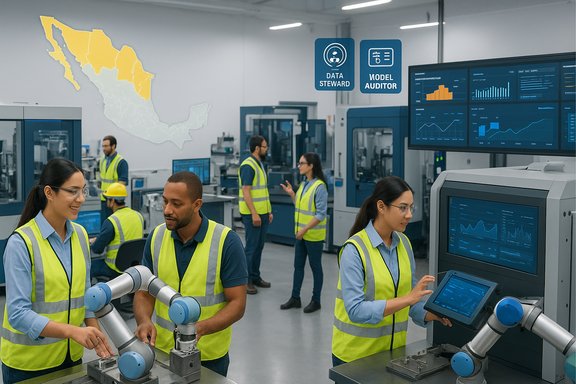
- Data‑driven operations demand new governance roles (data stewards, model auditors, agent managers) that did not exist a decade ago.
- Quick growth in demand exposes regional training gaps: northern manufacturing hubs face labor shortages while the south still struggles with weak industrialization and access to technical education.
AI adoption: real use, soft governance
The Michael Page finding that more than one in three professionals use generative tools daily is a signal: adoption often precedes governance. Workers are augmenting routine tasks — drafting, summarizing, design ideation, basic data analysis — with consumer and enterprise AI tools. But companies and HR functions have been slower to:- add AI competencies to job descriptions,
- define what safe and compliant AI use looks like inside employee workflows, or
- create structured, in‑workplace upskilling that embeds AI capability in everyday roles.
Educational supply: what exists, what’s missing
Universities, technical schools and the training ecosystem
Mexico’s higher‑education and technical ecosystem is extensive: hundreds of public universities and numerous private institutions provide STEM and business programs that feed the labor market. But quantity does not equal alignment. Two persistent problems stand out:- Curricula lag: many college programs still emphasize theory over the hands‑on, instrumented practices demanded by Industry 4.0.
- Geographic imbalance: centers of training and industrial activity are unevenly distributed, leaving northern clusters tight on labor and southern regions underdeveloped.
Microcredentials and corporate programs: scaling targeted skills
Companies and NGOs are experimenting with short, intensive credentialing programs that couple technical modules with soft skills. Samsung Innovation Campus (SIC), for example, targets participants aged 18–29 with courses in AI, programming and problem solving, and integrates microcredentialing for soft skills with CENEVAL assessments — creating compact, employable profiles for entry‑level and early‑career roles. These programs aim to compress the time from training to productive employment and to reduce the variance in candidate quality that firms encounter during large hiring drives.The human factor: retention, turnover and talent economics
Staffing and retention are the operational cracks where strategy and reality collide. Turnover models vary by sector, but frontline roles — assembly, warehousing, production lines — are particularly vulnerable to churn. Industry commentary and regional analyses report a dizzying range of turnover outcomes; one practical industry piece cites frontline turnover between 22% and 176% depending on region and sector, a range that translates into material replacement and training costs for employers. For firms scaling in Mexico, even moderate turnover can convert a nearshoring price advantage into a retention tax that eats margins. Retention depends on several controllable levers:- Clear development pathways and visible promotion criteria tied to new, AI‑enabled tasks.
- On‑the‑job upskilling and micro‑learning embedded in workflows rather than distant classroom modules.
- Competitive total rewards that account for the scarcity of hybrid technical/digital skills in certain hubs.
- Inclusive hiring and support that reduces loss rates among historically excluded groups, notably women.
Gender equity and why it’s core to competitiveness
The diversity imperative
Gender balance in STEM and AI is not a social add‑on — it is a competitiveness and risk‑management issue. Global analyses show that women are significantly underrepresented in science and AI: UNESCO and related analyses repeatedly place the share of women researchers in the low 30s percentage range and estimate that women make up roughly 22% of AI professionals in many datasets. That imbalance has practical consequences: products and models trained by homogeneous teams are more likely to carry blind spots and algorithmic biases, which can lead to reputational, regulatory and commercial harms down the road. In Mexico specifically, the pipeline narrows early: fewer girls choose STEM tracks, and by later stages female representation in technical roles and research lags behind global averages. Industry and civil society programs stress mentorship, role models and exposure as critical interventions. In practice, initiatives such as SIC and targeted corporate sponsorship aim to make STEM pathways more visible and accessible to girls and young women.Why representation matters for AI safety and product quality
Diverse teams catch different failure modes. When AI and automation shape customer experiences, hiring decisions or quality checks, homogeneous development teams are more likely to miss context‑sensitive biases in training data or to deploy models that under‑serve particular user groups. Representation increases the odds that real use cases and edge‑cases will be surfaced during product development and testing — a direct guardrail against downstream risk.Practical road map: how companies and policymakers can act
The Industry 4.0 workforce problem is solvable, but not by ad hoc measures. The following is a practical, sequenced roadmap that companies, industry groups and governments can implement.1. Map skills to tasks — do a role‑by‑role AI exposure audit
- Inventory tasks in every job family and identify which tasks are already automated or augmented by AI.
- Design human‑in‑the‑loop thresholds for safety‑critical outputs (quality control, clinical devices, high‑risk decisions).
- Build micro‑credentials for oversight roles (model auditor, data steward, agent manager).
2. Scale dual‑education and apprenticeship programs
- Partner with technical institutes to replicate the German dual model: classroom theory plus guaranteed workplace rotations.
- Focus on regional parity — incentivize programs in southern states through subsidies or tax credits to reduce geographic imbalances.
- Use public–private training centers co‑funded by industry consortia to create shared pipelines for specialized skills (e.g., precision welding, automated assembly).
3. Embed AI learning into the job, not just the classroom
- Prioritize “learning‑in‑flow” micro‑courses tied to everyday tasks. Pilot programs show far higher retention when learners apply skills immediately at work.
- Provide curated tool‑kits and approved models for frontline supervisors to reduce the ad hoc use of consumer AI that can leak sensitive operational data.
4. Redesign jobs and compensation to value AI oversight
- Update job descriptions and career ladders to include AI‑supervision and governance responsibilities.
- Adjust compensation bands to reward verification, curation, and model‑audit work — the human tasks that remain critical as AI takes over routine activities.
5. Measure outcomes, not adoption
- Track error rates, rework, quality metrics and candidate experience changes after AI roll‑out rather than simple usage metrics.
- For HR analytics and recruitment AI, require third‑party audits of fairness and accuracy before full deployment.
What’s working: early wins and promising programs
- Corporate microcredentials and partnerships with assessment bodies (for example, programs that partner with CENEVAL to certify soft skills) compress training time and give employers verifiable skills evidence. Samsung Innovation Campus and similar initiatives illustrate how blended programs can scale quickly and include women and underrepresented groups.
- Dual education and apprenticeships — when structured with guaranteed workplace rotations and industry‑sponsored projects — produce graduates who require less on‑the‑job training and who integrate faster into Industry 4.0 processes.
- Firms adopting Agent System of Record patterns (registering and governing AI agents centrally) and human‑in‑the‑loop governance lower operational risk while enabling scaled agent usage across business units. These operational patterns are emerging as best practice in enterprises working with large AI estates.
Risks and unresolved issues
While the path forward is visible, several hazards must be managed deliberately.- Energy and infrastructure constraints: high‑density AI and manufacturing facilities require reliable power and grid upgrades. Nearshoring gains can be stymied if utilities and PPAs are not addressed early in project planning. This is less a workforce issue than an enabling condition: large investments in human capital can’t pay off if factories and compute sites cannot be reliably energized.
- Uneven adoption and skill polarization: if AI fluency concentrates among a small subset of workers, the benefits of productivity gains will be uneven and could exacerbate turnover among lower‑skilled roles. Proactive reskilling programs are needed to democratize opportunity.
- Governance vacuum: widespread individual use of consumer AI tools in work processes exposes organizations to data privacy and compliance risks. Formal procurement rules, allowed model lists, and employee training must catch up quickly to reduce leakage risk and reputational exposure.
- Gender and inclusion gaps: closing representation gaps is both a moral and a commercial imperative. Without deliberate action — scholarships, mentoring, flexible pathways and visible role models — AI systems built in homogeneous environments will under‑serve broad swathes of customers and users.
A scoreboard for near‑term action (what to measure in the next 12 months)
- Percentage of job families with an AI exposure audit completed.
- Number of industry–university dual programs launched or expanded, and placement rate of graduates into manufacturing roles within six months.
- Adoption rate of microcredentials for oversight roles and pass/fail rates against real‑world assessments.
- Turnover rate for frontline roles before and after introduction of targeted retention interventions (mentorship, career ladders, pay adjustments).
- Share of recruitment and performance processes that have been audited for AI fairness and privacy compliance.
Conclusion: integrate AI responsibly, invest in people deliberately
Mexico’s nearshoring moment can deliver substantial economic and social returns — but only if the country converts announcements and capital flows into a durable talent advantage. The immediate task is not purely technological: it is organizational and educational. The evidence is clear:- Workers are already using AI widely (37% daily users in one major survey), yet job architecture and formal HR processes lag.
- Programs that combine hands‑on training, microcredentials and industry rotations (for example, Samsung Innovation Campus’ model with CENEVAL certification) scale quickly and reduce onboarding friction.
- HR leaders recognize the imperative: major talent‑survey findings show a majority of HR teams are prioritizing AI and role redesign — but operationalizing this shift requires measurable reskilling, inclusive recruitment and governance frameworks.
Note: Where data points and quotations were drawn from specific reports and media coverage, the article cross‑checked survey results (Talent Trends 2025, Mercer Global Talent Trends), primary education and labor statistics reported by INEGI and major outlets, and coverage of corporate and training initiatives. Several industry and policy figures cited in recent reporting are based on firm or association disclosures and may evolve as longer‑term audits and government datasets are updated; these items should be monitored and validated against official releases for final program design and public policy decisions.
Source: Mexico Business News Building Mexico’s Industry 4.0 Workforce
