The Worm Did Not Need You to Install the Package
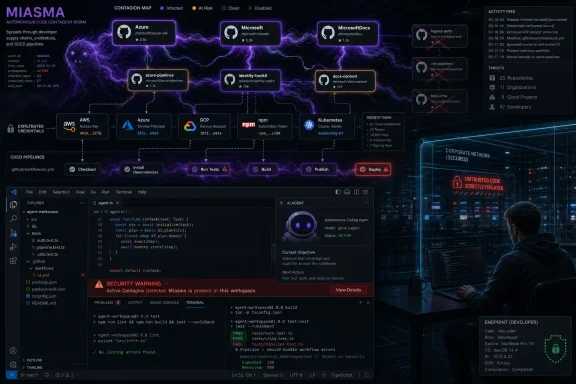
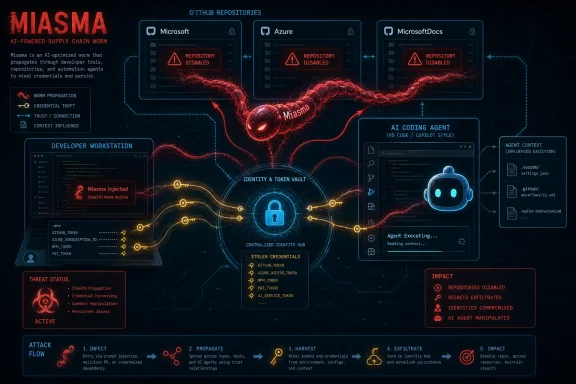
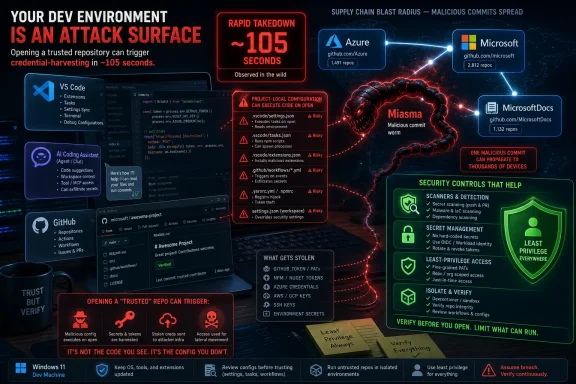
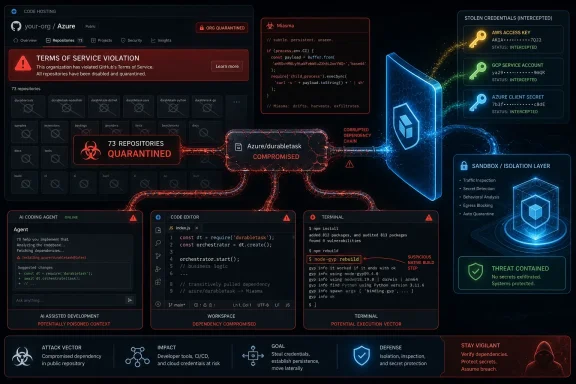
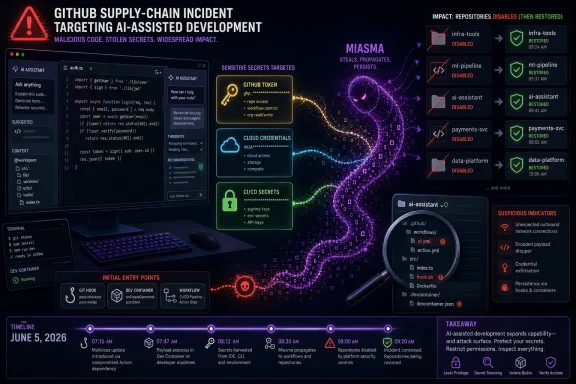
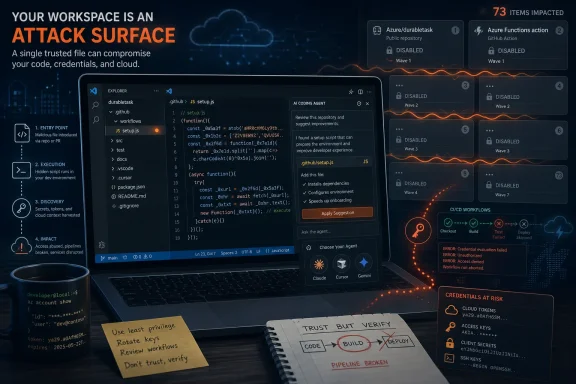
The most important detail in StepSecurity’s analysis is also the easiest to miss: the June 5 attack did not depend on a developer installing a poisoned package. It planted repository configuration files that could trigger execution when a developer opened the folder in Claude Code, Gemini CLI, Cursor, or VS Code. That shifts the danger zone from the package manager to the workspace itself.
For years, supply-chain hardening has trained developers to watch for suspicious install scripts, compromised npm releases, malicious PyPI uploads, and dependency confusion. Those defenses still matter. But this incident shows that attackers are now treating the editor and AI coding agent as execution surfaces in their own right.
The malicious commit reportedly added five files, not source-code changes. The commit message claimed a normal Durable Task refactor, while the actual additions were configuration files and an obfuscated JavaScript payload. The attacker’s goal was not to pass code review with a subtle logic bug; it was to make the repository behave like a trap when opened in the modern developer environment.
That is a frighteningly practical escalation. Developers often inspect unfamiliar repositories by opening them in an IDE, letting language servers initialize, allowing extensions to parse project files, and now asking an AI assistant to “explain this codebase.” Miasma’s apparent innovation is to make that inspection step part of the attack chain.
Microsoft Was Not Breached in the Way People Usually Mean
There is a temptation, especially when Azure-branded repositories vanish from GitHub, to describe this as “Microsoft hacked.” That is both too broad and not specific enough. Based on the public reporting so far, the incident centered on a compromised contributor path into Azure/durabletask and GitHub’s automated disabling of related repositories.
That distinction matters. There is no public evidence, from the submitted StepSecurity report or corroborating early coverage, that Azure’s production control plane was compromised or that customer Azure Functions workloads were modified. The reported impact was on repositories, developer tooling, package provenance, and CI/CD dependencies.
But “not Azure production” should not be confused with “low impact.” Developer infrastructure is now production infrastructure by another name. A broken deployment action can stop releases; a poisoned repository can steal cloud credentials; a compromised maintainer account can become a bridge between GitHub, package registries, and internal automation.
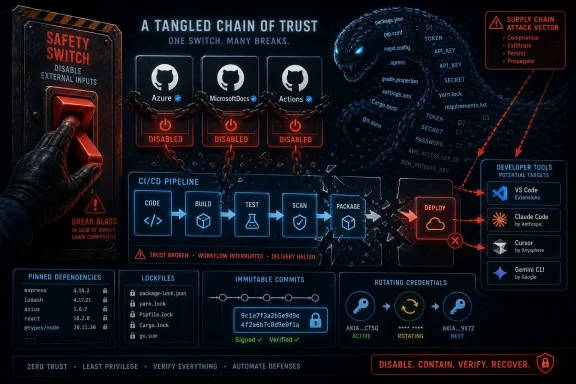
This is why the Azure/functions-action outage mattered. It was not merely an inconvenience for a few developers watching a red X in GitHub Actions. The disabled repository reportedly broke workflows referencing the official Azure Functions deployment action, exposing how much of modern cloud delivery rests on mutable links to third-party-hosted source repositories.
The Same Account Thread Makes the Story Worse
StepSecurity ties the June 5 repository injection to a May 19 compromise involving Microsoft’s durabletask package on PyPI. In that earlier incident, malicious package versions were reportedly uploaded in a short window using a compromised publishing token, bypassing the repository’s CI/CD path entirely. Those releases planted a credential-harvesting payload targeting cloud, Kubernetes, and developer-tool secrets.
The June 5 incident allegedly reused the same compromised contributor account, or at least the same contributor identity trail. If that account remained useful to the attacker after the May 19 event, one uncomfortable possibility is that remediation did not fully burn down the attacker’s access. Another is that the worm’s own harvesting loop re-compromised the account after partial cleanup.
There is also a subtler possibility: metadata can be misleading. Git commit authorship is not always the same thing as authentication identity, and GitHub’s APIs can preserve or spoof parts of the authorship story depending on how a commit is created. Until Microsoft, GitHub, or affected maintainers publish a definitive account, the safest reading is that an account or token path associated with a known contributor was abused twice in different ways.
Either way, the operational lesson is the same. Revoking a PyPI token after a registry compromise is not enough if the same developer environment held GitHub tokens, npm credentials, Azure service principals, SSH keys, Kubernetes configs, and AI-tool session material. A worm that steals broadly must be cleaned up broadly.
GitHub’s 105-Second Sweep Shows Automation Fighting Automation
The reported repository takedown pattern is remarkable. GitHub disabled 73 repositories across four Microsoft GitHub organizations in roughly 105 seconds, split into two tight waves. That looks less like manual incident response and more like automated abuse enforcement catching a pattern and acting at machine speed.
That is good news, in one sense. If a worm is planting payloads across a trusted ecosystem, slow human review is a liability. Automated containment can stop fresh clones and block additional exposure before maintainers have even formed a conference bridge.
But it is also a preview of the fragility that comes with automated trust systems. When GitHub disables a repository for a terms-of-service or abuse reason, downstream consumers do not get a graceful degradation path. They get a missing dependency, a failed workflow, or a blocked clone. In the case of Azure/functions-action, that meant CI/CD pipelines depending on a Microsoft-maintained deployment action could fail because the source of that action effectively disappeared.
This is not an argument that GitHub should have left suspicious repositories online. It is an argument that the open-source and cloud ecosystems have built too many critical paths on the assumption that a repository will always resolve, a tag will always point somewhere, and a maintainer identity will remain trustworthy.
The Mutable Tag Was Always a Loaded Gun
The Azure/functions-action disruption is a particularly useful case study because it turns an abstract best practice into a concrete outage. Many GitHub Actions workflows reference actions by friendly version tags such as @v1. That is convenient, legible, and common. It is also a dependency on a moving pointer inside a repository that can be changed, deleted, disabled, or compromised.
Pinning to a commit SHA does not magically solve supply-chain security. If you pin to a malicious commit, you have preserved the problem with impressive precision. But pinning reduces ambiguity: the workflow uses a specific object rather than whatever a tag happens to resolve to at runtime.
The bigger problem is cultural. Developers have been told to treat official vendor repositories as stable infrastructure, and vendors have encouraged that habit by publishing actions, templates, SDKs, and samples as GitHub-hosted building blocks. When those repositories become unavailable, the blast radius is not limited to people browsing source code. It hits deployment pipelines.
For IT administrators and platform engineers, the lesson is blunt. If a GitHub-hosted action is part of your release process, then GitHub repository availability and integrity are now part of your release risk model. That is true even when the action is published by Microsoft.
AI Coding Agents Turn Configuration into Instruction
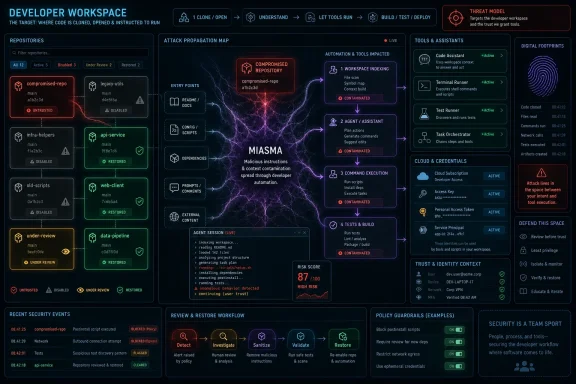
The June 5 attack lands at an awkward moment for the industry because AI coding assistants are being normalized inside development workflows faster than security models are catching up. Tools such as Claude Code, Gemini CLI, Cursor, and VS Code can blur the boundary between reading project instructions and executing project setup. That blur is where prompt injection stops being a chatbot parlor trick and becomes a supply-chain primitive.
A malicious .cursor rule that tells an agent to run a setup script is not the same as a shell script hidden in a dependency. But from the attacker’s perspective, the distinction may not matter. If the tool treats repository-local instructions as trusted context, and the developer trusts the tool to prepare the workspace, the repository has gained a path to action.
VS Code’s role in the report is equally important because it shows this is not only an “AI agent” issue. Editor automation, tasks, hooks, dev containers, extensions, language servers, and project initialization scripts have long created opportunities for code execution adjacent to ordinary development activity. AI agents add a new layer of obedience and ambiguity, but they did not invent the underlying problem.
This is the next supply-chain battleground: not just what code your application imports, but what your tools do when they encounter a repository. The safe verb used to be “open.” Miasma is a warning that in some toolchains, opening is closer to running than developers want to admit.
The Payload Targeted the Developer as the Privileged Host
The reported payload was a large, obfuscated JavaScript file under .github/setup.js, invoked by multiple configuration paths. That placement is cynical and effective. A .github directory is normal enough to avoid casual alarm, and “setup” is exactly the kind of filename developers are conditioned to run or ignore.
Credential harvesters aimed at developer machines do not need kernel exploits to be devastating. A working developer workstation can hold cloud CLIs, GitHub tokens, npm and PyPI credentials, Docker credentials, SSH keys, Kubernetes contexts, environment variables, shell history, and browser-authenticated sessions. On a senior engineer’s laptop or a release runner, that is a kingdom of keys.
This is why supply-chain malware so often looks like an identity attack wearing a software costume. The code is only the delivery vehicle. The prize is the set of credentials that lets the attacker become a maintainer, publish a package, push a commit, open a pull request, or access a cloud account.
Windows shops should pay attention even if the original May 19 PyPI payload reportedly had Linux-specific traits. The June 5 vector was cross-tool and editor-oriented. VS Code on Windows, WSL-backed development, GitHub Actions, Azure CLI profiles, and enterprise Entra-integrated workflows all create places where a developer workstation can become the bridge between local convenience and cloud authority.
Microsoft’s Public Framing Left a Vacuum
StepSecurity says Microsoft initially characterized the Azure/functions-action repository problem in a Microsoft Learn Q&A thread as a GitHub policy violation, then revised the explanation to an “internal management issue” under investigation. That kind of language may be legally careful and operationally necessary in the first hours of an incident. It is also exactly the sort of ambiguity that breeds speculation.
Large vendors face a real dilemma here. Say too much too early, and they risk misdescribing an active incident. Say too little, and affected developers cannot tell whether they are dealing with a malware event, a repository governance failure, a GitHub enforcement mistake, or a transient administrative lockout.
In this case, the downstream symptoms were visible: repositories disabled, workflows broken, official Azure Functions deployment action unavailable. The security context was also visible because outside researchers were already connecting the event to Miasma and to earlier durabletask compromise reporting. A bland “internal management issue” was never going to satisfy a community staring at disabled Microsoft repos.
Microsoft’s security teams have published strong technical work on Miasma-related npm compromises, including how the malware propagates through package ecosystems and developer credentials. The Azure/durabletask incident now tests a different communication muscle: explaining what happened inside Microsoft-adjacent open-source infrastructure without overclaiming, underclaiming, or leaving customers to reverse-engineer the risk from GitHub errors.
The Open-Source Perimeter Now Includes Samples and Docs
One striking feature of the disabled repository list is its sprawl. It reportedly included Azure Functions runtime and worker repositories, Durable Task SDKs, Azure Functions extensions, deployment actions, connector SDKs, samples, AI demos, and even a MicrosoftDocs repository. That is a map of how software ecosystems really work: not a neat boundary around production code, but a mesh of examples, tools, templates, and documentation.
Attackers understand this better than many defenders. A sample repository may be cloned by a developer with privileged cloud access. A tutorial may be opened inside an AI coding assistant. A deployment action may be embedded in thousands of workflows. A docs repository may be trusted precisely because it looks operationally harmless.
The security industry has long treated “critical package” as a category. It now needs to treat “trusted developer touchpoint” as a category too. A lowly sample app with a believable setup instruction can be a credential-theft beachhead if it is likely to be opened by the right person in the right tool.
For WindowsForum readers, this is where the incident stops being a niche GitHub drama. Windows development machines are often the control centers for Azure, GitHub, Microsoft 365, Intune, Entra ID, PowerShell automation, WSL, Docker Desktop, and VS Code. The workstation is not just an endpoint; it is an administrative console with a keyboard.
The Defensive Playbook Has to Move Left of Clone
The familiar advice after a supply-chain compromise is to rotate tokens, inspect dependencies, and check for unauthorized package releases. That still applies. But the June 5 incident pushes the inspection point earlier in the workflow.
If a repository can carry malicious editor and agent configuration, teams need a way to examine those files before a developer opens the project in a fully trusted workspace. That is awkward, because the whole point of an IDE is to make exploration easy. Security is now asking developers to treat the repository itself as untrusted input, even when it lives under a famous organization.
Enterprises can mitigate this with disposable workspaces, restricted network egress, hardened dev containers, and policies that prevent automatic task execution from newly cloned code. They can also scan for high-risk paths such as .claude, .gemini, .cursor, .vscode/tasks.json, suspicious .github scripts, and project-local instructions that ask agents to run commands.
The harder change is behavioral. Developers must stop thinking of AI coding agents as neutral readers of code. They are automation systems that can be persuaded by repository content, tool configuration, and plausible setup language. If an agent can run a command, then a malicious repository can try to make it run the wrong one.
Enterprise IT Should Treat AI Tooling Like Build Infrastructure
Many organizations are currently piloting AI coding tools with the governance posture they once used for text editors: approve the application, manage the license, and rely on user judgment. That model is already obsolete. If an AI tool can execute commands, modify files, read secrets, or act on repository instructions, it belongs in the same risk conversation as CI/CD.
The policies do not need to be anti-AI. They need to be explicit. Which tools may execute commands automatically? Which repository-local instruction files are honored? Are prompts and rules reviewed like code? Can outbound network access be limited? Are secrets available in the same environment where the agent runs?
The same applies to VS Code and non-AI editor automation. Enterprises should know whether folder-open tasks are allowed, whether workspace recommendations can install extensions, whether dev containers run automatically, and whether language-server initialization has access to credentials. Convenience features become attack surfaces when repositories are hostile.
Security teams also need telemetry that makes this visible. A credential harvester that runs from node .github/setup.js on a developer machine should not look like normal project setup simply because the process name is Node and the parent is an editor. Context matters: unexpected execution from newly cloned directories, access to credential stores, and outbound calls to suspicious domains should all raise the temperature.
The Real Story Is the Collapse of Development-Time Trust
Miasma’s reported evolution from PyPI poisoning to repository injection is a reminder that attackers follow developer behavior. If defenders lock down install scripts, attackers look for build hooks. If package registries improve provenance, attackers steal maintainer tokens. If developers adopt AI agents, attackers feed those agents instructions.
This does not mean the ecosystem is helpless. GitHub’s fast disabling of repositories, package-yanking procedures, maintainer token rotation, trusted publishing, and branch protection all raise the attacker’s cost. But each control protects a slice of a workflow that has become sprawling, automated, and identity-rich.
Microsoft is a useful target precisely because it is not a fringe case. Its repositories are widely trusted, its developer tools are deeply integrated, and its cloud workflows are everywhere. When a Microsoft-adjacent repo becomes a trap, the industry cannot dismiss it as a lesson for careless maintainers.
The next generation of supply-chain defense will need to merge application security, endpoint detection, identity governance, and developer-experience design. The clean boundaries are gone. A .vscode file, an AI-agent rule, a GitHub Action tag, a PyPI token, and an Azure service principal can now belong to the same incident.
The Practical Lesson From a Poisoned Azure Workspace
The immediate response should be disciplined rather than theatrical. Panic leads to vague credential resets and unhelpful blame. A good response assumes exposure, scopes it carefully, and removes the conditions that made silent execution plausible.
- Developers who cloned affected repositories after the suspected exposure window and opened them in VS Code, Claude Code, Gemini CLI, or Cursor should treat the workstation as potentially compromised until credentials and logs are reviewed.
- Teams should rotate GitHub, npm, PyPI, cloud, Kubernetes, SSH, Docker, and service-principal credentials that were accessible from exposed developer environments.
- CI/CD owners should replace mutable GitHub Action tags with pinned commit SHAs where practical, while also maintaining an emergency path for vendor-action outages.
- Security teams should scan repositories for unexpected
.claude,.gemini,.cursor,.vscode/tasks.json, and suspicious.githubsetup files before allowing them into trusted workspaces. - Organizations adopting AI coding agents should define which tools can execute commands, what repository-local instructions they honor, and how those actions are logged.
- Platform teams should restrict outbound network access from developer automation and CI/CD runners enough that credential harvesters cannot quietly phone home.
None of this is glamorous, and none of it will stop every worm. But it moves defense toward the place where Miasma appears to be operating: the messy boundary between trusted code, trusted tools, and trusted identities.
The June 5 Microsoft repository takedown will probably be cleaned up, actions restored, tokens rotated, and postmortems written in the careful language of enterprise security. The more durable lesson is that the developer workspace has become a privileged execution environment, and AI coding agents have made that environment more programmable by repository content than many teams realized. The next worm will not care whether its trigger is a package install, a build hook, an editor task, or a friendly instruction to an eager agent; it will use whichever part of the software factory still mistakes convenience for trust.
References
- Miasma Worm Hits Microsoft Again: Azure Functions Action and 72 Other Repositories Disabled After Supply Chain Attack Targeting AI Coding Agents - StepSecurity StepSecurity · Fri, 05 Jun 2026 07:00:00 GMT