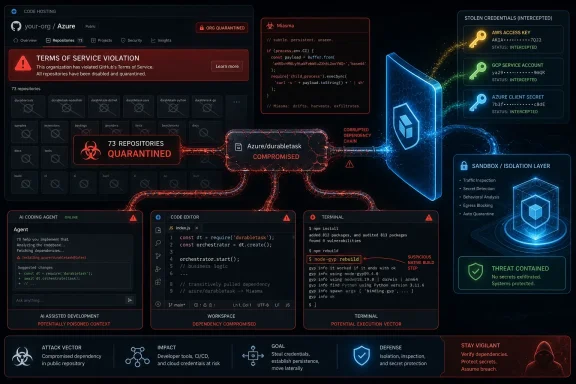
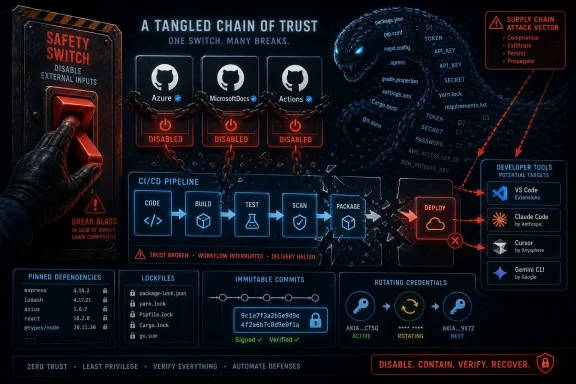
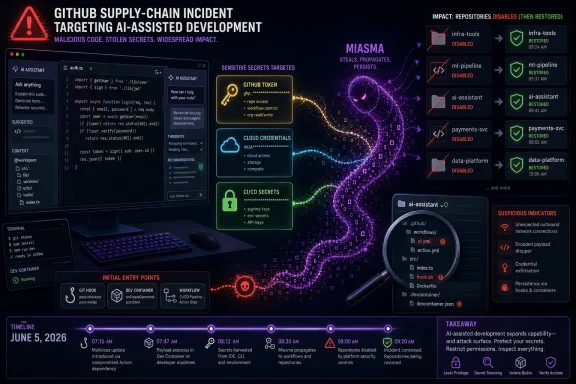
On June 5, 2026, GitHub disabled 73 repositories across Microsoft’s Azure, Microsoft, Azure-Samples, and MicrosoftDocs organizations after a malicious commit was pushed to Azure/durabletask through a reportedly compromised contributor account. The immediate blast radius was not Windows Update or Azure’s production cloud, but the software factory around them: GitHub Actions workflows, Azure Functions tooling, Durable Task libraries, and developer machines. The larger story is sharper than “another supply-chain incident.” Miasma appears to have found the seam between source control, AI-assisted development, and the old assumption that opening a trusted repository is a safe act.

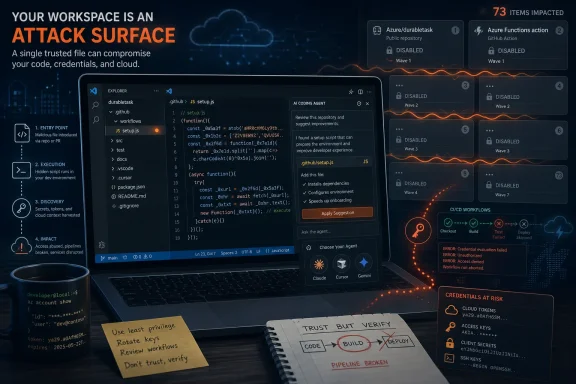
Cybersecurity-themed image showing a laptop coding interface with an attack-surface warning and CI/CD pipeline alerts.The Worm Did Not Need You to Install the Package​

The most important detail in StepSecurity’s analysis is also the easiest to miss: the June 5 attack did not depend on a developer installing a poisoned package. It planted repository configuration files that could trigger execution when a developer opened the folder in Claude Code, Gemini CLI, Cursor, or VS Code. That shifts the danger zone from the package manager to the workspace itself.
For years, supply-chain hardening has trained developers to watch for suspicious install scripts, compromised npm releases, malicious PyPI uploads, and dependency confusion. Those defenses still matter. But this incident shows that attackers are now treating the editor and AI coding agent as execution surfaces in their own right.
The malicious commit reportedly added five files, not source-code changes. The commit message claimed a normal Durable Task refactor, while the actual additions were configuration files and an obfuscated JavaScript payload. The attacker’s goal was not to pass code review with a subtle logic bug; it was to make the repository behave like a trap when opened in the modern developer environment.
That is a frighteningly practical escalation. Developers often inspect unfamiliar repositories by opening them in an IDE, letting language servers initialize, allowing extensions to parse project files, and now asking an AI assistant to “explain this codebase.” Miasma’s apparent innovation is to make that inspection step part of the attack chain.

Microsoft Was Not Breached in the Way People Usually Mean​

There is a temptation, especially when Azure-branded repositories vanish from GitHub, to describe this as “Microsoft hacked.” That is both too broad and not specific enough. Based on the public reporting so far, the incident centered on a compromised contributor path into Azure/durabletask and GitHub’s automated disabling of related repositories.
That distinction matters. There is no public evidence, from the submitted StepSecurity report or corroborating early coverage, that Azure’s production control plane was compromised or that customer Azure Functions workloads were modified. The reported impact was on repositories, developer tooling, package provenance, and CI/CD dependencies.
But “not Azure production” should not be confused with “low impact.” Developer infrastructure is now production infrastructure by another name. A broken deployment action can stop releases; a poisoned repository can steal cloud credentials; a compromised maintainer account can become a bridge between GitHub, package registries, and internal automation.
This is why the Azure/functions-action outage mattered. It was not merely an inconvenience for a few developers watching a red X in GitHub Actions. The disabled repository reportedly broke workflows referencing the official Azure Functions deployment action, exposing how much of modern cloud delivery rests on mutable links to third-party-hosted source repositories.

The Same Account Thread Makes the Story Worse​

StepSecurity ties the June 5 repository injection to a May 19 compromise involving Microsoft’s durabletask package on PyPI. In that earlier incident, malicious package versions were reportedly uploaded in a short window using a compromised publishing token, bypassing the repository’s CI/CD path entirely. Those releases planted a credential-harvesting payload targeting cloud, Kubernetes, and developer-tool secrets.
The June 5 incident allegedly reused the same compromised contributor account, or at least the same contributor identity trail. If that account remained useful to the attacker after the May 19 event, one uncomfortable possibility is that remediation did not fully burn down the attacker’s access. Another is that the worm’s own harvesting loop re-compromised the account after partial cleanup.
There is also a subtler possibility: metadata can be misleading. Git commit authorship is not always the same thing as authentication identity, and GitHub’s APIs can preserve or spoof parts of the authorship story depending on how a commit is created. Until Microsoft, GitHub, or affected maintainers publish a definitive account, the safest reading is that an account or token path associated with a known contributor was abused twice in different ways.
Either way, the operational lesson is the same. Revoking a PyPI token after a registry compromise is not enough if the same developer environment held GitHub tokens, npm credentials, Azure service principals, SSH keys, Kubernetes configs, and AI-tool session material. A worm that steals broadly must be cleaned up broadly.

GitHub’s 105-Second Sweep Shows Automation Fighting Automation​

The reported repository takedown pattern is remarkable. GitHub disabled 73 repositories across four Microsoft GitHub organizations in roughly 105 seconds, split into two tight waves. That looks less like manual incident response and more like automated abuse enforcement catching a pattern and acting at machine speed.
That is good news, in one sense. If a worm is planting payloads across a trusted ecosystem, slow human review is a liability. Automated containment can stop fresh clones and block additional exposure before maintainers have even formed a conference bridge.
But it is also a preview of the fragility that comes with automated trust systems. When GitHub disables a repository for a terms-of-service or abuse reason, downstream consumers do not get a graceful degradation path. They get a missing dependency, a failed workflow, or a blocked clone. In the case of Azure/functions-action, that meant CI/CD pipelines depending on a Microsoft-maintained deployment action could fail because the source of that action effectively disappeared.
This is not an argument that GitHub should have left suspicious repositories online. It is an argument that the open-source and cloud ecosystems have built too many critical paths on the assumption that a repository will always resolve, a tag will always point somewhere, and a maintainer identity will remain trustworthy.

The Mutable Tag Was Always a Loaded Gun​

The Azure/functions-action disruption is a particularly useful case study because it turns an abstract best practice into a concrete outage. Many GitHub Actions workflows reference actions by friendly version tags such as @v1. That is convenient, legible, and common. It is also a dependency on a moving pointer inside a repository that can be changed, deleted, disabled, or compromised.
Pinning to a commit SHA does not magically solve supply-chain security. If you pin to a malicious commit, you have preserved the problem with impressive precision. But pinning reduces ambiguity: the workflow uses a specific object rather than whatever a tag happens to resolve to at runtime.
The bigger problem is cultural. Developers have been told to treat official vendor repositories as stable infrastructure, and vendors have encouraged that habit by publishing actions, templates, SDKs, and samples as GitHub-hosted building blocks. When those repositories become unavailable, the blast radius is not limited to people browsing source code. It hits deployment pipelines.
For IT administrators and platform engineers, the lesson is blunt. If a GitHub-hosted action is part of your release process, then GitHub repository availability and integrity are now part of your release risk model. That is true even when the action is published by Microsoft.

AI Coding Agents Turn Configuration into Instruction​

The June 5 attack lands at an awkward moment for the industry because AI coding assistants are being normalized inside development workflows faster than security models are catching up. Tools such as Claude Code, Gemini CLI, Cursor, and VS Code can blur the boundary between reading project instructions and executing project setup. That blur is where prompt injection stops being a chatbot parlor trick and becomes a supply-chain primitive.
A malicious .cursor rule that tells an agent to run a setup script is not the same as a shell script hidden in a dependency. But from the attacker’s perspective, the distinction may not matter. If the tool treats repository-local instructions as trusted context, and the developer trusts the tool to prepare the workspace, the repository has gained a path to action.
VS Code’s role in the report is equally important because it shows this is not only an “AI agent” issue. Editor automation, tasks, hooks, dev containers, extensions, language servers, and project initialization scripts have long created opportunities for code execution adjacent to ordinary development activity. AI agents add a new layer of obedience and ambiguity, but they did not invent the underlying problem.
This is the next supply-chain battleground: not just what code your application imports, but what your tools do when they encounter a repository. The safe verb used to be “open.” Miasma is a warning that in some toolchains, opening is closer to running than developers want to admit.

The Payload Targeted the Developer as the Privileged Host​

The reported payload was a large, obfuscated JavaScript file under .github/setup.js, invoked by multiple configuration paths. That placement is cynical and effective. A .github directory is normal enough to avoid casual alarm, and “setup” is exactly the kind of filename developers are conditioned to run or ignore.
Credential harvesters aimed at developer machines do not need kernel exploits to be devastating. A working developer workstation can hold cloud CLIs, GitHub tokens, npm and PyPI credentials, Docker credentials, SSH keys, Kubernetes contexts, environment variables, shell history, and browser-authenticated sessions. On a senior engineer’s laptop or a release runner, that is a kingdom of keys.
This is why supply-chain malware so often looks like an identity attack wearing a software costume. The code is only the delivery vehicle. The prize is the set of credentials that lets the attacker become a maintainer, publish a package, push a commit, open a pull request, or access a cloud account.
Windows shops should pay attention even if the original May 19 PyPI payload reportedly had Linux-specific traits. The June 5 vector was cross-tool and editor-oriented. VS Code on Windows, WSL-backed development, GitHub Actions, Azure CLI profiles, and enterprise Entra-integrated workflows all create places where a developer workstation can become the bridge between local convenience and cloud authority.

Microsoft’s Public Framing Left a Vacuum​

StepSecurity says Microsoft initially characterized the Azure/functions-action repository problem in a Microsoft Learn Q&A thread as a GitHub policy violation, then revised the explanation to an “internal management issue” under investigation. That kind of language may be legally careful and operationally necessary in the first hours of an incident. It is also exactly the sort of ambiguity that breeds speculation.
Large vendors face a real dilemma here. Say too much too early, and they risk misdescribing an active incident. Say too little, and affected developers cannot tell whether they are dealing with a malware event, a repository governance failure, a GitHub enforcement mistake, or a transient administrative lockout.
In this case, the downstream symptoms were visible: repositories disabled, workflows broken, official Azure Functions deployment action unavailable. The security context was also visible because outside researchers were already connecting the event to Miasma and to earlier durabletask compromise reporting. A bland “internal management issue” was never going to satisfy a community staring at disabled Microsoft repos.
Microsoft’s security teams have published strong technical work on Miasma-related npm compromises, including how the malware propagates through package ecosystems and developer credentials. The Azure/durabletask incident now tests a different communication muscle: explaining what happened inside Microsoft-adjacent open-source infrastructure without overclaiming, underclaiming, or leaving customers to reverse-engineer the risk from GitHub errors.

The Open-Source Perimeter Now Includes Samples and Docs​

One striking feature of the disabled repository list is its sprawl. It reportedly included Azure Functions runtime and worker repositories, Durable Task SDKs, Azure Functions extensions, deployment actions, connector SDKs, samples, AI demos, and even a MicrosoftDocs repository. That is a map of how software ecosystems really work: not a neat boundary around production code, but a mesh of examples, tools, templates, and documentation.
Attackers understand this better than many defenders. A sample repository may be cloned by a developer with privileged cloud access. A tutorial may be opened inside an AI coding assistant. A deployment action may be embedded in thousands of workflows. A docs repository may be trusted precisely because it looks operationally harmless.
The security industry has long treated “critical package” as a category. It now needs to treat “trusted developer touchpoint” as a category too. A lowly sample app with a believable setup instruction can be a credential-theft beachhead if it is likely to be opened by the right person in the right tool.
For WindowsForum readers, this is where the incident stops being a niche GitHub drama. Windows development machines are often the control centers for Azure, GitHub, Microsoft 365, Intune, Entra ID, PowerShell automation, WSL, Docker Desktop, and VS Code. The workstation is not just an endpoint; it is an administrative console with a keyboard.

The Defensive Playbook Has to Move Left of Clone​

The familiar advice after a supply-chain compromise is to rotate tokens, inspect dependencies, and check for unauthorized package releases. That still applies. But the June 5 incident pushes the inspection point earlier in the workflow.
If a repository can carry malicious editor and agent configuration, teams need a way to examine those files before a developer opens the project in a fully trusted workspace. That is awkward, because the whole point of an IDE is to make exploration easy. Security is now asking developers to treat the repository itself as untrusted input, even when it lives under a famous organization.
Enterprises can mitigate this with disposable workspaces, restricted network egress, hardened dev containers, and policies that prevent automatic task execution from newly cloned code. They can also scan for high-risk paths such as .claude, .gemini, .cursor, .vscode/tasks.json, suspicious .github scripts, and project-local instructions that ask agents to run commands.
The harder change is behavioral. Developers must stop thinking of AI coding agents as neutral readers of code. They are automation systems that can be persuaded by repository content, tool configuration, and plausible setup language. If an agent can run a command, then a malicious repository can try to make it run the wrong one.

Enterprise IT Should Treat AI Tooling Like Build Infrastructure​

Many organizations are currently piloting AI coding tools with the governance posture they once used for text editors: approve the application, manage the license, and rely on user judgment. That model is already obsolete. If an AI tool can execute commands, modify files, read secrets, or act on repository instructions, it belongs in the same risk conversation as CI/CD.
The policies do not need to be anti-AI. They need to be explicit. Which tools may execute commands automatically? Which repository-local instruction files are honored? Are prompts and rules reviewed like code? Can outbound network access be limited? Are secrets available in the same environment where the agent runs?
The same applies to VS Code and non-AI editor automation. Enterprises should know whether folder-open tasks are allowed, whether workspace recommendations can install extensions, whether dev containers run automatically, and whether language-server initialization has access to credentials. Convenience features become attack surfaces when repositories are hostile.
Security teams also need telemetry that makes this visible. A credential harvester that runs from node .github/setup.js on a developer machine should not look like normal project setup simply because the process name is Node and the parent is an editor. Context matters: unexpected execution from newly cloned directories, access to credential stores, and outbound calls to suspicious domains should all raise the temperature.

The Real Story Is the Collapse of Development-Time Trust​

Miasma’s reported evolution from PyPI poisoning to repository injection is a reminder that attackers follow developer behavior. If defenders lock down install scripts, attackers look for build hooks. If package registries improve provenance, attackers steal maintainer tokens. If developers adopt AI agents, attackers feed those agents instructions.
This does not mean the ecosystem is helpless. GitHub’s fast disabling of repositories, package-yanking procedures, maintainer token rotation, trusted publishing, and branch protection all raise the attacker’s cost. But each control protects a slice of a workflow that has become sprawling, automated, and identity-rich.
Microsoft is a useful target precisely because it is not a fringe case. Its repositories are widely trusted, its developer tools are deeply integrated, and its cloud workflows are everywhere. When a Microsoft-adjacent repo becomes a trap, the industry cannot dismiss it as a lesson for careless maintainers.
The next generation of supply-chain defense will need to merge application security, endpoint detection, identity governance, and developer-experience design. The clean boundaries are gone. A .vscode file, an AI-agent rule, a GitHub Action tag, a PyPI token, and an Azure service principal can now belong to the same incident.

The Practical Lesson From a Poisoned Azure Workspace​

The immediate response should be disciplined rather than theatrical. Panic leads to vague credential resets and unhelpful blame. A good response assumes exposure, scopes it carefully, and removes the conditions that made silent execution plausible.
  • Developers who cloned affected repositories after the suspected exposure window and opened them in VS Code, Claude Code, Gemini CLI, or Cursor should treat the workstation as potentially compromised until credentials and logs are reviewed.
  • Teams should rotate GitHub, npm, PyPI, cloud, Kubernetes, SSH, Docker, and service-principal credentials that were accessible from exposed developer environments.
  • CI/CD owners should replace mutable GitHub Action tags with pinned commit SHAs where practical, while also maintaining an emergency path for vendor-action outages.
  • Security teams should scan repositories for unexpected .claude, .gemini, .cursor, .vscode/tasks.json, and suspicious .github setup files before allowing them into trusted workspaces.
  • Organizations adopting AI coding agents should define which tools can execute commands, what repository-local instructions they honor, and how those actions are logged.
  • Platform teams should restrict outbound network access from developer automation and CI/CD runners enough that credential harvesters cannot quietly phone home.
None of this is glamorous, and none of it will stop every worm. But it moves defense toward the place where Miasma appears to be operating: the messy boundary between trusted code, trusted tools, and trusted identities.
The June 5 Microsoft repository takedown will probably be cleaned up, actions restored, tokens rotated, and postmortems written in the careful language of enterprise security. The more durable lesson is that the developer workspace has become a privileged execution environment, and AI coding agents have made that environment more programmable by repository content than many teams realized. The next worm will not care whether its trigger is a package install, a build hook, an editor task, or a friendly instruction to an eager agent; it will use whichever part of the software factory still mistakes convenience for trust.
References​

  1. Primary source: StepSecurity
    Published: Fri, 05 Jun 2026 07:00:00 GMT
  2. Related coverage: thenextweb.com
  3. Related coverage: ai-heartland.com
  4. Official source: microsoft.com
  5. Related coverage: jun-trends.tech
  6. Related coverage: winbuzzer.com
  1. Related coverage: semgrep.dev
  2. Related coverage: snyk.io
 

GitHub disabled 73 Microsoft-owned repositories on June 5, 2026, after researchers reported that the self-replicating Miasma worm had reached projects under the Azure, Azure-Samples, Microsoft, and MicrosoftDocs organizations. That makes this more than another poisoned package story. It is a reminder that the software supply chain is no longer a neat sequence of registry, maintainer, build server, and user. It is a mesh of identities, AI coding tools, automation tokens, and repositories that can all become both target and transport.

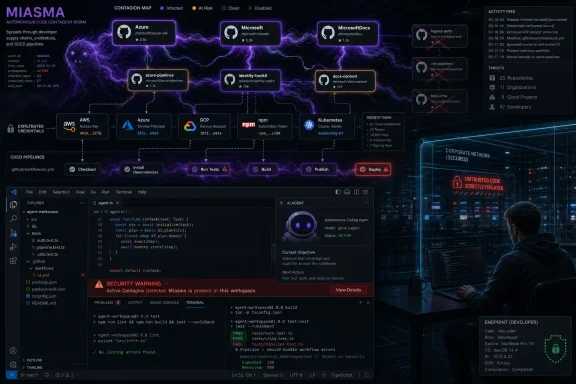
Cybersecurity dashboard showing the “MIASMA” contagion map across cloud pipelines with a security warning in an IDE.Microsoft’s Repos Became the Warning Label​

The uncomfortable fact about the Miasma incident is not simply that Microsoft repositories were affected. Big organizations have sprawling GitHub estates, and sprawling estates are hard to police. The sharper point is that Microsoft and GitHub sit at the center of the developer trust economy, and even that center is now exposed to attacks that behave less like traditional intrusions and more like contagion.
The reports so far describe 73 repositories disabled across four Microsoft GitHub organizations, including high-visibility Azure and documentation properties. Among the names reported were Azure sample projects, Durable Task-related repositories, Functions infrastructure, AI demo material, and Windows driver documentation. GitHub’s intervention appears to have been fast, with one report saying the repositories were contained in a 105-second sweep, but speed after detection is not the same thing as confidence before exposure.
The incident also lands awkwardly because one of the repositories tied to the story, Azure’s durabletask ecosystem, had already appeared in earlier reporting around a compromised PyPI package. If that linkage holds, the story becomes less about a one-off repository infection and more about persistence: credentials, tokens, or automation paths that were not fully burned down after the first compromise.
That is the scenario security teams dread. The attacker does not need to “break into Microsoft” in the cinematic sense. It is enough to compromise a maintainer, a package publisher, a development workstation, or a token with write access and then let the worm exploit the permissions that software teams have granted in the name of productivity.

The Registry Was Only the First Battlefield​

For years, supply-chain security has been framed around package registries. npm, PyPI, RubyGems, NuGet, and container registries became the obvious chokepoints because they distribute code at scale. If an attacker can publish a malicious update to a trusted package, downstream installations become the blast radius.
Miasma suggests that model is now too narrow. The reports describe a worm that does not merely wait for a malicious package install. It pushes code into writable repositories, plants execution hooks in development workflows, and relies on the developer’s normal activity to trigger the next stage. The registry is still relevant, but the source repository itself becomes a malware distribution surface.
That matters because many developers treat source repositories differently from packages. A package install is at least vaguely understood as execution. A repository clone feels like inspection. Opening a project in an editor or AI coding agent feels even safer, closer to reading than running. Miasma attacks precisely that false distinction.
Modern repositories are not inert folders of text. They contain package scripts, editor configuration, workspace settings, task definitions, test commands, CI workflows, container definitions, and now agent-facing instructions. The line between “open this project” and “execute this project’s intentions” has been getting thinner for years. AI coding agents have made it thinner still.

The AI Coding Agent Is Now Part of the Attack Surface​

The most novel detail in the Miasma reporting is the claimed execution path through development tools including Claude Code, Gemini CLI, Cursor, Visual Studio Code, and npm test scripts. A developer only needs to clone an affected repository and open it in an agent-assisted workflow for the malicious code to have a chance to run. Whether every named tool is equally exposed will need careful vendor-by-vendor analysis, but the strategic direction is obvious: attackers are targeting the place where developers increasingly outsource attention.
This is not an argument that AI coding tools are uniquely reckless. Editors and build systems have executed workspace logic for decades. The difference is behavioral. Developers are now encouraged to throw unfamiliar repositories at agents, ask for summaries, request fixes, run test loops, and let the tool traverse project structure. That is an ideal environment for malware that wants a trusted local context, a developer identity, and access to secrets.
AI agents also blur responsibility. When an npm script fires during a test run, a human can be told not to run arbitrary scripts from untrusted repositories. When an agent decides it needs to inspect, execute, index, or modify a project to answer a prompt, the mental model becomes fuzzier. Did the developer run the code, or did the tool? From the malware’s perspective, that distinction is irrelevant.
This is the next phase of supply-chain compromise: not just poisoning what developers install, but poisoning what their tools are willing to believe. A repository can now carry instructions aimed at humans, machines, CI systems, and AI agents at the same time. Defensive models that treat those channels separately are going to miss the combined effect.

Miasma Turns Legitimate Identity Into the Payload​

The quoted FalconFeeds analysis gets to the heart of the problem: this campaign reportedly exploits the trust model itself. If a package is signed by a recognized maintainer, published from a valid account, committed through a permitted token, and pushed into a legitimate repository, the platform sees a normal workflow. The attacker’s innovation is to steal the identity that makes the workflow normal.
That is why supply-chain worms are so difficult to communicate to non-specialists. There may be no zero-day vulnerability in GitHub. There may be no broken cryptographic signature scheme. There may be no compromised Microsoft server in the old sense. The malware succeeds because the credentials and tokens it steals are precisely the credentials and tokens that organizations use to automate development.
Miasma reportedly harvests credentials for AWS, Azure, Google Cloud, Kubernetes, npm, and GitHub, then uses stolen access to commit to any repository the victim can write to. That makes the victim’s permission graph the worm’s map. Every overly broad personal access token, every long-lived cloud credential, every repository write grant, and every CI secret becomes a possible replication path.
This is where enterprises should resist the temptation to dismiss the incident as “open source chaos.” The same pattern applies inside private GitHub Enterprise organizations, Azure DevOps projects, GitLab groups, and internal monorepos. If developers have broad write access and automation has broad secret access, a worm does not need public visibility to move laterally. It only needs permission.

The Durable Task Thread Makes This Feel Less Accidental​

The durabletask connection is important because repeated appearance is rarely comforting in incident response. According to the reporting, TeamPCP previously infected the PyPI package “durabletask” hosted under Microsoft’s Azure organization to deliver an information-stealing payload. Security researcher Paul McCarty argued that seeing the same repository-linked ecosystem appear again suggests unresolved credential trauma rather than coincidence.
That claim should be treated carefully. Public reporting does not yet prove every step of the chain, and neither Microsoft nor GitHub has provided the kind of granular postmortem that would settle the matter. But the pattern is plausible enough to shape defensive thinking. When a package, maintainer, repository, or organization has been compromised once, cleanup cannot stop at reverting code.
A serious response has to assume that credentials were copied, tokens were exchanged, local developer machines may have been exposed, and CI/CD paths may have been modified. It also has to assume that the attacker had time to learn the project’s publishing flow. In supply-chain incidents, restoration is not the same as recovery.
The durabletask thread also illustrates why package-level and repository-level investigations must converge. A PyPI compromise may begin with a maintainer credential but lead to GitHub tokens. A GitHub repository infection may plant npm scripts that affect downstream packages. Documentation repositories may not ship binaries, but they can still reach developers who clone, build, lint, preview, or run local tooling. The unit of defense is no longer the package. It is the whole development environment.

GitHub’s Fast Takedown Is Necessary, Not Sufficient​

GitHub disabling affected repositories was the right immediate move. A public repository that may execute malware through common developer workflows cannot remain casually accessible while owners sort through commit history. Containment has to be blunt when replication is the risk.
But the platform’s challenge is bigger than takedown velocity. GitHub has to distinguish malicious self-propagation from legitimate automation in a world where bots constantly open pull requests, dependency tools rewrite manifests, CI workflows generate commits, and AI assistants increasingly propose or apply changes. The noise floor is rising.
This is a hard detection problem because the worm’s behavior overlaps with normal developer behavior. A legitimate maintainer may update package scripts, add workflows, modify dependency files, and push across multiple repositories. A malicious token may do the same. The difference lies in timing, provenance, intent, and correlation across accounts and organizations.
GitHub also carries a political burden that most platforms do not. Because Microsoft owns GitHub, a worm reaching Microsoft repositories instantly becomes a story about Microsoft’s stewardship of open source infrastructure. That does not mean GitHub failed uniquely. It does mean the platform is judged by a higher standard, especially when its parent company’s repositories are part of the incident.

The Windows Angle Is Broader Than Windows Code​

For WindowsForum readers, the immediate question is not whether Miasma infects Windows PCs in the classic consumer-malware sense. The larger concern is that Windows developers and administrators increasingly live inside the exact workflow Miasma targets: VS Code, GitHub, Azure samples, npm, Python packages, cloud CLIs, Kubernetes configs, and AI coding assistants.
A Windows workstation used for development is often a dense bundle of credentials. It may hold Azure CLI tokens, GitHub credentials, npm auth tokens, SSH keys, Docker logins, kubeconfigs, .env files, and cached access to internal services. If that workstation clones an infected repository and an agent or script executes the payload, the attacker may get far more than local files.
This is why “developer endpoint security” is no longer a niche concern. A compromised developer laptop can become a cloud incident, a source-code incident, a package-publishing incident, and a customer-impacting incident in one chain. Traditional endpoint detection matters, but so do token scope, secret storage, repository permissions, and tool sandboxing.
Windows shops should also pay attention to documentation and sample repositories. Many organizations treat samples as low-risk because they are not production code. In practice, samples are frequently cloned by engineers with privileged credentials on machines that also access production systems. The sample repository may be disposable; the developer context is not.

Signing Cannot Save a Compromised Publisher​

One of the more uncomfortable lessons from Miasma and its Shai-Hulud lineage is that authenticity is not the same as safety. The industry has spent years encouraging signed packages, provenance attestations, verified commits, and trusted publisher flows. Those controls are valuable. They are also limited when the attacker controls the identity doing the signing.
If a maintainer’s account or token is compromised, the malicious update can look like a legitimate update. If a CI workflow is compromised, generated artifacts can inherit the glow of automation. If a repository is infected through an authorized commit path, branch protection may not help unless it also constrains the relevant actor and workflow.
This does not mean signing and provenance are theater. They help narrow ambiguity and make tampering easier to investigate. But they are not a substitute for least privilege, short-lived credentials, mandatory review on sensitive files, and behavioral detection around unusual cross-repository writes.
The industry’s mistake has been to talk about trust as though it can be converted into a stamp. Miasma shows that trust is a live operational relationship. It depends on whether the maintainer’s environment is clean, whether tokens are constrained, whether automation is monitored, and whether abnormal propagation is stopped before it becomes ecosystem-wide.

Open Source Is Being Asked to Absorb Nation-State-Grade Hygiene​

There is an unfairness at the heart of modern software security. Open source maintainers are expected to defend projects that billion-dollar companies depend on, often with the staffing model of a hobby. Attackers, meanwhile, automate credential theft, worm propagation, and social targeting across ecosystems.
Microsoft’s appearance in the Miasma story cuts both ways. On one hand, it shows that even well-resourced organizations struggle with sprawling developer identity. On the other, it underscores how much the broader ecosystem depends on platforms and vendors to provide safer defaults. Individual maintainers cannot solve token hygiene, AI tool sandboxing, package provenance, and cross-repository anomaly detection alone.
There is also a cultural issue. Developer productivity tooling has been marketed as friction removal. Auto-run tasks, seamless authentication, one-click cloud deployment, agentic code editing, and integrated terminals all reduce the distance between intention and execution. Security often exists to reintroduce just enough friction to make dangerous actions visible.
Miasma is what happens when the productivity stack becomes an execution stack and the security model still assumes the developer will notice the difference. The attacker does not need to defeat every control. It only needs to find the places where convenience quietly became authority.

Enterprise Defenders Need to Hunt for Propagation, Not Just Payloads​

The practical response to Miasma should begin with the assumption that any cloned affected repository is a potential exposure event. That does not mean every developer who touched one is compromised, but it does mean organizations should audit local machines, tokens, and cloud access rather than merely deleting a directory and moving on.
The more important shift is from indicator chasing to propagation modeling. Hashes, filenames, repository descriptions, and known payload sizes are useful, but worms mutate. What matters is whether an identity suddenly wrote to repositories it rarely touches, added suspicious workflow files, modified package scripts, created strange public repositories, or accessed secrets outside its normal pattern.
Organizations should also look at AI coding tools as privileged development clients. If an agent can run commands, read project files, access the shell, or interact with credentials, it needs policy. That policy may include workspace trust prompts, command allowlists, network restrictions, containerized analysis environments, and a bias against opening unknown repositories in a credential-rich session.
The hard part is that these controls will annoy developers if imposed clumsily. The answer is not to ban modern tools and pretend the clock can be turned back. The answer is to make safe paths easier: disposable dev containers, scoped tokens, ephemeral cloud credentials, automated secret scanning, and clear separation between exploration environments and production-authorized workstations.

Microsoft Now Has to Explain the Trust Boundary​

Microsoft does not need to prove that no customer was affected before it says anything useful. It does need to explain the trust boundary. Which repositories were disabled? Were malicious commits pushed to default branches? Were releases, packages, documentation builds, or container images produced from affected code? Were any Microsoft-owned publishing credentials exposed? Were downstream users who cloned affected projects notified?
Those questions matter because repository compromise is not a binary event. A poisoned private branch that never shipped is different from a poisoned release artifact. A documentation repo with malicious workspace settings is different from an Azure Functions host repository with build pipeline reach. A disabled repository tells users that something was wrong; it does not tell them whether they were in the blast radius.
GitHub, too, has a transparency problem to solve. Fast containment is admirable, but ecosystem defenders need machine-readable detail quickly: commit hashes, timestamps, affected paths, known execution triggers, and recommended hunts. The public cannot rely on scattered screenshots, researcher threads, and third-party lists when the platform itself has the authoritative event history.
The risk for Microsoft is not only technical. It is reputational. The company has spent the last decade persuading developers that GitHub, Azure, VS Code, and Copilot-era tooling form a coherent productivity platform. Miasma attacks the seams between those products. Microsoft’s response has to be equally cross-product.

The Miasma Lesson Is Written in Permissions​

The concrete lesson from this incident is not “never trust Microsoft repositories” or “never use AI coding tools.” That would be both impractical and wrong. The lesson is that developer trust must become narrower, shorter-lived, and more observable.
  • Organizations should rotate credentials and revoke long-lived tokens for any developer or automation account that interacted with affected repositories during the reported exposure window.
  • Security teams should audit GitHub, npm, PyPI, Azure, AWS, GCP, and Kubernetes activity for unusual writes, package publishes, workflow changes, and repository creation events.
  • Developers should avoid opening unfamiliar repositories in AI coding agents or fully trusted editor workspaces on machines that hold production credentials.
  • Repository owners should require review for changes to package scripts, CI workflows, editor configuration, agent instruction files, and other execution-adjacent project files.
  • Enterprises should move exploratory repository analysis into disposable containers or virtual machines with no ambient access to cloud, package, or source-control credentials.
  • Platform vendors should treat agent-mediated execution as a first-class security boundary, not as an editor convenience feature.
The worm’s name is almost too apt. Miasma describes a bad atmosphere, something that spreads through the air before anyone can point to a single broken pipe. That is what modern supply-chain compromise increasingly feels like: not one vulnerability, but an environment saturated with excessive trust.
The next phase of developer security will not be won by pretending repositories are harmless until built, packages are safe because they are signed, or AI agents are merely smarter text editors. It will be won by treating every tool that can read code, run code, rewrite code, or publish code as part of the same security perimeter. Miasma reached Microsoft’s own GitHub estate because the perimeter is already there; the industry is only now admitting how porous it has become.

References​

  1. Primary source: secnews.gr
    Published: 2026-06-08T07:30:09.217408
  2. Related coverage: thehackernews.com
  3. Related coverage: qore.com
  4. Related coverage: theregister.com
  5. Related coverage: aiweekly.co
  6. Related coverage: deepwatch.com
  1. Related coverage: hackread.com
  2. Related coverage: chatforest.com
  3. Related coverage: ecosistemastartup.com
  4. Related coverage: itpro.com
  5. Related coverage: labs.cloudsecurityalliance.org
  6. Related coverage: mphasis.com
  7. Related coverage: github.blog
  8. Security advisory: msrc.microsoft.com
 

On June 5, 2026, GitHub reportedly disabled 73 repositories across Microsoft, Azure, Azure-Samples, and MicrosoftDocs after the Miasma supply-chain worm planted credential-stealing payloads that could trigger when developers opened affected code in modern AI coding tools. The incident is not just another poisoned-package story. It is a warning that the developer workstation, the repository, and the AI assistant have become a single execution environment. Microsoft’s AI coding ecosystem was not merely adjacent to the blast radius; it was part of the terrain the worm was built to exploit.

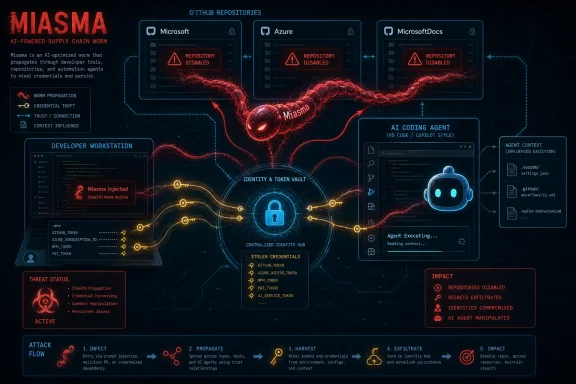
Cybersecurity graphic showing “MIASMA” AI supply-chain worm propagating through GitHub/servers with stolen credentials and disabled repositories.Miasma Turns the Coding Assistant Into the Tripwire​

For years, supply-chain security has taught developers to fear the install step. The dangerous moment was npm install, a postinstall script, a CI job, a build hook, or a package update that seemed routine enough to ignore. Miasma keeps that old playbook, but the newest reports around Microsoft’s repositories suggest a more unsettling expansion: the malicious code can be staged so that the moment of danger is opening a repository inside an AI-assisted development environment.
That distinction matters. AI coding tools such as Claude Code, Gemini CLI, Cursor, and VS Code-based agent workflows are designed to reduce friction between repository context and execution. They read project files, infer developer intent, inspect configuration, and increasingly run commands as part of normal assistance. The same affordances that make them useful also make them attractive as detonation surfaces.
The attack reportedly planted configuration and payload files capable of stealing credentials for GitHub, npm, cloud providers, Kubernetes, and other developer services. Once a victim’s tokens were harvested, the worm could use repository write access to commit itself elsewhere. In other words, it treated the developer not as the target’s edge but as the network fabric.
This is why the Microsoft angle matters even if GitHub’s containment was fast. Microsoft is not a random victim in the modern coding stack. It owns GitHub, VS Code, and Copilot, and it publishes an enormous amount of cloud and developer documentation through public repositories. If an attack can plausibly move through Microsoft’s open development surface, every enterprise that imitates Microsoft’s developer workflow should assume the same mechanics can be turned inward.

The Microsoft Repositories Were the Headline, Not the Whole Story​

The reported 73 disabled repositories created the news hook because Microsoft’s public engineering presence is vast and trusted. Names tied to Azure infrastructure and developer samples carry a particular kind of authority. Developers clone them because they are canonical, because documentation points to them, or because they are the fastest path to a working demo.
That trust is exactly what supply-chain attackers want. A malicious package can be dismissed as a third-party dependency mistake. A tainted repository under a Microsoft organization is a stronger social signal, even when the compromise comes through a stolen contributor credential rather than a breach of Microsoft’s core infrastructure. The logo does work that malware cannot.
The reported initial push through a previously compromised contributor account also reinforces a familiar lesson: the boundary between “Microsoft code” and “community contribution” is operationally blurry. Open-source maintainership depends on delegated trust, personal tokens, CI systems, publishing credentials, and repository permissions that are often scattered across humans and automation. Attackers do not need to defeat Microsoft as an institution if they can defeat one account with enough reach.
That is not an argument against open source. It is an argument against pretending public repository ownership is a sufficient trust model. In a world of token-driven automation, the real security perimeter is not the organization badge in GitHub’s UI. It is the set of credentials, workflows, branch rules, package publishing rights, and local developer environments that can mutate code downstream.

The Worm Learned From the Package Ecosystem’s Worst Habits​

Miasma did not appear in a vacuum. Microsoft’s own threat researchers had already described a Miasma-related campaign against the @redhat-cloud-services npm scope, where maliciously modified packages were published across dozens of versions and carried authentic-looking provenance. That earlier wave used npm lifecycle scripts, obfuscation, Bun runtime downloads, credential harvesting, cloud secret collection, and propagation through repositories and packages.
The uncomfortable part is that several of those behaviors map neatly onto accepted developer convenience. Package managers run scripts because developers need native modules and setup automation. CI systems hold secrets because deployment has to happen somewhere. Trusted publishing and provenance exist because the ecosystem needs a way to prove a package came from a legitimate pipeline. The attacker’s genius is not inventing a new universe; it is parasitizing the one developers already built.
Miasma’s reported use of Bun is also a reminder that tool diversity cuts both ways. New runtimes can improve performance and developer experience, but malware authors can adopt them just as quickly as legitimate teams. Security tools that reason too narrowly about Node, Python, Bash, or PowerShell can miss the handoff when an installer fetches another runtime and continues the attack there.
The campaign’s self-propagating behavior is the crucial escalation. Ordinary credential stealers are bad enough; they loot the developer and wait for an operator. A worm tries to turn every successful theft into the next distribution channel. When that channel is GitHub, npm, PyPI, or a cloud account, the compromise becomes less like burglary and more like contagion.

AI Coding Tools Collapse Reading and Running​

The traditional developer mental model separates reading code from executing code. You clone a repository, inspect files, maybe open it in an editor, and only later run commands. AI coding agents blur that distinction because their value comes from acting on project context, not passively displaying text.
This is not inherently reckless. Developers have always granted editors significant trust. Extensions run code, language servers index projects, debuggers attach to processes, and task runners automate common commands. VS Code in particular became dominant partly because it turned the editor into a programmable workbench.
AI agents move that workbench into a more autonomous phase. They do not merely color syntax or offer autocomplete. They infer tasks, inspect files, modify code, propose commands, and in some configurations execute them. That makes project metadata, agent instructions, tool configuration, and hidden setup files more security-sensitive than many organizations currently treat them.
Miasma’s reported targeting of AI coding agents therefore should not be read as a quirky novelty. It is a logical adaptation to where developer behavior is going. If the fastest way to onboard a project is to open it in an agent and ask for help, then the attacker wants the poisoned project to speak the agent’s language before the human has formed a threat model.
The industry has spent years teaching users not to open suspicious attachments. Developers now need an equivalent discipline for repositories. “Don’t open unknown code in a privileged agent session” sounds awkward today, but so did “don’t enable macros” before macro malware made the lesson unavoidable.

Microsoft’s Security Story Gets Politically Awkward​

Microsoft sits on both sides of this incident. Its security teams have been publishing detailed threat research on supply-chain attacks, malicious npm packages, dependency confusion, and Miasma-linked behavior. At the same time, Microsoft-branded repositories reportedly became part of the campaign’s visible blast radius.
That dual role is not hypocrisy. It is the reality of being the platform company for much of modern software development. Microsoft has more telemetry, more tooling, and more public attack surface than almost anyone else. When the threat landscape shifts toward developer infrastructure, Microsoft is both the observer and the observed.
Still, the optics are difficult. Microsoft’s pitch around Copilot, GitHub, Azure, Defender, and Security Copilot is that it can make software development faster and safer through platform intelligence. Miasma undercuts the easy version of that pitch. Faster context gathering and automated assistance are not automatically safer if attackers can influence what the assistant reads and runs.
The more credible Microsoft argument is not that AI coding ecosystems eliminate risk. It is that the platform can detect, contain, and revoke faster than humans can. Reports that GitHub disabled affected repositories quickly support that view, but containment speed is not the same as impact clarity. If developers cloned or opened compromised repositories before takedown, the relevant question becomes what credentials were exposed, what downstream repositories were touched, and what cloud permissions those tokens carried.
That is the hard part for enterprises. Repository takedown is visible. Credential misuse may be quiet. A stolen token with limited scope may go nowhere; a token with broad organization access can become a second incident days later. The post-incident work is less glamorous than the headline, but it is where the real security outcome is determined.

The Old Advice Still Works, But It Is No Longer Enough​

There is a comforting version of this story in which the fix is familiar: rotate credentials, pin dependencies, audit package versions, disable install scripts where possible, enforce branch protection, and monitor GitHub activity. All of that remains sensible. None of it is sufficient by itself.
The new gap is agent-aware policy. Organizations need to decide what AI coding tools can do with untrusted repositories, which directories they can read, which commands they can run, which secrets they can access, and whether they are operating in a sandbox or on a developer’s real workstation. A coding agent with access to a developer’s shell, cloud CLIs, GitHub token, SSH keys, and local .env files is not “just a chat window.” It is a privileged automation layer.
This is especially important on Windows developer machines, where VS Code, WSL, Docker Desktop, Git Credential Manager, Azure CLI, npm, Python tooling, and browser-authenticated cloud sessions often coexist. A single workstation may bridge consumer identity, enterprise identity, local admin rights, SSH keys, and cloud deployment access. That convenience is productive, but it also gives a credential harvester a rich menu.
Security teams should also revisit how they classify sample repositories. A demo cloned from an official-looking organization can feel low-risk because it is not production code. But samples are often opened quickly, run with real credentials, and adapted into internal projects. If an Azure sample asks for local cloud authentication, developers may comply without the same scrutiny they would apply to a production deployment script.
The practical lesson is blunt: repository trust must become contextual. Who owns it, who last committed to it, what changed recently, what configuration files it contains, and what an agent will do with it all matter. The badge is only one input.

The Provenance Problem Is Becoming a Confidence Problem​

One of the more corrosive details in the broader Miasma story is the abuse of legitimate-looking supply-chain signals. Earlier reporting described packages with authentic provenance characteristics because the attacker compromised trusted publishing paths rather than merely uploading from a throwaway account. That is exactly the nightmare scenario for security programs that have invested in attestations, signatures, and automated trust gates.
This does not mean provenance is useless. It means provenance answers a narrower question than many people want it to answer. It can help establish that an artifact came from a given pipeline. It cannot magically prove that the pipeline, account, token, maintainer, build script, or repository state was benign at the time.
The distinction is subtle but vital. A signed malicious artifact is still malicious. A package published through the “right” workflow can still be attacker-controlled if the attacker owns the credentials or the workflow path. Supply-chain security has to treat provenance as evidence, not absolution.
Miasma’s reported spread through repository commits makes this even more complicated. Developers often review dependency diffs more carefully than repository metadata or agent configuration files. A small addition under .github, .vscode, .claude, or another tool-specific directory may not trigger the same alarm as a suspicious binary. Attackers know that quiet configuration changes can be more powerful than noisy code changes.
The next phase of supply-chain defense will need to make these hidden control planes visible. That means diffing and alerting on agent instructions, editor tasks, workflow changes, package lifecycle hooks, publish configuration, and credential access patterns. The dangerous code may not be in the application. It may be in the instructions that tell the tools how to behave around the application.

Developers Are Now Part of the Runtime​

The Miasma incident also exposes a cultural lag. Many organizations still think of developer machines as places where code is written before it enters a controlled pipeline. In practice, developer environments are already runtimes for internal tools, package scripts, cloud CLIs, AI agents, test harnesses, containers, and deployment helpers.
That turns the developer into a high-value execution boundary. If a laptop or workstation has the credentials to publish a package, push to repositories, assume cloud roles, or approve CI workflows, it is not meaningfully less sensitive than a build server. It may be less monitored, less reproducible, and more permissive.
AI coding makes that boundary more dynamic. The agent can accelerate good work, but it can also accelerate bad assumptions. If a poisoned repository contains instructions that nudge an agent to inspect secrets, run setup scripts, or trust generated files, the human may not notice until after the tool has already done something useful-looking and dangerous.
This is not an argument to ban AI coding tools. It is an argument to stop treating them as ordinary productivity software. Enterprises eventually learned that browsers needed sandboxing, extension controls, identity protections, download scanning, and isolation for risky sites. Coding agents are headed toward the same governance path, only with source code and production credentials in the frame.
For Windows shops, the governance conversation should be concrete. Which agents are approved? Are they allowed to run commands automatically? Do they inherit the user’s environment variables? Can they read SSH keys, cloud token caches, or password manager exports? Are untrusted repositories opened inside containers or disposable dev environments? The answer cannot be “developers will be careful,” because the attack is designed for the moment when careful behavior looks like normal work.

The Blast Radius Runs Through Identity​

If Miasma has a center of gravity, it is identity. The worm’s value comes from harvesting tokens and using them to move through systems that trust those tokens. Code is the lure, but credentials are the bloodstream.
That is why token scope and lifetime matter more than almost any single malware indicator. A short-lived, narrowly scoped token that can only read one repository is a nuisance if stolen. A long-lived token with write access across an organization is a propagation engine. A cloud credential that can enumerate secrets or modify infrastructure turns a development incident into an enterprise incident.
Modern developer identity is messy because it spans many layers. GitHub has personal access tokens, fine-grained tokens, OAuth apps, SSH keys, GitHub Actions secrets, OIDC flows, and organization-level permissions. Cloud providers have CLIs, cached sessions, managed identities, service principals, access keys, and federation. Package registries have publish tokens and automation credentials. Worms thrive in the seams between these systems.
The defensive move is to reduce standing privilege. Developers should not carry broad publish rights all day because they occasionally need to release a package. CI should not have write access beyond what its job requires. Local machines should not store durable cloud keys where a project-level script can reach them. Agent sessions should not inherit every credential the user has accumulated over years of development.
This sounds obvious until it collides with productivity. Broad tokens survive because they reduce friction. Miasma is the bill for that frictionless design.

GitHub’s Fast Containment Does Not End the Investigation​

Reports that GitHub disabled the affected repositories quickly are important, and they deserve credit if accurate. Rapid containment can prevent casual cloning, halt obvious propagation, and give maintainers time to inspect changes. In a worm scenario, minutes matter.
But a disabled repository is the beginning of incident response, not the end. Anyone who cloned, pulled, opened, built, or ran affected code during the exposure window may need to assume local compromise until proven otherwise. That means inspecting developer machines, rotating tokens, reviewing GitHub audit logs, checking cloud access logs, and looking for unexpected commits or repositories.
The downstream uncertainty is particularly hard with public repositories. Microsoft and GitHub can see their own platform activity, but they cannot perfectly know every local clone or private fork. A developer may have mirrored code into an internal repository. A company may have used a sample in a workshop. A contractor may have opened the project in an agent on a personal machine.
That is why public supply-chain incidents have a long tail. The visible artifact disappears, but the copied state persists. Attackers only need one privileged developer who interacted with the poisoned content before the takedown.
For IT administrators, the right question is not “Were we directly affected by those 73 repositories?” The better question is “Do we have enough telemetry to know whether any developer environment touched them, and do we know what credentials those environments exposed at the time?” Many organizations will not like the answer.

The AI Coding Boom Needs a Security Reset, Not a Panic​

The easy response to Miasma is alarmism: AI agents are dangerous, developers should stop using them, and the old editor was safer. That misses the broader trend. Coding agents are being adopted because they save time, reduce boilerplate, explain unfamiliar code, and make sprawling systems easier to navigate. They are not going away.
The real problem is that security models have not caught up with usage models. Many teams adopted AI coding tools as if they were autocomplete upgrades. Attackers are treating them as programmable operators. The attacker’s model is more accurate.
A healthier approach starts with tiered trust. Opening a known internal repository in an approved agent inside a managed dev environment is one risk category. Opening a fresh public repository with automatic command execution and access to local secrets is another. The tool should behave differently in those scenarios, and enterprise policy should enforce the difference.
Vendors also have work to do. AI coding tools should make execution boundaries obvious, surface risky project instructions, warn on suspicious configuration, and default to least privilege when opening unfamiliar code. They should treat hidden agent instruction files and editor task definitions as security-relevant. They should make it easy to use disposable sandboxes rather than relying on every developer to build one manually.
Microsoft has a special burden here because of its position. VS Code is the default workbench for a huge slice of the industry, GitHub is the default collaboration platform, Azure is a major cloud target, and Copilot is Microsoft’s flagship developer AI product. If the ecosystem needs safer defaults for agentic development, Microsoft cannot credibly leave that to smaller vendors.

The Practical Readout for WindowsForum Readers Is Uncomfortably Local​

The most important lessons from Miasma are not abstract supply-chain principles. They land on the machines and workflows that Windows developers, sysadmins, and IT pros touch every day. The attack path runs through tools that many readers already use: VS Code, Git, npm, Python, cloud CLIs, GitHub credentials, WSL, and increasingly AI coding assistants.
This is where organizations should begin tightening the bolts:
  • Developers should rotate GitHub, npm, cloud, and CI/CD credentials if they interacted with repositories or packages tied to the Miasma exposure window.
  • Teams should audit recent commits for unexpected changes to editor configuration, agent instruction files, package lifecycle scripts, GitHub workflows, and hidden setup files.
  • AI coding agents should open untrusted repositories in isolated environments that do not inherit production credentials or broad local secrets.
  • GitHub and cloud tokens should be short-lived, narrowly scoped, and separated by task rather than accumulated in one all-powerful developer session.
  • Security monitoring should treat unusual repository creation, suspicious GitHub API activity, unexpected package publishing, and sudden Bun runtime execution as meaningful signals.
  • Official-looking sample repositories should not be exempt from scrutiny, especially when they request cloud authentication or are opened directly inside an agentic coding workflow.
The uncomfortable truth is that Miasma did not need science-fiction AI to become dangerous. It needed ordinary developer trust, powerful automation, and credentials that were too available. AI coding agents sharpen that combination, but they did not create it from nothing.

The Next Worm Will Assume the Agent Is Watching​

Miasma’s significance is not that Microsoft was embarrassed or that GitHub had to disable a batch of repositories. Those are the visible symptoms. The deeper shift is that malware authors are beginning to design for the agent-mediated software lifecycle, where code is cloned, summarized, modified, and sometimes executed by tools that sit between human intent and machine action.
That has consequences for every layer of the Windows and cloud development stack. Endpoint security has to understand developer runtimes, not just office macros and browser downloads. Repository security has to inspect agent and editor control files, not just application code. Identity teams have to assume developer tokens are worm fuel. AI tool vendors have to treat project context as hostile until proven otherwise.
Microsoft will likely use incidents like this to argue for deeper integration between GitHub, Defender, Entra, Azure, and Copilot governance. That may be commercially convenient, but the underlying need is real. Fragmented developer security is poorly matched to worms that move across packages, repositories, agents, and clouds in one continuous chain.
The lesson for the industry is sharper than “be careful what you install.” In the AI coding era, be careful what you let your tools understand, what you let them execute, and which credentials they can reach while they are trying to be helpful. Miasma is a preview of attacks that will not merely poison dependencies but manipulate the entire choreography of modern development. The next serious worm will arrive assuming an agent is already in the loop, and the safest organizations will be the ones that redesigned their developer environments before that assumption became normal.

References​

  1. Primary source: BankInfoSecurity
    Published: 2026-06-08T20:30:13.293794
  2. Related coverage: thenextweb.com
  3. Related coverage: perplexityaimagazine.com
  4. Related coverage: stepsecurity.io
  5. Related coverage: byteiota.com
  6. Related coverage: windowsforum.com
  1. Related coverage: devopstales.github.io
  2. Official source: github.com
  3. Related coverage: arstechnica.com
  4. Related coverage: complexdiscovery.com
  5. Related coverage: zeronoise.ai
  6. Related coverage: techxplore.com
  7. Official source: microsoft.com
  8. Official source: download.microsoft.com
  9. Official source: cdn-dynmedia-1.microsoft.com
 

On June 5, 2026, GitHub disabled 73 Microsoft-owned repositories across the Azure, Azure-Samples, Microsoft, and MicrosoftDocs organizations after the self-replicating Miasma worm was detected in a malicious commit to Azure’s Durable Task project. The takedown was fast — reportedly completed in 105 seconds — but the lesson is not that GitHub’s alarms worked. It is that the modern developer workstation has become part of the production attack surface. Miasma did not merely poison code; it exploited the trust developers place in the tools that help them read, build, and increasingly delegate software work.

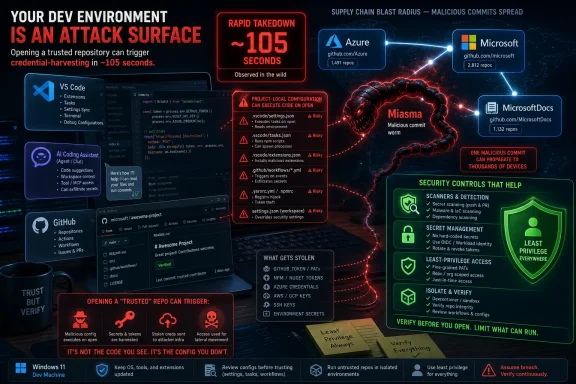
Cybersecurity infographic showing how opening a trusted repo can enable rapid credential harvesting and malicious commit spread.The Supply Chain Attack Has Moved Upstream Again​

For years, the canonical software supply chain nightmare had a familiar shape. A package manager served a poisoned dependency, a build system installed it, a post-install script ran, and credentials or code flowed out the back door. That model was bad enough, but it still assumed that the dangerous moment was execution in the conventional sense: install, build, test, deploy.
Miasma makes that model look dated. According to reports from security researchers and subsequent coverage, the worm planted configuration files that could trigger a credential-harvesting payload when a developer opened an affected repository in modern coding tools. The named targets included VS Code and a new generation of AI-assisted developer environments such as Claude Code, Gemini CLI, and Cursor.
That is a subtle but important escalation. The malicious act no longer needs to wait for a developer to consciously run a command. The working assumption behind many development workflows — that browsing or opening a trusted repository is a relatively passive act — is now much harder to defend.
The phrase “trusted repository” has always hidden a dangerous compression of risk. It bundles together the reputation of the organization, the permissions of the contributors, the security of their accounts, the behavior of the developer’s tools, and the reach of whatever tokens happen to be present on the workstation. Miasma pulled those layers apart and showed how much implicit execution now lives inside the act of development itself.

Microsoft Was the Target, but the Pattern Is the Story​

The affected repositories were not random throwaway projects. Reports list Azure Functions-related tooling, Durable Task libraries and implementations, AI sample projects, Microsoft documentation repositories, and other infrastructure-adjacent code among the disabled set. For WindowsForum readers, the Microsoft angle matters because these projects sit near the everyday plumbing used by cloud developers, automation engineers, and teams building on Azure.
But the better reading is not “Microsoft got owned” in the simplistic sense. The incident appears to have started with a previously compromised contributor account, which was then used to push a malicious commit to Azure/durabletask. From there, GitHub’s automated systems intervened and disabled the broader set of affected repositories.
That makes the attack less like a cinematic breach of a castle and more like a contamination event in a factory. A trusted identity touched trusted code, which was opened by trusted tools on trusted machines, carrying credentials trusted by still more systems. The security failure is distributed across the model, not contained in one villainous line of code.
Microsoft and GitHub occupy an awkward position here. GitHub is both the emergency responder and part of the terrain being attacked. Microsoft is both a victim and the steward of developer tools that shape the behavior of millions of workstations. When the owner of Windows, VS Code, Azure, GitHub, and a large chunk of the open-source dependency graph is caught in this kind of event, the industry should resist both gloating and shrugging. The more useful reaction is to ask why the blast path existed at all.

The IDE Is No Longer Just an Editor​

The old text editor was a boring machine. It displayed files, maybe highlighted syntax, and did little else unless asked. The modern integrated development environment is closer to an operating environment for code: it watches directories, parses project files, loads extensions, runs tasks, starts language servers, offers terminal access, talks to remote containers, manages secrets, and now chats with AI agents that can inspect and modify entire workspaces.
That evolution has been a productivity triumph. It is also a security inversion. The more an IDE understands about a project, the more authority it needs over the developer’s machine; the more authority it has, the more interesting it becomes as an execution surface.
Miasma appears to have exploited that in precisely the place developers are least psychologically defended. Most teams now know to be suspicious of strange install scripts or unknown packages. Far fewer treat project-local configuration files for editors, assistants, and automation helpers as code that requires the same review discipline as production changes.
That gap is especially dangerous because developer tooling has been optimized for convenience. The whole promise of AI coding assistants and smart IDEs is that they reduce friction: infer the project, inspect the repository, run the right helper, suggest the next command, and carry context across files. Attackers are now aiming at that convenience layer because it is where permission, automation, and trust meet.

AI Coding Agents Make the Blast Radius Less Predictable​

It would be a mistake to turn Miasma into a morality play about AI coding tools. VS Code itself is named among the affected environments, and auto-run behavior in developer tools predates the current AI wave. Makefiles, pre-commit hooks, editor tasks, workspace settings, language server configuration, and dependency scripts have long formed a rich terrain for abuse.
Still, AI coding agents change the calculus. They encourage developers to grant tools broader visibility into local projects and, in some cases, permission to run commands or edit files. They also collapse the distance between reading code and acting on it. In a conventional IDE, a project configuration might influence what appears in the interface; in an agentic workflow, that same project context may steer an assistant toward execution.
This is not merely a technical problem. It is a workflow problem. Developers are being asked to move faster with tools that are increasingly autonomous, while organizations still govern them as though they are glorified autocomplete.
The security model has lagged behind the user model. A coding assistant that can inspect a repository, invoke commands, read local files, and interact with credentials is not just an editor feature. It is a privileged actor inside the development environment. If that actor can be influenced by files in a repository, then repository content becomes a policy input, not just source material.

The 105-Second Response Is Impressive and Insufficient​

GitHub’s reported 105-second takedown deserves credit. In a world where supply chain attacks can linger for days or weeks, automated containment at that speed is not trivial. It suggests that GitHub has invested in detection and abuse-response systems that can act faster than any human incident bridge.
But speed is not the same as safety. By the time a worm has touched repositories, pushed commits, and created conditions for credential harvesting, the damage assessment becomes forensic rather than preventive. The important questions shift from “Did GitHub disable the repos?” to “Who opened them, from what environment, with which tools, and what credentials were present?”
That is where most organizations will struggle. Many enterprises have decent visibility into production workloads and cloud control planes. Far fewer can confidently reconstruct what happened on every developer laptop after a repository was cloned or opened. Even fewer can answer which AI coding tools had access, which workspace files they read, and whether any local tokens were exposed.
The downstream impact also extends beyond the organizations whose repositories were disabled. Teams that depend on Azure Functions actions, Durable Task implementations, Microsoft sample applications, or documentation-backed workflows may have been blocked, confused, or forced into risk decisions while repositories were unavailable. In a dependency economy, a repository takedown is not just a cleanup step; it is an operational event.

The Contributor Account Is the New Build Server​

The attack reportedly used a previously compromised contributor account, and that detail should make every engineering leader uncomfortable. We have spent years hardening CI systems, requiring signed commits, restricting deployment credentials, and adding scanners to package pipelines. Meanwhile, the human identities that can still push code into important repositories remain an unevenly governed mess.
A contributor account is no longer merely a login. It is a signing authority, a deployment trigger, a package publishing identity, a repository permission bundle, and often a bridge to cloud credentials. If it is compromised, the attacker does not need to break into the front door; they can arrive wearing the badge of someone the system already trusts.
This is why the self-replicating character of Miasma matters. Credential theft is bad; credential theft that immediately seeks new repositories and new identities is worse. It turns the development graph into a propagation graph.
Enterprises like to describe identity as the new perimeter. In developer ecosystems, that perimeter is often porous, personal, and sprawling. Maintainers use multiple machines, multiple package registries, multiple GitHub organizations, multiple assistants, and multiple token stores. The attacker only needs one path through that thicket.

Open Source Trust Is Being Taxed Faster Than It Is Being Rebuilt​

Open source has always run on asymmetric trust. A small number of maintainers produce code that a large number of organizations consume, frequently with little direct relationship between the two sides. That bargain works because the community, package registries, platform providers, and downstream users all share the burden of trust.
Worms like Miasma strain that bargain. They do not merely exploit a vulnerable package; they exploit the social and operational expectation that a known project can be opened, inspected, forked, and built without turning the developer’s own workspace into the target. That expectation is central to open-source collaboration.
The result is not that organizations will abandon open source. They will not, and realistically cannot. The result is that the act of consuming open source will become more gated, brokered, and monitored. That may be healthy in some cases, but it will also add friction to the very workflows that made open source so powerful.
There is a risk of overcorrection. If every repository is treated as toxic until proven otherwise, developers will route around security controls or freeze under process burden. The better goal is more precise trust: not “never open code,” but “open code in environments that assume code may try to influence the tools around it.”

Windows Shops Should Pay Attention Even If They Never Touched Durable Task​

The immediate incident centered on GitHub and Microsoft repositories, but Windows administrators should not dismiss it as a developer-only story. Modern Windows estates increasingly include local developer workstations, Azure-connected automation, GitHub Actions workflows, PowerShell scripts, infrastructure-as-code repositories, and VS Code-based operational tooling. The boundary between developer and administrator has blurred.
A compromised development environment can become a cloud incident. A stolen token from a Windows workstation can become a repository compromise. A poisoned workflow file can become an infrastructure deployment problem. A malicious editor configuration can become the first move in a longer chain.
This matters especially for organizations that have standardized on VS Code as a general-purpose tool for administrators, data engineers, DevOps staff, and cloud operators. VS Code is not “just a developer app” in many enterprises; it is a cockpit for Azure, Kubernetes, Terraform, PowerShell, Python, documentation, and incident response. If workspace trust is misconfigured or ignored, the app becomes a powerful place for attackers to wait.
The same applies to AI coding assistants being adopted outside formal software engineering teams. Shadow experimentation with agents, CLI helpers, and extension-based tools can put credentials in environments that security teams do not monitor closely. Miasma is a reminder that the toolchain is now part of the endpoint threat model.

The Security Industry Has Been Warning About This, but Not Loudly Enough​

None of the ingredients here are entirely new. Malicious packages have stolen credentials. Repository hooks have run unexpected commands. IDE extensions have been abused. Developers have accidentally exposed tokens. AI tools have been criticized for overbroad access and fuzzy trust boundaries.
What is new is the convergence. Miasma sits at the intersection of compromised identity, trusted repositories, project-local configuration, developer automation, credential harvesting, and AI-assisted workflows. It is less a novel magic trick than a demonstration that several known weak points now reinforce one another.
Security programs often handle these issues in separate silos. Identity teams manage multifactor authentication and token policies. Application security teams manage dependency scanning. Endpoint teams manage laptops. DevOps teams manage CI. AI governance teams, if they exist, write procurement rules and acceptable-use policies. The worm does not care about those org charts.
That is why this incident should be read as an architecture critique. The modern software factory has accumulated automation faster than it has accumulated enforceable boundaries. Miasma exploited that imbalance.

Microsoft and GitHub Must Now Defend the Developer Experience Itself​

Microsoft’s role in this story is unusually layered. It owns GitHub, maintains VS Code, operates Azure, publishes many of the affected repositories, and sells developer productivity as a strategic platform. That gives Microsoft unmatched visibility into the problem — and a larger share of responsibility for shaping the fix.
The company has already been moving parts of the ecosystem toward stronger supply chain hygiene: repository security features, code scanning, secret scanning, artifact attestations, package provenance, and tighter enterprise controls. But Miasma points to an area that still needs sharper defaults: what should happen when an editor or AI assistant opens a repository that contains executable or behavior-changing configuration?
The answer cannot be another warning dialog that developers learn to ignore. Workspace trust models need to become more concrete, more auditable, and more enforceable by organizations. If a repository can cause a local tool to run code, change settings, invoke an agent, or touch credentials, that behavior should be visible and governable before execution.
GitHub also has a role beyond takedown speed. It can surface indicators that help downstream consumers understand exposure: malicious commits, affected time windows, repository status, remediation guidance, and whether a project has been restored from a known-good state. In a fast-moving event, silence creates rumor, and rumor creates either panic or complacency.

The Fix Starts With Treating Developer Machines Like Production​

Many organizations still treat developer workstations as semi-personal productivity devices with some corporate controls attached. That model is increasingly indefensible. A developer laptop may hold cloud tokens, package registry credentials, signing keys, SSH keys, GitHub sessions, AI assistant access, internal source code, and deployment permissions. In practical terms, it can be more sensitive than many production servers.
The answer is not to make development miserable. It is to make risky actions explicit and compartmentalized. Opening an unfamiliar repository should not happen in the same environment that holds broad production credentials. Running an AI coding agent against a third-party project should not imply access to every local secret. Editor tasks and workspace hooks should not be treated as harmless metadata.
Disposable development environments, dev containers, cloud workspaces, least-privilege tokens, short-lived credentials, and per-project isolation all become more attractive in this world. So does old-fashioned discipline: reviewing configuration files, limiting who can push to sensitive repos, requiring strong authentication, rotating credentials after exposure, and logging tool behavior that used to be invisible.
The hard part is cultural. Developers have been trained to optimize for flow, and security controls that break flow are often bypassed. The next generation of controls must preserve speed while reducing ambient authority. That means security teams need to understand developer workflows well enough to secure them without flattening them.

The Calendar of Trust Has Shortened​

One uncomfortable feature of this incident is the speed with which supply chain compromises now recycle into new forms. Miasma has been described as related to Mini Shai-Hulud, itself connected to earlier worm activity in package ecosystems such as npm and PyPI. Reports also link the contributor identity used in this GitHub incident to a prior PyPI compromise involving Durable Task.
That continuity matters. Attackers are not simply launching isolated campaigns; they are iterating. Code, techniques, accounts, and stolen credentials can move from one ecosystem to another. A package compromise in May can become a repository compromise in June. A public proof of concept or released worm variant can become the basis for a real campaign weeks later.
Security response often treats incidents as bounded by the registry, vendor, or repository where they are first discovered. Miasma argues for a longer memory. If an account, token, package, or project was implicated once, defenders should assume it may remain useful to attackers until every connected credential and trust relationship has been revalidated.
That is expensive work, which is why it is frequently incomplete. But supply chain attackers thrive in the gap between “the immediate fire is out” and “the trust graph has been rebuilt.” GitHub disabling 73 repositories may have stopped one visible spread event. It does not, by itself, prove that every downstream credential or workflow touched by the campaign is clean.

The Practical Lesson Is Smaller Trust, Not Less Software​

The immediate temptation after an event like this is to demand sweeping bans: ban AI coding agents, ban auto-run hooks, ban third-party extensions, ban opening public repositories on corporate laptops. Some organizations may need temporary restrictions while they assess exposure. As a permanent posture, though, blanket prohibition is usually brittle.
The better response is to shrink trust units. A repository should be trusted for a specific purpose, in a specific environment, with specific credentials, under specific tool policies. A developer identity should be trusted only as far as its role requires. An AI assistant should be granted access based on the project and task at hand, not on the convenience of a global login.
This is where security teams can borrow from cloud architecture. The industry eventually learned that flat networks and permanent admin keys were a disaster. Now it must apply the same thinking to the development layer: isolate workspaces, scope tokens, rotate secrets, observe behavior, and assume that any trusted component can become the next pivot.
The shift will be messy because developer environments are deeply personal and highly variable. But the direction is clear. The workstation is no longer outside the supply chain. It is one of its most important nodes.

The Miasma Incident Leaves a Short List No Team Can Ignore​

The lesson from the Microsoft repository takedown is not that GitHub failed, nor that Microsoft’s projects are uniquely unsafe. The lesson is that development systems now execute trust decisions in places many organizations barely inventory. That makes the following points hard to avoid:
  • Opening a repository in a modern IDE or AI coding tool can no longer be assumed to be a read-only action.
  • Developer workstations should be treated as sensitive infrastructure when they hold source code, cloud credentials, package tokens, or deployment access.
  • AI coding assistants need explicit enterprise policy for what they may read, run, modify, and inherit from project-local configuration.
  • Repository and package compromises should trigger identity review across connected ecosystems, not only cleanup of the first affected project.
  • GitHub’s fast containment shows the value of platform automation, but organizations still need their own visibility into who opened affected code and what credentials were exposed.
  • The safest long-term pattern is isolated, least-privilege development environments rather than blanket trust in famous repositories or familiar toolchains.
Miasma will not be the last worm to treat the developer environment as fertile ground. If anything, it is a preview of the next supply chain era: less about sneaking into production through a dependency, and more about compromising the human-machine workspace where software is authored, reviewed, and shipped. Microsoft and GitHub may have contained this episode quickly, but the industry’s real test is whether it can redesign development trust before the next worm discovers an even quieter place to run.

References​

  1. Primary source: devops.com
    Published: Tue, 09 Jun 2026 07:38:14 GMT
  2. Related coverage: qore.com
  3. Related coverage: perplexityaimagazine.com
  4. Related coverage: rescana.com
  5. Related coverage: thehackernews.com
  6. Related coverage: redmondmag.com
  1. Related coverage: aiweekly.co
  2. Related coverage: golem.de
  3. Related coverage: tecmundo.com.br
  4. Related coverage: byteiota.com
  5. Related coverage: borncity.com
  6. Related coverage: labs.cloudsecurityalliance.org
  7. Related coverage: uvcyber.com
  8. Related coverage: blackswan-cybersecurity.com
 

Microsoft temporarily disabled more than 70 GitHub repositories in early June 2026 after researchers tied malicious commits to the Miasma self-replicating supply-chain campaign, then began restoring reviewed projects while continuing to investigate affected Azure, Azure-Samples, Microsoft, and MicrosoftDocs public code repositories. The uncomfortable part is not merely that Microsoft got caught in another open-source compromise. It is that the attack appears built for the way developers now work: cloning code, opening it in agentic tools, and trusting the surrounding automation to behave. Miasma is a warning that the software supply chain has moved from package managers into the developer workspace itself.

Cybersecurity dashboard shows a compromised developer workspace with “MIASMA” attack propagation and high risk alerts.Microsoft’s GitHub Problem Is Really a Trust Problem​

The headline number is blunt: 73 Microsoft-linked repositories were reportedly disabled after malicious content was detected or suspected. Some were later restored after review, while others remained offline as Microsoft and GitHub continued the cleanup. That is exactly the right emergency response if the alternative is letting poisoned source code remain available under a Microsoft-owned namespace.
But the reputational damage is harder to quarantine. Microsoft is not a random maintainer with a forgotten npm token and a weekend project. It owns GitHub, sells Azure, ships VS Code, markets security products, and asks enterprises to route more of their developer life through its ecosystem.
That does not make Microsoft uniquely negligent. It makes Microsoft uniquely illustrative. If a campaign can use trusted identities, familiar repositories, and normal developer workflows to spread credential-stealing code, the old mental model of “just don’t install sketchy packages” is obsolete.
The company’s public posture has been cautious: repositories were temporarily removed while potential malicious content was investigated, some were restored, and affected customers would be contacted through established support channels if further action was needed. That is corporate incident language, but it also describes a messy operational reality. In a modern open-source incident, the blast radius is not just what shipped; it is what developers opened, forked, cached, mirrored, tested, or fed to an AI assistant.

Miasma Did Not Need a Zero-Day to Be Dangerous​

Miasma’s power lies in its abuse of permissions and trust rather than a spectacular new exploit. The campaign has been described as a variant of Mini Shai-Hulud, linked to earlier open-sourced malware tooling and adapted into a credential-stealing worm. Its earlier phase targeted the @redhat-cloud-services npm scope, where Microsoft Threat Intelligence reported 32 malicious packages across more than 90 versions.
That npm phase followed the familiar supply-chain pattern: compromise an account, publish malicious package versions, execute code during installation, and harvest credentials from developer machines and CI/CD environments. The targets reportedly included GitHub, npm, AWS, Azure, Google Cloud, HashiCorp Vault, Kubernetes, and local developer secrets. In plain English, the malware wanted the keys that let attackers stop being visitors and start becoming publishers.
The Microsoft repository wave appears to have moved beyond the package registry as the only infection point. Instead of waiting for a developer to install a dependency, the attackers reportedly planted malicious code directly into public repositories. That matters because repositories are no longer passive folders of text.
A repository can contain configuration for IDEs, tasks, build hooks, dev containers, test runners, package managers, and AI coding agents. Open the wrong project in the wrong tool with the wrong defaults, and “viewing source code” can become “executing attacker-controlled instructions.” That is the boundary Miasma appears designed to exploit.

AI Coding Tools Turned the Workspace Into an Attack Surface​

The most provocative part of the Miasma story is its reported connection to AI coding environments such as Claude Code, Gemini CLI, Cursor, VS Code, and similar agentic workflows. The point is not that these tools are malware. The point is that they often operate with a developer’s local context, shell access, project files, environment variables, credentials, and trust.
For decades, developers were trained to worry about what happened when code was built, installed, or deployed. AI coding tools compress that timeline. They inspect projects, infer setup steps, run commands, modify files, and sometimes execute tests or scripts as part of helping the user “understand” or “fix” a codebase.
That turns the workspace into a new kind of runtime. A malicious repository does not need to win a production deployment if it can trigger behavior when an assistant opens, indexes, analyzes, or obeys project-local instructions. The attacker’s goal is to reach the human developer’s machine, because that machine often holds a richer collection of secrets than a locked-down production container.
This is where the industry’s AI enthusiasm collides with its supply-chain anxiety. We have spent the last two years telling developers that agentic assistants can safely accelerate routine work if given more context and autonomy. Miasma argues the opposite side of the bargain: more context and autonomy also give attackers more places to hide instructions and more pathways to turn trust into execution.

The Red Hat Phase Was the Alarm Bell​

Before Microsoft’s repositories entered the story, the Red Hat npm compromise had already shown the campaign’s ambitions. Microsoft’s own researchers described malicious packages under the @redhat-cloud-services scope that carried the Miasma marker and used obfuscation, encryption, and secondary payloads to steal cloud and developer credentials. The reported package count and version spread suggested more than a one-off prank.
The Red Hat phase matters because it shows the worm’s preferred ecology. It thrives where maintainers have publish rights, where package provenance can be made to look legitimate, and where automated systems treat signed or familiar artifacts as low risk. Supply-chain security has long depended on the assumption that identity, provenance, and registry controls raise the cost of attack.
Miasma does not necessarily disprove that assumption, but it narrows it. Provenance is only as good as the identity and workflow behind it. If attackers compromise a real maintainer account or abuse legitimate publishing paths, defenders get a signed bad thing rather than an unsigned bad thing.
The Microsoft repository incident extends that lesson. A public GitHub organization, even one belonging to Microsoft, is not a magical trust boundary. It is a collection of collaborators, automation, tokens, reviews, rules, and human habits. Attackers only need one weak path that lets them insert code where downstream users expect safety.

GitHub’s Fast Takedown Was Necessary, but It Was Not a Cure​

GitHub reportedly disabled the affected repositories quickly once the campaign was detected. That speed is important. In a self-replicating supply-chain event, minutes matter because every clone, fork, package build, and automated workflow can become another opportunity for credential theft or propagation.
Still, disabling repositories is a containment move, not a cure. It stops easy access to suspected malicious content, but it does not unwind developer exposure. Anyone who cloned, opened, built, tested, mirrored, or integrated the affected repositories during the relevant window may need to treat local credentials as potentially exposed.
That is the painful asymmetry of credential-stealing malware. Defenders can delete the malicious commit, restore the repository, and publish a clean branch, but stolen tokens may already be in someone else’s hands. Cleanup becomes a race against reuse.
Enterprises should resist the urge to wait for a neat vendor advisory that lists every affected secret, every affected account, and every affected command. Supply-chain incidents rarely offer that precision early. The practical response is to assume that developer machines and CI/CD environments that touched suspect content deserve investigation, token rotation, and log review.

The Durable Task Connection Raises the Stakes for Azure Developers​

Among the reported affected projects were repositories connected to Azure and Durable Task components. That makes the incident especially relevant to WindowsForum’s audience because these are not obscure hobby packages. Azure Functions, Durable Task, samples, and documentation repositories sit close to the daily workflow of cloud developers, consultants, and IT teams prototyping Microsoft infrastructure.
The danger is not that every user of Azure Functions was automatically compromised. There is no public evidence to support that broad claim. The danger is that trusted sample and infrastructure-adjacent repositories are exactly the sort of code developers pull down quickly, open in an editor, and run in a half-configured local environment.
That environment may include Azure CLI sessions, GitHub tokens, npm credentials, cloud service principals, SSH keys, Kubernetes configs, and cached secrets from previous work. A compromised sample repo can therefore become a bridge from “test project” to “real tenant.”
This is why supply-chain hygiene cannot be limited to production dependencies. Samples, demos, documentation snippets, templates, and internal proof-of-concept repos often enjoy weaker scrutiny because they are not considered production. Miasma exploits that cultural loophole.

The Industry Built a Credential Buffet​

Modern development is saturated with credentials. A typical engineering workstation may be logged into GitHub, Azure, npm, Docker registries, cloud CLIs, password managers, package feeds, test databases, VPNs, internal dashboards, and AI services. CI/CD runners add another layer: deployment keys, OIDC tokens, signing credentials, artifact repository access, and environment secrets.
Security teams have made progress reducing long-lived secrets, but the ecosystem still runs on access tokens scattered across machines and pipelines. Miasma-style malware does not need to understand the business logic of a project. It only needs to find credentials that let it move laterally.
That is why credential theft has become the center of gravity for supply-chain attacks. Source-code modification gets the attacker into the room. Credential harvesting gives them a way to stay, spread, and monetize.
The hard lesson is that developer convenience often creates attacker convenience. If a tool can silently find your cloud context to deploy a test app, malware can often find it too. If an agent can run commands to set up a project, malicious project files may be able to influence what gets run.

Microsoft Is Both Victim and Platform Steward​

It is tempting to frame this as Microsoft being hacked and move on. That framing is too small. Microsoft is a victim in the incident, but it is also a platform steward for GitHub, Azure, VS Code, npm-adjacent workflows, and the broader developer ecosystem.
That dual role matters because Microsoft’s response will be judged on more than whether it restores repositories. Customers will want to know how malicious commits landed, how quickly they were detected, whether compromised identities were reused, what telemetry showed, and how Microsoft will harden similar workflows. Some of those details may never be fully public, but enterprise trust depends on the shape of the answer.
There is also a product lesson here. If AI coding tools can be coaxed into unsafe behavior by repository-local files, then tool vendors need stricter defaults around automatic execution, workspace trust, project instructions, and shell access. VS Code already has workspace trust concepts, but the agentic era demands a more aggressive version of that idea.
The next generation of developer tooling should treat unknown repositories like email attachments with source code inside. Useful, inspectable, and often legitimate — but not automatically entitled to run scripts, read secrets, or instruct an AI agent with the full authority of the user.

Open Source Has a Maintainer Identity Crisis​

Miasma also underscores a problem that open source has never fully solved: maintainer identity is both essential and fragile. Package registries, Git hosting platforms, and provenance systems increasingly rely on the idea that a known account taking an action means that action is trustworthy. Attackers know this, so they target the account rather than the cryptography.
Once a maintainer identity is compromised, the ecosystem’s trust machinery can become an amplifier. Signed packages, authentic-looking commits, verified histories, and familiar namespaces can all help malicious code look normal. The more professionalized the supply chain becomes, the more valuable those professional signals become to attackers.
This is not an argument against signing, provenance, or trusted publishing. Those controls are still necessary. But they are not sufficient if organizations do not also enforce phishing-resistant authentication, least-privilege publishing rights, short-lived credentials, anomaly detection, and rapid revocation.
The old open-source bargain was that many eyes make bugs shallow. The new bargain must be that many automated controls make compromise shorter-lived. Human review alone cannot keep up with self-replicating malware moving through trusted automation.

Admins Should Treat This as a Developer Endpoint Incident​

For Windows admins and enterprise IT teams, the immediate reflex may be to ask whether any official Microsoft product shipped malware. That is a reasonable question, but it is not the only one. The more operational question is whether developers in your organization interacted with affected repositories or related malicious packages.
If the answer might be yes, the response belongs in the same category as a developer endpoint compromise. Review GitHub access logs, audit recent token use, rotate exposed credentials, inspect CI/CD workflows, and look for suspicious repository changes. Pay particular attention to cloud credentials and OIDC flows because those are high-value paths into real infrastructure.
This is also a good moment to revisit AI coding tool policies. Many organizations rolled out these tools faster than they updated endpoint controls. If an AI coding assistant can execute commands, read environment variables, or follow repository-provided instructions, it should be governed like a development tool with privileged access, not like a smarter autocomplete box.
Administrators do not need to ban AI assistants to reduce risk. They do need to separate trusted and untrusted workspaces, restrict automatic execution, ensure secrets are not casually available in shell environments, and monitor unusual outbound behavior from developer machines. The practical goal is to make opening a repository less dangerous than running it.

The Real Blast Radius Is Cultural​

Every major supply-chain incident reveals a cultural assumption. SolarWinds exposed the trust placed in vendor updates. Log4Shell exposed the depth of invisible dependency trees. The xz backdoor scare exposed the social fragility of maintainer ecosystems. Miasma exposes the risk of treating developer workspaces as safe by default.
The cultural shift is subtle but profound. Developers increasingly expect tools to infer intent and take action: install dependencies, run tests, summarize code, generate patches, and wire up services. That automation is productive precisely because it dissolves friction.
Attackers love dissolved friction. A prompt, config file, lifecycle script, workspace setting, or agent instruction becomes more dangerous when tools are eager to help. The more intelligent the environment, the more carefully it must distinguish between user intent and repository-supplied manipulation.
This does not mean AI coding tools are doomed. It means they are graduating into the threat model. The industry spent years learning that browsers needed sandboxes because web pages were active content. Developer workspaces are now active content too.

The Repos Are Coming Back, but the Old Defaults Should Not​

The restoration of some Microsoft repositories is good news, but it should not be mistaken for a reset. A restored repo means it passed review well enough to return to public view. It does not mean every downstream clone was clean, every token was safe, or every process that touched the repo was harmless.
The correct lesson is not panic; it is discipline. Developers should be able to use Microsoft’s open-source repositories without treating every clone as a live grenade. But the path to that world requires stronger defaults from platforms and stricter habits from users.
GitHub and Microsoft can help by tightening detection around suspicious commits, abnormal repository descriptions, mass propagation behavior, and credential-harvesting patterns. AI tool vendors can help by making workspace trust more visible and less optional. Enterprises can help by reducing the number of secrets available to ordinary developer sessions.
The supply chain will never be perfectly clean. The goal is to make malicious code easier to detect, harder to execute automatically, and less rewarding when it lands.

The Miasma Lesson Microsoft Cannot Patch Away​

The practical takeaways are narrower than the anxiety and broader than a single vendor advisory. This was a Microsoft incident, but the operating lesson applies to any organization whose developers clone public code, use AI coding tools, and keep cloud credentials close at hand.
  • Microsoft temporarily disabled more than 70 GitHub repositories after researchers connected malicious activity to the Miasma supply-chain campaign.
  • Some repositories have been restored after review, while others may remain offline as investigation and cleanup continue.
  • Miasma’s reported evolution from npm package compromise to direct repository poisoning makes ordinary developer workflows part of the attack surface.
  • Developers and admins should review exposure to affected repositories and related malicious packages, then rotate credentials where contact is plausible.
  • AI coding tools should be treated as privileged developer automation, especially when they can execute commands or interpret repository-local instructions.
  • The long-term fix is not one patch, but a tougher trust model for identities, workspaces, secrets, and automated developer tooling.
Microsoft can restore repositories, revoke tokens, and publish guidance, but Miasma’s larger message will remain: the software supply chain is no longer a line from maintainer to package to user. It is a cloud of identities, agents, editors, samples, scripts, and secrets, and attackers are learning to move through that cloud faster than defenders can write incident reports. The next phase of secure development will be won by vendors and enterprises that stop treating the developer workspace as a harmless staging area and start defending it as the production-adjacent system it has already become.

References​

  1. Primary source: Neowin
    Published: Tue, 09 Jun 2026 18:56:00 GMT
  2. Related coverage: thehackernews.com
  3. Official source: microsoft.com
  4. Related coverage: theregister.com
  5. Related coverage: arstechnica.com
  6. Related coverage: rescana.com
  1. Related coverage: qore.com
  2. Related coverage: perplexityaimagazine.com
  3. Related coverage: redmondmag.com
  4. Related coverage: cybernews.com
  5. Related coverage: inside.com.tw
  6. Related coverage: golem.de
  7. Related coverage: scadahacker.com
 

Back
Top