

Michigan’s forests, wetlands, and backyard ponds hide a remarkable cast of hidden neighbors: small, secretive, and ecologically vital salamanders that shape food webs, signal environmental change, and—in the case of the eastern newt—stage one of nature’s most fascinating multi-stage life histories. This feature peels back the leaf litter, explains the red-orange “eft” mystery, and examines the conservation challenges that place these moisture‑loving amphibians at the center of freshwater conservation in the state.
Michigan’s herpetofauna includes a surprising diversity of salamanders that most residents rarely see unless they’re out on a rainy spring night or poking under rotting logs. State natural resource materials list the core species residents are most likely to encounter—including the mudpuppy, eastern newt, spotted and marbled salamanders, the blue‑spotted complex, red‑backed salamander, and several mole salamanders—making up roughly a dozen species depending on how complexes and seasonal records are tallied. These state guides are the first stop for anyone looking to learn which salamanders are local to a county or wetland.
Salamanders in Michigan occupy many ecological niches: permanently aquatic forms (like the mudpuppy), semi‑aquatic breeders that visit vernal pools, and fully terrestrial species that nonetheless rely on moist microhabitats for skin respiration and reproduction. Their skin is soft, permeable, and specially adapted to exchange gases and water—but that same permeability also makes them extremely sensitive to contaminants, temperature shifts, and habitat loss.
Crucially, amphibians serve as effective bioindicators: their permeable skin and complex life cycles (aquatic larvae, often terrestrial juveniles, and aquatic or semi‑aquatic adults) expose them to pollutants and stressors across multiple ecosystems. Because of this, changes in salamander abundance or health often provide early warning signs of wider environmental problems such as water pollution, habitat fragmentation, or the arrival of novel pathogens. This role as a “canary in the coal mine” for freshwater systems is well documented in conservation literature.
Egg deposition is similarly interesting. Females typically attach eggs singly to submerged leaves, stems, or detritus; published life‑history treatments and field guides report females laying from the low hundreds to several hundred eggs in a single season. One long‑used compilation of eastern newt natural history cites typical clutch ranges between 200–375 eggs per female, with deposition occurring over many days. Local and regional guides sometimes report lower per‑female totals (e.g., “more than 100 eggs”), reflecting geographic and seasonal variation in reproductive output. In short: the “around 300 eggs” figure used in popular summaries sits comfortably within the range reported by the scientific and naturalist literature.
Why the variation in counts?
Reducing chemical runoff, protecting vernal pools and buffers, and preserving forest cover are practical conservation measures that directly benefit salamander populations.
As of current national surveillance and peer‑reviewed syntheses, intensive surveys and collaborative testing programs have not detected Bsal in wild North American amphibian populations. Large surveillance efforts by federal agencies and academic partners have tested thousands of samples and, to date, reported no confirmed wild detections of Bsal on the continent. However, risk modeling and experimental infection studies show many North American urodelans are susceptible, so surveillance and trade controls remain high‑priority actions for prevention and early detection. In short: Bsal is not known from wild populations in North America today, but the invasion risk is considered serious and ongoing surveillance is essential.
Why that matters for Michigan
If you care about clean water, healthy forests, and resilient ecosystems, pay attention to salamanders. A small rainfall migration across a forest road, a red‑orange eft in the leaf litter, or a reported observation to the Herp Atlas can all provide the data and momentum conservationists need to keep Michigan’s amphibian heritage intact for the decades ahead. (miherpatlas.org)
Source: Michigan State University Mighty, moist, and mysterious: Meet Michigan’s salamanders
 Background: Michigan’s salamanders at a glance
Michigan’s herpetofauna includes a surprising diversity of salamanders that most residents rarely see unless they’re out on a rainy spring night or poking under rotting logs. State natural resource materials list the core species residents are most likely to encounter—including the mudpuppy, eastern newt, spotted and marbled salamanders, the blue‑spotted complex, red‑backed salamander, and several mole salamanders—making up roughly a dozen species depending on how complexes and seasonal records are tallied. These state guides are the first stop for anyone looking to learn which salamanders are local to a county or wetland.Salamanders in Michigan occupy many ecological niches: permanently aquatic forms (like the mudpuppy), semi‑aquatic breeders that visit vernal pools, and fully terrestrial species that nonetheless rely on moist microhabitats for skin respiration and reproduction. Their skin is soft, permeable, and specially adapted to exchange gases and water—but that same permeability also makes them extremely sensitive to contaminants, temperature shifts, and habitat loss.
Why salamanders matter: ecosystem roles and ecological signals
Salamanders are more than curiosities. Both as larvae and as adults they are active predators of invertebrates—mosquito larvae, aquatic insect larvae, worms, snails, and slugs—and they are also prey for birds, snakes, fish, and small mammals. Through those feeding relationships they help regulate detrital processing in forest soils and nutrient flows into ponds and streams.Crucially, amphibians serve as effective bioindicators: their permeable skin and complex life cycles (aquatic larvae, often terrestrial juveniles, and aquatic or semi‑aquatic adults) expose them to pollutants and stressors across multiple ecosystems. Because of this, changes in salamander abundance or health often provide early warning signs of wider environmental problems such as water pollution, habitat fragmentation, or the arrival of novel pathogens. This role as a “canary in the coal mine” for freshwater systems is well documented in conservation literature.
Species spotlight: the eastern newt and the intriguing red eft
Three stages, two metamorphoses — and a bright orange detour
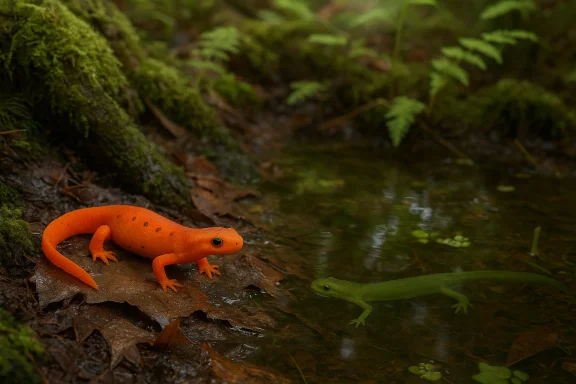
The eastern newt (Notophthalmus viridescens) is the species most Michiganders recognize by sight—when they’re lucky enough to spot one—thanks to the terrestrial juvenile stage known as the red eft. The eastern newt’s life cycle typically includes:- Aquatic eggs and larvae that hatch with external gills and feed in ponds or vegetated water.
- A terrestrial juvenile stage—the red eft—with rougher, drier skin and a conspicuous red‑orange coloration that acts as a warning to predators.
- A return to an aquatic adult form, olive‑green in color, with a flattened, rudder‑like tail adapted for swimming.
Courtship, eggs, and early development
Eastern newt courtship is elaborate and chemo‑communicative. Males use a combination of tactile behaviors, cheek gland secretions, and tail‑fanning to waft pheromones toward the female; if receptive, the female picks up a sperm packet (spermatophore) deposited by the male. This often underwater “dance” is common in ponds and sheltered wetlands during late winter through spring.Egg deposition is similarly interesting. Females typically attach eggs singly to submerged leaves, stems, or detritus; published life‑history treatments and field guides report females laying from the low hundreds to several hundred eggs in a single season. One long‑used compilation of eastern newt natural history cites typical clutch ranges between 200–375 eggs per female, with deposition occurring over many days. Local and regional guides sometimes report lower per‑female totals (e.g., “more than 100 eggs”), reflecting geographic and seasonal variation in reproductive output. In short: the “around 300 eggs” figure used in popular summaries sits comfortably within the range reported by the scientific and naturalist literature.
The red eft’s warning color and toxins
The red eft’s gaudy coloration is aposematic: it advertises toxicity. Efts possess skin secretions—alkaloids and related compounds—that deter predators, and the bright orange hue is a signal to would‑be predators to leave them alone. This defense lets efts be active on forest floors for months to years before many return to water and settle into the adult aquatic phase. Sources report variable durations for the eft stage depending on climate and subspecies—commonly 2–7 years—before the second metamorphosis back to the aquatic adult form.Michigan’s salamander checklist: who you might see (and why counts vary)
Michigan resource pages and field guides list roughly 10–13 named salamander taxa in the state, depending on whether isolated, historical, or irregular records are included and how hybrid complexes (for example within the blue‑spotted complex) are counted. Official state education pages highlight the species most commonly encountered and those that are legally protected (marbled salamander listed as threatened in Michigan; small‑mouthed salamander listed as endangered; the western lesser siren listed as a species of special concern). For naturalists, the working species list found via the Michigan Herp Atlas is the best real‑time reference—its database documents observations statewide and has been used to rediscover or confirm records of rare species.Why the variation in counts?
- Historical museum records and modern citizen‑science observations may add or subtract species from a state checklist.
- Some taxa form complexes or hybrid zones that challenge simple species tallies.
- Rare or vagrant records (for example, a western lesser siren outside its core range) show up occasionally and are treated carefully by state records managers.
The biggest threats: habitat loss, pollution, and the specter of novel pathogens
Habitat loss and water quality
Wetlands, vernal pools, forested riparian corridors, and undisturbed leaf litter are essential salamander habitat. When these habitats are drained, fragmented, or polluted, populations decline quickly because salamanders depend on moist microhabitats and clean water to complete life stages and reproduce. Agricultural runoff, urban stormwater, and improper disposal of household chemicals all create chronic stressors that can reduce survival and cause sublethal effects that limit reproduction.Reducing chemical runoff, protecting vernal pools and buffers, and preserving forest cover are practical conservation measures that directly benefit salamander populations.
Disease threats: Bsal and other pathogens
One disease has rightfully captured conservation attention: the salamander‑killing chytrid fungus Batrachochytrium salamandrivorans (Bsal). First recognized as a catastrophic agent of salamander declines in Europe, Bsal has generated urgency because North America supports the world’s richest salamander diversity and could face major biodiversity losses if the pathogen becomes established.As of current national surveillance and peer‑reviewed syntheses, intensive surveys and collaborative testing programs have not detected Bsal in wild North American amphibian populations. Large surveillance efforts by federal agencies and academic partners have tested thousands of samples and, to date, reported no confirmed wild detections of Bsal on the continent. However, risk modeling and experimental infection studies show many North American urodelans are susceptible, so surveillance and trade controls remain high‑priority actions for prevention and early detection. In short: Bsal is not known from wild populations in North America today, but the invasion risk is considered serious and ongoing surveillance is essential.
Why that matters for Michigan
- North America’s exceptionally high salamander diversity elevates the stakes of any introduction.
- Michigan’s mix of vernal pools and forested landscapes would provide many susceptible host populations if Bsal were introduced.
How citizens and land managers can protect Michigan’s salamanders
Conservation is partly about large policy and research actions—but it’s also about practical on‑the‑ground choices. Here are concrete steps that help salamanders and freshwater systems:- Preserve and protect vernal pools and forest buffers. Avoid filling, draining, or removing vegetation from small wetlands that often go unnoticed yet are amphibian breeding nurseries.
- Minimize use of fertilizers, pesticides, and herbicides. These chemicals wash into wetlands and can be absorbed through amphibian skin, causing developmental and reproductive harm.
- Prevent pet and plant releases. Don’t release aquarium animals, water garden plants, or pet amphibians into the wild; this is a primary pathway for invasive species and disease spread. The Michigan State University Extension RIPPLE program is a resource for retailers and hobbyists on how to rehome or responsibly dispose of aquarium and pond organisms.
- Join or support citizen‑science monitoring. Programs such as the Michigan Herp Atlas allow residents to submit sightings that help map species distributions and detect early population changes or disease events. These databases are actively used by managers and researchers. (miherpatlas.org)
- Observe safe handling practices. If you must handle a salamander (for relocations, educational purposes, or scientific surveys), wash hands and remove chemicals or lotions first; amphibian skin absorbs contaminants easily. Limit handling and always follow local regulations and best‑practice protocols for fieldwork.
- Keep a 50–100 foot forested buffer around ponds and streams where possible.
- Avoid draining or filling depressional wetlands on your property.
- Replace broad‑spectrum pesticides with integrated pest management methods.
- Use RIPPLE network retailers or local rescues if you need to rehome aquarium animals.
Science and surveillance: what researchers are watching now
Wildlife health agencies and academic groups continue to prioritize three linked efforts:- Broad surveillance for pathogens like Bsal and ranaviruses, including testing of wild amphibians, captive animals, and trade pathways.
- Improved understanding of which species are most susceptible and where ecological hotspots of risk occur. Experimental challenge studies and population vulnerability assessments are being used to inform the Lacey Act and consultative risk‑management tools.
- Active outreach, such as the RIPPLE program and state educational materials, to minimize accidental introductions from the pet and aquatic plant trades.
Strengths and risks: a critical assessment
Notable strengths
- Michigan benefits from an active conservation infrastructure: state agency field programs, university extension outreach (including RIPPLE), and a central citizen‑science portal (Michigan Herp Atlas) that together form a pragmatic early‑warning and response system.
- The public is increasingly engaged: volunteer reporting and local conservation groups contribute to mapping and monitoring efforts.
- The natural history of key species—like the eastern newt—is well documented, allowing managers to interpret population trends against robust life‑history baselines.
Persistent risks and knowledge gaps
- Surveillance limitations: even large surveys have imperfect detection. Low pathogen prevalence, localized introductions, or gaps in sampling coverage could delay detection of emerging pathogens like Bsal. Continued, targeted surveillance is essential.
- Trade and movement pathways: live amphibian and aquatic plant trade remain significant pathways for accidental introductions of pathogens and invasive species. Regulatory frameworks (including Lacey Act listings) reduce risk but are not a cure‑all; enforcement and ongoing risk assessment remain necessary.
- Habitat fragmentation and water‑quality stressors continue to degrade breeding habitats. Vernal pool loss and forest fragmentation are hard to reverse at scale without coordinated land‑use policy and incentives for private‑land conservation.
- Some natural history numbers are variable across sources (for example, reported lifespans for eastern newts range across the literature). When communicating these figures, it’s important to present ranges and note regional variability. Multiple field guides and species accounts show lifespan estimates covering roughly 8–15 years in the wild depending on study and population. Presenting a narrow single number without context can mislead.
Practical guidance for educators, landowners, and citizen scientists
- For classroom activities: avoid releasing classroom amphibians or pond organisms into the wild—use outreach channels recommended by extension programs (RIPPLE) to rehome or surrender animals ethically.
- For backyard pond owners: design ponds with escape‑proof edges and avoid connecting ornamental water features to natural waterways.
- For volunteers: follow reporting protocols and include photographic vouchers when possible for Herp Atlas submissions; if you suspect disease in wild amphibians (unusual numbers of dead or sick animals), report promptly to state wildlife health authorities rather than moving animals.
- Bookmark and use the Michigan Herp Atlas to report sightings—these records are used by conservation planners. (miherpatlas.org)
- Find a nearby RIPPLE retailer or contact MSU Extension for guidance on rehoming aquarium organisms.
- Remove or minimize pesticide and fertilizer use in landscaping and gardening near freshwater features.
Conclusion: a quiet group with a loud message
Michigan’s salamanders—small, moist, and often overlooked—are central players in freshwater and forest ecosystems. The eastern newt’s red eft shows the drama of amphibian life histories, and across the state the mix of aquatic and terrestrial salamanders knit food webs together in ways we only sometimes appreciate. The good news is multiple tools and institutions exist to protect these species: active state guidance, university extension programs, and powerful citizen‑science platforms. The bad news is that the threats—habitat loss, water pollution, and the risk of pathogens like Bsal—are serious and require continued vigilance.If you care about clean water, healthy forests, and resilient ecosystems, pay attention to salamanders. A small rainfall migration across a forest road, a red‑orange eft in the leaf litter, or a reported observation to the Herp Atlas can all provide the data and momentum conservationists need to keep Michigan’s amphibian heritage intact for the decades ahead. (miherpatlas.org)
Source: Michigan State University Mighty, moist, and mysterious: Meet Michigan’s salamanders
