

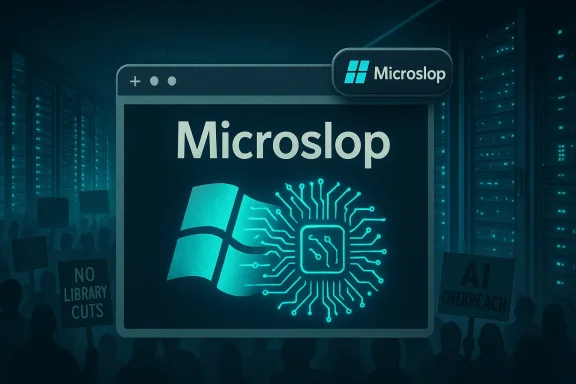
The nickname "Microslop" has gone from internet snark to a visible user protest, encapsulating a widening backlash against Microsoft’s aggressive integration of Copilot across Windows and recent internal cost‑cutting that removed longstanding employee information resources — a revolt that surfaced this month in a cheeky browser extension that replaces every instance of "Microsoft" with "Microslop" and in heated conversations across social media and enterprise channels.
Microsoft’s strategy of turning artificial intelligence from a set of optional features into a system‑level product primitive — the “Copilot everywhere” play — has driven enormous infrastructure commitments, new product experiments, and an internal reorganization that places AI at the heart of the company’s roadmap. The firm publicly committed to spending more than $80 billion on AI‑capable datacenter construction in fiscal 2025, a scale of investment that has amplified both market expectations and internal pressure to ship agentic AI experiences. At the same time, Microsoft has told some publishers and internal stakeholders that it will stop renewing many library and news subscriptions as part of a shift to an "AI‑powered learning experience" via an internal Skilling Hub. That change — which affected long‑standing vendors such as Strategic News Service and led to lost access to publications including The Information for some employees — was announced internally in November 2025 and publicly reported in January 2026. These two trends — outsized external AI infrastructure spending and the internal pruning of traditional information subscriptions — form the immediate context for the Microslop flap. Users interpret the juxtaposition as a values and priority mismatch: lavish external investment versus visible internal retrenchment.
Microsoft’s broader bet — that Copilot and a new layer of agentic services can drive the next wave of productivity and commerce — remains strategically logical. The risk is execution: poor defaults, fragile reliability, and perceived replacement of independent information will leave users and enterprise buyers vulnerable to the very “slop” the company and its critics disagree about. That debate will continue to shape Windows’ public image and Microsoft’s advertising and commerce ambitions unless the company pairs its developer‑scale investments with visible, verifiable commitments to user control, transparency, and independent oversight.
Note on unverifiable items: several colorful details circulating in fringe and aggregator pieces — notably specific counts of GPU models at named datacenters, precise fiber‑optic cable length claims, and some exact market‑share percentages tied to Copilot — could not be independently confirmed through authoritative Microsoft communications or major press reporting at publication time; these should be treated as unverified until corroborated by primary documentation or official disclosures.
Source: PPC Land Frustrated users rename Microsoft to "Microslop" after cuts and AI overreach
 Background
Microsoft’s strategy of turning artificial intelligence from a set of optional features into a system‑level product primitive — the “Copilot everywhere” play — has driven enormous infrastructure commitments, new product experiments, and an internal reorganization that places AI at the heart of the company’s roadmap. The firm publicly committed to spending more than $80 billion on AI‑capable datacenter construction in fiscal 2025, a scale of investment that has amplified both market expectations and internal pressure to ship agentic AI experiences. At the same time, Microsoft has told some publishers and internal stakeholders that it will stop renewing many library and news subscriptions as part of a shift to an "AI‑powered learning experience" via an internal Skilling Hub. That change — which affected long‑standing vendors such as Strategic News Service and led to lost access to publications including The Information for some employees — was announced internally in November 2025 and publicly reported in January 2026. These two trends — outsized external AI infrastructure spending and the internal pruning of traditional information subscriptions — form the immediate context for the Microslop flap. Users interpret the juxtaposition as a values and priority mismatch: lavish external investment versus visible internal retrenchment.What happened: library cuts, Skilling Hub, and the Microslop meme
Employee subscriptions and the Skilling Hub
Starting in November 2025, Microsoft’s vendor management team issued automated notices that certain library and news contracts would not be renewed on expiration. Internal FAQs characterized the change as a transition toward a "modern, AI‑powered learning experience" delivered through Microsoft’s Skilling Hub — an internal learning platform that prioritizes AI tools and synthesized content over curated publisher feeds. Longstanding contracts, including those that had supplied executive briefings for decades, were affected. This is a strategic choice as much as a cost action: Microsoft is betting that internally delivered AI tools can scale learning at lower marginal cost while aligning content to company-specific workflows. That bet raises immediate questions about independence and depth — professional journalism and independent analysis often provide context, cross‑checks, and investigative reporting that are hard to reproduce via in‑house models without careful sourcing and editorial independence. The company has framed the change as modernization; impacted publishers and some staff see it as premature and tone‑deaf.The Microslop extension and community backlash
Outrage at the company’s AI pivot and perceived product missteps crystallized into an online meme — "Microslop" — that quickly migrated into tooling. A browser extension, widely circulated in browser stores and community forums, replaces visible instances of "Microsoft" with "Microslop" on pages rendered in the browser. The add‑on exists across multiple collections (Chrome, Firefox) and was promoted on forums and social media; archives and storefront listings confirm its presence and its stated behavior as a client‑side, visual substitution that does not alter underlying page data. The extension’s existence is small in user numbers compared with Microsoft’s billions of users, but symbolically potent. It conveys organized user dissatisfaction in a way that is easy to share, visually obvious, and tailor‑made for meme culture. The extension’s developer framed it as satire and catharsis; community reactions ranged from applause to warnings about extension permissions.Why the backlash hardened: product, reliability, and optics
Product reliability problems that feed distrust
The Microslop meme is not purely aesthetic. Over the latter half of 2025, Windows 11 users reported recurring faults in core OS components — Start Menu, Taskbar, File Explorer, and System Settings — across multiple monthly updates. Those reliability problems, combined with visible Copilot feature rollouts into many core apps (Notepad, Paint, File Explorer, Office), created an optics problem: users were receiving new, AI‑centric features while fundamental functionality felt flaky. That dissonance deepened distrust. Inside Microsoft, senior leaders privately expressed frustration with Copilot’s integrations, describing certain email/calendar interactions and third‑party integrations as not meeting internal expectations for reliability and usefulness. Reporting indicates these internal critiques have been strong and unusually public inside the company’s engineering channels. Those internal admissions — combined with external user pain — created a perception gap between marketing rhetoric and lived product experience.Defaults, placement, and perceived coercion
User anger is not only about buggy output; it’s also about defaults and placement. Copilot elements have been surfaced in prominent UI areas (taskbar pill, New Tab/Edge surfaces, right‑click context menus), at times reappearing after users thought they had disabled them. Even when opt‑outs exist, the difficulty of discovering durable controls fosters a sense of coerced adoption: features feel pushed rather than offered. For many users and IT administrators, the experiences look like nudges toward Microsoft’s own services and data capture patterns, not user empowerment. Community threads and insider reports capture this pattern and the resulting erosion of trust.What’s true — and what isn’t: verifying the big claims
- Microsoft’s fiscal 2025 AI infrastructure commitment: Microsoft publicly announced plans to invest roughly $80 billion in AI‑capable datacenter construction during fiscal 2025, with more than half of that spending expected in the United States. This figure is confirmed in multiple reporting outlets and Microsoft commentary.
- Library and subscription cancellations: reporting from mainstream outlets confirms Microsoft has been closing or repurposing the Microsoft Library and cutting back many subscriptions, with the company citing a move to an AI‑driven Skilling Hub. The Verge and other outlets reported on automated termination notices to long‑term vendors.
- Copilot Checkout and agentic commerce features: Microsoft launched Copilot Checkout and related Brand Agent commerce capabilities in early January 2026; major payments and commerce partners such as PayPal and Stripe are participating in the initial rollout. The partnership announcements and product descriptions are confirmed by vendor press releases and technology coverage. The launch claims Microsoft internal metrics on conversion lifts; those specific figures are labeled as internal data in partner press material and warrant scrutiny.
- The "Microslop" extension: multiple independent listings and community posts show a client‑side extension that replaces "Microsoft" with "Microslop" is publicly available on add‑on stores and discussed across forums, and its manifest and description indicate that the substitution is visual only and not data‑exfiltrating (though permission scopes remain a valid safety concern).
- Fairwater datacenter and “hundreds of thousands of NVIDIA GB200s” claim: this is reported only in the PPC Land article and related aggregations and could not be independently verified through major press or Microsoft releases. While Microsoft has heavily invested in datacenters and GPU resources, detailed counts of specific GPU models and the fanciful claim about fiber cable length circling Earth are not substantiated by mainstream reporting and should be treated as unverified. Readers and analysts should therefore treat those specific figures with caution until Microsoft or other authoritative outlets publish confirming details.
- Market‑share and ad performance statistics tied to Copilot: Microsoft and partners have released internal performance claims (improved click‑through rates, conversion uplifts) connected to Copilot‑enabled advertising and commerce flows. These figures are frequently drawn from proprietary samples and internal A/B analyses; they are useful signals of product potential but must be evaluated critically because attribution and baseline selection materially affect percentages. Where possible, rely on independent third‑party verification for attribution claims.
Why the tradeoffs matter: product, privacy, and platform economics
Microsoft’s Copilot strategy is coherent as a business bet: embed AI across Windows and Microsoft 365, increase stickiness, capture new intent signals for advertising and commerce, and drive Azure consumption through large‑scale GPU and datacenter investments. If Copilot reliably helps users and preserves trust, it can differentiate Microsoft across productivity, search, and commerce — and create a new integrated ad/commerce funnel where conversations turn directly into transactions. The recent Copilot Checkout launch is emblematic of this vision. But the path to that vision is hazardous if users feel coerced or if reliability lags significantly behind promise:- Data and privacy questions: agentic assistants that synthesize personal data, browsing context, and purchase intent concentrate sensitive signals. Users and IT admins want transparent telemetry, retention policies, and clear governance for any actions the assistant can take on their behalf. Eroded trust reduces adoption and opens regulatory scrutiny.
- Replacing independent journalism with AI summaries: removing curated publisher subscriptions in favor of internal AI synthesis risks narrowing the viewpoint set available to employees, particularly for competitive intelligence and investigative journalism. Even strong LLMs are dependent on their training data and retrieval sources; they are not a drop‑in replacement for a seasoned analyst’s reporting, sourcing, and skepticism.
- Reputation and adoption friction: memes and visible protests like the Microslop extension amplify the perception that Microsoft is putting corporate strategy above user experience. Brand reputation damage is a slow, cumulative risk that can affect consumer preference, enterprise procurement conversations, and regulatory posture over time.
Strengths in Microsoft’s approach — and opportunities
Microsoft is not without advantages that make the Copilot strategy credible if executed responsibly:- Scale of investment: the $80 billion capital allocation buys Microsoft time and capacity to build a differentiated infrastructure moat for large models and agentic services. That scale, if deployed efficiently, translates into performance and latency advantages for customers and partners.
- Integrated product portfolio: Microsoft controls Windows, Office, Azure, Edge, Bing, LinkedIn, and an advertising ecosystem. If Copilot can provide seamless, privacy‑respecting value across those surfaces, Microsoft can create genuinely new productivity flows for consumers and businesses.
- Partner ecosystem for commerce: working with PayPal, Stripe, and other commerce providers for Copilot Checkout means Microsoft does not have to own every part of the stack to enable agentic commerce. Partnering reduces friction for merchant adoption and increases trust signals around payments and fraud protection.
- Enterprise governance and admin tooling: Microsoft’s long history in enterprise software means it has the channels (Intune, Azure AD, enterprise policy controls) to provide the governance IT teams require — if it invests in making those controls visible, simple, and durable.
Risks and blind spots Microsoft must address now
- Ship reliability before spectacle
- Prioritize fixes for core OS regressions and ensure Copilot integrations follow a strict “don’t break existing workflows” rule. Users tolerate new features when the basic platform is solid. Community testing and extended staged rollouts will be essential.
- Provide transparent telemetry and opt‑out mechanisms
- Publish machine‑readable telemetry documentation, retention schedules, and clear opt‑out defaults for all Copilot surfaces. Busy admins need single‑click policies to disable assistant features fleet‑wide.
- Preserve independent sources for critical work
- For teams that rely on independent analysis (competitive intelligence, public policy, investigative work), maintain curated publisher feeds or provide human‑verified alternatives; do not prematurely replace independent reporting with unvetted AI summaries.
- Audit claims and partner metrics publicly
- When public performance figures (conversion lifts, CTR gains) are deployed in sales conversations or press releases, provide transparent methodology appendices or independent audits to reduce skepticism about attribution.
- Treat community protest as signal, not noise
- Satirical tools, memes, and extensions reveal recurring user pain points. Instead of dismissing them as trolling, analyze the underlying reproducible complaints and prioritize remediation.
Practical guidance for users and IT managers
- If you manage devices: treat Copilot features as optional experiments. Use pilot groups and staged enablement; enforce organization policies to disable background snapshotting or memory features until provenance, retention, and access controls are validated.
- If you’re a Microsoft employee who relied on publisher feeds: assume contract expirations may be phased over months. Keep backups of critical reports and advocate internally for continued access where independent analysis impacts product or strategy decisions.
- For security‑minded users: be cautious about browser extensions that request broad access to “all websites,” even when the manifest claims no telemetry. Review code or prefer community‑vetted alternatives. The Microslop add‑on is visually harmless by design, but wide permissions always carry risk.
The road ahead: three scenarios
- Calm execution and course corrections
- Microsoft slows major UI experiments, prioritizes reliability fixes, offers clear admin controls, and couples Copilot rollout with transparent telemetry and independent audits. The microslop meme fades as product quality improves and adoption grows in a controlled, trust‑worthy way.
- Tactical wins, structural distrust remains
- Copilot and agentic commerce show strong advertiser and merchant value (higher CTRs and conversion metrics reported by internal tests), but user sentiment remains mixed. Microsoft captures a new commerce channel while facing persistent consumer skepticism — brand tension persists and regulatory attention increases.
- Reputation erosion leading to platform effects
- If reliability and privacy complaints compound while the company continues to use heavy-handed defaults and scale back independent resources, enterprise procurement decisions and platform usage could be affected over time. This would be the most costly outcome, given the years and capital invested in AI infrastructure.
Conclusion
The Microslop moment is more than a punchy meme and a quirky browser add‑on. It’s a concentrated cultural signal that a sizeable portion of Microsoft’s power users feel alienated by the company’s recent choices: a heavy pivot to agentic AI productization, simultaneous internal cuts in independent information resources, and user‑visible reliability regressions in core OS functionality. The company’s scale and technical resources give it a real shot at making integrated, trustworthy AI experiences — but the path requires humility, operational discipline, and public commitments on reliability, governance, and information diversity.Microsoft’s broader bet — that Copilot and a new layer of agentic services can drive the next wave of productivity and commerce — remains strategically logical. The risk is execution: poor defaults, fragile reliability, and perceived replacement of independent information will leave users and enterprise buyers vulnerable to the very “slop” the company and its critics disagree about. That debate will continue to shape Windows’ public image and Microsoft’s advertising and commerce ambitions unless the company pairs its developer‑scale investments with visible, verifiable commitments to user control, transparency, and independent oversight.
Note on unverifiable items: several colorful details circulating in fringe and aggregator pieces — notably specific counts of GPU models at named datacenters, precise fiber‑optic cable length claims, and some exact market‑share percentages tied to Copilot — could not be independently confirmed through authoritative Microsoft communications or major press reporting at publication time; these should be treated as unverified until corroborated by primary documentation or official disclosures.
Source: PPC Land Frustrated users rename Microsoft to "Microslop" after cuts and AI overreach
