

Microsoft’s attempt to silence a one‑word meme inside its official Copilot Discord exploded into a broader lesson about moderation, AI governance, and the modern dynamics of online communities when the very effort to suppress ridicule instead amplified it into a viral protest.
When Windows 11 shipped in 2021 it was, for many users, an iterative evolution of Windows 10 rather than a revolution. Over time Microsoft has pivoted Windows and Office into an AI‑first narrative driven by Copilot branding and generative features. That strategy—powerful in marketing terms—has also increased friction with long‑time users who feel their control, predictability, and performance were traded for novelty and opaque automation. The nickname “Microslop” emerged in that context: a crude portmanteau used by critics to describe low‑quality outputs, intrusive AI behavior, and features they saw as half‑baked or overpromoted.
In late February and very early March 2026 a simple moderation rule inside the official Copilot Discord—adding “Microslop” to a keyword filter—set off a predictable internet reflex. Users discovered posts with that word were being blocked; they then deliberately tested, evaded, and mass‑posted the term and its variations. Moderation escalated from silent deletions to account actions, channel restrictions, and a temporary server lockdown in which message history was reportedly hidden or removed. Journalists likened the incident to the Streisand Effect: the attempt to suppress a nickname magnified its spread.
Microsoft framed the move to add filters and temporarily lock the server as a defensive step against a spam campaign that was actively disrupting community channels. A company spokesperson said the filters were intended to slow harmful, unrelated content while stronger safeguards were implemented. Independent reports and community threads, however, show the intervention was perceived by many as thin‑skinned censorship of a legitimately held user joke and critique. The result was a PR headache that landed squarely in the headlines.
From a product‑trust perspective, incidents like the Microslop backlash matter because they affect perception in two ways:
But messaging alone doesn’t fully address perception. When a company frames a user joke as part of a malicious spam campaign, it will be judged on evidence and proportionality. If users perceive an overbroad definition of “spam,” trust erodes. That is why transparency—showing what attack indicators were observed, timelines, and why certain mitigations were chosen—matters. In high‑trust contexts, the best response is to treat the community as a partner rather than an adversary.
Trust is not an abstract metric; it’s constructed from countless small interactions: predictable updates, clear opt‑outs, transparent mistakes, and respectful community management. Heavy‑handed moderation in a public forum signals a lack of tolerance for criticism and undermines the perception that a company is responsive to its users.
Put differently: technology and marketing can build adoption quickly at first, but long‑term acceptance depends on a product’s ability to earn trust through quality, transparency, and respect for user autonomy. Incidents like Microslop are not fatal, but they are accelerants—if left unaddressed they make skeptical users louder and more organized.
Handled differently, the episode could have been a quick technical tweak, a short community note, and a closed incident. Instead, it became a public lesson in why transparency, measured enforcement, and investment in smarter moderation tooling matter as much as the underlying AI features companies race to deploy.
For companies and community custodians wrestling with similar tensions, the Microslop episode is a reminder: you cannot automate away cultural dynamics. You can only design controls that respect them, react proportionally, and keep the community as a partner in product success rather than an adversary in reputation management.
Source: Tech4Gamers After Microsoft Bans “Microslop,” Copilot Discord Users Invent Memes To Mock Windows 11 AI
 Background / Overview
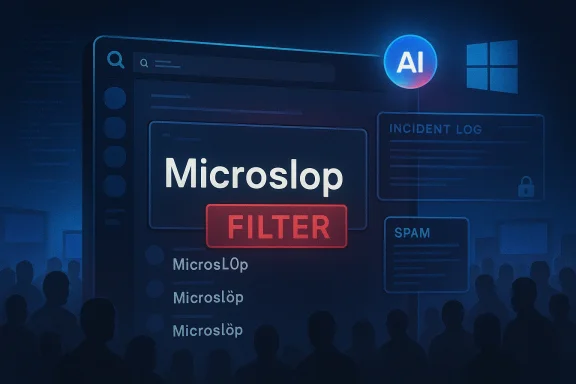
When Windows 11 shipped in 2021 it was, for many users, an iterative evolution of Windows 10 rather than a revolution. Over time Microsoft has pivoted Windows and Office into an AI‑first narrative driven by Copilot branding and generative features. That strategy—powerful in marketing terms—has also increased friction with long‑time users who feel their control, predictability, and performance were traded for novelty and opaque automation. The nickname “Microslop” emerged in that context: a crude portmanteau used by critics to describe low‑quality outputs, intrusive AI behavior, and features they saw as half‑baked or overpromoted.In late February and very early March 2026 a simple moderation rule inside the official Copilot Discord—adding “Microslop” to a keyword filter—set off a predictable internet reflex. Users discovered posts with that word were being blocked; they then deliberately tested, evaded, and mass‑posted the term and its variations. Moderation escalated from silent deletions to account actions, channel restrictions, and a temporary server lockdown in which message history was reportedly hidden or removed. Journalists likened the incident to the Streisand Effect: the attempt to suppress a nickname magnified its spread.
Microsoft framed the move to add filters and temporarily lock the server as a defensive step against a spam campaign that was actively disrupting community channels. A company spokesperson said the filters were intended to slow harmful, unrelated content while stronger safeguards were implemented. Independent reports and community threads, however, show the intervention was perceived by many as thin‑skinned censorship of a legitimately held user joke and critique. The result was a PR headache that landed squarely in the headlines.
How the incident played out — a concise timeline
Discovery and first reaction (late Feb – March 1, 2026)
- Community members noticed that messages containing “Microslop” were blocked and that senders received automated moderation notices. The filter appeared to act at the server level rather than being a manual, per‑message deletion. This was first observed in the Copilot Discord and rapidly circulated beyond the server.
Escalation: testing the filter (March 1–2, 2026)
- Once the block was publicized, users purposely tried to circumvent it using substitutions—“Microsl0p,” “Micr0slop,” punctuation, and diacritics—or by posting walls of the term to test whether the filter matched naive substrings only. Those evasions exposed the limits of a simple keyword approach and turned evasion into performance art.
Lockdown and cleanup (March 2, 2026)
- Moderators responded by restricting channels, pausing invites, disabling posting for affected roles, and temporarily locking portions of the server while the team worked to contain the surge. Several outlets reported that recent message history was no longer visible when the server reopened. Microsoft characterized the actions as necessary to prevent spam and protect community members.
Aftermath: conversation and commentary
- Coverage from multiple outlets—technical sites, gaming press, and mainstream publications—documented the escalation and questioned whether the defensive posture was proportionate. The incident quickly migrated into broader commentary about Microsoft’s AI strategy, trust challenges, and community management.
Why a one‑word filter backfired: an analysis
At first glance, adding a single derogatory word to a filter list looks like a reasonable, low‑cost mitigation against spammy insults. But the incident exposed multiple predictable technical and social failure modes.1) Naïve keyword filtering is brittle
Many moderation systems start with simple substring or regular expression matches because they’re easy to implement. That simplicity is also their weakness: once users understand the exact match, evasion—substituting characters, inserting zero‑width spaces, or adding punctuation—becomes trivial. The Copilot Discord users quickly demonstrated this by switching from “Microslop” to “Microsl0p” and a host of other orthographic dodge tactics. That behavior forced moderators into an arms race: add more keywords, then add more, ad infinitum, or adopt smarter filters that require configuration and testing.2) Moderation signals can become the story
The Streisand Effect is a cultural constant in internet communities: trying to hide something makes it viral. When members saw their phrasing removed and learned why, the act of being censored became newsworthy. Instead of quelling a joke, the filter converted the community’s frustration into performative protest. The moderation action itself became a meme generator.3) Moderation without context fuels mistrust
Automated moderation that lacks transparent context (why was this blocked? who decided?) often looks arbitrary. For communities that already feel coerced—here, users who believe AI is being forced into their OS and workflows—opaque moderation looks like corporate overreach. That perception erodes the legitimacy of the community space. Multiple reports highlighted that members saw the filter as heavy‑handed, which amplified indignation.4) Operational pain: locking is blunt and visible
Locking channels and hiding message history are effective at stopping immediate spread, but they’re dramatic and publicly visible decisions. Those steps can be read as an admission that moderation failed, or that a company is unwilling to engage with criticism. The quicker, less visible path is better tooling and policies that avoid sudden, dramatic lockdowns. The incident shows how a modest filtering decision can cascade into a visible operational response that fuels headlines.Memes, mockery, and modern protest mechanics
The community response demonstrates classic meme tactics: reappropriation, substitution, and amplification. Users didn’t just resent Copilot outputs; they turned ridicule into easily shareable content that spread across platforms. Tactics included:- Simple orthographic substitutions (o → 0) and diacritics to bypass filters.
- Browser extensions and site overlays that replaced “Microsoft” with derogatory variants in user pages (a protest tool that had previously surfaced in other controversies).
- Mass reposting and cross‑platform sharing to ensure the joke lived beyond the Discord walls.
Corporate context: why this matters for Microsoft
Microsoft’s strategy across Azure, Windows, and Office in recent years has centered on embedding AI capabilities and promoting Copilot as a brand umbrella. That strategy is a high‑stakes pivot: Microsoft made early, large investments in AI that helped it gain access to leading models and research. The company’s 2019 commitment of $1 billion to OpenAI is a well‑documented milestone in that partnership and is part of a sequence of multibillion commitments and infrastructure investments that followed. Those business ties underpin Microsoft’s public AI posture and help explain why the Copilot conversation is strategically sensitive.From a product‑trust perspective, incidents like the Microslop backlash matter because they affect perception in two ways:
- For enterprise and mainstream users, visible community friction lowers confidence that Microsoft understands customer pain points or respects user control.
- For developers, partners, and the broader tech press, the episode prompts scrutiny about how well Microsoft manages the social side of product rollouts—not just the technical quality of the features.
The moderation and governance problem — technical specifics
If you run a moderated community that will inevitably attract protest, here are the technical pitfalls illustrated by this incident:- Keyword lists without semantic awareness: Simple word lists are high false‑positive and false‑negative risk vectors. They will either block harmless content or be trivially evaded.
- Reactive escalation: When initial filters fail, the reflex to widen the filter or perform account bans produces collateral damage and alienates legitimate members.
- Lack of progressive enforcement: Enforcement should escalate in stages—warnings, rate limits, temporary mutes, then bans—not leap immediately to server lockdown.
- Insufficient auditability and transparency: Users want to know why actions were taken and by whom. A public incident log or appeal path reduces conspiracy narratives.
- No comprehensive anti‑spam tooling in place: Spam campaigns today can be coordinated, AI‑generated, and high volume; defending against them requires rate limiting, behavioral signals, CAPTCHAs, and automated bot‑detection rather than single‑term filters.
What Microsoft said — and why the messaging mattered
Microsoft’s public framing emphasized spam mitigation. The company stated that the Copilot Discord had been targeted by spammers and that temporary filters were applied to slow the activity while stronger safeguards were implemented. That defense is credible: organized spam and low‑quality bot content have become more common and can overwhelm small moderation teams. Forbes and Kotaku reported Microsoft’s quoted explanation, noting that the filters were a temporary protective measure.But messaging alone doesn’t fully address perception. When a company frames a user joke as part of a malicious spam campaign, it will be judged on evidence and proportionality. If users perceive an overbroad definition of “spam,” trust erodes. That is why transparency—showing what attack indicators were observed, timelines, and why certain mitigations were chosen—matters. In high‑trust contexts, the best response is to treat the community as a partner rather than an adversary.
Recommendations: what community managers and platform teams should do
For brands running high‑visibility communities—especially those tightly coupled to product launches and sensitive public narratives—there are tactical and strategic steps to reduce risk and improve outcomes.Tactical (short term)
- Implement progressive enforcement: warnings → rate limits → temporary mutes → bans.
- Use behavioral signals for spam detection, not just keyword blocking.
- Add trusted moderators and transparent incident logs for high‑profile events.
- Provide clear appeal and review mechanisms for users who feel wrongly moderated.
- Communicate rapidly and publicly when drastic measures are taken: explain why, for how long, and what will change.
Strategic (longer term)
- Invest in semantic moderation: models that understand intent and context rather than relying solely on substring matches.
- Run community‑facing experiments for controversial features—early opt‑ins, developer previews, and staged rollouts—to reduce surprise and resentment.
- Treat high‑traffic official channels as part of product telemetry: integrate feedback loops so that surfaced complaints feed product teams quickly and visibly.
- Maintain a “playbook” for meme escalations: predefined steps for how to respond to emergent nicknames, protest tools, and coordinated campaigns.
Larger implications: AI adoption, trust, and user agency
The Microslop flap is a microcosm of a larger tension: companies racing to embed AI across products and customers who want both the benefits and control. Many users welcome AI that saves time; many others fear that poor outputs, privacy tradeoffs, and forced defaults will degrade their experience.Trust is not an abstract metric; it’s constructed from countless small interactions: predictable updates, clear opt‑outs, transparent mistakes, and respectful community management. Heavy‑handed moderation in a public forum signals a lack of tolerance for criticism and undermines the perception that a company is responsive to its users.
Put differently: technology and marketing can build adoption quickly at first, but long‑term acceptance depends on a product’s ability to earn trust through quality, transparency, and respect for user autonomy. Incidents like Microslop are not fatal, but they are accelerants—if left unaddressed they make skeptical users louder and more organized.
Lessons for readers, admins, and product teams
- For community admins: consider filters a last resort. Test them privately and roll them out with clear messaging and an appeal process.
- For product teams: use moderated communities as early warning systems, not as containment buckets. If users are mocking a feature publicly, that’s a signal to prioritize product fixes or opt‑out paths.
- For everyday users: symbolic protests work because they are cheap to perform and cheap to share. Corporations need to be prepared for the social dynamics that follow.
- For journalists and commentators: moderation incidents are often the canary in the coal mine of product‑user misalignment. Report, but also look for the underlying product and governance drivers.
Conclusion
The “Microslop” incident is a small story with outsized lessons. A one‑word keyword filter deployed to stem spam turned into a live case study of the perils of blunt moderation, the contagious nature of memes, and the reputational cost of misreading a community. Microsoft’s position at the forefront of the AI wave—supported by large investments and deep product integration—makes every community flare‑up newsworthy, but it also makes these moments opportunities.Handled differently, the episode could have been a quick technical tweak, a short community note, and a closed incident. Instead, it became a public lesson in why transparency, measured enforcement, and investment in smarter moderation tooling matter as much as the underlying AI features companies race to deploy.
For companies and community custodians wrestling with similar tensions, the Microslop episode is a reminder: you cannot automate away cultural dynamics. You can only design controls that respect them, react proportionally, and keep the community as a partner in product success rather than an adversary in reputation management.
Source: Tech4Gamers After Microsoft Bans “Microslop,” Copilot Discord Users Invent Memes To Mock Windows 11 AI
