

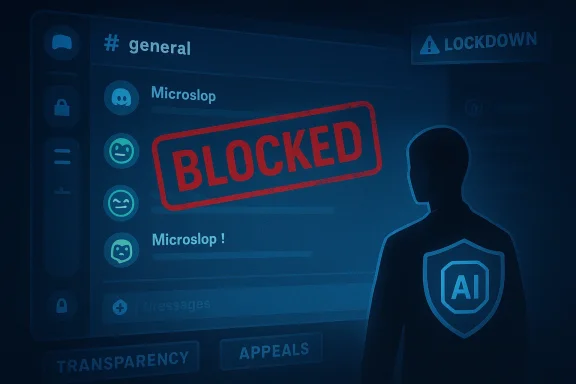
Microsoft’s Copilot Discord erupted into a textbook Streisand effect over the weekend when moderators quietly added the derisive nickname “Microslop” to an automated filter, only to watch the community weaponize the restriction and force a temporary lockdown of the server. The episode began as a routine moderation action but quickly escalated into a public relations flashpoint that exposes both the fragility of top-down brand governance and the limits of keyword-only moderation in modern online communities. s://gizmodo.com/microsoft-bans-term-microslop-from-official-discord-server-2000728388)
Microsoft has been advancing an “AI-first” posture across Windows, Office, Edge, and enterprise services for several years, bundling Copilot-style assistants and on-device agents into an increasing portion of its product line. That push has generated rising user friction and creative backlash, including a satirical rebrand — “Microslop” — used online to mock perceived low-quality, intrusive, or unnecessary AI features. The nickname spread organically across social platforms and even inspired browslace mentions of Microsoft with the epithet.
In late February and early March 2026, moderators in the official Copilot Discord server added the word “Microslop” to an automated moderation block. Users attempting to post the exact term received an automated notification that their content had been restricted; posts including obfuscated variants such as “Microsl0p” initially bypassed the filter. As members tested and exploited these bypasses, moderation escalated to hide message history, retemporarily lock portions of the server while administrators implemented broader safeguards. Multiple outlets and community logs confirm the timeline of events.
Do:
For Microsoft, the incident should prompt a clear, public recalibration: treat community signals as product feedback, pair automation with human review and graduated enforcement, and make user control — not hidden filters — the default. For other companies, the lesson is equally practical: control the conversation by participating in it, not by trying to silence it. The internet is a forgiving place for products that earn trust; it becomes an unforgiving one for those that attempt to police its vocabulary.
Source: International Business Times UK Microsoft's Discord Server in Chaos Amid AI Backlash
 Background
Microsoft has been advancing an “AI-first” posture across Windows, Office, Edge, and enterprise services for several years, bundling Copilot-style assistants and on-device agents into an increasing portion of its product line. That push has generated rising user friction and creative backlash, including a satirical rebrand — “Microslop” — used online to mock perceived low-quality, intrusive, or unnecessary AI features. The nickname spread organically across social platforms and even inspired browslace mentions of Microsoft with the epithet.In late February and early March 2026, moderators in the official Copilot Discord server added the word “Microslop” to an automated moderation block. Users attempting to post the exact term received an automated notification that their content had been restricted; posts including obfuscated variants such as “Microsl0p” initially bypassed the filter. As members tested and exploited these bypasses, moderation escalated to hide message history, retemporarily lock portions of the server while administrators implemented broader safeguards. Multiple outlets and community logs confirm the timeline of events.
What happened, step by step
1. The filter insertion
Moderators added a single-word filter to block “Microslop” after community chatter turned widespread. The block was not advertised in advance and appeared to be intended as a targeted anti-spam measure. The automated moderation reply reported the term as “inappropriate,” preventing the message from appearing publicly while informing only the sender.2. Rapid testing and evasion
Members immediately tested the filter by substituting characters (for example, “o” → “0”), capitalizing letters, and inserting punctuation. These simple obfuscations successfully bypassed the initial filter widely enough that the flood continued and ell-known behavior pattern in meme-driven moderation incidents: a blocked term becomes a challenge variable and an invitation to creative circumvention.3. Escalation to lockdown
As evasion proliferated, moderation moved from automated keyword blocks to heavier-handed measures: hiding message history for affected time windows, restricting posting permissions in channels, and temporarily locking portions of the server to stem the surge. Microsoft described the activity as “spammers attempting to disrupt and overwhelm the space with harmful content,” and said the server was temporarily locked while measures were put in place, a standard line used to justify emergency intervention.4. The Streisand effect and amplification
Rather than extinguishing the meme, the moderation action amplified it. Coverage across gaming and tech outlets, fans’ screenshots, and discussions on social media turned the incident into a broader debate about Microsoft’s AI strategy, and the term’s visibility increased dramatically. The very act of banning the term served as a cultural accelerant — a phenomenon well-understood in digital communities.Why this escalated: an analysis of moderation mechanics
Moderation systems are typically built from two layers: algorithmic filters (keyword lists, toxicity models) and human moderators. Each layer has trade-offs.- Keyword blocks are fast and low-effort, but brittle. They only catch exact matches and miss creative variations.
- Regex and fuzzy matching can reduce bypasses but increase false positives, suppressing legitimate conversation.
- Machine-learning classifiers can detect intent and context but require training data and careful thresholds; they also produce opaque decisions that frustrate users.
- Human moderation brings judgment and nuance but is not scalable in the face of large, coordinated surge activity.
Technical missteps that made things worse
- Silent suppression — blocking only at the sender level (so the poster sees a restricted notice but no public trace) removes transparency and fuels suspicion.
- Lack of graduated responses — instead of throttling repeat offenders or temporarily muting persistent accounts, moderators escalated to server lockdowns, which impacted non-participating members and removed public context.
- Reactive, not proactive, communication — the initial public-facing explanation framed the event as spam suppression; it did not acknowledge the meme or provide a clear plan to restore normalcy, which left a vacuum filled by critics and mockery.
The cultural dynamics: why memes win
Memes thrive on visibility, reproducibility, and shared identity. When a brand attempts to suppress a meme, the cultural incentives often flip: suppression becomes part of the joke. This is the classic Streisand effect — attempting to hide information makes it far more visible.- Blocking a single word gives the community a rallying point and a simple experiment: “How far can we push this?”
- Meme culture rewards creativity; users derive social capital from discovering new bypasses and publicizing them.
- The ban itself is symbolic: for many members it confirmed an existing narrative — that Microsoft pushes unwanted AI into products and then polices dissent rather than addressing the critique.
What this reveals about Microsoft’s broader AI strategy and user trust
The Discord incident is a small, visible symptom of larger tensions between Microsoft’s AI ambitions and segments of its user base.- Microsoft has integrated Copilot-style assistants into Windows, Edge, Office, and other flagship products. That integration has improved some workflows but also introduced privacy concerns, usability regressions, and perceptions of forced adoption.
- When users feel that new features are being imposed without clear opt-out controls or transparent governance, resentment turns symbolic and communicative: a nickname like Microslop is shorthand for a set of grievances.
- Heavy-handed community enforcement — especially when perceived as protecting brand image at the expense of user discourse — further erodes trust.
Brand governance lessons: how companies should — and shouldn’t — respond
This episode provides a practical checklist for brand and community managers facing similar flare-ups.Do:
- Be transparent early. Acknowledge the issue and explain immediate steps in plain language. Transparency reduces rumor-driven escalation.
- Use graduated enforcement. Start with warnings, rate limits, and temporary mutes before lockclosing channels.
- Apply context-aware moderation. Use models and human review that distinguish between harassment/spam and legitimate, contextual criticism.
- Engage the community. Invite feedback and offer an appeals route for members who feel unfairly moderated.
- Treat meme formation as signal, not noise. Memes encapsulate grievances; study them for product or policy insights.
- Rely on single-word blacklists. They are easy to circumvent and guarantee creative evasion.
- Remove public context without communication. Hiding history or restricting channels without explanation ensures the narrative will be built outside the company’s control.
- Conflate critique with harmful content. Heavy penalties applied to legitimate criticism will produce backlash and reputational damage.
The legal and privacy subtext: Recall, Copilot, and the privacy question
Beyond the immediate moderation misstep, the Microslop backlash ties into real privacy and governance concerns — most prominently around features such as Recall, which captures user activity, and deeper telemetry integrated into Copilot features.- Users who are wary of pervasive recording and automated summarization interpret mass AI rollouts as surveillance-by-default unless opt-outs are clear and enforceable.
- The reputational hit from perceived invasiveness is compounded when community channels feel policed rather than listened to.
- Regulators are watching: repeated privacy complaints and public community outrage can contribute to regulatory scrutiny and higher compliance costs.
Tecegex and ML alone don’t solve social amplification
From a purely technical angle, there are three broad anti-evasion tooling options and their trade-offs:- Exact-match keyword blacklists — cheap and deterministic, but easily bypassed.
- Regular expressions and approximate string matching — more robust but costlier and riskier for false positives (e.g., catching legitimate discussion).
- Contextual moderation via ML — can identify intent and semantics, but requires labeled data, is hard to tune, and risks opaque decisions that frustrate users.
Reputation riswhat Microsoft — and others — can do next
- Public, specific explanation: Admit what filtering was applied, explain why, and correct any mischaracterizations. Ambiguity fuels mythology.
- Restore context: If message history was hidden, selectively restore it or provide a redacted transcript with a moderator note explaining the reasons for any removals.
- Offer a community forum: Create a moderated thread or town-hall where product teams can hear criticism directly and outline planned changes. The community wants to be heard more than it wants punitive action.
- Review moderation policy: Move from ad hoc keyword bans to graduated enforcement plus human review for borderline content.
- Revisit product signals: Use the meme as a product signal and investigate whether particular Copilot or Recall behaviors are triggering disproportionate user concern.
A broader industry lesson: trust, consent, and AI adoption
The Microslop flare-up is a microcosm of a larger adoption challenge facing the software industry: how to introduce automation and AI in ways that preserve user agency and trust. When companies treat AI as an unquestionable moat, users may respond with humor, derision, or organized resistance.- Consent matters. Opt-outs must be meaningful, discoverable, and reliable.
- Value must be demonstrated. Users will tolerate automation that demonstrably saves time or improves outcomes, not features that feel intrusive or degradative.
- Governance is mandatory. Product safety, privacy-by-design, and clear redress channels are increasingly non-negotiable for sustained adoption.
What to watch next
- Will Microsoft publish a post‑mortem and restore a transparent log of actions taken during the lockdown? A clear timeline would demonstrate accountability.
- Will product teams adjust Copilot and Recall behavior in response to the broader backlash? Early reporting indicates some reconsideration; watch for product notices or feature toggles that offer clearer user control.
- Will other large vendors change moderation tactics to avoid similar blowups? Expect community managers to study this case closely.
Conclusion
What began as a modest moderation choice morphed into a public-relations cautionary tale. The Copilot Discord lockout over the word “Microslop” underscores a simple truth: in online communities, words are rarely just words. They are signals, jokes, and social tests. When companies respond with blunt, opaque enforcement, they risk turning a nuisance into a narrative.For Microsoft, the incident should prompt a clear, public recalibration: treat community signals as product feedback, pair automation with human review and graduated enforcement, and make user control — not hidden filters — the default. For other companies, the lesson is equally practical: control the conversation by participating in it, not by trying to silence it. The internet is a forgiving place for products that earn trust; it becomes an unforgiving one for those that attempt to police its vocabulary.
Source: International Business Times UK Microsoft's Discord Server in Chaos Amid AI Backlash
