• Thread Author
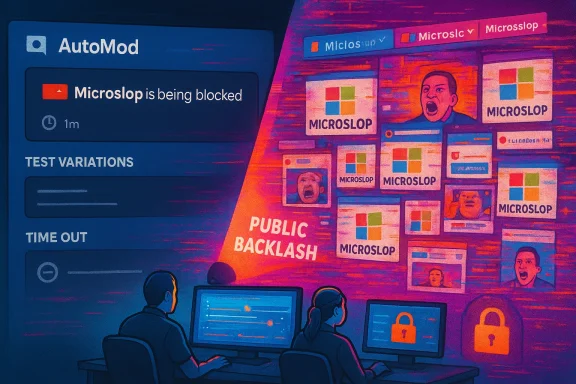
Microsoft’s official Copilot Discord server was quietly enforcing a one-word ban — “Microslop” — and when the community pushed back by testing and evading the filter, moderators effectively locked large parts of the server to stop the escalation, leaving members unable to read or post while the incident played out publicly. (windowslatest.com)

Background / Overview​

The word “Microslop” is shorthand for a much larger user revolt: a scornful portmanteau that fuses Microsoft’s name with the widely used tech term slop — shorthand for low‑quality AI output. The meme first spread in earnest after public comments about “slop vs. sophistication” from Microsoft leadership, and it quickly metastasized into browser extensions, protest posts, and repeated mentions across social platforms. Mainstream tech outlets and specialist sites documented the trend, noting how the nickname became a proxy for frustration with aggressive AI rollout and perceived quality regressions.
Community reaction to the Copilot push has not been limited to jokes. Over the past year, Windows users and IT pros have logged reliability complaints, surprised re-enabling of AI features, and an optics problem: visible AI surfaces launched into an OS that many users felt still had fundamental stability issues. That mix of grievance and ridicule created fertile ground for a single, sharable insult to stick — and for it to spread into places brand teams would prefer remain constructive.

What happened in the Copilot Discord (what we can verify)​

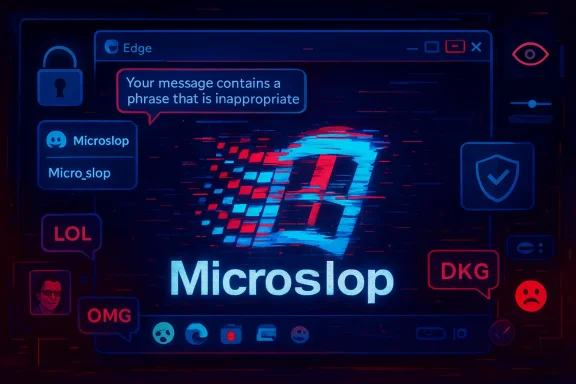
Windows Latest reported that messages containing the exact word “Microslop” were being blocked by the Copilot Discord server’s moderation system; senders received a server moderation notice stating the content included a phrase deemed inappropriate, and the message did not appear publicly. The article included a recording and screenshots showing the moderation notice and the subsequent activity that led moderators to restrict messaging and lock channels. (windowslatest.com)
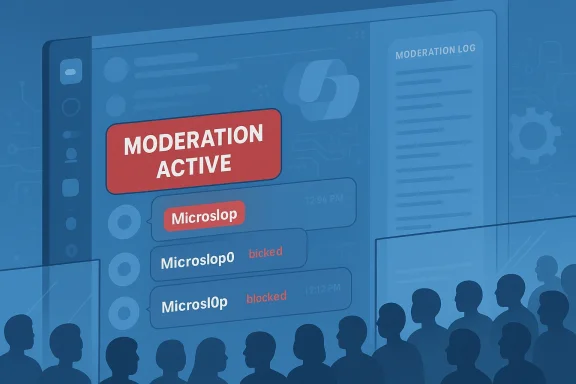
After the block was noticed and shared on social media, users deliberately attempted circumventions — substituting letters for numbers, inserting punctuation, or using lookalike characters — and those variations reportedly bypassed the server’s keyword filter. The testing escalated from a meme‑driven prank to a raid-like situation: some accounts lost posting privileges, message history was hidden in affected channels, and sections of the server were placed into a locked or read-only state while moderators intervened. Windows Latest’s timeline shows the filter discovery, quick experimentation, and the server‑wide containment measures in short order. (windowslatest.com)
Important verification note: the core reporting about the filter and the lockdown comes from Windows Latest’s direct coverage and media included in that story. Contemporary reporting from other outlets documented the broader Microslop meme and Microsoft’s public AI push, but independent, contemporaneous confirmation of the specific Discord moderation actions beyond Windows Latest’s reporting was limited at the time of coverage. Readers should treat the Discord incident as credibly reported by a named tech outlet, but acknowledge the usual caveat: moderation actions inside private, brand‑run community servers are sometimes short‑lived and hard to corroborate once restored. (windowslatest.com)

Why this matters: trust, tone, and product communities​

Brand communities are fragile spaces​

Official product communities — particularly those operated on platforms like Discord — serve dual roles: they are support hubs and marketing channels. That duality demands careful moderation to keep channels helpful, professional, and actionable. Keyword lists and automations are normal tools for brand moderation teams; they can and do block profanity, personal attacks, spam, and sometimes brand‑deprecating nicknames. From a moderation‑policy perspective, removing a derogatory, meme-driven nickname is a defensible rule for a server meant for feedback and support. (windowslatest.com)
But the Microslop episode shows the darker side of that calculus: when a moderation policy intersects with a viral meme, the enforcement itself becomes the story. The Streisand effect kicks in. An apparently minor filter becomes proof for critics that the company is trying to silence dissent, which rapidly amplifies the criticism beyond the server and into broader social conversation. Multiple outlets documented how Nadella’s phrasing about AI quality helped spark the meme, and how the meme then fed organized protests (including browser extensions and coordinated posts). That context matters because it explains why a single filter can balloon into reputational damage.

Moderation as a pressure valve — and a liability​

When moderators locked channels and hid history, they were acting like emergency responders: pause activity, prevent more damage, and regain control. That tactic can work: short, surgical containment allows time to patch rules, adjust automations, and re-open with clearer expectations. However, from a community relations standpoint, broad lockdowns are blunt instruments that punish bystanders and fuel narratives about heavy-handed corporate control.
Companies must weigh three competing goals in such moments:
  • preserve productive discourse and support flows,
  • prevent harassment and brand abuse,
  • avoid turning enforcement into a PR flare.
Microsoft’s Copilot server responded with containment; whether that was proportionate depends on the scale and persistence of the raid, something the public cannot fully see beyond the snapshots reported. The lesson for community teams is clear: transparency and context matter at least as much as enforcement mechanics.

The technical mechanics: keyword filters, evasions, and the cat-and-mouse game​

How keyword moderation typically works​

Server‑side moderation on Discord often uses:
  • exact keyword lists that trigger automated blocks,
  • regex or pattern matching to catch variations,
  • third‑party moderation bots that enforce community policies,
  • rate limits and automatic temporary suspensions for repeated infractions.
An exact string block is the bluntest tool: it prevents exact matches but is trivially bypassable with substitutions (zero for O, unicode lookalikes, inserted punctuation). Smarter filters use regular expressions and fuzzy matching to catch common evasion tactics, but those introduce a higher risk of false positives — blocking legitimate discussion inadvertently. The Copilot server’s initial block — if accurately reported — appears to have been a straightforward keyword block that did not immediately account for evasions. That’s why users were able to bypass it with “Microsl0p” and similar variants. (windowslatest.com)

Why moderation sophistication matters​

More sophisticated moderation pipelines add:
  • contextual analysis (natural language understanding to detect intent),
  • rate and pattern heuristics (to detect raid behavior vs. isolated posts),
  • manual review queues for ambiguous cases,
  • whitelisting for trusted user groups.
Those methods reduce false positives and make containment decisions less visible (and thus less likely to generate headlines). But they also require resources: trained moderation teams, tooling, and clear escalation protocols. The Microslop episode suggests the Copilot community relied on a quick keyword block that lacked sufficient fallback measures, which in turn led to visible escalation and server‑wide restrictions.

The larger narrative: Copilot, Windows 11, and the trust deficit​

Not just a meme — a symptom​

Microslop is shorthand for accumulated grievances: perceived performance regressions in Windows, intrusive placement of AI features, confusing defaults, and a sense that major design choices were made for marketing rather than user benefit. Those complaints have been cataloged by community threads, independent tests, and investigative reporting through the last year. When sentiment sours across that many vectors, a meme becomes a proxy weapon: easy to repeat, viral, and emotionally satisfying.

Product concessions and reputational repair​

Microsoft has already had to adjust course on some visible AI elements following user backlash. Recent browser updates and product controls have increasingly given users ways to hide or remove Copilot affordances — concessions that show the company responds when pressure is sustained. Still, concessions alone don’t repair trust; companies also need to demonstrate reliability, predictable opt‑outs, and a willingness to prioritize core functionality over surface features. Observers have noted some of these changes as tactical retreats rather than a wholesale rethinking of strategy.

Community safety vs. free expression: an ethical crossroad​

The moderation ethics problem​

Corporations operating public communities face competing ethical demands:
  • create a safe, helpful space for customers,
  • respect legitimate critical speech,
  • avoid unduly censoring valid complaints.
Blocking a single derogatory nickname sits in a gray area between brand protection and censorship. If the nickname is used to harass individuals or derail conversations, removing it is defensible. If the block is part of a pattern of suppressing organized criticism, it becomes an ethical problem and a PR liability. Transparency helps: clear, public moderation guidelines and visible appeal processes reduce the “censorship” narrative. The Copilot server incident underscores the need for visible rules and consistent enforcement over opaque, reactive filters. (windowslatest.com)

Practical safeguards community teams should adopt​

  • Publish a concise moderation policy and a process for appeals.
  • Use graduated enforcement (warnings, short timeouts, manual review) rather than immediate global lockdowns when possible.
  • Prefer context‑aware moderation (intent detection) over strict string blocks.
  • Communicate incident responses publicly when a moderation action affects large groups.
These measures reduce the chance that an enforcement action designed to preserve civility inflames a larger reputational crisis.

Tactical lessons for Microsoft and other platform owners​

  • Reassess keyword lists regularly and test for evasions before deploying them widely. Exact string blocks are brittle and will be circumvented. (windowslatest.com)
  • Build quick, transparent escalation playbooks that include a public status update when large parts of a community are affected. Silence invites speculation.
  • Offer durable opt‑outs for intrusive product features and make those opt‑outs easy to find and persist across updates. A product that forces acceptance invites organized pushback.
  • Invest in moderation tooling that balances automation with human judgment to prevent flush‑to‑the‑top enforcement actions that hit innocent users. (windowslatest.com)

What this means for IT pros, privacy‑minded users, and community members​

  • IT and enterprise admins should watch the optics of vendor communities: vendor‑run channels are part of a company’s reputation surface and can influence end‑user sentiment inside organizations. When vendor communities appear to censor criticism, internal procurement teams will notice.
  • Privacy‑minded users should remember that server moderation is an ephemeral, platform‑level control. Archival screenshots and recordings often end up as the public record; if you’re joining official channels for support, keep copies of important guidance. (windowslatest.com)
  • Community members who value open dialogue should push for clear rules and appeals processes in any official forum they use. A healthy community is a negotiated space; when brand teams own the terms, that negotiation must be explicit.

A balanced read on Microsoft’s position​

Microsoft’s desire to maintain a constructive Copilot community is rational. Brand teams must prevent harassment, spam, and harassment-driven derailment of support forums. Blocking a single insulting nickname — if the server judged it harmful — is an easily explainable moderation choice.
But the execution reveals a deeper problem: a lack of calibrated, transparent moderation paired with a product strategy that made the brand a repeated target. The moderation action, once visible, validates critics’ claims about opaque control and corporate defensiveness. The result is reputational friction that is much harder to repair than the original meme.
This is not just a community incident; it is a symptom of a fragile trust relationship between Microsoft and its Windows user base. Rebuilding that trust will require more than better moderation logic — it will require visible improvements in product reliability, persistent and discoverable user controls, and clearer public communication about how customer feedback shapes the roadmap. (windowslatest.com)

Final analysis: risk, opportunity, and the road ahead​

  • Risk: If brand communities continue to be run without transparent policies and robust escalation playbooks, moderation incidents will keep feeding social campaigns that harm sentiment and adoption. Large, visible products like Copilot are natural lightning rods; each reactive moderation choice compounds the reputational risk.
  • Opportunity: Microsoft and other platform owners can use these moments as diagnostics. A well-handled moderation incident can become a trust-building exercise if accompanied by apology, transparent explanation, policy updates, and product concessions that address the underlying grievances.
  • Tactical takeaway: Invest in moderation systems that combine automated protections with human-in-the-loop review, publish clear rules and appeal mechanisms, and treat public community incidents as PR and product telemetry simultaneously. That approach reduces the chance a discrete enforcement action becomes a viral reputational event.

Quick recommendations for community managers and product teams​

  • Immediately after an incident:
  • Publish a short public note explaining what happened and why (without exposing moderation inner workings).
  • Reopen affected channels in a graduated way, restoring history where safe.
  • Offer a mechanism for affected users to appeal or request clarification.
  • Medium term:
  • Audit keyword rules and add fuzzy matching and intent detection.
  • Train moderators on escalation and public communication.
  • Align product teams and community teams so product changes that might provoke reaction have preflight comms and opt‑out clarity.
  • Long term:
  • Treat community incidents as product telemetry: feed lessons back into product design and privacy/opt‑out UX.
  • Measure sentiment improvements after changes and publish progress reports to regain trust.

Microsoft’s Copilot Discord moderation episode is small in isolation but telling in context: a viral nickname met with a blunt automated block, an active community that immediately found workarounds, and a moderation response that escalated into server lockdowns visible to the public. The technical fix for a single keyword is trivial; the harder work is rebuilding user trust inside and outside community channels. If Microsoft wants Copilot to be a helpful, widely adopted assistant rather than a standing target for criticism, it must pair product changes with transparent moderation, meaningful user controls, and readable signals that dissent will be treated as feedback — not something to be quietly blocked. (windowslatest.com)
The incident will likely fade as moderation teams adjust rules and reopen channels, but it should remain a cautionary example for any company that runs official communities while rolling controversial features into flagship products.

Source: Windows Latest Microsoft gets tired of “Microslop,” bans the word on its Discord, then locks the server after backlash
 
Microsoft’s Copilot Discord briefly turned into a case study in how not to manage a brand crisis: a one‑word keyword filter — “Microslop” — escalated into a serverwide lockdown and a visible disappearance of recent chat history, leaving users and observers asking whether the reaction did more harm than the original insult. ([windowslatest.com]test.com/2026/03/02/microsoft-gets-tired-of-microslop-bans-the-word-on-its-discord-then-locks-the-server-after-backlash/)

Background​

What happened, in plain terms​

Over the weekend, members of the official Microsoft Copilot Discord discovered that messages containing the slang term Microslop were blocked by the server’s moderation. Users attempting to post the word received a notice that their message “contains phrase that is inappropriate,” and those messages did not appear to other members. When community members started deliberately testing and circumventing the filter with variations (for example using zeros or symbols in place of letters), moderation tightened and moderators reportedly restricted posting and hid message history in several channels while they worked to contain the disruption. The server is now visible again and accepting new messages, but observers report that a two‑day window of conh where the Microslop posts peaked — is not visible in public channel history.

Why the word matters​

“Microslop” is a portmanteau — Microsoft + slop — that crystallized broader frustrations with the company’s aggressive Copilot and AI integrations into Windows and other products. The term became a viral meme and protest slogan earlier in the year; it’s shorthand for users’ perception that some AI features produce low‑quality, intrusive results. That meme context matters because corporate communities often attempt to limit insults to keep channels useful for support and feedback — but the decision to block a word closely tied to a public reputation issue carries its own risks.

Timeline and key facts​

The filter and the flashpoint​

  • Initial trigger: Community members found their messages containing the literal string “Microslop” blocked by the Copilot Discord server’s moderation layer; the senders were shown a moderation message rather than seeing their post live.
  • Rapid escalation: Once the filter was publicized, users began testing iants like “Microsl0p,” inserting punctuation, image posts, etc.). Those workarounds rapidly proliferated.
  • Moderator response: Moderators reportedly responded by tightening permissions, disabling posting in certain channels and hiding message history while they regained control. The server subsequently reopened to posting, but at least one independent observer has reported that messages from a recent two‑day span are no longer visible in public history. That specific gap — reported as February 28 and March 1 by one outlet — could not be independently corroborated from multiple archival sources at the time of reporting; it should therefore be treated as plausible but currently unverified.

Who amplified the story​

Public attention grew after screenshots and a short report circulated from independent tech sites and social posts from high‑visibility accounts. That social amplification turned a moderation skirmish into a short‑lived reputational story, with the usual mix of ridicule, critique, and «Streisand effect» amplification — the very phenomenon companies try to avoid by suppressing content.

Technical mechanics: how Discord moderation works (and why the outcome isn’t surprising)​

Understanding the technical affordances that moderators used explains how a single blocked word can cascade into a serverwide containment action.

Keyword filters and AutoMod​

Discord provides server admins with an AutoMod tool that supports both preset lists of “commonly flagged words” and customizable keyword lists. AutoMod rules can be configured to block a message, send a moderator alert, or trigger automated penalties such as timeouts. When AutoMod blocks a message, the sender typically receives a notice visible only to them; the message is prevented from appearing publicly. That behavior matches the reports from the Copilot Discord incident.
Key AutoMod behaviors to note:
  • Custom keywords can match exact strings or use wildcards to catch partial matches.
  • Moderators can choose whether to block a message outright (so no one sees it) or to log it and notify staff.
  • The system is designed for a rapid, automated response — which is powerful for stopping harassment, but brittle when applied to viral memes or sarcasm.

Read Message History and permission controls​

Discord’s channel permissions include a literal Read Message History permission. If that permission is revoked for a role or for @everyone, users who later gain access (or return to the channel) will not be able to scroll back and see previous messages. That means a moderator can temporarily restrict history visibility without necessarily deleting messages from the server database. In practice, this is often used to create “locked” or “read‑only” states for safety, but it also creates a visual effect identical to message removal for regular members. That fits the reports that February 28–March 1 posts vanished from view even though the server has since reopened.
  • Practical consequence: A server admin can hide past conversation by changing permission bits; observers cannot tell from the client whether messages were deleted or merely hidden from their view.

The optics: why this was a public‑relations misstep​

Blocking a single insult inside a managed support community is defensible. Hiding or erasing the visible record during a reputation fight is the part that triggers a backlash.

The Streisand effect and message discipline​

Attempts to suppress a meme often magnify it. The more official channels try to stamp out a derogatory phrase, the more attention the phrase receives — and social platforms reward attention. The Copilot Discord incident illustrates that dynamic: a keyword block drew attention, attention created a raid of variants, moderators locked the space, and the lockdown itself became the headline. That sequence is a classic case of suppression creating amplification.

Transparency and trust​

When a corporate community shows signs of content removal — especially around critical commentary — users interpret it as censorship rather than content management. The result is a loss of trust that goes beyond the immediate thread: users begin to wonder whether the company is listening, whether feedback is welcome, and whether the community is a genuine support channel or a marketing echo chamber. The visible hiding of recent history is particularly damaging because it removes the ability for community members to audit moderator actions or reconstruct conversations.

Brand management tradeoffs​

From a moderation perspective, a company-run Discord aims to:
  • Keep channels useful for support and product feedback.
  • Prevent harassment and profanity.
  • Maintain a civil tone for volunteers and staff.
Those goals are reasonable — but in practice they collide with the need to allow legitimate criticism and to avoid the appearance of heavy‑handed suppression. In short: moderation that is technically effective can still be politically and socially counterproductive.

Broader context: Microslop and the Copilot backlash​

To evaluate the incident fairly, it’s important to place it within the larger user reaction to Microsoft’s Copilot rollouts.

The meme and the movement​

The Microslop meme emerged as a condensation of many complaints: perceived UI bloat, questionable defaults that surface Copilot prominently, uneven AI output quality, and real product reliability problems in unrelated areas. The meme became a vehicle for community protest, spawning browser extensions, social posts, and mass sharing. KnowYourMeme and community threads document how the term migrated from in‑group snark to a widely recognized protest label.

Product responses and pressure points​

Microsoft has faced sustained user pressure over Copilot’s placement and defaults. In other contexts, Microsoft has adjusted UI elements after backlash — for example, user demand has pushed the company to provide ways to hide or remove Copilot UI affordances in products such as the Edge browser. Those moves show a pattern: when the community organizes and the optics become painful, product teams sometimes backtrack or add more explicit cncident is one skirmish inside that broader tug‑of‑war.

Responsible moderation: what Microsoft could have done differently​

This section lays out practical alternatives and best practices that would have preserved control while reducing reputational damage.

Short‑term containment that preserves transparency​

  • Use a visible, public moderation notice rather than hiding message history. Explain why the filter exists and what will happen to content caught by it.
  • Post an explicit moderator announcement in the server that channels are temporarily restricted for moderation and provide an approximate timeline for reopening.
  • Offer an audit channel accessible to moderators where flags and deleted messages are logged (redacted where necessary) — and summarize actions for the broader community.
    These steps would have kept the community informed and reduced the perception of covert deletion. Discord’s AutoMod supports alerting moderators and routing flagged items to specific alert channels; leaning on those features and communicating about them reduces surprise.

Keyword filtering with nuance​

  • Avoid a blunt single‑word blacklist for a term already in widespread public use; instead, pattern‑match for harassment, threats, or doxxing content.
  • Use rate limiting and temporary channel slowdowns to blunt coordinated posting bursts rather than turning the entire channel into read‑only.
  • Allow an appeals flow for users who believe they were incorrectly blocked.
    These options preserve useful protection while reducing the political hazard of silencing a meme that functions as public criticism.

Public moderation logs and policy​

  • Publish a short moderation policy in the server’s description and pin rules to channels.
  • Maintain a public record (moderation log) of mass actions (bans, channel lockdowns, message prunes) so users understand the scale and reason for interventions.
    This approach aligns community moderation with corporate transparency obligations and reduces the likelihood that routine content control will be read as malicious erasure.

What this incident tells us about modern platform governance​

The Copilot Discord episode is small in technical scope but large in symbolic value: it reinforces three lessons for product teams that run public communities.
  • Automated rules are necessary but politically charged. Automation scales moderation, but when automation is applied to public reputation questions it can look like censorship. The technical ability to block strings must be balanced with a communications strategy.
  • Visibility beats secrecy. Temporary technical containment is reasonable; secret deletion or unexplained history hiding is not. Users interpret opacity as evidence of wrongdoing.
  • Brand reputation lives off platform. Attempts to sanitise a company’s owned channels do not stop conversations elsewhere; they only redirect attention. The best long‑term remedy is product improvements and genuine engagement with critics.

What we can verify — and what remains uncertain​

  • Verified: Independent reporting confirms that the Copilot Discord was using a keyword filter that blocked the literal string “Microslop,” and that moderators restricted posting and changed channel visibility while dealing with the surge. Those core facts are corroborated by multiple outlets and by community reporting.
  • Verified: Discord’s AutoMod and permission model permit both keyword blocking and the revocation of Read Message History, which results in past messages being inaccessible to affected users without deleting them. That technical capability explains how messages can appear to “disappear” even when they are not removed from backend logs.
  • Unverified / cautionary: The specific claim that all messages from February 28 and March 1 are gone from the public server is reported in some writeups but could not be confirmed by independent archival sources at the time of writing; it is therefore flagged here as plausible but not independently proven. The same visual outcome — hidden history — can produce the identical observation, so readers should be cautious about assuming deletion without access to server logs or an official statement.

Recommendations for Microsoft and other companies that operate public communities​

  • Publish a short, clear moderation policy pinned in community spaces and reference it when moderation actions occur.
  • When large‑scale actions are taken (channel lockdowns, mass removals), issue a brief public statement explaining the reason and the expected timeline for reopening.
  • Use AutoMod’s logging and moderator alerting rather than global message deletion for public reputation issues; route evidence to a staff‑only channel and summarize actions for the community.
  • Avoid one‑word bans for terms that are the subject of public discourse; instead, target behavioral patterns (spamming, harassment, doxxing).
  • Invest in product fixes that reduce the underlying source of anger. Removing or clarifying intrusive defaults, improving quality, and adding durable opt‑outs will reduce the need for hard moderation. Recent product concessions to user demand in other Microsoft properties show that product changes are often the clearest remedy.

Conclusion​

The Copilot Discord incident is small but instructive: it exposes the brittle intersection of automated moderation, corporate reputation, and community energy. Blocking the term “Microslop” may have made short‑term sense inside a managed support forum — but the decision to hide posting and make history invisible turned a moderation event into a reputational one. The technical tools (keyword filters, permission flips) work as designed; the governance problem is that how those tools are used matters as much as what they stop.
For community managers, the lesson is simple: protect your communities, but do it in the open. For product teams, the lesson is harsher: if product design and defaults create resentment, moderation will only paper over the symptom while the root cause keeps producing more of the same. The Microslop moment is a reminder that in the age of AI’s messy rollout, transparency and humility will buy far more trust than silence and suppression.

Source: PiunikaWeb Microsoft hid Copilot Discord's #general history over "Microslop" posts, it's back now
 
Microsoft’s Copilot community found a new name for the company’s AI push — “Microslop” — and the attempt to silence the nickname inside the official Copilot Discord exploded into a textbook case of moderation gone wrong, a PR self-inflicted wound and a useful cautionary tale about how not to manage a brand community in the age of meme culture and generative AI backlash. Windows Latest documented that messages containing the term were blocked by the Copilot server’s moderation, users started iterating around the filter (Microsl0p, Micro$lop, and friends), and moderators responded by restricting channels and hiding message history — a move that only amplified the story.

Background​

The nickname “Microslop” emerged as an online shorthand for a broader feeling of frustration: users who feel Microsoft has pushed AI-first features — especially Copilot — into Windows and other products with insufficient polish, transparency or respect for user choice. The meme accelerated after public comments by Microsoft leadership and proliferated with community tools (browser extensions that replace “Microsoft” with “Microslop”) and protest sites and trackers that catalog alleged AI “slop” incidents. Coverage across tech media and community forums shows the term is now widely used as both satire and protest.
Companies run official Discord servers for one reason: to create a moderated, constructive space for support, feedback and community building. But brand-run servers also face a unique dynamic — they are both customer-support channels and social platforms. That makes moderation choices inherently fraught: exert too much control and you amplify criticism; allow too much chaos and you lose the ability to run an effective support community. The Copilot Discord’s decision to block the specific insult reflects that tension — and the reaction demonstrates how easily the Streisand effect can take over a message the moderators intended to suppress.

What happened inside the Copilot Discord​

The filter, the workaround, the lockdown​

According to reporting, the Copilot server used a server-side keyword filter that prevented messages containing “Microslop” from appearing publicly; senders reportedly received a moderation notice telling them the message contained an inappropriate phrase. Early attempts to bypass the filter — simple character substitutions such as “Microsl0p” — worked, and what began as a handful of prevented messages escalated into a broader raid of substitutions, jokes, and memes. Moderators then restricted access to several channels, hid message history from many members and disabled posting for affected roles while they tried to regain control. This escalation turned a simple keyword block into a full-blown community incident.

Why it blew up​

There are three straightforward reasons the reaction was so strong:
  • Memes scale quickly: a blocked term is news, and the internet loves a punchline that involves censorship, real or perceived.
  • The target is a powerful brand: people are more likely to troll or protest when they feel a large corporation is tone-deaf.
  • Moderation optics: users interpret aggressive content controls in brand spaces as evidence of sensitivity or hypocrisy, which fuels the narrative rather than suppressing it.
Taken together, those forces turned a keyword ban into viral content, and the community reaction spilled into other social platforms and news outlets.

How Discord moderation works (and why keyword filters are brittle)​

To understand why this outcome was predictable, it helps to look at how Discord’s moderation tools function. Discord provides built-in filtering options — including a language filter and Automod keyword detection — that can redact or prevent messages containing flagged terms. The language filter is a client-side feature users can opt into, while server-side Automod and keyword bans allow server owners and moderators to block phrases or take automated actions. These systems are intentionally blunt instruments: simple pattern matching is fast, but it’s easy to evade with substitutions, spacing, special characters or images.
This brittleness is not a technical failing alone — it is an architectural reality. Keyword filters operate at the string level, not at the level of semantics. That means they:
  • Block exact matches but miss obvious variants.
  • Risk false positives if a blocked string appears within a legitimate word or technical phrase.
  • Can be gamed with punctuation, homoglyphs (e.g., zero for O), or image-only posts that bypass text scanning.
Those properties make keyword bans useful for blunt moderation but dangerous as a long-term brand strategy. When a community’s identity is linked to a satirical label, blocking that label becomes an invitation for parody and escalation.

The PR dynamics: why attempting to erase a meme often strengthens it​

The pattern we saw in the Copilot Discord is classic Streisand effect in action: attempts to suppress information or speech draw more attention to it. The meme’s lifecycle here followed the textbook route:
  • A nickname (Microslop) circulates as a critique of an AI-first strategy.
  • Microsoft’s official community blocks the term.
  • Blocking becomes news; community members use variations and screenshots to amplify the story.
  • Media coverage and social posts spread the meme even further.
This sequence is not unique to Microsoft. When organizations try to remove or hide criticism instead of engaging with it, online communities build narratives of censorship, hypersensitivity and bad faith. For many users, seeing an official channel ban a term that references product quality felt like validation of their grievance rather than an appropriate moderation decision. The immediate consequence — a community that no longer trusts the server as a space for candid discussion — can destroy a support channel's value overnight.

The larger context: Microslop as a symptom, not a cause​

While the Discord moderation episode is compelling on its own, it’s worth stressing that “Microslop” is shorthand for more persistent frustrations with Microsoft’s product direction — perceived over-emphasis on AI features, reliability problems in core OS components, and opaque defaults that push Copilot into prominent UI real estate. Independent reporting across the tech press and numerous community threads documents a broader erosion of goodwill that made the meme resonate. Microsoft has been criticized for frequent UI changes, new data flows, and an aggressive rollout cadence that some users feel prioritizes marketing over stability and user choice. Those grievances gave life to the Microslop label; the Discord moderation decision simply illuminated the underlying tensions.

What Microsoft might have been trying to do — and why that approach misfired​

From an internal perspective, blocking a slur or derogatory nickname in an official community is an understandable impulse: moderators want to keep conversations constructive, minimize harassment, and preserve channels for product feedback and support. But the execution details — a single, blunt keyword ban without a public explanation or engagement strategy, followed by channel lockdowns — made the action read as reactive and heavy-handed.
Problems with the approach:
  • Lack of transparency: Users saw messages disappear without explanation, which breeds suspicion.
  • No public engagement: The company did not use the moment to clearly address the underlying issues that spawned the nickname.
  • Brand-versus-community mismatch: Official support channels are not the right place to suppress satire that lives predominantly on open social networks.
A better path would have been a multi-part strategy: gentle enforcement for explicitly abusive behavior, public rules and rationale for moderation, and rapidly available avenues for community feedback. Instead, the Copilot Discord’s choices amplified distrust and drove the story into the wider press cycle.

Legal and ethical considerations​

Moderation choices do not live in a vacuum. Companies that host communities must navigate a web of legal obligations (platform safety laws in some jurisdictions), terms-of-service constraints, and internal policies about harassment and brand management. Two points matter here:
  • Automated moderation can and does make mistakes. When you automate removals, you need clear remediation channels for users to appeal moderation decisions.
  • Brand-run spaces have a fiduciary-like duty to be clear about what is and isn’t allowed; arbitrary removal of commentary about product quality crosses into reputation management rather than community care.
Ethically, heavy-handed moderation can be seen as an attempt to control narrative rather than resolve substantive complaints. That risks not only reputational damage but also regulatory attention if critics tie moderation to user harms like surveillance, unfair practices, or deceptive defaults. Microsoft — like any company — must balance lawful content enforcement with respect for user expression and transparent escalation pathways.

Practical recommendations for brand communities and moderators​

The Copilot Discord incident is an opportunity to codify lessons. Here are practical, actionable steps community teams should adopt to reduce risk and maintain trust.

1. Build transparent moderation policies​

  • Publish simple, readable rules that explain what’s disallowed and why.
  • Clarify the difference between harassment and criticism; mockery of the company’s product should be treated differently from personal attacks.
  • Provide a clear appeals channel and reasonable SLAs for responses.

2. Favor context-aware moderation over blunt keyword bans​

  • Use keyword filters sparingly and pair them with human review for edge cases.
  • Implement regex and phrase-based matches cautiously; monitor false positives and tune regularly.
  • Consider rate-limits or temporary slow modes for channels under stress rather than full lockdowns.

3. Communicate proactively during incidents​

  • Acknowledge the issue publicly in the server and on social channels.
  • Explain the steps being taken to restore normal operations and why they were necessary.
  • Invite affected users to a feedback thread or an open AMA to reduce speculation.

4. Design for resilience against memes​

  • Expect satire and prepare a “meme playbook”: how to respond, when to ignore, when to engage.
  • Use humor sparingly — but authentically — to defuse tension if corporate voice allows for it.

5. Treat official support channels as user-first spaces​

  • Prioritize clarity, respect, and problem-solving over reputation management.
  • Train moderators to differentiate between abusive behavior and legitimate criticism.
These practices do not remove the possibility of viral backlash, but they reduce the chance that a moderation action becomes the headline. They also preserve the server’s role as a productive support and feedback channel rather than a PR battleground.

Why this matters for Microsoft, the industry and users​

Microsoft is not alone in wrestling with community reactions to AI features. Across the industry, companies face the same paradox: users often want the benefits of AI but recoil when features are shoved into their workflows without clear opt-in, transparent data practices or stable performance.
For Microsoft specifically, the Copilot Discord episode is more than an isolated moderation misstep. It is an amplification of broader user sentiment that has already pushed the company to reconsider product placement and controls in several places. Recent product moves — like adding options to hide Copilot UI elements and pledges to improve stability — show Microsoft is listening, but community distrust is brittle and hard to rebuild. That makes community transparency and careful moderation essential tools for reputational repair.

A note on verification and uncertain claims​

A few points deserve caution. The precise wording of the moderation notice and the internal rationale for channel lockdowns are reported by a small number of outlets and witnessed by community members; Microsoft has not published an official, public account explaining the moderation rules or the exact decision-making chain. Where specific phrasing or motives are reported, those reports should be read as community-sourced and media-sourced reconstructions rather than as confirmed internal facts. Companies rarely disclose the precise content of their moderation rulebooks, which makes external verification of internal moderation logic difficult. In short: we can verify that keyword blocking and channel lockdowns occurred and that the community interpreted them as heavy-handed; we cannot independently verify the internal, managerial conversations that led to those decisions.

The long view: memes, moderation, and the future of product communities​

The Microslop moment is unlikely to be the last time a meme collides with corporate moderation. As AI features proliferate into operating systems, browsers and productivity apps, the risk profile for community backlash increases. Corporations need two complementary competencies:
  • Product humility: ship less aggressively when core functionality is at risk; prioritize stability and user control.
  • Community competence: treat communities as partners for feedback, not as audiences to be curated for brand-safe narratives.
If a company can pair better product stewardship with transparent, empathetic moderation, it will reduce the frequency and potency of viral episodes like this one. For Microsoft, that means more visible toggles, clearer defaults, and community channels that encourage problem-solving rather than reputation defense. For users, it means sustained pressure — through feedback and constructive criticism — that keeps product teams accountable.

Conclusion​

The Copilot Discord incident is a microcosm of a larger challenge tech companies face today: how to integrate powerful but imperfect AI features into products without alienating the very users they rely on. The choice to ban “Microslop” inside an official community was understandable in principle — but poorly executed in practice. It turned a community moderation problem into a broader public-relations issue and highlighted that in the age of memes and instant amplification, suppression almost always backfires.
Brand communities are fragile. They require trust, transparency and a willingness to accept criticism as a signal rather than a threat. Moderation systems are tools — not solutions — and their use must be guided by a strategy that respects user voice and recognizes that trying to erase a joke rarely makes it go away. Microsoft’s broader product decisions will determine whether the Microslop era becomes a footnote or a long-term dent in user trust. For community managers everywhere, the lesson is clear: prepare for memes, prefer context to censorship, and when a community speaks in satire, listen first and moderate second.

Source: PC Gamer The term 'Microslop' has overrun the Microsoft Copilot Discord server, and attempts to moderate it have gone badly
 
Microsoft’s Copilot community was briefly reduced to the very thing it was trying to police: a rumbling, viral meme. Reports show the official Copilot Discord server began automatically deleting posts that used the nickname “Microslop” and, as the moderation escalated, moderators restricted channels and ultimately locked portions of the server — a move that only amplified the nickname’s reach and the community’s anger. ([windowslatest.com]atest.com/2026/03/02/microsoft-gets-tired-of-microslop-bans-the-word-on-its-discord-then-locks-the-server-after-backlash/)

Background​

How “Microslop” went from joke to branding problem​

The nickname “Microslop” emerged in early 2026 as a compact expression of user frustration with Microsoft’s aggressive push to fold its Copilot AI across Windows, Office, Edge, and other consumer touchpoints. The meme grew quickly after company leadership urged the public to stop calling AI “slop,” an admonishment that produced the textbook Streisand effect: attempts to discourage the term helped propel it into broader use. Cyber and mainstream tech outlets traced the phrase back to that exchange and the broader backlash, and multiple independent outlets documented the growth of the meme and viral tools such as a browser extension that replaces occurrences of “Microsoft” with “Microslop.”

Why it stuck​

“Microslop” is shorthand for several interlocking frustrations:
  • Perceived coercion — Copilot elements appearing in prominent UI places (taskbar, context menus, Edge’s UI) where users feel nudged rather than offered.
  • Reliability regressions — users reporting regressions or new bugs tied to updates as AI features arrived.
  • Privacy and control concerns — confusion about which data Copilot sees and how to disable persistent features.
    These complaints have been documented in multiple community reports and analysis pieces and are reflected across forum threads and news coverage.

What happened inside the Copilot Discord​

The moderation trigger​

Multiple outlets reported that messages containing the exact string “Microslop” were being blocked by the Copilot Discord server’s moderation rules; an auto-moderation reply notified posters that “Your message contains a phrase that is inappropriate,” and some users reported being suspended or banned when they persisted. As the workaround attempts (Microsl0p, Micro_slop, etc.) proliferated, moderators tightened permissions and in at least one reported case locked the server until the situation cooled.
This sequence — keyword filter, user evasion, moderator escalation — is not novel in community moderation, but the optics are notable when the word being suppressed is a meme about the company itself. The incident was visible enough to be picked up by mainstream tech outlets within hours.

What we can verify (and what we can’t)​

  • Verified by multiple independent reports: the Copilot Discord employed a keyword filter that blocked “Microslop” and similar varited posting and locked channels as the disruption escalated.
  • Not independently verifiable by public logs: Discord moderation actions and ban lists are private to server admins. We rely on on‑the‑record screenshots, user testimonials, and reporting by reputable outlets; absent official Microsoft disclosure, we cannot enumerate every suspension, nor can we verify whether corporate policy mandated the filter or if it was a community moderator choice. Where a claim lacks confirmation, this article flags it as reported but not independently verified.

The Streisand effect in practice​

How suppression amplified the message​

Attempting to silence a simple nickname in the company’s own community produced the predictable social-media multiplier. Once users noticed the filter, they deliberately tested and exploited it with creative spellings; screenshots and short clips circulated across X, Reddit, and other forums; and the phrase’s reach expanded. Outlets that would otherwise not have covered a community moderation decision ran pieces because the incident spoke directly to wider narratives about forced feature rollouts and corporate tone-deafness.

The browser extension as cultural punctuation​

A small but symbolically powerful artifact of the backlash was a browser extension that visually replaced “Microsoft” with “Microslop” on web pages. This extension’s popularity — and its mention in multiple tech outlets — illustrates how users turned a meme into a persistent, personalized protest. The extension did not alter backend data or break links, but it acted as a visible reminder of discontent for anyone who installed it.

Why users are pushing back — a deeper look​

Perceived coercion: UI placement and defaults​

Multiple reports and community threads describe Copilot elements placed where long‑standing affordances sit: taskbar icons, right‑click menu entries, and prominent app banners. When an AI feature is made visually prominent and difficult to permanently hide, users interpret that as product coercion rather than feature discovery. Practical consequences follow: users spend time looking for hide/remove toggles, IT administrators add workarounds, and word of mouth hardens into active pushback. Independent coverage confirms this pattern of placement and user response.

Reliability and regression concerns​

Across forums and independent reporting, users have associated recent Windows updates and Copilot rollouts with a rise in regressions and flaky behavior in the OS’s core components. Whether the correlation implies causation remains contested, but the perception matters: when your flagship consumer AI arrives alongside stability problems, user tolerance for the AI decreases. This community-level skepticism was a major factor in the traction of the “Microslop” label.

Privacy and control questions​

Copilot’s capability to access files, screenshots, and in some variants to act on user data has raised privacy concerns. Instances reported in community threads — like defaults that enabled model training or confusion around which Copilot mode is active — magnified anxiety. While Microsoft publishes documentation and opt-out controls for enterprise customers in many cases, consumer controls and signals have often been described as confusing or non‑obvious by power users and admins. Multiple journalistic pieces have called out these gaps.

Moderation, brand risk, and community management​

The calculus companies use when moderating brand insults​

Organizations commonly filter profanity, targeted harassment, or persistent trolling in official channels to protect constructive discourse; but when the filtered content is a meme about the organization, moderation choices take on reputational risk. The Copilot Discord’s response — filter then lockdown — followed a classic moderation playbook to pause and contain. Yet in a charged environment, containment can read like censorship and feed the narrative the moderation sought to avoid. Windows Latest and contemporaneous forum reporting laid this sequence out in detail.

Why brand teams misjudge these moves​

There are at least three predictable miscalculations:
  • Underestimating the symbolic value of a meme. Snuffing out a joke in your own house turns it into your story.
  • Overestimating the moderating forum’s control. Keyword filters are brittle; evasion and mimicrng the broader context. If users already feel compelled by poor controls, bugs, or intrusive defaults, enforcement decisions are read as tone‑deaf rather than tidy community hygiene.
Those miscalculations played out here and are visible in both the coverage and the community’s reaction.

The technical angle: what the reports actually show​

Verified technical claims​

  • Keyword moderation was in effect on the Copilot Discord and blocked posts using the string “Microslop.” Multiple outlets reproduced screenshots of the moderation reply.
  • Users successfully bypassed simple filters by substituting characters or punctuation (for example, “Microsl0p”), demonstrating the limitations of naive keyword blocking.

Claims that need caution​

  • Reports of mass bans or a coordinated Microsoft directive to “ban all mentions of Microslop” are inconsistently described across sources. Some users reported personal bans; others reported temporary channel locks. We do not have internal server logs, nor an official Microsoft statement confirming the exact scale of enforcement at the time of writing. Where reporting lacks a primary official confirmation, readers should treat those details as community‑reported and not independently verifiable.

Cross‑reference: what at least two independent sources say​

To ensure the core facts are sound, we checked multiple independent outlets:
  • Windows Latest and Windows Central both reported the Copilot Discord filtering and the subsequent server lockdowns and user workarounds, confirming the moderation pattern.
  • PCWorld and Cybernews both documented the meme’s origins and the cultural momentum of “Microslop,” pointing to the same set of causes: perceived over‑reach by Microsoft’s Copilot integration and the viral reaction to leadership messaging.
These overlapping narratives provide reasonable confidence about the incident’s shape: moderation triggered a coordinated evasion, moderators escalated, and the situation turned into a broader cultural story.

Analysis: what the incident reveals about Microsoft’s AI strategy and community health​

Not just a meme — a symptom​

“Microslop” is a catchy label, but it matters because it concentrates multiple user grievances into one easily shared artifact. In that sense the Discord incident was a signal, not the disease:
  • It signals friction between rapid product branding (Copilot everywhere) and user expectations about control and stability.
  • It highlights how community channels can quickly amplify both justified grievances and performative trolling.
  • It shows that well‑meaning moderation choices, when applied to brand criticism, can backfire spectacularly.
This is not merely public relations theater; brands that systematically suppress dissent inside official channels risk losing those forums as genuine feedback loops. Many of the public outcry items — difficulty disabling Copilot features, confusing defaults, and UX regressions — are operational problems that accumulate reputational cost if unaddressed.

Short-term costs, long-term governance questions​

The immediate cost of the Discord episode is reputational noise: headlines, memes, and an energized set of detractors. But the deeper governance question is structural: how should companies design both product rollouts and community governance so that protests are visible and addressable without being amplified by heavy-handed suppression?
A few governance needs become clear:
  • Transparent opt‑out controls and clear, durable user settings for major changes.
  • Better documentation and FAQ messaging specifically targeted at the friction points (e.g., “What happens when I hide Copilot?”).
  • Community moderation policies that differentiate between abuse and legitimate protest, and that prioritize reconciliation and feedback capture instead of short-term silence.

Practical recommendations for Microsoft (and other companies in similar position)​

Product changes​

  • Make opt‑outs durable and discoverable. If a user decides to disable Copilot features, the UI should make that choice obvious and persistent across updates.
  • Surface clear privacy boundaries. A concise, plain‑language summary of what Copilot can and cannot access will blunt a lot of suspicion.
  • Stability first. Prioritize reliability fixes for core OS components before layering more agentic features on top; when new features create regressions, user trust erodes quickly.

Community and moderation changes​

  • Adopt “feedback as feature” policies. Rather than blanket bans, route critical but civil commentary to a triage channel that product teams monitor.
  • Treat memes as early warning signs. A viral nickname indicates a concentrated sentiment; investigate the underlying complaints rather than simply removing the visible symptom.
  • Use graduated enforcement. Warn and offer corrective channels before deploying bans on community members who are primarily protesting rather than abusing.

Public relations and messaging​

  • Acknowledge, then fix. Public acknowledgement of the issue plus a roadmap for concrete fixes is far more effective than silence or suppression.
  • Build public opt‑out commitments and document them. A visible promise — and the technical means to honor it — will rebuild trust.

Risks and counterarguments​

Risk: over-indexing on memes​

Companies can overreact to every viral moment. Not every meme requires a product retreat. But silence or suppression tends to escalate the meme, while a nuanced, constructive engagement often defuses it.

Risk: opening the floodgates to abuse​

Easing moderation can invite organized harassment. That’s why a hybrid approach — stricter enforcement for abusive content and more tolerance plus routing for critical commentary — is the right balance.

Counterargument: scale and enterprise considerations​

Microsoft operates at an enormous scale and balances consumer desires with enterprise and cloud commitments. Some product choices (particularly those benefitting large enterprise customers) may not align perfectly with consumer wishes. The governance challenge is to make that trade‑off visible and manageable for end users, not secretive.

Conclusion​

The Copilot Discord incident is a microcosm of a larger challenge facing every company that folds AI into its product fabric: the technical promise of AI collides with product design realities and human reaction. Blocking a nickname in an official channel might sound like a tidy fix for brand damage, but in practice it feeds the very phenomenon it aims to stop. The right response is not heavier moderation — it is clearer controls, better reliability, and community governance that treats protest as feedback rather than trouble to be removed.
If Microsoft wants to move past “Microslop” as a cultural moment, it will need to move beyond surface optics and demonstrate through durable product choices and transparent communication that Copilot’s benefits outweigh the tradeoffs users complain about. Until then, every moderation action in a public forum will be read through the lens of those unresolved grievances — and that lens will keep brightening the meme rather than dimming it.

Source: PCWorld Microsoft says stop calling it Microslop, or you're banned
 
Microsoft’s official Copilot Discord was briefly locked and several members were banned after moderators deployed an automated keyword filter that removed posts containing the nickname “Microslop,” and the attempt to suppress the meme quickly escalated into a visible community revolt and a full server lockdown.

Background​

The term “Microslop” emerged as a pejorative portmanteau used by some members of the wider Windows and AI communities to mock Microsoft’s aggressive Copilot branding and integration across Windows and Microsoft 365. What began as a joke, a browser-extension prank, and conversational shorthand spread into official product communities where moderators attempted to apply policy through automated filters. The moderation setting—designed to block a single word—triggered a cascade of evasion, testing, and protest that ultimately resulted in restricted channels and temporary closures of public discussion spaces.
This incident is noteworthy not only because a single keyword triggered broad enforcement, but because the moderation response itself became the story: the community reaction amplified the nickname’s reach and framed Microsoft’s Copilot push as heavy‑handed and tone-deaf to meme culture.

What actually happened — a timeline​

The filter goes live​

Moderators on the official Copilot Discord deployed an automated moderation rule that filtered out posts containing the nine-letter term “Microslop.” That filter deleted or blocked those messages as they were posted, and in some cases prevented users from seeing previously posted messages containing the word.

Users escalate and test the block​

Rather than silently accept the suppression, community members quickly began to test, spoof, and subvert the filter—using leetspeak, images, alternative spellings, and deliberately flooding channels with the term to make a point about censorship and community autonomy. The testing behavior is familiar to moderators: attempts to evasion-test a filter often increase visibility of the content the policy seeks to hide.

Moderation response intensifies​

As the evasion behavior grew, moderators escalated enforcement—restricting posting permissions in affected channels, hiding message history, and ultimately locking parts of the server to stop the immediate disruption. Several users report temporary bans for posting the word or for the tactics used to protest it. The community perceived those actions as punitive and disproportionate, which in turn fueled broader social-media chatter.

The PR problem​

The visible closure of channels and deletion of message history became a story in itself: instead of reducing attention, the moderation move drew more eyes and framed the company as trying to erase criticism rather than engage with it. In short order the nickname—already a meme—gained more traction across other platforms.

Why this mattered: community dynamics and brand risk​

Memes are not nuisances — they’re signals​

Memes like “Microslop” are shorthand for broader sentiment: dissatisfaction with product choices, frustration at perceived monetization or coercion, or simple irreverence at corporate messaging. When companies treat memes as mere nuisances to be excised, they miss the signal the meme is sending. This incident demonstrates that removing the symptom (a word) without addressing the perceived cause (Copilot rollout practices and user friction) can make sentiment worse.

Moderation vs. community trust​

Community trust is fragile. Heavy-handed enforcement—especially visible deletions or bans that appear to target dissent rather than enforce clear safety rules—erodes the implicit social contract between a platform and its users. Communities prize predictable, transparent, and proportionate moderation. When a moderation action is perceived as arbitrary, it becomes a rallying point. The Copilot Discord event followed a familiar arc: a technical moderation rule was applied, users tested it, enforcement was escalated, and trust fractured.

The signal-to-noise paradox​

Automated moderation scales well for clear, harmful content; it scales poorly when context matters. A short keyword like “Microslop” carries little violent or illegal intent, but enormous contextual value. The paradox is that the tool best suited to stop clear abuse—simple word filters—can cause outsized damage when used on words that are culturally or politically charged within a community.

Technical anatomy: how a single word can lock a server​

Keyword filters and automated moderation​

Discord’s moderation tools (and many third-party moderation bots) allow the creation of keyword lists that automatically delete or flag messages. Those systems typically operate on pattern matching rather than semantic understanding, which makes them blunt instruments: they catch the exact pattern and often variants unless specifically tuned to allow exceptions. In this case, a single-word block was sufficient to trigger immediate deletion of posts containing the nickname.

Escalation mechanics​

Moderators can pair filters with rate-limiting, channel lockdowns, and mass deletions. Each step is an escalation: initial deletions aim to suppress, rate limits aim to stem the flood, and lockdowns aim to prevent further spread. But each step also signals to the community that an extraordinary action is being taken, which can inflame rather than calm.

Visibility of enforcement​

A core problem here was visibility: the enforcement was not private or quietly reasoned with affected users; it was visible to the entire server. Hiding message history and locking channels made those enforcement signals broadcast content themselves, accelerating attention outside the community.

Community response: memes, protest, and narrative framing​

Memetic amplification​

When users feel censored, they will often take the easiest route to reassert the narrative: they repeat the censored term, obfuscate it, and spread it to other communities. The Copilot Discord’s attempt to erase the nickname turned it into a badge of defiance across broader social feeds, blogs, and other servers. What started as a niche insult migrated to a symbol of resentment at Copilot’s ubiquity.

Narrative control and third-party coverage​

Press and independent sites picked up the story quickly because it illustrates a clear, journalistic throughline: large tech company applies censorship-like moderation to criticism; moderation backfires and becomes news. Coverage emphasized the optics: a company’s official community being locked over a single word looks, at best, tone-deaf. That narrative is sticky and difficult to reverse once it spreads.

Corporate and PR analysis: what Microsoft got right and what it didn’t​

What Microsoft did well​

  • The company took a decisive action when the disruption began, aiming to protect the experience of users seeking genuine support. Rapid technical enforcement can reduce the immediate operational burden on volunteer moderators and staff, and it can help contain spam or harassment at scale. That intent aligns with responsible community operations.

Where the response failed​

  • Proportionality: A one-word ban for a pejorative that expresses criticism is a disproportionate blunt instrument. The decision lacked nuance and did not appear to differentiate between malicious attacks and social commentary.
  • Transparency: There was no visible, community-facing explanation that contextualized the enforcement or provided a remediation path for banned users. Without clear communication, actions read as censorship.
  • Escalation management: The decision to lock channels and hide message history was an escalation that amplified visibility rather than containing it. Lockdowns are appropriate for severe threats, but they are poor substitutes for community engagement and corrective messaging.

Broader context: Copilot friction and precedent​

The “Microslop” flap did not occur in a vacuum. Over the past year, Copilot has been at the center of debates about branding, bundling, and user control—issues that include UX complaints about persistent placement, re-enablement problems, and consumer concern over pricing and bundling. Those underlying tensions set the stage for a meme-driven backlash: when product decisions irritate users, they create fertile ground for lampooning and ridicule. Treating ridicule as an isolated nuisance ignores the upstream product and policy choices that created the discontent.

Legal, policy, and moderation implications​

Free expression vs. platform rules​

Private communities hosted by platform providers have broad leeway to enforce rules, but enforcement must be defensible and consistent. When enforcement appears arbitrary—especially against speech that constitutes criticism rather than harassment—the action may trigger reputational fallout and regulatory scrutiny in certain jurisdictions. That said, there is no legal requirement for a private company to host criticism; the risk here is reputational, not strictly legal.

Governance and escalation playbooks​

Large organizations should adopt a tiered governance playbook for community moderation that includes:
  • Clear, public moderation policies that distinguish harassment from criticism.
  • A documented escalation path for automated enforcement that includes human review.
  • A communication plan for affected users and the broader community.
  • Post-incident transparency reports that explain what happened and what will change.

Recommendations — how Microsoft and similar communities should do better​

For product and community teams​

  • Avoid blunt filters for cultural content. Use contextual moderation (human-in-the-loop) for terms that are culturally loaded but not inherently abusive.
  • Implement soft enforcement first. Replace instant deletion with warnings, temporary timeouts, or message redaction that preserves context for moderators to review.
  • Communicate proactively. When enforcement actions affect a large portion of the community, publish a short, plain-English explanation and a remediation path.
  • Instrument and measure. Track metrics for moderation actions (appeals, repeat offenses, sentiment change) and tie them back to product choices.
  • Design remediation flows. Allow easy appeals and transparent logs so affected users understand the rationale and resolution path.

For community moderators​

  • Use tiered responses: detect → warn → human review → escalate.
  • Preserve conversation history for incident reviews; hiding history should be reserved for illegal or privacy-sensitive content.
  • Engage with the community about rule changes before they go live, especially if the change is symbolic or likely to be viewed as political.

Strengths and risks of Microsoft’s approach to Copilot communities​

Strengths​

  • Centralized moderation can protect support spaces from spam and abuse, ensuring productive help channels remain usable.
  • Quick action reduces short-term noise and can restore usability for users seeking technical help.
  • Corporate presence in official communities allows direct product feedback and rapid triage of issues.

Risks​

  • Reputational amplification: Visible deletions and channel locks can make the enforcement itself the news, overshadowing the original complaint.
  • Community alienation: Repeated heavy-handed enforcement erodes goodwill with power users who often amplify or defend brands.
  • Policy mismatch: Tools designed to remove abusive content are ill-matched for policing criticism and satire, creating a mismatch between enforcement tools and community norms.

Lessons for the wider industry​

This episode is a practical case study for any company running official product communities. The technical affordances of modern moderation tools are powerful but blunt. Using them without a policy framework that accounts for cultural nuance is likely to produce predictable blowback: users will weaponize evasion techniques, meme culture will amplify the issue, and external media will frame the enforcement as evidence of censorship or tone-deafness.
The right approach is not to ban dissenting speech outright, but to distinguish actionable harms from social commentary, engage with critics where possible, and apply enforcement transparently and proportionally when harm truly occurs.

Practical checklist for avoiding a repeat​

  • Audit keyword blocklists quarterly and flag culturally loaded terms for manual review.
  • Establish a public moderation policy that explains how satire and criticism are treated.
  • Train moderators to prioritize context over pattern matches and to document decisions.
  • Provide a clear, simple appeals channel and publish periodic incident summaries.
  • Coordinate moderation policy with product messaging and PR to ensure consistent public-facing narratives.

Conclusion​

The Copilot Discord “Microslop” incident is a modern parable about the limits of automation, the potency of memes, and the fragility of community trust. A single, automated word filter intended to protect a support environment instead exploded into a reputational problem because it disregarded context, proportionality, and the social dynamics that govern online communities. For Microsoft and any company scaling AI and product communities, the lesson is clear: invest in human judgment where nuance matters, communicate openly when enforcement affects public discourse, and treat memes as early warning signals rather than nuisances to be deleted. The technical tools exist to keep communities safe; what’s missing too often is the governance and humility to use them wisely.

Source: PCMag Microsoft Effort to Ban 'Microslop' on Copilot Discord Didn't Go As Planned
Source: GameGPU https://en.gamegpu.com/news/zhelezo...polzovatelej-za-ispolzovanie-slova-microslop/
 
Microsoft’s attempt to silence a single meme word inside its official Copilot Discord exploded into a broader public relations headache: the nickname “Microslop” was added to an automated keyword filter, users deliberately evaded and amplified the ban, and moderators ultimately locked significant parts of the server — a sequence that turned a small content-moderation decision into a visible, self-inflicted brand crisis. ([windowslatest.com]atest.com/2026/03/02/microsoft-gets-tired-of-microslop-bans-the-word-on-its-discord-then-locks-the-server-after-backlash/)

Background​

How “Microslop” became a thing​

The nickname “Microslop” — a portmanteau combining Microsoft and slop (slang for low-quality output) — started as social-media mockery of Microsoft’s increasingly visible Copilot and AI integrations across Windows and Edge. The term gained traction in January 2026 after public comments by Microsoft leadership about moving “beyond the arguments of slop vs. sophistication,” which many users read as tone-deaf and sparked the meme’s spread. That grassroots backlash spawned browser extensions, image macros, and repeated usage across X, Reddit, and other platforms, where users adopted the name as shorthand for perceived AI bloat or low-quality features.
  • A developer-created browser extension that visually replaces “Microsoft” with “Microslop” amplified the meme into everyday browsing experiences, further cementing the nickname in broader online conversation.
  • Coverage from technology outlets and user communities documented the nickname’s spread and linked it to ongoing user frustration with certain Windows 11 updates and Copilot defaults.

The setting: Microsoft Copilot’s Discord community​

The Copilot Discord server functions as a public-facing channel for announcements, product feedback, and user support — the sort of brand-run community where companies often deploy proactive moderation to preserve tone and prevent harassment. Discord’s AutoMod system, and other server-side moderation tools, let administrators block specific words or patterns, hide offending messages, and trigger automatic actions like timeouts or bans. Those technical tools offer convenience but also carry risks when they intersect with meme-driven public discourse.

What happened (timeline)​

Discovery of a keyword filter​

Sometime in late February or early March 2026, users noticed that posts containing the word “Microslop” were not appearing publicly in the Copilot Discord; instead, senders received a moderation notice explaining the message had been blocked for containing an inappropriate phrase. Observers reported the behavior as a server-side keyword filter rather than community-driven downvotes or manual deletions. Tech outlets picked up the story after community members shared screenshots and screen recordings demonstrating the block.

Testing and escalation​

Once users realized that a one-word ban was in place, a predictable escalation began. Community members intentionally tested the filter by posting variations such as “Microsl0p” (zero for “o”) or adding punctuation and diacritics to circumvent simple keyword matches. Those evasion attempts exposed the limits of naïve keyword blocking and turned the ban itself into a meme-driving activity. Moderation systems are often exposed to this “cat-and-mouse” behavior: whenever a single static term is targeted, motivated communities quickly iterate around it.

Server lockdown and hidden history​

Faced with mass testing, repeated filter evasion, and coordinated posting behavior, moderators escalated their response: posting permissions in many channels were disabled, message history was hidden for large swathes of the community, and accounts using the targeted term were reportedly time-limited or banned from posting. The visible result was a serverwide restriction that left everyday users unable to read or contribute in affected channels — an outcome that amplified frustration and attracted broader coverage.

Aftermath: conversation spilled outward​

Instead of quietly achieving the intended aim (preventing a derogatory nickname in a branded forum), the moderation sequence propelled the nickname further into public view. Tweets, forum threads, and news pieces interpreted the lockdown as heavy-handed censorship; the Streisand effect — where efforts to suppress information make it more prominent — was the immediate PR consequence. The incident also reanimated prior complaints about default Copilot placement and perceived coercion in Microsoft’s product choices, making the single-word ban a signal that fed existing narratives.

Technical anatomy: why keyword bans fail here​

AutoMod, regex, and the limits of pattern matching​

Discord’s AutoMod supports custom keyword rules, wildcards, and regular expressions (regex) — powerful tools when wielded correctly. Regex can prevent common evasion techniques by matching patterns rather than exact strings, and wildcards can block prefixes, suffixes, or embedded variants. However, regex is also easy to get wrong: overly broad expressions can inadvertently block benign messages, and strict patterns can be circumvented with trivial character substitutions. Discord’s own guidance warns that improper regex can render entire communities uncommunicative if misapplied.

Human & policy factors​

  • Moderators are typically exempt from AutoMod in most server setups, but the lack of transparent, public-facing policy about why a term is blocked invites skepticism.
  • Community rules that rely on opaque keyword lists create a perception of arbitrary enforcement, especially when the blocked term is clearly part of public discourse rather than direct harassment.
  • When the moderation action targets satire or opinion rather than slurs or explicit threats, the community’s calculus shifts: enforcement becomes a political or cultural act, not a safety measure.

The escalation dynamic​

  • Company adds a keyword to a filter (technical action).
  • Users discover and test the filter; some deliberately subvert it (memetic reaction).
  • Moderators escalate to lock channels or hide history, which harms neutrals more than bad actors (collateral damage).
  • News coverage and social reposting amplify the story, making the attempt to suppress look worse than the original insult.
This is a classic escalation pattern seen whenever companies attempt to control memetic discourse inside participatory platforms.

Why this mattered: beyond one Discord server​

Brand perception and memetic identity​

Memes are identity shorthand. Once “Microslop” gained brief cultural traction, it functioned like an epithet that summarized broader frustration: quality concerns, intrusive defaults, and a marketing tone that many users found out of touch. The ban inadvertently reinforced the narrative — that Microsoft was trying to control the label rather than address the underlying complaints. Coverage across multiple outlets and languages showed the nickname’s reach long before the Discord incident; the server lockdown simply made the dispute more visible.

Product trust and defaults​

A deeper story underlies the meme: users had growing concerns about how Copilot features were appearing across Windows and Edge, and whether opt-outs were effective or persistent. When companies roll out disruptive UI or system-level services, user trust hinges on predictable behavior and durable controls. Reactive moderation that focuses on language rather than addressing defaults tends to look like a bandage over a structural problem. Community reporting and forum analysis Hilighted a pattern of perceived coercion: features appearing in prominent UI locations and reappearing after users tried to disable them. Those optics amplify the damage from a moderation misstep.

Community governance and user autonomy​

Official brand communities are not neutral public squares. They’re curated spaces with rules and a purpose: product feedback, beta testing, or customer support. But if moderation policies are inconsistent, opaque, or enforced in ways that disadvantage genuine users, those communities erode their own utility. A locked server that prevents users from reading support posts or announcements is a direct operational risk: frustrated users cannot get help, and the company loses a meaningful engagement channel.

What Microsoft (or any company) could have done differently​

1. Treat satire differently from abuse​

Blocking slurs and direct harassment is a legitimate safety measure. Blocking satire, political critique, or brand nicknames should be handled with more nuance. Publicly documented rules that explain when and why satire will be moderated reduce heat.

2. Use graduated responses​

AutoMod can be configured to warn, log, or remove privately before escalating. A graduated model — warn, then silent deletion only for repeat violations, and manual review before bans — prevents knee-jerk lockdowns that harm productive users. Discord’s AutoMod supports a range of automatic responses and alerting moderators rather than immediate channel-wide restrictions.

3. Communicate transparently and quickly​

When controversies arise, a short, public moderator note explaining the rationale and expected next steps calms speculation. Silence or hidden actions invite mistrust. In this case, a clear moderator message explaining: “We’re temporarily applying a filter to reduce abusive language; we’re reviewing exceptions and will restore channels” would likely have reduced the perception of censorship.

4. Pair content moderation with product action​

If users are using a derogatory nickname because of perceived product problems, responding with product changes or an honest roadmap statement reduces the meme’s fuel. At minimum, public acknowledgement that the company hears the criticism reframes the conversation from suppression to engagement.

Legal, ethical, and operational risks​

Legal: moderation vs. speech​

While private platforms and brand communities aren’t legally bound like governments, heavy-handed moderation can still spark regulatory scrutiny and reputational harm. In certain jurisdictions, transparency requirements for content moderation are becoming common; lack of transparent policy could attract regulatory queries in the longer term.

Ethical: trust & power asymmetry​

Companies control official channels for reasons — they are brand assets, support hubs, and testing grounds. But that control creates a power asymmetry. Excessive or opaque enforcement undermines the legitimacy of those spaces and creates moral hazards: users may be less willing to provide candid feedback, and critical voices move to adversarial channels where the company cannot engage constructively.

Operational: loss of support paths​

Locking a server to stop a meme can block legitimate support requests and crash a community’s ability to triage issues. For product teams that rely on community signals and bug reports, that’s a direct productivity loss.

Broader cultural lessons for Big Tech​

Memes are not noise​

In the social age, memes summarize complex user emotions and product g to filter them without addressing root causes is rarely effective. Corporate communications teams should track memetic signals as early-warning indicators rather than treat them as mere trolling.

Moderation is a product problem too​

Designing moderation is a product-design problem: it requires foresight, testing, fail-safes, and clear user communication. Tools like Discord’s AutoMod are powerful, but their misuse is rarely technological failure alone — it’s a human and policy failure as much as it is a technical one.

The Streisand effect remains a real operational hazard​

Attempts to suppress a term inside a closed—even official—space can paradoxically magnify it. That is particularly true for brands that already face trust issues around defaults, privacy, or perceived coercion. In this sense, the Copilot Discord incident is a textbook example of how suppression often backfires.

What to watch next​

Signals that indicate repair​

  • Public moderator notes or a transparent review of the action that led to the lockdown.
  • Product-level adjustments that address the complaints behind the meme (for example, more durable opt-outs or clearer UI choices).
  • Reopening channels and restoring history, with an apology or explanation, can blunt the narrative that the company is attempting to silence dissent.

Signals of deeper trouble​

  • Continued use of heavy-handed language filters without public explanation.
  • Escalation of coordinated protest actions (browser extensions, coordinated hashtag use) that further damage brand perception.
  • Persistent technical regressions in Windows or Copilot features that feed the “slop” narrative.
Community logs and forum analyses assembled by observers show the incident’s arc and the kinds of moderator decisions that triggered the backlash; those same logs can be used as case studies to improve future governance.

Practical advice for community managers​

  • Audit your keyword lists regularly and document the rationale for each blocked term.
  • Implement staged enforcement: notify -> warn -> delete -> escalate.
  • Use regex and wildcard patterns carefully — test them in a staging environment before wide deployment. Discord explicitly warns that incorrect regex can block legit conversation.
  • Keep a public, accessible moderation policy that explains appeals and exemptions.
  • If a meme begins to trend outside your community, coordinate a cross-functional response: communications, product, and community moderation should align.

Conclusion​

The Microslop episode is small in technical scope but large in symbolic consequence. A one-word ban inside an official Copilot Discord server should have been a straightforward enforcement task, but because it touched on a broader cultural fault line — user frustration with AI-first defaults and perceived declines in product quality — it became a flashpoint. That is the cautionary tale: moderation without transparency or parallel product action risks turning a manageable online nuisance into a public relations event. For community managers and product teams, the lesson is simple but stark: treat memes as signals, not noise; design moderation as a product with safety nets; and prioritize transparent communication when enforcement becomes visible. Failure to do so leaves brands vulnerable to exactly the memetic amplification they sought to prevent.

Source: Newsweek https://www.newsweek.com/microsoft-gets-major-backlash-banning-microslop-in-forums-11606934/