

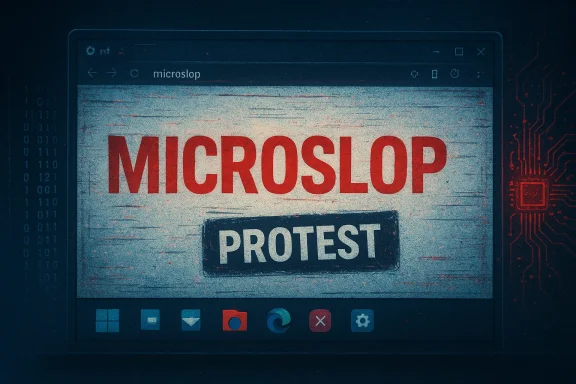
Windows 11’s AI experiment has a new nickname: “Microslop,” and the joke just graduated into tooling — a browser extension that replaces every on‑page instance of “Microsoft” with “Microslop” is circulating across browser stores and social platforms, turning user anger into a visible, repeatable protest against the company’s aggressive Copilot push.
Microsoft’s Copilot strategy began as an experiment in late 2022 and early 2023, when Bing Chat (later unified under the Copilot brand) introduced generative answers inside search and Edge. The company formally announced Windows Copilot as a system‑level assistant at Build 2023; the feature was presented as a persistent, sidebar‑style assistant integrated into Windows and marketed as a new productivity surface for the OS. Since then, Microsoft has rolled out or tested Copilot‑branded features across core Windows surfaces and apps — from taskbar placement and Edge visual language experiments to assistant actions in File Explorer, generative features in Paint (Image Creator / DALL·E integration), and writing helpers in Notepad. Those additions are now visible to many Insiders and, in staged rollouts, to mainstream Windows 11 users.
The present “Microslop” moment is not just a meme. It’s a signal: when the public adopts a single, sticky slur for a company’s product direction, that perception becomes a procurement and regulatory lever. Microsoft retains structural advantages — Azure, device partnerships, and distribution channels — that make the agentic vision achievable, but executing that vision without undermining trust is a different, harder problem.
Source: Windows Latest Windows 11 users coin “Microslop” as AI backlash grows, and even a browser extension that renames Microsoft to Microslop
 Background
Microsoft’s Copilot strategy began as an experiment in late 2022 and early 2023, when Bing Chat (later unified under the Copilot brand) introduced generative answers inside search and Edge. The company formally announced Windows Copilot as a system‑level assistant at Build 2023; the feature was presented as a persistent, sidebar‑style assistant integrated into Windows and marketed as a new productivity surface for the OS. Since then, Microsoft has rolled out or tested Copilot‑branded features across core Windows surfaces and apps — from taskbar placement and Edge visual language experiments to assistant actions in File Explorer, generative features in Paint (Image Creator / DALL·E integration), and writing helpers in Notepad. Those additions are now visible to many Insiders and, in staged rollouts, to mainstream Windows 11 users. What “Microslop” is and why it stuck
The meme explained
“Microslop” fuses Microsoft’s name with slop — a cultural shorthand for poor‑quality AI output and hurried productization. The term consolidated scattered complaints (bad suggestions, hallucinations, intrusive UI changes, and perceived coercive defaults) into a single, memetic brand that’s easy to amplify on X, Reddit, and image boards. That compression is powerful: it translates many specific, reproducible grievances into a single soundbite that journalists and procurement teams remember.From complaint to extension
Users didn’t stop at jokes. A small developer published a browser extension — available in archived listings and community posts — that visually replaces “Microsoft” with “Microslop” locally on pages in Chromium and Firefox builds. The extension's manifest and store description explicitly state it performs client‑side visual substitutions and claims it does not transmit or store user data. The novelty of the tool underscores how pervasive and performative the backlash has become.The product arc: how Copilot went from novelty to default‑adjacent
A compressed timeline
- February 2023 — Microsoft rolls out the “new Bing” with a chat assistant (the early codename “Sydney” became shorthand among testers and press).
- May 2023 — Windows Copilot announced at Microsoft Build as a persistent assistant and experimental OS surface.
- Late 2023 onward — Copilot branding is extended across apps (Edge, Office, Paint, Notepad) and Microsoft begins promoting Copilot+ PCs with dedicated NPU requirements.
Examples of integration that irritated users
- File Explorer: “Ask Copilot” and an “AI actions” submenu appeared in the right‑click context menu. Those entries sometimes pointed to first‑party apps rather than providing in‑place results, and Microsoft later added control to hide AI Actions when no enabled actions exist.
- Paint / Image Creator: DALL·E‑powered image generation (branded as Image Creator) was integrated into Paint as a side panel, requiring sign‑in and consuming AI credits for some customers. The feature is presented as creative tooling, but it also raised questions about account gating and compute paths.
- Notepad: Native AI helpers — Rewrite, Summarize, and Write — were added to Notepad with Copilot menus and keyboard shortcuts; Microsoft’s documentation shows these features are available and explains workflows, but hands‑on reliability and privacy assumptions remain points of debate for many users.
Why the backlash hardened: credibility, defaults, and tone
Reliability vs. spectacle
Multiple hands‑on tests and viral clips showed assistant suggestions that either failed or performed worse than the preexisting UI behavior they were meant to replace. One short viral clip — where a long, AI‑styled suggestion returned nothing but a terse manual keyword did — crystallized the complaint: the UI promises convenience, but the underlying system sometimes delivers less value than older, simpler affordances. Those reproducible, easy‑to‑explain failures feed the perception that Microsoft’s AI push emphasizes showy demos over dependable engineering.Defaults and perceived coercion
Users have also complained that AI UI elements appear prominently and in some instances re‑enable after removal or are distributed through servicing channels that are hard to fully block. Even if Microsoft documents opt‑outs and admin controls, the optics of frequent surface change without durable, obvious master switches has eroded trust for privacy‑minded consumers and many IT admins. Community projects and scripts have proliferated to remove or block Copilot elements where official toggles felt insufficient.Executive tone matters
A high‑profile executive post urging the industry to “get beyond the arguments of slop vs. sophistication” — and other public comments from AI leadership that some read as dismissive — amplified the optics problem. Tone‑deafness in executive messaging can quickly transform technical issues into reputational crises, because it frames criticism as cultural petulance instead of product evidence. Exact paraphrases and social posts should be treated with caution when reconstructed, but the overall effect on public sentiment is clear and measurable.OEMs, market traction, and the Copilot+ hardware story
What a Copilot+ PC is — and why it matters
Microsoft’s Copilot+ PC program defines a hardware tier designed to run richer on‑device AI experiences. A central hardware metric in Microsoft’s messaging is a neural processing unit (NPU) capable of 40+ TOPS (trillions of operations per second), and Microsoft’s public documentation and product pages explicitly describe that floor as a requirement for many Copilot+ experiences. Those NPUs enable features like local image generation, Live Translate, and reduced‑latency local inference.Sales reality: AI stickers don’t automatically move buyers
Despite the Copilot+ marketing, OEM channels and analysts report that mainstream consumers prioritize battery life, display quality, sustained CPU/GPU performance, and price over NPU TOPS numbers. Executives from major vendors have publicly and privately signaled that consumers are not buying in scale because a laptop is labeled “AI” — the hardware story is necessary for capability, but not sufficient as a consumer purchase driver. Industry coverage, benchmarking statistics, and OEM briefings suggest the AI PC upgrade wave is more gradual and price‑sensitive than early hype predicted.How Microsoft is responding — control surface and admin options
Microsoft has taken measured, technically concrete steps to address specific pain points:- Context menu hygiene: Microsoft updated preview builds so that the AI Actions section does not appear if no enabled actions exist, reducing clutter for users who disable those hooks.
- Admin uninstallation: Recent Insider preview releases added Group Policy and management controls that allow administrators, under specific conditions, to uninstall the Copilot app on Pro/Enterprise/EDU devices — a nod to enterprise demand for decisive control over AI surfaces. Those policies come with caveats (e.g., app launch restrictions and licensing considerations).
- Feature‑scoped opt‑outs: Microsoft’s documentation and UI now show more granular toggles for Notepad features, Paint’s Image Creator, and other Copilot integrations. That said, the timing and discoverability of admin controls often lag consumer visibility, creating a short‑term governance gap.
Practical guidance for users, IT teams, and OEMs
For everyday Windows 11 users
- If a particular AI surface is annoying, check the app’s settings (e.g., Paint’s Image Creator, Notepad’s Copilot menu) and disable the relevant toggle where available.
- Consider installing browser extensions or content filters cautiously; community extensions that modify page content may claim not to collect data, but they require broad site permissions. Vet extensions and prefer official store entries with source code or transparent provenance.
For IT administrators
- Audit Copilot and Recall behaviors in a small pilot group before rolling out to critical fleets.
- Use available Group Policy / Intune controls to limit Copilot and background snapshotting until you have validated retention, DLP, and audit requirements.
- Require human confirmation and logging for any automated agentic actions that change financial, legal, or compliance‑sensitive states.
For OEMs and channel partners
- Prioritize the day‑to‑day purchase drivers: battery life, display quality, thermal performance, and price competitiveness. Marketing an NPU without a clearly communicated, verifiable benefit is unlikely to shift mainstream demand. Industry reporting and OEM commentary back this up.
Where the evidence is thin — and what needs independent verification
- Executive quotes and paraphrases circulating on social media are often edited or reposted in ways that change tone. When stories hinge on a single sentence attributed to a CEO, treat direct phrasing as potentially paraphrased and verified only when original posts or official transcripts are available. The high‑level framing of models→systems is defensible, but specific attributions should be handled carefully.
- Community claims about persistent re‑provisioning of UI elements after removals are real in many hands‑on reports, but exact server flag names, and the final stable‑release behavior of specific preview flags, require Microsoft release notes to be definitive. Treat flag strings and server‑gate behavior as provisional until Microsoft publishes the final stable documentation.
- OEM statements vary in tone and specificity; while several outlets and briefings show vendors tempering AI‑first marketing, the scope of that pivot differs by region and SKU. Use earning call transcripts and OEM press releases for procurement decisions rather than social reporting alone.
The broader implications for Windows as a platform
Microsoft’s strategic choice to make Windows an “agentic OS” — an operating system that can host autonomous helpers and multi‑step agents — is substantial and legitimate: it promises new productivity models by orchestrating tasks across apps and cloud services. But moving from demos to dependable systems requires operational work: reproducible reliability metrics, auditable action logs, conservative defaults, independent NPU/battery/privacy benchmarks, and transparent upgrade paths for users with offline or air‑gapped requirements. Those are the kinds of commitments that restore corporate credibility over time.The present “Microslop” moment is not just a meme. It’s a signal: when the public adopts a single, sticky slur for a company’s product direction, that perception becomes a procurement and regulatory lever. Microsoft retains structural advantages — Azure, device partnerships, and distribution channels — that make the agentic vision achievable, but executing that vision without undermining trust is a different, harder problem.
Conclusion
The Microslop backlash is a classic credibility problem: technical ambition collided with uneven delivery, unclear defaults, and social amplification. The emergence of a tongue‑in‑cheek browser extension is an unusual but telling escalation — users have weaponized humor, tooling, and community scripts to make a reputational point visible everywhere they browse. Microsoft has made some operational fixes — hiding empty AI Actions, documenting Notepad and Paint AI helpers, and adding admin controls for Copilot removal in preview builds — but correcting the narrative requires more than incremental toggles. The company must deliver reproducible reliability metrics, clearer admin and privacy controls, independent benchmarking for Copilot+ claims (for example, the advertised 40+ TOPS NPU floor), and a communications posture that pairs long‑term systems promises with immediate, verifiable product commitments. Until those guardrails are visible and enforced, the Microslop meme will remain an effective shorthand for buyers, admins, and regulators to question whether Copilot’s convenience justifies its costs. Microsoft can still redeem the agentic OS narrative — but only by turning systems rhetoric into measurable, auditable action. The next six to twelve months will decide whether Copilot becomes a quietly useful background assistant, or a persistent reputational friction that shapes Windows procurement decisions for years.Source: Windows Latest Windows 11 users coin “Microslop” as AI backlash grows, and even a browser extension that renames Microsoft to Microslop
