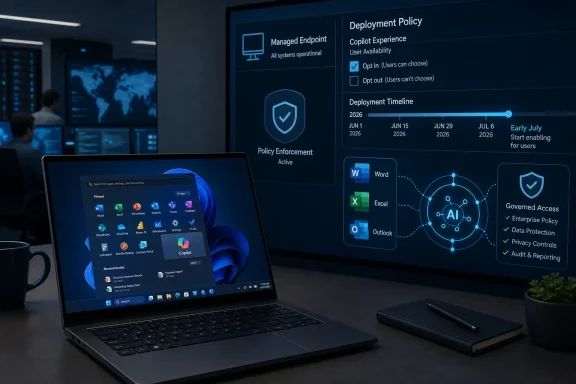
Microsoft has resumed the automatic installation of the Microsoft 365 Copilot app on eligible commercial Windows PCs in June 2026, targeting devices with Microsoft 365 desktop apps already installed while excluding tenants in the European Economic Area. The move revives a deployment plan Microsoft paused in March over a technical issue, and it lands exactly where enterprise admins are most sensitive: software appearing on managed endpoints without a conventional deployment decision. This is not just another Copilot story. It is a test of whether Microsoft’s AI strategy can coexist with the consent model that IT departments still expect from a business platform.

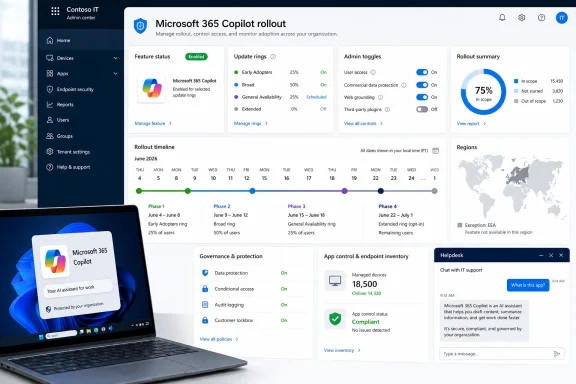
A laptop screen shows Microsoft 365 Copilot rollout details in an admin center interface.Microsoft Turns the Installer Back On​

The basic mechanics are straightforward. If a commercial Windows device has the Microsoft 365 desktop apps installed, and if it is on an eligible update channel and version, Microsoft 365 Copilot can now arrive automatically as part of the broader Microsoft 365 Apps ecosystem. Users may simply notice a new entry in the Start menu or Installed Apps, not a traditional installation prompt.
That distinction matters because Microsoft is not merely shipping an optional app through the Store. It is using the reach of Microsoft 365 Apps to place an AI-branded entry point on machines that organizations already rely on for Word, Excel, PowerPoint, Outlook, and Teams-adjacent productivity workflows. In Microsoft’s framing, the Copilot app is a unified front door for Microsoft 365 AI experiences. In many admins’ framing, it is another example of Redmond deciding that “installed” is a product-management preference rather than an IT change-control event.
The rollout is phased. According to the reported Message Center update, Microsoft began enabling the first feature flag on June 4, with additional waves running through June and into July 1. That means many organizations will not see the app arrive everywhere at once. It also means the window for administrators to review the setting, decide whether to opt out, and communicate with users is not theoretical; it is already open.
Microsoft’s public deployment documentation has described the automatic installation path for months, including the minimum Microsoft 365 Apps Version 2511 requirement, the exclusion of Semi-Annual Enterprise Channel devices, and the fact that European Economic Area tenants are treated differently. The unresolved tension is not whether Microsoft documented the behavior. It is whether documentation and an opt-out switch are enough when the default action is to install a new AI application across business PCs.

The March Pause Was a Reprieve, Not a Retreat​

When Microsoft paused the automatic Copilot installation in March 2026, it was tempting to read the move as a quiet concession to backlash. After all, the company had already spent years testing the patience of Windows users with AI surfacing in search, the taskbar, Settings experiments, Edge integrations, and the ever-present Copilot brand. A pause looked like the sort of tactical retreat companies make when telemetry meets annoyance.
But Microsoft’s own wording pointed elsewhere. The company said the automatic installation had been temporarily disabled because of a technical issue and that it would provide an update when the process was re-enabled. That is not the language of a strategy being abandoned. It is the language of a rollout being debugged.
The June resumption confirms the point. Microsoft did not decide that automatic deployment was the wrong lever. It decided that the lever should be pulled once the blocking issue was resolved and the admin-control story was sufficiently in place.
This is where the episode becomes more revealing than the app itself. Microsoft has repeatedly shown that it sees Copilot not as a discrete product that users discover, evaluate, and install, but as a layer that should be present wherever Microsoft 365 work happens. The company can make that argument credibly from a product standpoint. If Copilot is meant to summarize documents, query business data, draft content, and become a cross-app productivity assistant, then burying it behind a manual download is strategically incoherent.
The trouble is that enterprise Windows is not just a product surface. It is an estate. It has inventories, baselines, user training, help-desk scripts, compliance rules, software-approval boards, and security exceptions. An app that is “just a front door” to Microsoft 365 can still be a new executable, a new updater path, a new support artifact, and a new user expectation.

The Copilot App Is Small, but the Precedent Is Large​

The Microsoft 365 Copilot app is not the same thing as granting every employee a paid Microsoft 365 Copilot license. That distinction should be made clearly, because it is where some of the public anger can get technically sloppy. The app may appear even where advanced licensed Copilot capabilities are not available to a given user. It can function as an entry point for Microsoft 365 experiences, Copilot Chat, search, agents, and other Microsoft 365 surfaces depending on licensing and tenant configuration.
That does not make the deployment inconsequential. Enterprise users do not typically reason in terms of licensing matrices when a new app appears on their work PC. They see the Copilot name, assume something has changed, and ask IT why it is there. If the answer is “Microsoft installed it automatically unless we opted out,” the help desk inherits a trust problem that the product group created.
The precedent is more important than the payload. Microsoft is normalizing a model in which Microsoft 365 Apps can become a delivery vehicle for adjacent “modern apps” that Microsoft considers part of the suite experience. The company already has a defensible story here: users expect Microsoft 365 to evolve, and cloud-connected productivity software is not a static bundle of desktop binaries. But there is a difference between updating Word and installing a new branded app that changes the visible software inventory.
That difference is not nostalgia. It is governance. In managed environments, the presence of an application can trigger software asset reviews, privacy assessments, support documentation, and executive questions about AI enablement. Even if the technical footprint is benign, the organizational footprint is not.

Admins Get a Switch, but Microsoft Keeps the Default​

Microsoft deserves some credit for giving administrators a way to prevent the automatic installation. The setting lives in the Microsoft 365 Apps admin center, under device configuration and modern app settings, where admins can clear the option that enables automatic installation of the Microsoft 365 Copilot app. The company’s docs also say that if a user uninstalls the app after automatic installation, the one-time installation process does not simply reinstall it again through the same mechanism.
Those are meaningful controls. They are also not the same as making the deployment opt-in.
Defaults are policy in enterprise software. When Microsoft makes Copilot installation the default for eligible commercial devices, it is saying that the expected state of the Microsoft 365 Apps estate includes this app unless an administrator intervenes. That may be reasonable for organizations already moving aggressively toward Copilot adoption. It is less reasonable for organizations still evaluating data governance, user readiness, licensing costs, and acceptable AI use.
The opt-out model also assumes that administrators saw the Message Center update, understood its operational impact, had the right permissions in the correct admin portal, and acted before the relevant deployment wave reached their tenant. In smaller organizations, that assumption may be optimistic. In large organizations, it may be bureaucratically unrealistic.
This is a recurring Microsoft problem. The company often provides the control eventually, but it places the burden of resisting product momentum on administrators. The practical message is: Microsoft will move the platform forward, and if you do not like the direction, you need to find and flip the right switch in time.

Europe Gets a Different Windows, Again​

The European Economic Area exclusion is another reminder that Microsoft’s product behavior increasingly depends on geography. EEA tenants are reportedly unaffected by this automatic deployment, and Microsoft’s public documentation has said customers in the EEA cannot enable installation of the Microsoft 365 Copilot app to devices with Microsoft 365 Apps through this automatic path.
That is not a small footnote. It reflects the broader reality that European regulatory pressure has forced large platform companies to separate, disclose, unbundle, or restrain behaviors that might pass with less friction elsewhere. Windows and Microsoft 365 are no longer universally identical products. They are policy-sensitive platforms, and Europe often gets the version with more explicit restraint.
For US admins, that creates an uncomfortable comparison. If automatic deployment is too sensitive or constrained for one major regulatory region, why should it be the default elsewhere? Microsoft may have legal and operational reasons for the distinction, but users and administrators will read it more simply: some customers get protection from surprise installation by default, and others get an opt-out buried in an admin center.
The EEA carve-out also weakens any argument that automatic installation is technically essential. If Microsoft can run Microsoft 365 Apps without this automatic Copilot app path in Europe, then the rest of the world is dealing with a strategic choice, not a platform necessity.
That does not mean the app is malicious, unsafe, or useless. It means the deployment model is discretionary. And discretionary defaults deserve scrutiny.

The AI Strategy Is Colliding With the Windows Trust Model​

Microsoft’s Copilot push has always had two speeds. In marketing, Copilot is the future of work, the interface layer for productivity, and the connective tissue between documents, meetings, email, chat, and business data. On endpoints, it often feels like another icon arriving before the organization has decided what role AI should play.
That mismatch is why forced or semi-forced Copilot deployments generate disproportionate irritation. The app itself may not consume much disk space or run disruptive background workloads. But it carries the symbolic weight of Microsoft’s AI agenda, and that agenda has often moved faster than user comfort.
Windows users have been trained over decades to distrust surprise software. They remember browser toolbars, OEM bloatware, consumer app promotions, Store app stubs, Edge prompts, Teams auto-start behavior, and feature updates that changed workflows without warning. Microsoft 365 customers, especially commercial ones, have somewhat more tolerance for managed evolution because cloud software changes continuously. Still, there is a line between updating the service and planting a new visible application on the device.
Copilot sits directly on that line. Microsoft wants it to feel native and inevitable. Many users experience that inevitability as pressure.
For IT pros, the deeper issue is not whether Copilot is good. It is whether Microsoft is willing to let customers decide when Copilot becomes part of the endpoint experience. The June rollout suggests Microsoft’s answer is yes, but only if admins actively say no.

The Naming Problem Makes the Rollout Feel Messier Than It Is​

Part of the confusion comes from Microsoft’s Copilot branding sprawl. There is Microsoft Copilot, the consumer-facing assistant. There is Microsoft 365 Copilot, the work and school productivity layer tied to Microsoft 365 data and licensing. There is Copilot Chat, Copilot in Windows, Copilot+ PCs, GitHub Copilot, Security Copilot, and a growing set of agents and app-specific experiences.
To Microsoft, these distinctions are product architecture. To normal users, they are a fog bank.
The Microsoft 365 Copilot app is intended as a work-oriented entry point, particularly for users authenticating with organizational accounts. It is not the same as the consumer Copilot app that has appeared in Windows contexts. It is also not a magical license upgrade that grants paid Copilot features to everyone. Yet the visible word “Copilot” does most of the emotional work.
That branding ambiguity increases the support burden. A user who sees Copilot installed may ask whether company data is now being used for AI training, whether their documents are being scanned, whether they have a new paid license, or whether they are expected to use AI in daily work. Some of those fears may be misplaced, but they are not irrational. Microsoft has made Copilot the umbrella term for too many related but distinct experiences.
The company’s recommendation that admins notify users before the app appears is therefore sensible. It is also an admission that the rollout creates a communication event. If a software change requires user messaging to prevent surprise, then it is not merely a background maintenance update.

The Security Argument Cuts Both Ways​

There is a security case for Microsoft’s approach. Centralized deployment can reduce the chance that employees download unofficial AI tools, install random browser extensions, or paste company data into unsanctioned services. A managed Microsoft 365 Copilot entry point can be governed through tenant controls, identity, licensing, and enterprise data protection policies in ways that consumer AI tools cannot.
That argument is real, and many CISOs will recognize it. Shadow AI is already a problem. If employees are going to use AI anyway, an officially managed entry point may be preferable to an uncontrolled sprawl of third-party tools.
But the security case is not a blank check for surprise installation. Security teams also care about software inventory discipline, attack surface, update mechanisms, user expectations, and change visibility. A new app deployed system-wide, even a Microsoft one, is still part of the endpoint estate. It needs to be understood, documented, and monitored.
The app’s installation context matters here. Microsoft’s documentation says automatic installation through Microsoft 365 Apps can happen in the SYSTEM context and provision the app system-wide. That may be administratively efficient, but it also underscores why this is not just a casual per-user convenience. It is a device-level change.
Enterprises can manage that change. What they resent is discovering that they must manage it because Microsoft decided the default state had changed.

Microsoft’s Best Argument Is Also Its Weakness​

Microsoft’s strongest defense is that Microsoft 365 is no longer just a collection of desktop apps. It is a cloud productivity platform, and the Copilot app is part of the platform’s modern interface. From that perspective, automatic installation is not an invasion; it is suite coherence.
There is logic there. If a company pays for Microsoft 365 and expects users to work across cloud files, shared documents, Teams meetings, Outlook messages, and enterprise search, a unified AI entry point is not absurd. The old mental model of Office as a few isolated Win32 apps is already out of date. The Microsoft 365 app itself, the web portal, Loop components, and cloud-backed file experiences have been pulling users into a more integrated environment for years.
But that argument works only if Microsoft is trusted to curate the environment in the customer’s interest. Trust is exactly what forced installation erodes. The more Microsoft insists that Copilot is simply part of the suite, the more admins will ask why it needs a separate visible app, why it appears by default, and why EEA customers are handled differently.
The company is trying to collapse the distinction between “Microsoft 365 has new capabilities” and “Microsoft installed a new app on your PC.” Customers are not obligated to accept that collapse.

The Practical Work Starts Before the Icon Appears​

For administrators, the immediate response should be boring, which is another way of saying effective. Check whether your tenant is eligible, whether your devices are on Current Channel or Monthly Enterprise Channel, and whether Microsoft 365 Apps Version 2511 or later is broadly deployed. Review the Microsoft 365 Apps admin center setting for automatic Copilot app installation. Decide whether the app aligns with your organization’s AI rollout plan or whether you need to opt out for now.
The harder work is communication. If the app is allowed to arrive, users should know what it is, what it is not, and whether their access to Copilot features depends on licensing. They should also know whom to ask before using AI with sensitive company information. Silence leaves room for rumor, and Copilot rumors tend to spread faster than admin center updates.
Organizations that are not ready for Copilot should treat the automatic installation switch as part of a larger AI governance checklist, not as an isolated annoyance. If you are blocking the app because policies are not ready, that is a signal to finish the policies. If you are allowing it because Copilot adoption is underway, that is a signal to prepare training and support materials.
The worst posture is drift: letting the app arrive because nobody noticed the Message Center post, then treating the resulting questions as user confusion. In that scenario, Microsoft may have created the surprise, but IT owns the aftermath.
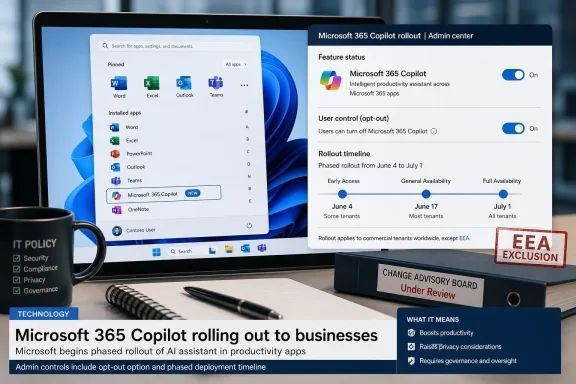
Redmond’s June Copilot Push Leaves Admins With a Narrow Playbook​

Microsoft’s resumed rollout is concrete enough that organizations should stop debating whether the automatic installation plan is hypothetical. The relevant question is whether their tenant should accept Microsoft’s default or override it before the deployment wave reaches enough machines to become a support issue.
  • Commercial Windows devices with Microsoft 365 desktop apps are the target, provided they meet Microsoft’s eligibility and update-channel requirements.
  • The automatic installation path does not apply to tenants in the European Economic Area, and Semi-Annual Enterprise Channel devices are not targeted.
  • Administrators can prevent the automatic installation through the Microsoft 365 Apps admin center by disabling the relevant modern app setting.
  • The rollout is phased through June 2026, with reported feature-flag waves extending into July 1.
  • The app’s arrival does not automatically mean every user has a paid Microsoft 365 Copilot license, but it does create a visible Copilot entry point that users will notice.
  • Organizations that allow the app should communicate before deployment, because the absence of a prompt does not mean the absence of user concern.
Microsoft is not going to stop trying to make Copilot feel like part of the furniture. The company has invested too much money, executive attention, and product identity in AI to leave adoption to a download button. But if Copilot is to become a durable part of work rather than another Windows irritant, Microsoft will need to treat deployment consent as more than a checkbox in an admin portal. The next phase of enterprise AI will not be won by making the icon unavoidable; it will be won by making the case so clearly that administrators no longer feel ambushed when it appears.

References​

  1. Primary source: Neowin
    Published: Fri, 05 Jun 2026 14:54:00 GMT
  2. Related coverage: pcworld.com
  3. Related coverage: windowslatest.com
  4. Official source: learn.microsoft.com
  5. Related coverage: techradar.com
  6. Related coverage: techcrunch.com
  1. Related coverage: techspot.com
  2. Related coverage: techtimes.com
  3. Related coverage: gadgets360.com
  4. Related coverage: windowscentral.com
  5. Related coverage: windowsforum.com
  6. Related coverage: tomshardware.com
  7. Official source: microsoft.com
 

Microsoft has resumed automatic installation of the Microsoft 365 Copilot app on eligible commercial Windows PCs in June 2026, targeting devices that already run Microsoft 365 desktop apps outside the European Economic Area. The move revives a rollout Microsoft paused in March after citing a technical issue, and it makes clear that the pause was not a retreat from the company’s broader AI distribution strategy. For IT departments, the issue is less whether Copilot is useful than whether Microsoft has again treated managed Windows estates as a channel for product placement by default. The app can be blocked, but the burden of action sits with administrators, not with Microsoft.

Screenshot of Microsoft 365 Copilot rollout dashboard with enabled features, rings, timeline, and helpdesk chat.Microsoft Turns the Pause Into a Countdown​

The important word in Microsoft’s March communication was always temporarily. When the company disabled automatic installation of the Microsoft 365 Copilot app earlier this year, some customers read the move as a sign that Microsoft might be backing away from one of its more aggressive Copilot pushes. That was understandable. By early 2026, Microsoft had already absorbed months of criticism over AI surfaces appearing in places users did not ask for them, from Windows entry points to Microsoft 365 workflows.
But the latest Message Center update suggests a more prosaic explanation: the machinery was stopped because something was broken, not because the strategy had changed. Microsoft is now restarting the same basic plan, with a phased rollout beginning June 4 and running through the end of the month into July 1. That timeline matters because it turns what looked like a reprieve into an operational deadline.
The affected systems are not random consumer PCs. Microsoft is aiming this at commercial Windows devices with Microsoft 365 Apps already installed, meaning the app is being delivered into environments that are supposed to be governed by tenant policy, update rings, licensing controls, endpoint management, and change advisory boards. In other words, Microsoft is not merely adding another app to a home Start menu. It is altering the default software inventory of business endpoints.
That distinction is what makes the story bigger than Copilot fatigue. Microsoft’s argument is that the Microsoft 365 Copilot app is a logical entry point into the Microsoft 365 experience. Many administrators will see something else: another example of the vendor converting a subscription footprint into an installation channel.

The App Is Small, but the Governance Problem Is Not​

The Microsoft 365 Copilot app is not the same thing as silently assigning every user a paid Copilot license. It is an app shell, a desktop entry point into Microsoft 365 Copilot, Copilot Chat, search, agents, files, and related Microsoft 365 experiences depending on licensing and tenant configuration. On a device where users already work in Word, Excel, PowerPoint, Outlook, Teams, OneDrive, and the Microsoft 365 web portal, Microsoft can plausibly argue that the app belongs in the same family.
That framing is convenient, but it does not eliminate the trust problem. Enterprise desktops are not just collections of vendor-approved shortcuts. They are managed workspaces with security baselines, application allow lists, support documentation, user training, privacy reviews, and help desk expectations. Even a relatively harmless app can become a meaningful change when it appears without a local install action.
Microsoft says the automatic installation happens in the background and should not interrupt users. That may be true in a narrow technical sense. The trouble is that “doesn’t interrupt the user” is not the same as “doesn’t affect the organization.” The surprise is itself the interruption.
The company is reportedly telling admins to notify users before the app appears. That advice is sensible, but it also reveals the awkwardness of the deployment model. If Microsoft knows the appearance of the app may confuse users, then the company also knows it is making administrators explain a change many of them did not initiate.

Eligible Does Not Mean Ready​

Microsoft’s eligibility rules narrow the blast radius, but they do not make the rollout benign. Devices need commercial Microsoft 365 desktop apps, and Microsoft’s public documentation has tied automatic installation to Microsoft 365 Apps version 2511 or later on Current Channel or Monthly Enterprise Channel. Devices on the Semi-Annual Enterprise Channel are not in scope for the automatic install path described in the deployment guidance.
That distinction will matter in larger organizations. Enterprises that keep productivity apps on slower update channels may dodge the immediate push, while organizations on Current Channel or Monthly Enterprise Channel are more likely to see the app arrive. Smaller businesses that rely on Microsoft defaults may discover the change only when users notice a new entry in Installed Apps or the Start menu.
The European Economic Area carve-out is equally telling. Microsoft’s documentation says automatic installation through Microsoft 365 Apps is not enabled for EEA customers. The company frames this as a deployment distinction, but the policy reality is obvious enough: Microsoft has learned that defaults tolerated in one jurisdiction may become regulatory liabilities in another.
That creates an odd global split. A U.S.-based tenant with users abroad may be treated differently from an EEA-based tenant with devices elsewhere, because Microsoft’s documentation points to tenant attributes rather than simply the physical location of the PC. For admins, this is one more reminder that cloud-era Windows behavior is increasingly shaped by tenant metadata, licensing state, update channel, region, and feature flags—not merely by what is installed on the disk.

Feature Flags Are the New Patch Tuesday Fog​

The rollout schedule reported from the Message Center is a familiar Microsoft 365 pattern: feature flags first, infrastructure and schema work in the middle, then more flags to complete the experience. Feature Flag 1 began June 4 and is expected to finish June 10. Feature Flag 2 is expected to run June 11 through June 17. A Microsoft Graph schema rollout is expected June 18 through June 24. Feature Flag 3 is expected to run June 25 through July 1.
That is a normal enough sequence for cloud service engineering. It is also maddening for administrators who want a crisp answer to a simple question: when will this app show up on my endpoints? Microsoft 365 has spent years moving from monolithic releases to staged service activation, and that model is technically safer. It also makes causality harder to explain.
A traditional Windows admin could once point to a KB number, an MSI, a GPO, or a software deployment job. Today, an endpoint’s behavior may depend on whether a server-side flag has reached a tenant, whether a channel update has landed, whether a service schema has propagated, and whether a device has checked in during the right window. The machine may look unchanged until it suddenly is not.
That ambiguity is not unique to Copilot, but Copilot amplifies it because the product is politically loaded inside many organizations. Security teams want to know what data paths are enabled. Legal teams want to know what users can paste into AI tools. Executives want to know why competitors appear to be deploying AI faster. Users want to know why yet another Microsoft icon exists. Administrators sit in the middle, translating feature flags into workplace reality.

The Opt-Out Exists, but Defaults Still Do the Work​

Microsoft deserves some credit for providing an administrative opt-out. Public deployment guidance says admins can prevent automatic installation in the Microsoft 365 Apps admin center by going through Customization, Device Configuration, and Modern Apps settings, then disabling automatic installation for the Microsoft 365 Copilot app. That is better than a hard-coded install with no tenant-level control.
But the existence of an opt-out does not settle the argument. Defaults are policy. In software distribution, the default path often determines the outcome because many organizations are understaffed, many tenants are inconsistently governed, and many administrators do not live inside the Message Center every morning waiting for a new “major change” to land.
Microsoft knows this better than anyone. The company’s entire cloud productivity strategy depends on defaults, prompts, nudges, seeded experiences, and gradual normalization. Teams became infrastructure not merely because it was a good product, but because it was bundled, integrated, and made increasingly unavoidable. OneDrive, Edge, Loop components, and the Microsoft 365 app have all benefited from similar gravity.
Copilot is now being given that same gravitational assistance. Microsoft is not waiting for every customer to make a clean, affirmative deployment decision. It is placing the app where it believes the workflow should begin, then allowing administrators to say no if they move in time.
That inversion is the heart of the controversy. In a managed estate, the customer normally decides what gets installed and the vendor supplies the means. Microsoft’s cloud model increasingly asks customers to monitor what the vendor plans to install and intervene before it happens.

Microsoft Is Selling an Entry Point, Not Just an Assistant​

The Microsoft 365 Copilot app is best understood as a front door. It gives Microsoft a dedicated place on Windows to route users into AI-assisted search, chat, agents, files, meetings, and eventually whatever new productivity abstraction the company wants to promote. That makes the desktop app strategically important even when the user does not have the full paid Microsoft 365 Copilot license.
A standalone app gives Microsoft a more controllable canvas than Word or Excel. Office apps carry decades of user expectations; a Copilot hub can evolve faster. It can surface recommended files, summarize work, expose agents, push prompts, and direct users toward features that Microsoft wants to make habitual. The app is less about today’s icon than tomorrow’s behavioral loop.
That is why the “it’s just an app” defense is incomplete. Distribution creates habit, and habit creates market power. If the Copilot app becomes the default place where millions of workers start their day, Microsoft has created a new layer between the user and the organization’s information. That layer may be helpful, but it is not neutral.
Enterprises understand this when the vendor is anyone other than Microsoft. Few IT departments would shrug if a third-party SaaS provider quietly placed a new AI assistant on every managed Windows endpoint because the organization already used its browser plugin or document connector. Microsoft gets more tolerance because it owns the productivity suite, the identity platform, the endpoint management stack, and the operating system. That is precisely why the tolerance is becoming more strained.

The Branding Confusion Is Now a Support Cost​

Microsoft’s Copilot naming remains a mess, and automatic installation makes that mess visible to ordinary users. There is Microsoft Copilot, the consumer-facing assistant. There is Microsoft 365 Copilot, the paid work assistant integrated with Microsoft 365 data and apps. There is Copilot Chat. There are Copilot experiences inside Word, Excel, PowerPoint, Outlook, Teams, Edge, Windows, and the Microsoft 365 app. There are also Copilot+ PCs, which refer to hardware capabilities and local AI features rather than a subscription to Microsoft 365 Copilot.
This is not just a branding columnist’s complaint. It becomes a help desk problem. A user sees “Microsoft 365 Copilot” installed and assumes they now have the licensed Copilot features their colleague demonstrated in Teams. Another user opens the app and encounters a different chat experience than the one they used in a browser. A manager asks why AI was installed after the company said it had not approved Copilot. A security analyst wants to know which Copilot logs, policies, and data protections apply.
Microsoft’s documentation tries to separate these concepts, but documentation is not what most users experience. They experience an icon. If the icon arrives automatically, the organization owns the explanation.
For admins who have already spent the last two years untangling “new Teams,” “classic Teams,” “Microsoft 365,” “Office,” “Copilot,” and “Copilot for Microsoft 365,” this rollout adds another layer of semantic debt. Microsoft can rename products faster than enterprises can update training materials.

The EEA Exception Says the Quiet Part Out Loud​

The European Economic Area exclusion is one of the most revealing details in the rollout. Microsoft is not saying the app cannot technically be installed in Europe. It is saying this automatic installation route is not enabled for EEA customers. Manual deployment remains available through other paths.
That means Microsoft has built the switch. It can separate automatic distribution from product availability. It can allow customers to deploy the app deliberately without making the suite installer do it for them. The EEA gets that posture by default; many other regions get automatic installation unless admins opt out.
The reason is not hard to infer. European regulators have spent years scrutinizing platform bundling, default services, user choice, and the way large technology companies use dominant products to advance adjacent ones. Microsoft knows the terrain. It has been here before with browsers, media players, Teams, and cloud licensing complaints. Copilot may be new technology, but the competition and consent questions are old.
For U.S. and other non-EEA customers, the lesson is uncomfortable. The same technical product can be distributed under a more restrained model when Microsoft has sufficient legal incentive. That does not automatically make the non-EEA rollout illegal or abusive, but it does weaken the argument that automatic installation is simply necessary for product coherence.
It also leaves global companies with a two-speed governance model. A multinational tenant may need to understand not only which devices are eligible, but why a European subsidiary’s expectations differ from a U.S. business unit’s experience. The result is more policy work for customers because Microsoft has chosen an uneven default.

Security Teams Will Care About Perception as Much as Permissions​

The Microsoft 365 Copilot app is not, by itself, proof that sensitive corporate data is being sprayed into an AI model. Microsoft has invested heavily in enterprise data protection messaging, tenant controls, auditability, and permission-respecting retrieval for Microsoft 365 Copilot experiences. Those details matter, and security teams should evaluate the actual data flows rather than react to the word “AI” as if every implementation were identical.
But perception can still become a security issue. If users believe “Copilot is now installed,” they may assume the company has approved broader AI use. They may paste data into whatever Copilot-branded surface is easiest to access, without understanding the difference between consumer and commercial experiences, licensed and unlicensed modes, or browser and desktop entry points. The risk is not only what the app does; it is what the app signals.
This is why Microsoft’s advice to communicate with users ahead of the rollout is more than courtesy. It is risk management. Organizations need to explain what the app is, what it is not, who is licensed for which features, what data users may enter, and where official policy lives. If they do not, the new icon becomes an invitation to improvise.
There is also the more mundane endpoint-security angle. Application inventory changes can trigger alerts, confuse baselines, complicate gold images, and create exceptions in app control policies. Even when the software is signed by Microsoft and delivered through supported channels, a sudden new app can produce operational noise. In mature environments, noise has a cost.

Admin Centers Have Become the Real Operating System​

One of the underappreciated shifts in modern Windows administration is that more consequential settings now live outside Windows itself. The Microsoft 365 Apps admin center, Intune, Entra, Defender portals, Teams admin center, Purview, and Message Center collectively shape the user’s desktop as much as local policy does. The operating system is still there, but the control plane has moved upward.
The Copilot app rollout is a perfect example. The decision is not primarily a Windows Update setting. It is not something most users will understand as an app they downloaded. It is tied to Microsoft 365 Apps, tenant eligibility, update channel, service-side rollout, and a Microsoft 365 Apps admin center control. For the modern IT department, the Windows desktop is increasingly the rendered output of cloud policy.
That model has advantages. It lets Microsoft patch, configure, and evolve experiences quickly. It gives admins central switches. It reduces the need for some legacy deployment packaging. It makes sense in a world where work follows identity more than device ownership.
But it also shifts power toward Microsoft’s roadmap. If the vendor can add a new experience by changing the cloud default, the administrator’s job becomes defensive: read the advisory, find the toggle, test the impact, communicate the change, and document the exception. That may be manageable for a large enterprise with a dedicated Microsoft 365 governance team. It is a heavier lift for schools, nonprofits, local governments, and small businesses whose “IT department” may be one person with too many portals already open.

The Copilot Push Is Running Ahead of Copilot Readiness​

Microsoft’s urgency is understandable. The company has invested enormous technical, financial, and strategic capital into AI. It wants Copilot to become the interface layer for work before rivals establish their own habits inside the enterprise. Google, OpenAI, Anthropic, Salesforce, ServiceNow, Slack, Notion, Zoom, and countless vertical vendors all want some version of the same prize: the assistant that sits closest to the worker’s intent.
Microsoft’s advantage is distribution. It owns the apps where much of the work already happens. It owns the identity system. It owns the endpoint. It owns the admin relationship. From a business strategy standpoint, failing to use that advantage would be almost irrational.
From a customer standpoint, however, distribution is not the same as readiness. Many organizations are still writing AI acceptable-use policies. Some are piloting Copilot with small groups. Others are waiting for clearer ROI, better controls, more predictable licensing, or stronger internal data hygiene. A new app appearing across eligible PCs can make the organization look further along than it is.
That disconnect matters because AI deployment is not like adding a PDF reader. The value of enterprise AI depends on permissions, information architecture, training, user judgment, legal posture, and business process redesign. Installing an entry point is the easy part. Making it safe, useful, and supportable is the hard part.
Microsoft often behaves as if exposure will create adoption, and adoption will justify the exposure. That flywheel worked for some cloud collaboration tools. AI may prove less forgiving because misuse, disappointment, and confusion are more expensive.

The App Can Be Removed, but the Memory Remains​

Microsoft’s documentation indicates that if the Microsoft 365 Copilot app is automatically installed through Microsoft 365 Apps and a user later uninstalls it, the automatic installation is not supposed to keep reinstalling it repeatedly. That is an important operational detail. The rollout is not described as an endless enforcement loop.
Still, admins should be careful about relying on user uninstall behavior as a governance model. If the organization does not want the app installed, tenant-level prevention is cleaner than asking users to remove it or scripting cleanup afterward. Removal after surprise installation also does nothing to prevent the support tickets, screenshots, and internal debate that happen when users first notice it.
This is where Microsoft’s “major change” label is appropriate. The app may be small, but the deployment has organizational meaning. It changes user-facing software inventory, touches AI policy, and intersects with region-specific compliance posture. That is major enough.
It also fits a broader pattern in which Microsoft tests the boundary between service evolution and customer consent. Sometimes the company retreats, sometimes it clarifies, sometimes it renames, and sometimes it simply resumes the rollout once the blocking issue is fixed. Customers have learned to treat pauses as pauses, not promises.

The June Copilot Calendar Gives Admins a Narrow Window​

For administrators who do not want surprises, the practical response is not complicated, but it is time-sensitive. Check whether the tenant is in scope, verify Microsoft 365 Apps update channels, review the Microsoft 365 Apps admin center setting, and decide whether the Copilot app should be deployed automatically, manually, or not at all. Then tell users what to expect.
That last step is easy to dismiss and costly to skip. Users do not distinguish between a tenant-level app deployment, a Windows update, a Microsoft Store update, and an AI licensing change. They see a new Microsoft app and draw conclusions. If the organization does not supply the narrative, the rumor mill will.
The reported rollout milestones also suggest admins should not wait until the end of June. Feature flags are already moving. A tenant that looks unaffected today may not remain so next week. The safer assumption is that eligible non-EEA commercial Windows devices on the right Microsoft 365 Apps channels will eventually receive the app unless a prevention control is set.
This is also a good moment to audit Copilot communication more broadly. If the organization has approved Microsoft 365 Copilot for some users, say who and why. If it has approved Copilot Chat but not paid Copilot, explain the difference. If it has not approved AI use for sensitive data, say that clearly. The desktop icon is only one piece of a larger governance conversation.

The Real Story Is the Default Microsoft Chose​

The concrete facts of this rollout are easy to summarize, but the strategic lesson is larger. Microsoft has decided that the Microsoft 365 Copilot app belongs on eligible commercial Windows PCs by default, and it has placed the burden on administrators to opt out where that default is unwanted. That choice tells us more about Microsoft’s AI strategy than any keynote demo.
The company is no longer merely offering Copilot as an add-on for curious customers. It is weaving Copilot-branded entry points into the fabric of Microsoft 365 and Windows. The app is part of a distribution campaign designed to make AI feel native, expected, and eventually indispensable.
For some organizations, that will be welcome. They want Microsoft to accelerate AI adoption, reduce deployment friction, and give users an obvious place to begin. For others, it will feel like yet another example of Redmond mistaking license ownership for consent.
Both reactions can be true. Microsoft can be solving a real adoption problem while also creating a governance problem. The controversy exists because the same mechanism that helps eager customers move faster can push cautious customers before they are ready.

The Admin’s June Checklist Writes Itself​

The immediate task for IT is to turn Microsoft’s cloud-side rollout into a local decision rather than a surprise. The app may arrive quietly, but the policy around it should not.
  • Administrators should verify whether their tenant is outside the European Economic Area and whether eligible Windows devices run Microsoft 365 Apps on Current Channel or Monthly Enterprise Channel.
  • Organizations that do not want automatic installation should disable it in the Microsoft 365 Apps admin center before the phased rollout reaches their tenant.
  • Help desks should be briefed on the difference between Microsoft Copilot, Microsoft 365 Copilot, Copilot Chat, and Copilot+ PCs so they can answer user questions without improvising.
  • Security and compliance teams should update AI-use guidance to explain what the desktop app permits, what licensing enables, and what data users may enter into approved Copilot experiences.
  • Endpoint teams should expect application inventory changes, app-control questions, and possible user confusion even if the installation itself is technically quiet.
  • Leaders should treat the rollout as part of Microsoft’s broader AI-default strategy, not as an isolated app deployment.
Microsoft’s resumed Copilot installation push is not the end of administrator control, but it is another reminder that control now has to be exercised earlier, higher up the stack, and with sharper attention to Microsoft 365 service messages. The next phase of Windows management will be defined less by what ships on installation media and more by what Microsoft decides to light up after the device is already in service. For customers, the job is to make sure those decisions remain choices, not discoveries.

References​

  1. Primary source: Neowin
    Published: 2026-06-05T15:12:07.023932
  2. Related coverage: windowslatest.com
  3. Related coverage: pcworld.com
  4. Related coverage: techtimes.com
  5. Related coverage: windowsreport.com
  6. Official source: learn.microsoft.com
  1. Related coverage: computerworld.com
  2. Related coverage: netservicesgroup.com
  3. Related coverage: vpncentral.com
  4. Related coverage: techradar.com
  5. Related coverage: gadgets360.com
  6. Related coverage: tech.yahoo.com
  7. Related coverage: techspot.com
  8. Related coverage: windowscentral.com
  9. Related coverage: tomshardware.com
  10. Official source: microsoft.com
  11. Related coverage: techriver.com
  12. Official source: techcommunity.microsoft.com
  13. Official source: news.microsoft.com
 

Microsoft is resuming the automatic installation of the Microsoft 365 Copilot app on eligible Windows PCs in June 2026, targeting devices that already have Microsoft 365 desktop apps installed unless administrators opt out through Microsoft’s management controls. The change reverses a pause that had briefly suggested Microsoft was reconsidering the optics of pushing AI software onto managed desktops. Instead, the company appears to have treated the pause as a staging problem, not a strategy problem. For Windows users and IT departments, the message is blunt: Copilot is no longer just a feature Microsoft wants you to discover; it is becoming part of the furniture.

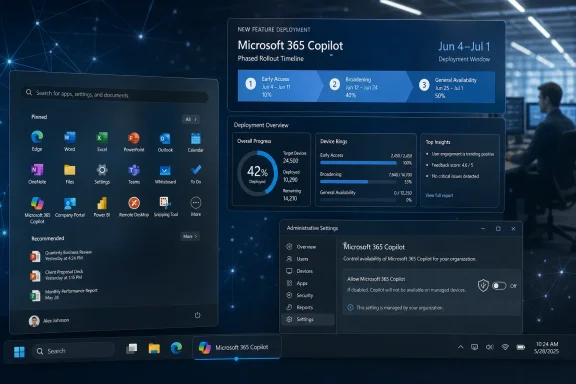
Microsoft 365 Copilot deployment dashboard showing rollout timeline, progress, and device rings in a blue interface.Microsoft Turns a Pause Into a Reset​

The important word in Microsoft’s latest move is not Copilot. It is automatic. The Microsoft 365 Copilot app is being placed onto eligible Windows systems without an end user initiating the install, approving a prompt, or seeking it out from the Store.
That distinction matters because Windows users have spent the past few years watching Microsoft experiment with different ways of making Copilot unavoidable. First came taskbar buttons, Edge integrations, sidebar experiments, Office prompts, and AI-powered branding inside products that already had names. Now the Microsoft 365 Copilot app is being treated less like a downloadable assistant and more like a default companion to Microsoft 365 itself.
Microsoft had previously paused this automatic deployment, after earlier plans drew criticism from users and administrators who saw the app as yet another unrequested addition to Windows. The updated rollout suggests that Microsoft did not abandon the plan. It merely delayed it long enough to refine the deployment path and give administrators another chance to find the off switch.
The company’s schedule is also revealing. The restart begins with a feature flag deployment from June 4 through June 10, followed by phased rollout stages that extend through June and are expected to finish around July 1. That is a standard enterprise-safe cadence on paper, but the practical effect is still a forced presence: if a PC qualifies and the organization does nothing, the app arrives.

The Copilot App Is Not the Same Thing as a Copilot License​

Microsoft’s defenders will fairly point out that installing the Microsoft 365 Copilot app does not automatically grant access to the paid Microsoft 365 Copilot features that require licensing. The app is a container, an entry point, a launcher for Copilot Chat and related Microsoft 365 AI experiences. It does not magically turn every user into a paid Copilot customer.
That is true, and it is also not the whole story. In platform strategy, placement is power. An app in the Start menu, an icon in a workflow, or a preinstalled client on a corporate laptop changes user expectations before anyone approves a purchase order.
Microsoft’s immediate goal is not necessarily to make every affected customer pay for Copilot tomorrow. It is to normalize the Copilot surface across the Microsoft 365 estate. Once the app is already present, Microsoft can market features, expose free or limited chat capabilities, and make the paid tier feel like an upgrade from something already in daily view rather than a separate product requiring deliberate adoption.
That is why the auto-install decision has annoyed so many Windows watchers. Microsoft keeps insisting that Copilot is a productivity layer, but it is deploying that layer using the old tactics of platform bundling. If the company is confident that Copilot will win on usefulness, the question becomes why it so often arrives by default rather than by demand.

Administrators Get a Switch, but They Also Get the Work​

The practical dividing line here is between managed and unmanaged environments. IT administrators can opt out, but they have to know the deployment is coming, understand which setting governs it, and make the change before the rollout reaches their devices. In enterprise IT, “you can disable it” is not the same as “it will not affect you.”
Every new default has an operational cost. Someone must read the Message Center post, assess the affected population, update internal guidance, test the policy behavior, and explain the change to help desk staff before users start asking why a new Copilot app appeared. That is not catastrophic, but it is work created by Microsoft’s product priorities rather than the customer’s stated needs.
The phrase “eligible PCs” also does a lot of quiet work. In this case, eligibility generally means Windows devices with commercial Microsoft 365 desktop apps installed, outside the European Economic Area, and within Microsoft’s supported deployment scope. But for many admins, the only eligibility definition that matters is simpler: machines that yesterday did not have this app may soon have it because Microsoft decided they should.
The most frustrating part is that this is not a security update, a compatibility fix, or a required component for Office documents to open. It is a strategic app deployment. Microsoft is using the installed base of Microsoft 365 Apps as the distribution rail for its AI ambitions.
That may be rational from Redmond’s perspective. It is also exactly the kind of vendor-driven change that makes sysadmins suspicious of cloud-managed productivity suites. The cloud gives Microsoft a faster way to improve software; it also gives Microsoft a faster way to change the customer’s environment.

Europe Gets the Quiet Version of Microsoft​

One of the most telling details is that customers in the European Economic Area are excluded from this automatic deployment. Microsoft has not needed to deliver a grand philosophical explanation for that carve-out. The implication is obvious enough: European regulatory pressure has changed the company’s risk calculation.
This has become a recurring pattern. Microsoft often presents global product integration as natural, inevitable, and user-beneficial, until a stricter regulatory environment forces a more modular approach. Then, suddenly, the experience can be separated after all.
The EEA exclusion does not necessarily mean Microsoft believes the rollout would violate European rules. It does mean Microsoft sees enough complexity or exposure there to avoid pushing the same default. For everyone outside the EEA, including most U.S. users and organizations, the more aggressive version of Microsoft’s platform strategy remains intact.
That contrast is hard to ignore. If Microsoft can withhold automatic installation in one region, then automatic installation is not technically essential. It is a business choice. And when a business choice is framed as a default experience, customers are right to ask whose convenience is being optimized.
The answer is not mysterious. Microsoft wants Copilot woven into the Microsoft 365 story before rival AI assistants, independent chat tools, or internal enterprise AI platforms become the default place employees go for help. The fight is not merely over features. It is over habit.

The Start Menu Is Becoming a Sales Channel Again​

Windows veterans have seen versions of this movie before. Microsoft has long used default placement to steer behavior, whether through browsers, search, Teams, OneDrive, widgets, or consumer apps bundled into fresh Windows installs. The Copilot rollout belongs to that lineage, even if the packaging is more enterprise-polished.
The Start menu used to be a neutral inventory of what the user or administrator installed. Over time, it has become a contested promotional surface: suggested apps, pinned services, cloud tie-ins, and now AI entry points. That shift has made every new Microsoft default feel less like a feature and more like an assertion of ownership.
For Microsoft 365 customers, the tension is sharper because they are already paying. These are not users pirating software or avoiding the ecosystem. They are organizations that licensed Microsoft’s productivity suite and now find that the suite’s footprint can expand into new app experiences unless they actively decline.
Microsoft would likely argue that the Microsoft 365 Copilot app is part of the broader value of Microsoft 365, especially as AI becomes central to productivity software. That argument will land with some customers, particularly those already piloting Copilot or standardizing on Microsoft’s AI stack. But it will irritate others who separate productivity software from AI adoption and want that boundary respected.
The issue is consent at scale. A single user can uninstall an app and move on. An enterprise has to govern software presence, data exposure, support documentation, user training, and compliance posture. A default install is never just an icon.

Copilot’s Real Competition Is Admin Trust​

Microsoft’s AI challenge is not simply to make Copilot smarter. It is to convince customers that Copilot will behave predictably inside environments that are already complex. Auto-installing an app may increase reach, but it can also reduce trust.
Trust is especially important because Copilot sits near sensitive work. Even when the app itself does not unlock paid features, the brand is associated with AI access to organizational data, Microsoft Graph, documents, meetings, chats, and workflows. Security teams are understandably cautious about anything that appears to expand AI surfaces before governance catches up.
There is also a communications problem. Microsoft 365 Message Center posts are essential for administrators, but they are not a substitute for product restraint. If a meaningful change requires every customer to notice a message, interpret it correctly, and act in time, then the default is doing more work than Microsoft wants to admit.
The company has created a rhythm in which administrators must constantly monitor not only patches and vulnerabilities, but also product monetization changes, branding shifts, feature retirements, and AI experiments. That may be the reality of modern SaaS, but it is not cost-free. It shifts planning authority from the customer’s roadmap to Microsoft’s calendar.
This is where Copilot’s rollout risks becoming counterproductive. The users most likely to object to forced installation are often the same people who influence enterprise adoption: admins, power users, security staff, and technically literate managers. If those groups experience Copilot first as an unwanted deployment, Microsoft starts the relationship in a deficit.

The Paid AI Upsell Is Hiding in Plain Sight​

Microsoft has been careful to distinguish the Microsoft 365 Copilot app from the paid Microsoft 365 Copilot license. But the app’s presence still serves the paid product. It makes Copilot visible, familiar, and organizationally harder to ignore.
That is not inherently sinister. Software companies build funnels. Free tiers, bundled clients, and default integrations are common methods for driving adoption. The problem is that Microsoft is not a normal app vendor operating on an equal desktop. It owns Windows, Microsoft 365 Apps, Entra ID, Intune, Edge, Teams, and much of the administrative fabric around business computing.
When Microsoft places another app into that environment automatically, it benefits from control that competitors do not have. A rival AI productivity tool has to persuade the customer to deploy it. Microsoft can make its tool appear as part of the existing estate, then ask the customer to manage exceptions.
That is why the Copilot app debate is larger than one icon. It is about whether Microsoft’s AI strategy will respect enterprise choice or rely on the gravitational pull of defaults. The company keeps saying Copilot is transformative. Its deployment tactics sometimes imply that transformation needs a nudge from administrative inertia.
A more confident approach would be opt-in by default for organizations, paired with clear deployment wizards, migration aids, and measurable ROI dashboards. Microsoft has some of those pieces. But the automatic install suggests that the company still prefers the oldest growth tactic in the Windows playbook: be there first.

The Windows Enthusiast’s Complaint Has Gone Mainstream​

For years, Windows enthusiasts complained about bloat, ads, nagging prompts, and cloud tie-ins while mainstream business users shrugged. The Copilot rollout shows how that enthusiast critique has migrated into enterprise computing. The complaint is no longer just that Windows includes things some people dislike. It is that Microsoft’s defaults increasingly behave like policy decisions made elsewhere.
This matters because Windows is not merely a consumer operating system. It is the endpoint layer for regulated businesses, schools, hospitals, manufacturers, governments, and small firms with thin IT staffing. The more Microsoft treats Windows and Microsoft 365 as live canvases for strategic distribution, the more every customer must become a Microsoft roadmap analyst.
There is also a cultural mismatch. Microsoft speaks about AI in terms of productivity, transformation, and empowerment. Many users experience AI rollouts as clutter, uncertainty, and yet another thing to disable. Both can be true, but Microsoft often seems impatient with the second reality.
Copilot may eventually become genuinely useful enough that the resistance fades. Microsoft has the data, the distribution, and the application context to build something powerful. But usefulness earned over time is different from presence imposed at launch.
If Copilot is good, users will ask for it. If Copilot is mandatory-adjacent, users will ask how to remove it. Microsoft should care which sentence becomes the common one.

The June Rollout Leaves Administrators With a Narrow Window​

For organizations that do not want the Microsoft 365 Copilot app automatically installed, the immediate task is not philosophical. It is administrative. Review the Microsoft 365 Apps admin settings, confirm the tenant’s desired posture, and document the decision before the phased deployment reaches the relevant devices.
The timing makes this especially important for lean IT teams. A June rollout that continues into early July overlaps with vacation schedules, fiscal-year transitions for some organizations, and the usual stream of Patch Tuesday work. Microsoft may see a phased feature flag as cautious; admins may see one more moving part in an already noisy month.
The most sensible response is to treat the Copilot app like any other software deployment with governance implications. Decide whether it belongs in the standard image. Decide who supports it. Decide what users should be told. Decide whether the organization’s AI policy is mature enough to accommodate another visible entry point.
Ignoring the rollout is still a decision. In this case, it is a decision to accept Microsoft’s default.

The Copilot Icon Is Small, but the Precedent Is Not​

The concrete details of this rollout are easy to summarize, but their significance is larger than the app itself. Microsoft is again testing how far it can move AI from optional tool to assumed infrastructure.
  • Microsoft is resuming automatic installation of the Microsoft 365 Copilot app on eligible Windows PCs during a phased rollout running through June and into early July 2026.
  • The deployment applies to supported Windows systems with Microsoft 365 desktop apps installed, unless administrators opt out through Microsoft’s management controls.
  • Devices that already have the Microsoft 365 Copilot app installed should not see a meaningful visible change from this rollout.
  • Installing the app does not automatically provide paid Microsoft 365 Copilot licensing or unlock all premium Copilot capabilities.
  • Customers in the European Economic Area are excluded from this automatic installation path, underscoring that the rollout is a policy choice rather than a technical necessity.
  • Administrators who do not want the app deployed need to act before Microsoft’s phased rollout reaches their environment.
The app can be managed, the rollout can be blocked, and the sky will not fall because another Microsoft icon appears on some Windows PCs. But that is too narrow a reading of the moment. Microsoft is teaching customers that AI will arrive first as a default and only afterward as a governance discussion. For a company that wants Copilot to become the trusted interface for work, that is a risky way to win the desktop.

References​

  1. Primary source: Windows Report
    Published: 2026-06-05T18:12:07.671916
  2. Official source: learn.microsoft.com
  3. Related coverage: windowslatest.com
  4. Related coverage: techtimes.com
  5. Official source: support.microsoft.com
  6. Related coverage: pcworld.com
  1. Related coverage: winbuzzer.com
  2. Related coverage: techradar.com
  3. Related coverage: windowscentral.com
  4. Related coverage: vpncentral.com
  5. Related coverage: gadgets360.com
  6. Related coverage: tomshardware.com
  7. Related coverage: pcgamer.com
  8. Related coverage: ema.europa.eu
  9. Related coverage: vendorcompliance.surf.nl
  10. Official source: fpc.microsoft.com
  11. Official source: microsoft.com
 

Microsoft is again moving ahead with automatic installation of the Microsoft 365 Copilot app on eligible Windows PCs with Microsoft 365 desktop apps, with reporting indicating the resumed rollout is intended to finish around July 1, 2026, after a temporary pause this spring. The narrow fact is simple; the broader story is messier. Microsoft has learned that Copilot needs distribution before it can become habit, but users and administrators have learned that “distribution” often means another Microsoft-controlled surface appearing before they asked for it. The fight is no longer about one app icon in the Start menu — it is about who gets to decide what counts as part of Windows and Microsoft 365.

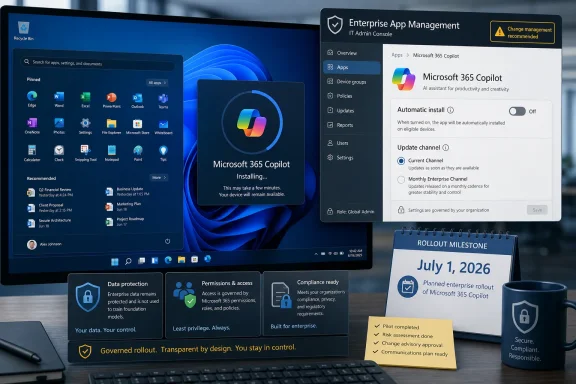
Enterprise setup screens show Microsoft 365 Copilot installing with rollout milestone, compliance, and governance alerts.Microsoft Has Reopened the Door It Briefly Pretended to Close​

The first round of automatic Microsoft 365 Copilot app installs was already controversial because it landed in the same cultural crater as every other unwanted Windows addition: promoted apps, Edge nudges, account prompts, OneDrive pressure, and Start menu experiments that seem to treat user attention as Microsoft inventory. Even if the Copilot app is technically tied to Microsoft 365 rather than Windows itself, most users experience it as another thing Microsoft put on their PC.
That distinction matters to product managers and licensing teams. It matters much less to the person who wakes a laptop, opens Start, and finds a new AI-branded app that arrived without a deliberate install. The operating system may call it a productivity surface; the user may call it bloat.
Microsoft’s own deployment documentation describes the mechanism plainly. Windows devices with Microsoft 365 desktop apps can receive the Microsoft 365 Copilot app automatically in the background, provided they meet version and channel requirements. The company also documented that automatic installation had been temporarily disabled because of a technical issue, while leaving the architecture of the rollout intact.
That is the point too many headlines miss. A pause is not a reversal. A pause is what a company does when the rollout process, messaging, or bug profile becomes too costly to continue that week.

The Copilot App Is a Beachhead, Not a Feature​

The Microsoft 365 Copilot app is easy to underestimate because, for many users, it looks like just another wrapper: a place to reach Copilot Chat, Microsoft 365 content, and AI-assisted work experiences. But Microsoft’s strategy is not to win the desktop by asking users to install a chatbot. It is to make Copilot a default workspace layer across Word, Excel, PowerPoint, Outlook, Teams, Edge, Windows, and the Microsoft 365 app ecosystem.
That makes the app less like a standalone product and more like a beachhead. Once it is present, Microsoft can route users through it, expose new licensing boundaries, promote premium Copilot features, and make “AI assistance” feel like a normal part of opening Office. The app’s presence lowers friction for Microsoft’s business model even when a user never asked for that friction to be lowered.
This is why the automatic install debate matters beyond annoyance. Microsoft is trying to normalize Copilot as infrastructure. Users are responding as if Microsoft is normalizing intrusion.
There is also a strategic asymmetry here. Microsoft can decide that Copilot belongs in the productivity suite because it owns the suite, the identity layer, the update channel, and the admin tooling. Users can object, uninstall, complain, or wait for policy controls. But unless the default changes, objection remains downstream of Microsoft’s choice.

The Admin Opt-Out Is Real, but It Is Not the Same as Consent​

For enterprise and education tenants, the most important practical detail is that administrators have a way to prevent automatic installation. Microsoft’s documented path runs through the Microsoft 365 Apps admin center, where admins can disable automatic installation for the Microsoft 365 Copilot app under modern app settings. That is meaningful control, and IT departments should use it if they do not want the app appearing across managed devices.
But opt-out control is not the same thing as opt-in consent. Microsoft has a long history of presenting administrative toggles as proof that customers are in control while still making the vendor-preferred behavior the default. In a large tenant, especially one with distributed endpoint ownership and layered change-management rules, a default can become policy simply because nobody caught the toggle in time.
The burden lands exactly where enterprise IT least wants it: on administrators who already track Patch Tuesday regressions, browser policy drift, Teams changes, Exchange Online advisories, Entra ID defaults, Intune baselines, and security exceptions. A new default install path is not “just an app.” It is another item to document, test, communicate, monitor, and defend.
That burden is sharper because Copilot is not a neutral calculator. It is an AI interface connected, at least conceptually, to organizational data, identity, permissions, and work history. Even if the app itself respects existing access controls, its arrival triggers governance questions that many organizations are still trying to answer.

AI Governance Does Not Fit Inside a Surprise Install​

Microsoft’s strongest argument for Copilot is that it inherits Microsoft 365’s permission model. In theory, Copilot should only surface what a user already has rights to access. In practice, many organizations have discovered that “already has rights” is not the same as “should be surfaced conversationally by an AI tool.”
For years, corporate file permissions have been permissive, stale, or accidental. SharePoint sites inherit groups nobody remembers. Teams channels accumulate documents long after projects end. Mailboxes contain old attachments, sensitive discussions, and compliance landmines. AI does not create all of that disorder, but it can make it searchable, summarizable, and suddenly visible.
That is why reports of Copilot-related access mistakes or unexpected exposure hit a nerve. Even when an incident turns out to be a bug, a configuration problem, or a misunderstanding of what the app can access, it reinforces the central anxiety: AI changes the consequences of messy permissions. The same file that was theoretically accessible yesterday may become practically discoverable tomorrow.
Automatic installation makes that governance problem feel backwards. Security teams want to classify data, review retention, tighten permissions, train users, and define acceptable use before the shiny interface arrives. Microsoft’s rollout model suggests the interface may arrive first, with governance catching up afterward.

Microsoft’s AI Strategy Keeps Colliding With Windows Fatigue​

The Copilot push also arrives at a bad moment for Windows trust. Windows 11 is no longer new, but it still feels unsettled to many users: redesigned settings that do not always go deep enough, Start menu tradeoffs, hardware requirements that stranded capable PCs, persistent Microsoft account pressure, and advertising-like surfaces that appear in places users once considered theirs.
Not all of that is about AI. In fact, the danger for Microsoft is that Copilot gets blamed for frustrations that predate it. When an operating system already feels too eager to promote, redirect, and personalize, an automatically installed AI app becomes evidence in a broader case.
Microsoft has attempted to modulate this perception. It has tested ways to remove or reduce some AI-related components, and it has publicly signaled at times that it understands the backlash against AI being “shoved everywhere.” But the company’s product roadmap still points in the opposite direction: Windows and Microsoft 365 are being reorganized around Copilot as an interface, not merely enhanced by it as a feature.
That is the contradiction users notice. Microsoft can say it is listening while continuing to place Copilot deeper into the daily workflow. The company may see those as compatible — refine the packaging, preserve the strategy — but users see the strategy more clearly than the packaging.

The European Exception Says the Quiet Part Out Loud​

One of the most revealing details in Microsoft’s deployment posture is that customers in the European Economic Area are treated differently. Microsoft’s documentation says EEA customers cannot enable this automatic installation path for devices with Microsoft 365 Apps. That reflects a regulatory environment where bundling, defaults, and user choice face more scrutiny than in the United States.
The practical effect is awkward. If automatic installation is genuinely harmless and customer-positive, why does geography change the default? The obvious answer is that legal and regulatory risk shapes product behavior. Microsoft is perfectly capable of giving users and organizations more explicit control when the cost of not doing so becomes high enough.
That should sharpen the debate in other markets. Users outside the EEA are not inherently less deserving of consent. They are simply less protected by the current regulatory bargain.
For IT pros, the European carve-out is also a reminder that Microsoft’s defaults are not laws of nature. They are business decisions. When those decisions change by region, channel, license, or tenant setting, administrators should treat them as policy choices to be challenged rather than technical inevitabilities to be accepted.

The Version Channel Is the Hidden Deployment Lever​

The automatic install path depends on Microsoft 365 Apps versioning and update channels, which means the rollout is not merely a Windows event. Devices need Microsoft 365 Apps Version 2511 or later, with availability tied to channels such as Current Channel and Monthly Enterprise Channel. Devices on the Semi-Annual Enterprise Channel are not in the same automatic path.
That makes update channel strategy more important than usual. Many organizations choose slower channels to reduce volatility, but Microsoft’s Copilot deployment shows that channels also determine when new product surfaces appear. In a world where AI features arrive through app updates rather than traditional OS upgrades, the Microsoft 365 Apps channel becomes a governance boundary.
This is where consumer framing fails enterprise reality. A home user may see an unwanted app. A sysadmin sees a new variable in endpoint state, help desk volume, user training, data governance, and compliance review.
The correct response is not panic. It is inventory. Admins need to know which devices are eligible, which channel they are on, whether the tenant-level opt-out is configured, whether the app is already present, and whether uninstall policies conflict with Microsoft’s own update behavior. The fight is not won by complaining after the icon appears.

Microsoft Is Selling Familiarity Before It Has Earned Trust​

The strongest case for automatic installation is that Copilot is becoming part of Microsoft 365, and Microsoft 365 is already a continuously updated cloud productivity platform. Nobody expects Word or Outlook to behave like boxed software from 2003. Features appear, panes change, buttons move, and cloud services evolve.
But Copilot is not a ribbon tweak. It is a new class of interface that can summarize, infer, generate, and act across user context. Microsoft wants Copilot to feel familiar before users have had time to decide whether it is trustworthy.
That is a risky bet. Familiarity can reduce fear, but forced familiarity can produce resistance. The more Microsoft treats Copilot as inevitable, the more skeptical users will examine every mistake as proof that inevitability is being used to bypass consent.
There is a version of this rollout that would have been easier to defend. Microsoft could have made the Copilot app a clearly announced optional install for consumers, a default-off tenant choice for businesses, and a guided deployment package for organizations that completed readiness checks. That would have slowed adoption metrics. It also would have treated AI governance as something more serious than a toggle hidden in an admin center.

Windows Users Have Seen This Movie Before​

Part of the backlash comes from memory. Microsoft has repeatedly used Windows’ privileged position to promote strategic products, from browsers and search to Teams, OneDrive, widgets, and Microsoft account flows. Each individual decision can be explained. Together, they create a pattern.
The pattern is not that Microsoft never gives users control. It often does. The pattern is that control tends to arrive after the default has served Microsoft’s distribution goals.
That history changes how Copilot is received. A company with a cleaner record might get the benefit of the doubt when it says a background install is just a productivity improvement. Microsoft gets judged against decades of bundling fights, antitrust scrutiny, and user-hostile defaults that made sense only from Redmond’s side of the glass.
This is why “you can uninstall it” is not a satisfying answer. The user’s complaint is not only that the app exists. The complaint is that the PC increasingly feels like a rented billboard for Microsoft’s current strategic priority.

The Security Argument Cuts Both Ways​

Microsoft can credibly argue that a managed, first-party Copilot app is safer than a sprawl of third-party AI tools. If employees are going to paste corporate data into chatbots, the enterprise would rather keep that activity inside Microsoft’s compliance, identity, logging, and data protection boundaries. That argument is not trivial.
But security-minded readers should be wary of the leap from “managed AI is safer than unmanaged AI” to “therefore automatic installation is appropriate.” Governance is not only about where data goes. It is also about who approves tools, how users are trained, what data is classified, what retention rules apply, and how organizations audit output-driven workflows.
A first-party AI app can reduce some risks while introducing others. It may keep prompts within a compliant environment, but it may also encourage users to ask broader questions of internal data than they otherwise would. It may respect permissions, but it may expose the consequences of permission sprawl. It may improve productivity, but it may generate output that users over-trust because it arrives under the Microsoft brand.
The responsible enterprise position is not anti-AI. It is anti-surprise. Copilot may belong in many organizations, but it belongs there through staged deployment, clear policy, and informed adoption — not through accidental discovery in the Start menu.

Microsoft’s Real Audience Is the CFO, Not the Power User​

The Copilot push is also a revenue story. Microsoft has invested heavily in AI infrastructure, partnerships, model integration, and product repositioning. Copilot licenses are a major pillar of the company’s growth narrative, and growth narratives need usage.
The automatic app install helps bridge the gap between license availability and daily behavior. If Copilot is visible, users may try it. If users try it, departments may justify licenses. If departments justify licenses, Microsoft turns AI from a capital-intensive bet into recurring revenue.
That does not make the product bad. Many Microsoft 365 customers will find real value in AI-assisted drafting, summarization, meeting synthesis, spreadsheet analysis, and document discovery. But it explains why Microsoft is so reluctant to leave Copilot as a purely optional add-on that users must seek out.
Power users often imagine they are the center of the Windows universe because they are loud, technical, and right about many interface sins. In this case, Microsoft is optimizing for a different buyer: the executive who wants AI transformation, the department head who wants productivity metrics, and the CFO who already pays for Microsoft 365 and can be persuaded to pay more.

The July Deadline Turns a Product Choice Into an IT Deadline​

If the reported July 1 completion target holds, administrators have little time to treat this as abstract platform politics. The immediate work is mundane but important: check tenant settings, review update channels, decide whether the app should be allowed, document the decision, and communicate with support teams before users start filing tickets.
For organizations that want Copilot, the automatic install may be convenient. It puts the app where users can find it and reduces packaging work. But convenience should not be confused with readiness.
For organizations that do not want Copilot yet, delay is no longer a strategy. The opt-out should be set intentionally, and endpoint management teams should verify that policy state matches reality. If the app is already installed, removal should be handled consistently rather than by ad hoc scripts that may break when Microsoft changes package names, dependencies, or update behavior.
The bigger lesson is that Microsoft 365 administration is becoming less about managing Office and more about managing a constantly expanding workspace platform. Apps, AI agents, web services, identity controls, and Windows shell experiences are converging. That convergence gives Microsoft enormous leverage — and gives administrators more places to be surprised.

The Copilot Rollout Leaves IT With a Short Checklist and a Long Memory​

Microsoft’s resumed rollout is not the end of the Copilot debate; it is the latest proof that the debate has moved from product demos to default behavior. The near-term actions are straightforward, but the long-term trust issue will linger.
  • Administrators should check the Microsoft 365 Apps admin center now if they do not want the Microsoft 365 Copilot app installed automatically across eligible devices.
  • Organizations should treat Copilot deployment as an AI governance decision, not merely as an Office app deployment.
  • Update channels now matter as policy boundaries because Microsoft can deliver major workspace changes through Microsoft 365 Apps servicing.
  • Users outside stricter regulatory regions should understand that Microsoft’s defaults are business choices, not technical necessities.
  • Security teams should review permissions and data exposure before enabling broad AI discovery across Microsoft 365 content.
  • Microsoft’s biggest risk is not that users hate AI, but that they stop trusting the company to introduce AI on reasonable terms.
Microsoft may still be right that AI will become a normal layer of productivity software. The mistake is assuming that inevitability grants permission. Copilot’s future in Windows and Microsoft 365 will depend less on whether Microsoft can install it and more on whether the company can prove it deserves to be there before users feel forced to remove it.

References​

  1. Primary source: PCWorld
    Published: Tue, 09 Jun 2026 15:28:00 GMT
  2. Official source: learn.microsoft.com
  3. Related coverage: windowslatest.com
  4. Related coverage: techtimes.com
  5. Related coverage: windowscentral.com
  6. Related coverage: winbuzzer.com
  1. Related coverage: pausehardware.com
  2. Related coverage: allthingsgeek.me
  3. Related coverage: pcguide.com
  4. Related coverage: techradar.com
  5. Related coverage: windowsforum.com
  6. Related coverage: gadgets360.com
  7. Related coverage: tomshardware.com
  8. Related coverage: pcgamer.com
  9. Official source: microsoft.com
  10. Related coverage: spscc.edu
  11. Related coverage: vendorcompliance.surf.nl
  12. Related coverage: itsguru.com
 

Back
Top