

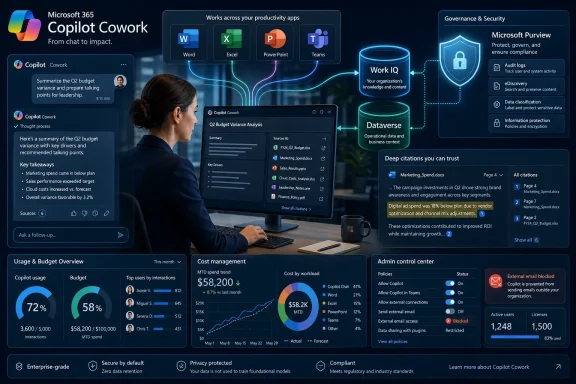
Microsoft made Copilot Cowork generally available for commercial Microsoft 365 Copilot customers in June 2026, adding usage-based billing, Work IQ business-data access, Dataverse querying, deeper citations, and new Purview-backed security and compliance controls across Microsoft 365 administration surfaces. The move is not just another monthly feature drop. It is Microsoft’s clearest admission yet that enterprise AI has entered its uncomfortable second phase: the assistant is becoming an actor, and the actor now needs a budget, an audit trail, and a leash.
Copilot Cowork’s general availability matters because it changes the implied contract between Microsoft 365 and the people who administer it. Traditional Copilot answers questions, drafts text, summarizes meetings, and helps users move faster inside familiar apps. Cowork is pitched as something more ambitious: an agent that can complete multi-step work, operate across files and business systems, and keep running while the user moves on.
That distinction is not marketing trivia. A chatbot that produces a bad paragraph wastes time; an agent that edits spreadsheets, creates PowerPoint decks, queries records, invokes plugins, and pushes long-running task notifications can affect business state. It can generate artifacts people may treat as work product. It can also spend money each time it acts.
Microsoft’s decision to put Cowork behind a toggle inside Copilot Chat is therefore both elegant and a little dangerous. The interface suggests continuity — same Copilot family, same conversational surface, same Microsoft 365 trust boundary. But the operating model has changed. Users are no longer merely asking Copilot what it knows; they are asking Cowork to do things on their behalf.
That is why the real story is not simply that Cowork is generally available. The story is that Microsoft is trying to normalize agentic AI inside the productivity suite before most organizations have fully digested the governance implications of the first Copilot wave.
That is a subtle but important shift. If Copilot can switch among models for different task types, Microsoft can sell enterprises a procurement abstraction: do not negotiate separately with every model provider, do not wire every agent into your tenant yourself, and do not invent a governance layer from scratch. Let Microsoft broker the models while IT keeps its hands on policy.
This is also why Cowork’s support for multiple models, custom skills, business-system plugins, image generation, branded PowerPoint templates, browser-based actions, and long-running notifications should be read as one package. Microsoft is not building a single assistant feature. It is building an execution layer for office work.
The execution layer is attractive because knowledge work is full of messy, repeated, cross-application chores that were never worth turning into formal software projects. Pull the latest numbers, compare two product versions, generate a deck in the company template, summarize a pipeline, create follow-ups, and alert the user when the job is done. That is exactly the territory where an agent can feel magical — and exactly where it can quietly create unreviewed operational risk.
Work IQ is being positioned as the connective tissue between Microsoft 365 Copilot and the organization’s work graph: documents, meetings, chats, emails, calendars, reports, semantic models, and business records. In the June update, Microsoft emphasized richer answers from Power BI reports and semantic models, giving users a way to ask natural-language questions and receive business insights without leaving Copilot.
The Dataverse integration pushes the same idea deeper into line-of-business data. If employees can query and analyze Dataverse records from Copilot Chat, Microsoft starts to blur the boundary between productivity assistant and business application front end. The promise is obvious: fewer app switches, fewer custom reports, faster access to operational information.
But the risk is equally obvious. The more useful Copilot becomes, the more it depends on the quality of identity, permissions, metadata, labels, and data architecture that many tenants have accumulated haphazardly over years. AI does not create oversharing in SharePoint, stale groups in Entra ID, or poorly classified business records. It merely makes those problems searchable, summarizable, and operationally convenient.
That is the uncomfortable bargain behind Work IQ. Microsoft can make organizational knowledge feel conversational, but it cannot make a messy tenant clean by inference. If Copilot can see too much, Cowork can potentially act on too much.
For users, deep citations reduce the friction of verification. Instead of receiving a polished answer and then spelunking through a source document to find out whether Copilot got it right, a worker can jump closer to the originating passage. That matters in regulated work, legal review, finance, HR, engineering, and any setting where an answer without provenance is worse than no answer at all.
For admins and compliance teams, citations also help establish a more realistic culture around Copilot output. The correct mental model is not “the AI knows.” It is “the AI assembled an answer from accessible sources, and those sources must be inspectable.” Deep citations nudge users toward that model.
Still, citations are not a cure for hallucination, outdated source material, or bad permissions. They make errors easier to catch; they do not prevent every error from being generated. Microsoft’s challenge is to keep improving provenance without training users to treat a citation as a stamp of truth.
That variable consumption is why Microsoft is giving administrators controls for usage-based billing, budgets, credit allocation, spending policies, usage limits, prepaid credits, and pay-as-you-go models. The dashboard is not merely a finance convenience. It is the mechanism by which IT can decide whether Cowork is a broad productivity tool, a controlled pilot, or a specialized capability for teams with clear business cases.
This is where the Copilot story starts to resemble cloud infrastructure. The first generation of SaaS trained organizations to count seats. Azure and AWS trained them to watch consumption. Cowork brings that cloud-cost discipline into the productivity suite, where many employees have never had to think about the marginal cost of an action.
That will create cultural friction. If a user asks Cowork to grind through a complex task, who owns the bill — the user, the department, central IT, or the business unit that benefits? If the answer is “everyone and no one,” the dashboard will become a postmortem tool rather than a governance control.
Microsoft appears to understand that risk. Group- and team-level cost reporting, granular agent metrics, scoped spending policies, and usage limits are all designed to prevent AI enthusiasm from turning into surprise invoices. But tools are only half the issue. Organizations will need norms: what tasks are worth agentic execution, which teams get higher caps, when to use cheaper models, and when human judgment is still the better bargain.
That matters because agents create new records of intent. A prompt is not just a search query. It can be an instruction, a business request, a disclosure event, or evidence of a risky pattern. A response is not just text. It may include summarized sensitive information, generated artifacts, or references to business documents.
If Cowork is to be used in legal, finance, healthcare, government, defense, or heavily regulated corporate environments, those interactions must be auditable and discoverable. They must inherit labels when appropriate. They must be subject to retention and investigation policies. They must be visible to the security teams responsible for detecting misuse.
Microsoft’s Purview story is therefore not a bolt-on. It is the enterprise argument for Copilot as opposed to unmanaged consumer AI. The company is effectively saying: yes, the agent can act, but it acts inside the Microsoft 365 compliance perimeter.
That claim will be tested. Earlier Copilot privacy and DLP incidents have made administrators wary of assurances that policy will always be enforced correctly. The new controls are welcome precisely because trust was not automatic. Microsoft now has to prove through reliability, transparency, and incident response that the compliance boundary is more than a diagram.
Email from outside the organization is uniquely risky. It can contain malicious instructions, spoofed business context, confidential third-party data, legal traps, phishing lures, and content the recipient is allowed to read but the organization may not want fed into automated reasoning. Humans have spent decades learning to treat external email with suspicion. Copilot needs its own version of that suspicion.
The control also reflects a growing recognition that AI security is not only about stopping data from leaving the tenant. It is also about controlling what data gets used to shape an answer. Grounding is power. If hostile or untrusted content can influence a response, then Copilot becomes a new surface for prompt injection, social engineering, and subtle workflow manipulation.
Blocking external email from Copilot context will not solve every problem. Users can still copy content manually, open attachments, click links, or ask Cowork to reason over documents created from external material. But it gives administrators a meaningful lever at the point where AI systems are most vulnerable: the moment they decide what information counts as context.
A SharePoint setting misconfigured in 2020 might have exposed too much data to too many employees. Copilot makes that exposure easier to discover. Cowork may make it easier to operationalize. Work IQ may make it easier to combine with business data. Plugins may make it easier to push into other systems. The blast radius is not necessarily new, but the velocity is.
That is why IT departments should resist treating Cowork as a simple feature enablement decision. The toggle is not the policy. The policy is who gets access, what systems Cowork can touch, which models are allowed, how much spend is permitted, what labels block processing, how external email is handled, what gets retained, who reviews risky interactions, and how exceptions are approved.
The administrative burden is real. Microsoft is giving customers more knobs because the product now needs them. But every new knob also requires ownership. Security teams, compliance officers, finance, legal, records managers, app owners, and department heads all have legitimate stakes in whether Cowork is enabled and how broadly it spreads.
That cross-functional governance may slow deployments. It should. The organizations that treat Cowork as a novelty will eventually discover that agentic AI has a way of becoming infrastructure once users depend on it.
The update also mentions organizational messages adding support for hybrid-joined devices, allowing admins to deliver in-product communications to users on machines connected to both on-premises Active Directory and Microsoft Entra ID. That detail will matter to the many enterprises that still live in hybrid reality, not cloud-only architecture diagrams. Microsoft’s AI push may be cloud-first, but its customer base remains stubbornly mixed.
Admins can also control access to Vision features in Microsoft 365, another sign that multimodal AI is being brought under enterprise policy rather than left as an app-level curiosity. Screens, images, documents, and browser contexts are all becoming potential AI inputs. Endpoint governance will increasingly mean governing what AI can perceive, not just what software can run.
This is where Windows management and Microsoft 365 governance converge. An organization that wants to deploy Cowork responsibly needs clean identity, sensible conditional access, device compliance, app protection, data classification, browser policy, and user education. The agent may live in Copilot, but the control environment spans the whole estate.
Cowork aims directly at that gap. It can help with multi-step tasks that are too bespoke for traditional automation and too tedious for humans to repeat manually. It can work across content types, generate outputs in branded formats, and bring business data into the flow of conversation. For many teams, that is exactly the kind of AI that finally feels less like a demo and more like a tool.
But the organizations most likely to benefit are also the ones least likely to treat governance as an afterthought. They will have already done the boring work: tightening permissions, rationalizing groups, labeling sensitive content, defining retention policies, mapping business data ownership, piloting with specific use cases, and training users to verify AI-generated work.
That is the irony of agentic AI adoption. The flashy demos reward imagination, but successful deployment rewards discipline. Cowork will be most useful in tenants that are least chaotic.
 Microsoft Turns Copilot From a Chat Window Into an Office Worker
Copilot Cowork’s general availability matters because it changes the implied contract between Microsoft 365 and the people who administer it. Traditional Copilot answers questions, drafts text, summarizes meetings, and helps users move faster inside familiar apps. Cowork is pitched as something more ambitious: an agent that can complete multi-step work, operate across files and business systems, and keep running while the user moves on.That distinction is not marketing trivia. A chatbot that produces a bad paragraph wastes time; an agent that edits spreadsheets, creates PowerPoint decks, queries records, invokes plugins, and pushes long-running task notifications can affect business state. It can generate artifacts people may treat as work product. It can also spend money each time it acts.
Microsoft’s decision to put Cowork behind a toggle inside Copilot Chat is therefore both elegant and a little dangerous. The interface suggests continuity — same Copilot family, same conversational surface, same Microsoft 365 trust boundary. But the operating model has changed. Users are no longer merely asking Copilot what it knows; they are asking Cowork to do things on their behalf.
That is why the real story is not simply that Cowork is generally available. The story is that Microsoft is trying to normalize agentic AI inside the productivity suite before most organizations have fully digested the governance implications of the first Copilot wave.
The Anthropic Partnership Is a Product Strategy, Not a Footnote
Cowork was built in collaboration with Anthropic, and that matters because Microsoft’s AI strategy is no longer reducible to “OpenAI inside Office.” Microsoft has spent years training customers to think of Copilot as the enterprise-friendly wrapper around frontier models, but Cowork makes the wrapper itself the strategic asset. The model underneath can vary; the admin surface, data boundary, identity layer, billing system, and compliance story remain Microsoft’s.That is a subtle but important shift. If Copilot can switch among models for different task types, Microsoft can sell enterprises a procurement abstraction: do not negotiate separately with every model provider, do not wire every agent into your tenant yourself, and do not invent a governance layer from scratch. Let Microsoft broker the models while IT keeps its hands on policy.
This is also why Cowork’s support for multiple models, custom skills, business-system plugins, image generation, branded PowerPoint templates, browser-based actions, and long-running notifications should be read as one package. Microsoft is not building a single assistant feature. It is building an execution layer for office work.
The execution layer is attractive because knowledge work is full of messy, repeated, cross-application chores that were never worth turning into formal software projects. Pull the latest numbers, compare two product versions, generate a deck in the company template, summarize a pipeline, create follow-ups, and alert the user when the job is done. That is exactly the territory where an agent can feel magical — and exactly where it can quietly create unreviewed operational risk.
Work IQ Is Microsoft’s Answer to the Context Problem
The most persistent enterprise complaint about generative AI is not that it cannot write fluent prose. It is that it often lacks the right context, cannot reliably reach the systems where business facts live, and returns answers that sound confident even when they are grounded in stale or incomplete information. Microsoft’s Work IQ branding is the company’s attempt to turn that weakness into a platform advantage.Work IQ is being positioned as the connective tissue between Microsoft 365 Copilot and the organization’s work graph: documents, meetings, chats, emails, calendars, reports, semantic models, and business records. In the June update, Microsoft emphasized richer answers from Power BI reports and semantic models, giving users a way to ask natural-language questions and receive business insights without leaving Copilot.
The Dataverse integration pushes the same idea deeper into line-of-business data. If employees can query and analyze Dataverse records from Copilot Chat, Microsoft starts to blur the boundary between productivity assistant and business application front end. The promise is obvious: fewer app switches, fewer custom reports, faster access to operational information.
But the risk is equally obvious. The more useful Copilot becomes, the more it depends on the quality of identity, permissions, metadata, labels, and data architecture that many tenants have accumulated haphazardly over years. AI does not create oversharing in SharePoint, stale groups in Entra ID, or poorly classified business records. It merely makes those problems searchable, summarizable, and operationally convenient.
That is the uncomfortable bargain behind Work IQ. Microsoft can make organizational knowledge feel conversational, but it cannot make a messy tenant clean by inference. If Copilot can see too much, Cowork can potentially act on too much.
Deep Citations Are a Trust Feature Masquerading as a Convenience
The new “deep citations” capability looks modest compared with Cowork’s agentic pitch, but it may prove more important for day-to-day adoption. Microsoft says Copilot responses can now link directly to specific sections of source files, beginning with Word and PowerPoint support and expanding later to meetings, web content, and PDFs. That is not just a nicer citation experience. It is a concession that enterprise AI must become easier to challenge.For users, deep citations reduce the friction of verification. Instead of receiving a polished answer and then spelunking through a source document to find out whether Copilot got it right, a worker can jump closer to the originating passage. That matters in regulated work, legal review, finance, HR, engineering, and any setting where an answer without provenance is worse than no answer at all.
For admins and compliance teams, citations also help establish a more realistic culture around Copilot output. The correct mental model is not “the AI knows.” It is “the AI assembled an answer from accessible sources, and those sources must be inspectable.” Deep citations nudge users toward that model.
Still, citations are not a cure for hallucination, outdated source material, or bad permissions. They make errors easier to catch; they do not prevent every error from being generated. Microsoft’s challenge is to keep improving provenance without training users to treat a citation as a stamp of truth.
Cost Management Is the Governance Feature Everyone Will Actually Notice
Microsoft’s new Cost Management Dashboard in the Microsoft 365 admin center may sound like a back-office detail, but it is central to Cowork’s enterprise fate. Agentic AI is expensive in a way traditional SaaS seats are not. A user license gives predictable access; an agent that plans, reasons, invokes tools, generates files, queries systems, and runs for a while introduces variable consumption.That variable consumption is why Microsoft is giving administrators controls for usage-based billing, budgets, credit allocation, spending policies, usage limits, prepaid credits, and pay-as-you-go models. The dashboard is not merely a finance convenience. It is the mechanism by which IT can decide whether Cowork is a broad productivity tool, a controlled pilot, or a specialized capability for teams with clear business cases.
This is where the Copilot story starts to resemble cloud infrastructure. The first generation of SaaS trained organizations to count seats. Azure and AWS trained them to watch consumption. Cowork brings that cloud-cost discipline into the productivity suite, where many employees have never had to think about the marginal cost of an action.
That will create cultural friction. If a user asks Cowork to grind through a complex task, who owns the bill — the user, the department, central IT, or the business unit that benefits? If the answer is “everyone and no one,” the dashboard will become a postmortem tool rather than a governance control.
Microsoft appears to understand that risk. Group- and team-level cost reporting, granular agent metrics, scoped spending policies, and usage limits are all designed to prevent AI enthusiasm from turning into surprise invoices. But tools are only half the issue. Organizations will need norms: what tasks are worth agentic execution, which teams get higher caps, when to use cheaper models, and when human judgment is still the better bargain.
Purview Becomes the Copilot Control Plane Microsoft Always Needed
The most important compliance updates are not glamorous, but they are the ones that make Cowork plausible in real enterprises. Microsoft says Cowork interactions now tie into Purview capabilities including audit logging, sensitivity label inheritance and display, Insider Risk Management, Data Security Posture Management Activity Explorer, Data Lifecycle Management, eDiscovery, and Communication Compliance. In plain English: Cowork activity is being pulled into the same governance fabric that already supervises Microsoft 365 data.That matters because agents create new records of intent. A prompt is not just a search query. It can be an instruction, a business request, a disclosure event, or evidence of a risky pattern. A response is not just text. It may include summarized sensitive information, generated artifacts, or references to business documents.
If Cowork is to be used in legal, finance, healthcare, government, defense, or heavily regulated corporate environments, those interactions must be auditable and discoverable. They must inherit labels when appropriate. They must be subject to retention and investigation policies. They must be visible to the security teams responsible for detecting misuse.
Microsoft’s Purview story is therefore not a bolt-on. It is the enterprise argument for Copilot as opposed to unmanaged consumer AI. The company is effectively saying: yes, the agent can act, but it acts inside the Microsoft 365 compliance perimeter.
That claim will be tested. Earlier Copilot privacy and DLP incidents have made administrators wary of assurances that policy will always be enforced correctly. The new controls are welcome precisely because trust was not automatic. Microsoft now has to prove through reliability, transparency, and incident response that the compliance boundary is more than a diagram.
External Email Is the Canary in the Copilot Mine
One of the most practical new controls lets administrators restrict external emails from being referenced by Microsoft 365 Copilot and Copilot Chat. Admins can configure Copilot so outside messages are not included in summaries, cited as references, or used as context when generating AI responses. That may sound narrow, but it reveals a lot about where AI governance is heading.Email from outside the organization is uniquely risky. It can contain malicious instructions, spoofed business context, confidential third-party data, legal traps, phishing lures, and content the recipient is allowed to read but the organization may not want fed into automated reasoning. Humans have spent decades learning to treat external email with suspicion. Copilot needs its own version of that suspicion.
The control also reflects a growing recognition that AI security is not only about stopping data from leaving the tenant. It is also about controlling what data gets used to shape an answer. Grounding is power. If hostile or untrusted content can influence a response, then Copilot becomes a new surface for prompt injection, social engineering, and subtle workflow manipulation.
Blocking external email from Copilot context will not solve every problem. Users can still copy content manually, open attachments, click links, or ask Cowork to reason over documents created from external material. But it gives administrators a meaningful lever at the point where AI systems are most vulnerable: the moment they decide what information counts as context.
Admins Are Being Asked to Govern a Moving Target
The June Copilot updates arrive with a familiar Microsoft rhythm: new capabilities, new admin controls, new dashboards, new roadmap promises, and a certain amount of operational ambiguity. That is not unusual for Microsoft 365. What is different is the speed at which AI features change the risk model.A SharePoint setting misconfigured in 2020 might have exposed too much data to too many employees. Copilot makes that exposure easier to discover. Cowork may make it easier to operationalize. Work IQ may make it easier to combine with business data. Plugins may make it easier to push into other systems. The blast radius is not necessarily new, but the velocity is.
That is why IT departments should resist treating Cowork as a simple feature enablement decision. The toggle is not the policy. The policy is who gets access, what systems Cowork can touch, which models are allowed, how much spend is permitted, what labels block processing, how external email is handled, what gets retained, who reviews risky interactions, and how exceptions are approved.
The administrative burden is real. Microsoft is giving customers more knobs because the product now needs them. But every new knob also requires ownership. Security teams, compliance officers, finance, legal, records managers, app owners, and department heads all have legitimate stakes in whether Cowork is enabled and how broadly it spreads.
That cross-functional governance may slow deployments. It should. The organizations that treat Cowork as a novelty will eventually discover that agentic AI has a way of becoming infrastructure once users depend on it.
Windows Shops Will Feel This Beyond the Browser
For WindowsForum readers, the Microsoft 365 framing should not obscure the endpoint implications. Copilot is increasingly experienced across Windows, Edge, Office apps, Teams, and the browser, while admin control lives across Microsoft 365, Entra, Purview, Intune, and related security surfaces. The boundary between “desktop feature” and “cloud productivity service” keeps getting thinner.The update also mentions organizational messages adding support for hybrid-joined devices, allowing admins to deliver in-product communications to users on machines connected to both on-premises Active Directory and Microsoft Entra ID. That detail will matter to the many enterprises that still live in hybrid reality, not cloud-only architecture diagrams. Microsoft’s AI push may be cloud-first, but its customer base remains stubbornly mixed.
Admins can also control access to Vision features in Microsoft 365, another sign that multimodal AI is being brought under enterprise policy rather than left as an app-level curiosity. Screens, images, documents, and browser contexts are all becoming potential AI inputs. Endpoint governance will increasingly mean governing what AI can perceive, not just what software can run.
This is where Windows management and Microsoft 365 governance converge. An organization that wants to deploy Cowork responsibly needs clean identity, sensible conditional access, device compliance, app protection, data classification, browser policy, and user education. The agent may live in Copilot, but the control environment spans the whole estate.
The Productivity Pitch Is Strongest Where the Governance Is Boring
Microsoft’s best argument for Cowork is not that it is futuristic. It is that modern office work is already full of invisible automation gaps. Employees stitch together Outlook, Teams, Excel, PowerPoint, Power BI, SharePoint, Dynamics, custom apps, PDFs, and browser workflows because the official systems rarely map cleanly to how work actually happens.Cowork aims directly at that gap. It can help with multi-step tasks that are too bespoke for traditional automation and too tedious for humans to repeat manually. It can work across content types, generate outputs in branded formats, and bring business data into the flow of conversation. For many teams, that is exactly the kind of AI that finally feels less like a demo and more like a tool.
But the organizations most likely to benefit are also the ones least likely to treat governance as an afterthought. They will have already done the boring work: tightening permissions, rationalizing groups, labeling sensitive content, defining retention policies, mapping business data ownership, piloting with specific use cases, and training users to verify AI-generated work.
That is the irony of agentic AI adoption. The flashy demos reward imagination, but successful deployment rewards discipline. Cowork will be most useful in tenants that are least chaotic.
The June Drop Redraws the Copilot Bargain
The practical message for IT is not to panic, and it is not to blindly enable everything. Microsoft has made Cowork generally available, expanded Copilot’s access to business data through Work IQ and Dataverse, added verification improvements through deep citations, and introduced the cost and compliance controls that make those moves administratively survivable. That combination is the new bargain.- Copilot Cowork should be treated as an agentic execution capability, not merely another chat feature inside Microsoft 365.
- Usage-based billing means departments need budgets, caps, reporting, and clear rules for which workloads justify agentic AI spend.
- Work IQ and Dataverse integration make Copilot more useful, but they also amplify the consequences of poor permissions and weak data governance.
- Deep citations improve verifiability, but they do not eliminate the need for human review of important AI-generated work.
- Purview controls are becoming essential infrastructure for Copilot deployments, especially where audit, eDiscovery, retention, DLP, and insider-risk requirements apply.
- External email restrictions are a sensible early control because untrusted content should not automatically become trusted AI context.
References
- Primary source: Petri IT Knowledgebase
Published: Thu, 02 Jul 2026 12:48:45 GMT
Loading…
petri.com - Official source: microsoft.com
Copilot Cowork is now generally available | Microsoft 365 Blog
Copilot Cowork is now generally available worldwide, bringing secure, AI-powered automation for complex enterprise tasks in Microsoft 365.www.microsoft.com - Official source: techcommunity.microsoft.com
Loading…
techcommunity.microsoft.com - Related coverage: cowork.tips
Loading…
www.cowork.tips - Related coverage: kesslernity.com
Understanding Microsoft 365 Copilot: 2026 Licensing Reference
What's included at each tier, how E3 and E5 affect your options, what Wave 3 adds — and how Claude fits into the M365 Copilot platform.www.kesslernity.com
- Related coverage: aguidetocloud.com
What's New in Microsoft 365 Copilot: June 2026
June 2026 brought Build: Microsoft Scout, Copilot Cowork GA, Claude in Copilot Chat, Federated Connectors GA and Word edits by default — in plain English.www.aguidetocloud.com
- Related coverage: windowscentral.com
This is Microsoft's new "Copilot Cowork": An experiment with Anthropic's Claude AI models that plans and delegates your work | Windows Central
Microsoft ships Copilot Cowork to its Frontier program.www.windowscentral.com - Related coverage: universal.cloud
Loading…
universal.cloud - Official source: news.microsoft.com
Copilot Cowork ya está disponible de forma general - Source EMEA
 news.microsoft.com
- Official source: directionsonmicrosoft.com
Microsoft’s Copilot Cowork Gets Model Choice Plus Usage-Based Billing - Directions on Microsoft
Microsoft’s Copilot 365’s Cowork feature, which is generally available worldwide as of June 16, will offer customers a choice of models and won’t be solely Anthropic-based as it is currently. Microsoft also is adding usage-based...www.directionsonmicrosoft.com - Related coverage: itpro.com
Copilot Cowork is now generally available: Everything you need to know, including pricing, usage limits, and new features | IT Pro
Microsoft has announced that Copilot Cowork is now generally available for users globally, following a beta period via the tech giant’s Frontier program.www.itpro.com - Related coverage: techradar.com
'The era of Copilot execution is here': Microsoft's Copilot Cowork is here with Anthropic AI to conquer all your biggest work tasks | TechRadar
Microsoft wants Copilot to 'take action' with your workwww.techradar.com - Related coverage: avantiico.com
Loading…
avantiico.com - Official source: adoption.microsoft.com
- Official source: learn.microsoft.com
Loading…
learn.microsoft.com - Related coverage: copilotconsulting.com
Microsoft Purview and Copilot | Copilot Consulting
Microsoft Purview is the compliance backbone for every Microsoft 365 Copilot deployment. Without Purview, you have no visibility into what Copilot is accessi...www.copilotconsulting.com - Related coverage: windowsforum.com
Loading…
windowsforum.com - Related coverage: onefrequencyconsulting.com
Loading…
www.onefrequencyconsulting.com - Related coverage: epcgroup.net
Loading…
www.epcgroup.net - Related coverage: labs.cloudsecurityalliance.org
CSA research note M365 Copilot CVE 2026 24299 20260505 csa styled
PDF documentlabs.cloudsecurityalliance.org