
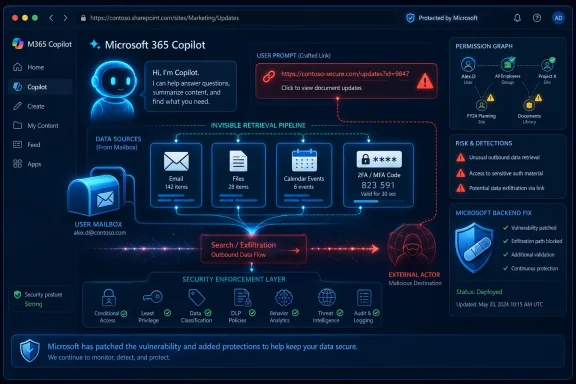
Microsoft patched CVE-2026-42824, a Microsoft 365 Copilot Enterprise Search vulnerability chain disclosed by Varonis in June 2026, after researchers showed that a crafted link could make Copilot retrieve and leak user-accessible emails, files, calendar details, and MFA codes. The bug, dubbed SearchLeak, is not just another entry in the monthly vulnerability ledger. It is a warning about what happens when enterprise search, generative AI, and inherited permissions become one system. Microsoft fixed the immediate flaw, but the architecture that made it frightening is now part of everyday corporate computing.
The selling point of Microsoft 365 Copilot is that it can see what you are allowed to see. It can summarize the email you forgot, find the spreadsheet buried in a SharePoint site, connect the meeting invite to the draft deck, and turn the sprawl of Microsoft 365 into something that feels conversational. For productivity, that is the magic trick.
For security, it is also the danger. SearchLeak mattered because it did not require the attacker to break into a mailbox in the traditional sense. The proof of concept instead abused the assistant sitting in front of the mailbox, using the victim’s own access as the fuel for exfiltration.
That distinction is more than semantic. In a conventional phishing campaign, the attacker tries to steal credentials, persuade the user to approve an MFA prompt, or lure them to a fake login page. In SearchLeak, the user’s click allegedly triggered a chain in which Copilot itself became the retrieval mechanism. The assistant did not need to be malicious; it only needed to be obedient in the wrong context.
Microsoft’s backend remediation appears to have closed the demonstrated path, and there are no confirmed reports of in-the-wild exploitation. But the incident lands at an awkward moment for enterprise AI adoption. CIOs have spent the past two years being told that copilots are safe because they respect existing permissions. SearchLeak shows why that answer is incomplete: respecting bad, broad, stale, or misunderstood permissions can still produce a breach-shaped outcome.
The first piece was parameter-to-prompt injection, a form of indirect prompt injection in which attacker-controlled instructions are smuggled into a place the AI system treats as relevant input. Instead of asking the victim to type a malicious prompt, the attacker places instructions inside a crafted URL or retrievable content. The user sees a link; the assistant sees something closer to an instruction.
The second piece was an HTML rendering race condition. In plain English, the researchers said Copilot could briefly render attacker-controlled output before protective processing fully neutralized it. Race conditions are old web security problems, but AI products give them new terrain because generated output arrives in streams, gets transformed, and is then displayed in a browser-like interface.
The third piece was a content security policy bypass involving Bing and server-side request forgery behavior. The practical effect, according to the research, was that stolen data could be embedded in a request that appeared to travel through trusted Microsoft infrastructure rather than directly to a suspicious domain. That is the kind of detail that keeps defenders awake, because many enterprise controls are built around the assumption that known cloud services are safer pathways.
None of those ingredients is conceptually new. Prompt injection, HTML sanitization gaps, and SSRF have all been studied before. SearchLeak is important because it joined them inside an AI retrieval workflow connected to enterprise data. The result was not a chatbot saying something embarrassing; it was a path from a user click to private organizational content.
Most enterprises have permission sprawl. SharePoint sites linger after projects end. Finance folders inherit access from old groups. Executives delegate mailboxes. Teams channels accumulate guests, contractors, and cross-functional members. OneDrive links are created for a meeting and forgotten for years. In that environment, “the AI only sees what the user can see” is less a guarantee than a mirror held up to years of access debt.
Copilot makes that debt more liquid. A human employee with access to 50,000 documents may never manually search through them all. A retrieval system can. A user may not know that a confidential spreadsheet is technically available to them. Copilot might find it because it is semantically relevant to a request.
That is why SearchLeak’s lesson extends beyond this CVE. AI assistants compress the distance between theoretical access and practical exposure. Data that was protected mostly by obscurity, friction, or organizational forgetfulness becomes easier to surface, summarize, and leak.
Security teams have long warned that least privilege is not an aesthetic preference; it is damage control. Copilot turns that principle into a deployment requirement. If a user’s access graph is messy, the assistant inherits the mess. If a tenant’s labels and DLP policies are inconsistent, the assistant operates inside that inconsistency. If governance is treated as a post-launch cleanup exercise, the AI rollout becomes a discovery engine for the attacker as much as the employee.
That does not mean every organization was one click away from universal compromise. Proofs of concept are controlled demonstrations, not automatic mass exploitation. The impact would depend on the user, the tenant, the availability of sensitive content, the timing of codes, and the exact state of Microsoft’s mitigations. Still, the example is plausible enough to be unsettling because many organizations continue to route security codes, password resets, approval notices, and recovery messages through email.
The deeper problem is that enterprise mailboxes are not just correspondence archives. They are identity infrastructure by accident. They contain reset links, invoice approvals, HR documents, legal discussions, travel plans, confidential attachments, calendar metadata, and internal politics. A search assistant with mailbox access therefore sits near the nervous system of the company.
SearchLeak also challenges the comforting belief that sensitivity labels and DLP policies are enough on their own. If an AI retrieval chain can cause protected data to be summarized, transformed, embedded, or transmitted through an unexpected path, then the policy engine is no longer watching the same clean boundary it was designed to enforce. DLP still matters, but it cannot be the only line of defense when the data movement occurs through generated content and trusted cloud services.
This is the security story enterprise AI vendors would rather not lead with. The most useful assistants are the ones that cross application boundaries. They read mail, scan files, understand chats, and join the dots. But each crossed boundary creates a new place where intent, identity, content, and policy have to be interpreted correctly at machine speed.
But a server-side fix can encourage the wrong kind of relief. The immediate exploit chain may be gone, yet the conditions that made it valuable remain common. Copilot still depends on tenant data hygiene. It still derives much of its usefulness from broad integration. It still operates in a world where links, prompts, retrieved documents, search results, and generated output collide.
The severity discussion is instructive. Some vulnerability records described a medium CVSS score, while Microsoft reportedly assigned maximum critical severity in its own handling. That discrepancy is not unusual, and it is not necessarily contradictory. CVSS is a technical scoring framework. Enterprise risk includes blast radius, customer trust, privilege boundaries, data sensitivity, and the possibility of chaining a bug into a business-impacting event.
For administrators, the classification debate is less important than the operational lesson. If a flaw can leak mailbox contents, SharePoint files, meeting details, or MFA codes for a targeted user, it deserves attention even if the numerical score looks ordinary. Security teams already know this from years of Exchange, SharePoint, and identity incidents: the number on the advisory is not always the same as the number in the incident room.
SearchLeak should also make organizations more skeptical of vendor reassurances framed only around platform fixes. “No action required” can be true for the patch and false for the program. Customers may not need to install an update, but they still need to review what Copilot can reach, what sensitive data lives in mailboxes, and whether their controls assume a pre-AI model of data access.
That makes the retrieval layer a security boundary. Not in the old sense of a firewall or an authentication prompt, but in the practical sense that it decides which private facts become available in which context. If an attacker can influence retrieval or output, they can potentially influence what the assistant discloses.
This is why indirect prompt injection has become one of the defining AI security problems. The assistant must consume untrusted text to be useful. Emails, web pages, documents, tickets, calendar invites, and chat messages are all potential input. Some of that input may contain instructions that look meaningful to the model but were never intended to be commands.
Traditional software draws a sharper line between data and instructions. AI systems blur that line by design. A phrase in a document can be context, content, instruction, or adversarial payload depending on how the model and surrounding application process it. SearchLeak sits squarely in that ambiguity.
The industry’s first wave of AI governance often focused on whether employees would paste secrets into public chatbots. That was a real concern, but it was the easy version of the problem. The harder version is what happens when the chatbot is inside the tenant, approved by procurement, connected to corporate identity, and marketed as compliant. At that point, the risk is not shadow AI. It is sanctioned AI with too much reach and too much trust.
The user interface is a browser. The assistant is a language model wrapped in product logic. The data lives across Exchange Online, OneDrive, SharePoint, Teams, and calendars. The exfiltration path may involve image loading, search infrastructure, and allowed domains. A defender looking only at one layer sees fragments.
Attackers love seams. The seam between prompt and parameter. The seam between streaming output and sanitization. The seam between trusted Microsoft services and customer-controlled destinations. The seam between what a user is allowed to access and what a user intended to disclose.
This is not a Microsoft-only problem. Google Workspace, Slack, Salesforce, ServiceNow, Atlassian, and every SaaS platform racing to add AI assistants face the same structural pressure. The more deeply an assistant integrates, the more valuable it becomes. The more valuable it becomes, the more attractive it is as an attack surface.
Microsoft is simply the most visible case because Microsoft 365 is where so much enterprise work already lives. A Copilot flaw is not merely a chatbot flaw; it is a possible route into the document repository, the mailbox, the meeting calendar, and the collaboration graph. That concentration is why even a patched proof of concept deserves more than a shrug.
An AI assistant may not move a labeled file intact. It may extract a sentence, summarize a table, combine two documents, or place sensitive data inside generated HTML. It may answer in a way that is derived from restricted material without reproducing the original file. The boundary between content and inference becomes harder to police.
SearchLeak reportedly demonstrated a DLP bypass scenario because the leakage occurred through the assistant’s generated response and a web request path rather than through a normal file transfer. That is the future headache. The sensitive object is no longer just a document being downloaded. It is information being transformed.
This is where security teams need to update their mental model. Protecting the file is not enough if the assistant can disclose the fact. Protecting the download button is not enough if the summary contains the secret. Protecting the obvious outbound connection is not enough if a trusted service becomes the relay.
None of this means DLP is obsolete. It means DLP has to be paired with AI-aware controls: retrieval restrictions, prompt-injection defenses, output filtering, session logging, context isolation, and a much cleaner permission model. The control plane must move closer to the AI workflow itself.
That starts with permissions. Administrators should review broad SharePoint access, stale Microsoft 365 groups, overshared OneDrive folders, inherited permissions, executive mailbox delegation, and guest access. These are not glamorous tasks, but they are exactly the tasks that determine whether an AI retrieval exploit finds trivia or treasure.
It also requires better visibility into AI activity. If Copilot searches a mailbox in an unusual way, retrieves a burst of sensitive documents, or touches content outside a user’s normal working pattern, security teams should be able to see that. Logs that were good enough for human search may not be good enough for AI-mediated search because the speed and semantic breadth are different.
Organizations should also stop treating AI rollout as a licensing project. Buying Copilot seats is easy. Governing them is the work. The right question is not “Who wants Copilot?” but “Which users, repositories, labels, and workflows can safely participate in AI retrieval today?”
For many companies, the honest answer will be phased adoption. Give Copilot to groups with cleaner data boundaries first. Exclude repositories that contain legal, finance, M&A, HR, credentials, or regulated records until access reviews are complete. Use pilots not just to measure productivity, but to measure what the assistant can unexpectedly find.
The new governance question is operational: what happens when the AI does something with authorized data that the user did not understand, request, or intend? That question cuts across identity, endpoint, network, SaaS administration, legal, compliance, and incident response. It cannot be solved by the AI team alone.
Incident response plans need to include AI retrieval logs. Red teams need to test indirect prompt injection against approved tools. Data owners need to know which repositories are indexed. Security architects need to decide whether certain classes of content should be excluded from AI access even when users can technically open them. Executives need to understand that Copilot rollout is not just a productivity milestone; it is a change to the organization’s data exposure model.
The uncomfortable truth is that AI assistants are making enterprise systems more legible. That is their promise. They turn scattered information into answers. But legibility is a double-edged property. What becomes easier for employees to find can become easier for attackers to induce, extract, or abuse.
Microsoft’s SearchLeak patch closed one dangerous door, and that matters. The next door may not be in Copilot, or in Microsoft 365, or even in a product enterprises currently view as AI. The durable lesson is that permission inheritance is not the same as safety, and that every organization adopting AI must now treat its data estate as something an assistant can actively reason over. The winners will not be the companies that freeze adoption; they will be the ones that clean up access, instrument the retrieval layer, and make AI useful without pretending it is harmless.
 SearchLeak Turns Copilot’s Strength Into the Liability
The selling point of Microsoft 365 Copilot is that it can see what you are allowed to see. It can summarize the email you forgot, find the spreadsheet buried in a SharePoint site, connect the meeting invite to the draft deck, and turn the sprawl of Microsoft 365 into something that feels conversational. For productivity, that is the magic trick.For security, it is also the danger. SearchLeak mattered because it did not require the attacker to break into a mailbox in the traditional sense. The proof of concept instead abused the assistant sitting in front of the mailbox, using the victim’s own access as the fuel for exfiltration.
That distinction is more than semantic. In a conventional phishing campaign, the attacker tries to steal credentials, persuade the user to approve an MFA prompt, or lure them to a fake login page. In SearchLeak, the user’s click allegedly triggered a chain in which Copilot itself became the retrieval mechanism. The assistant did not need to be malicious; it only needed to be obedient in the wrong context.
Microsoft’s backend remediation appears to have closed the demonstrated path, and there are no confirmed reports of in-the-wild exploitation. But the incident lands at an awkward moment for enterprise AI adoption. CIOs have spent the past two years being told that copilots are safe because they respect existing permissions. SearchLeak shows why that answer is incomplete: respecting bad, broad, stale, or misunderstood permissions can still produce a breach-shaped outcome.
The One-Click Attack Was Really a Three-Part Failure
Varonis described SearchLeak as a chained vulnerability rather than a single magic flaw. That matters because modern enterprise exploits increasingly look like this: one weakness is annoying, two are dangerous, and three become a working weapon.The first piece was parameter-to-prompt injection, a form of indirect prompt injection in which attacker-controlled instructions are smuggled into a place the AI system treats as relevant input. Instead of asking the victim to type a malicious prompt, the attacker places instructions inside a crafted URL or retrievable content. The user sees a link; the assistant sees something closer to an instruction.
The second piece was an HTML rendering race condition. In plain English, the researchers said Copilot could briefly render attacker-controlled output before protective processing fully neutralized it. Race conditions are old web security problems, but AI products give them new terrain because generated output arrives in streams, gets transformed, and is then displayed in a browser-like interface.
The third piece was a content security policy bypass involving Bing and server-side request forgery behavior. The practical effect, according to the research, was that stolen data could be embedded in a request that appeared to travel through trusted Microsoft infrastructure rather than directly to a suspicious domain. That is the kind of detail that keeps defenders awake, because many enterprise controls are built around the assumption that known cloud services are safer pathways.
None of those ingredients is conceptually new. Prompt injection, HTML sanitization gaps, and SSRF have all been studied before. SearchLeak is important because it joined them inside an AI retrieval workflow connected to enterprise data. The result was not a chatbot saying something embarrassing; it was a path from a user click to private organizational content.
Permission Inheritance Is Not a Security Strategy
Microsoft and its customers often frame Copilot’s access model as reassuring: Copilot only returns what the user already has permission to access. That statement can be true and still miss the point.Most enterprises have permission sprawl. SharePoint sites linger after projects end. Finance folders inherit access from old groups. Executives delegate mailboxes. Teams channels accumulate guests, contractors, and cross-functional members. OneDrive links are created for a meeting and forgotten for years. In that environment, “the AI only sees what the user can see” is less a guarantee than a mirror held up to years of access debt.
Copilot makes that debt more liquid. A human employee with access to 50,000 documents may never manually search through them all. A retrieval system can. A user may not know that a confidential spreadsheet is technically available to them. Copilot might find it because it is semantically relevant to a request.
That is why SearchLeak’s lesson extends beyond this CVE. AI assistants compress the distance between theoretical access and practical exposure. Data that was protected mostly by obscurity, friction, or organizational forgetfulness becomes easier to surface, summarize, and leak.
Security teams have long warned that least privilege is not an aesthetic preference; it is damage control. Copilot turns that principle into a deployment requirement. If a user’s access graph is messy, the assistant inherits the mess. If a tenant’s labels and DLP policies are inconsistent, the assistant operates inside that inconsistency. If governance is treated as a post-launch cleanup exercise, the AI rollout becomes a discovery engine for the attacker as much as the employee.
The 2FA Code Example Cuts Through the Abstraction
The most attention-grabbing part of the SearchLeak reporting is the possibility of extracting MFA or 2FA codes from email. That example is powerful because it turns an abstract enterprise search issue into a simple attack story: a user clicks a link, Copilot searches the mailbox, and a recent code is sent out.That does not mean every organization was one click away from universal compromise. Proofs of concept are controlled demonstrations, not automatic mass exploitation. The impact would depend on the user, the tenant, the availability of sensitive content, the timing of codes, and the exact state of Microsoft’s mitigations. Still, the example is plausible enough to be unsettling because many organizations continue to route security codes, password resets, approval notices, and recovery messages through email.
The deeper problem is that enterprise mailboxes are not just correspondence archives. They are identity infrastructure by accident. They contain reset links, invoice approvals, HR documents, legal discussions, travel plans, confidential attachments, calendar metadata, and internal politics. A search assistant with mailbox access therefore sits near the nervous system of the company.
SearchLeak also challenges the comforting belief that sensitivity labels and DLP policies are enough on their own. If an AI retrieval chain can cause protected data to be summarized, transformed, embedded, or transmitted through an unexpected path, then the policy engine is no longer watching the same clean boundary it was designed to enforce. DLP still matters, but it cannot be the only line of defense when the data movement occurs through generated content and trusted cloud services.
This is the security story enterprise AI vendors would rather not lead with. The most useful assistants are the ones that cross application boundaries. They read mail, scan files, understand chats, and join the dots. But each crossed boundary creates a new place where intent, identity, content, and policy have to be interpreted correctly at machine speed.
Microsoft Fixed the Bug, Not the Governance Problem
Microsoft deserves credit for patching SearchLeak before public disclosure and doing so on the backend without requiring customer-side action. That is one advantage of cloud-delivered productivity software: the vendor can close a dangerous path centrally rather than waiting for every administrator to deploy an update.But a server-side fix can encourage the wrong kind of relief. The immediate exploit chain may be gone, yet the conditions that made it valuable remain common. Copilot still depends on tenant data hygiene. It still derives much of its usefulness from broad integration. It still operates in a world where links, prompts, retrieved documents, search results, and generated output collide.
The severity discussion is instructive. Some vulnerability records described a medium CVSS score, while Microsoft reportedly assigned maximum critical severity in its own handling. That discrepancy is not unusual, and it is not necessarily contradictory. CVSS is a technical scoring framework. Enterprise risk includes blast radius, customer trust, privilege boundaries, data sensitivity, and the possibility of chaining a bug into a business-impacting event.
For administrators, the classification debate is less important than the operational lesson. If a flaw can leak mailbox contents, SharePoint files, meeting details, or MFA codes for a targeted user, it deserves attention even if the numerical score looks ordinary. Security teams already know this from years of Exchange, SharePoint, and identity incidents: the number on the advisory is not always the same as the number in the incident room.
SearchLeak should also make organizations more skeptical of vendor reassurances framed only around platform fixes. “No action required” can be true for the patch and false for the program. Customers may not need to install an update, but they still need to review what Copilot can reach, what sensitive data lives in mailboxes, and whether their controls assume a pre-AI model of data access.
Enterprise Search Has Become an Attack Surface
For years, search was treated as a convenience layer. It indexed what already existed and helped users find it faster. Generative AI changes that role because search is no longer just returning documents; it is interpreting them, combining them, ranking them, summarizing them, and sometimes acting on them.That makes the retrieval layer a security boundary. Not in the old sense of a firewall or an authentication prompt, but in the practical sense that it decides which private facts become available in which context. If an attacker can influence retrieval or output, they can potentially influence what the assistant discloses.
This is why indirect prompt injection has become one of the defining AI security problems. The assistant must consume untrusted text to be useful. Emails, web pages, documents, tickets, calendar invites, and chat messages are all potential input. Some of that input may contain instructions that look meaningful to the model but were never intended to be commands.
Traditional software draws a sharper line between data and instructions. AI systems blur that line by design. A phrase in a document can be context, content, instruction, or adversarial payload depending on how the model and surrounding application process it. SearchLeak sits squarely in that ambiguity.
The industry’s first wave of AI governance often focused on whether employees would paste secrets into public chatbots. That was a real concern, but it was the easy version of the problem. The harder version is what happens when the chatbot is inside the tenant, approved by procurement, connected to corporate identity, and marketed as compliant. At that point, the risk is not shadow AI. It is sanctioned AI with too much reach and too much trust.
The Browser, the Bot, and the Cloud Are Now One System
One of the reasons SearchLeak feels modern is that it does not fit neatly into one security bucket. It is partly an AI safety issue, partly a web application flaw, partly an identity and access problem, and partly a cloud service trust problem. That makes it exactly the kind of incident enterprises should expect more often.The user interface is a browser. The assistant is a language model wrapped in product logic. The data lives across Exchange Online, OneDrive, SharePoint, Teams, and calendars. The exfiltration path may involve image loading, search infrastructure, and allowed domains. A defender looking only at one layer sees fragments.
Attackers love seams. The seam between prompt and parameter. The seam between streaming output and sanitization. The seam between trusted Microsoft services and customer-controlled destinations. The seam between what a user is allowed to access and what a user intended to disclose.
This is not a Microsoft-only problem. Google Workspace, Slack, Salesforce, ServiceNow, Atlassian, and every SaaS platform racing to add AI assistants face the same structural pressure. The more deeply an assistant integrates, the more valuable it becomes. The more valuable it becomes, the more attractive it is as an attack surface.
Microsoft is simply the most visible case because Microsoft 365 is where so much enterprise work already lives. A Copilot flaw is not merely a chatbot flaw; it is a possible route into the document repository, the mailbox, the meeting calendar, and the collaboration graph. That concentration is why even a patched proof of concept deserves more than a shrug.
DLP Was Built for Files, Not for AI-Mediated Meaning
Data Loss Prevention systems usually think in terms of files, fields, patterns, labels, and destinations. They look for credit card numbers, health records, classified labels, or regulated identifiers. They can block uploads, warn users, restrict sharing, and quarantine content. These controls remain necessary, but AI complicates their job.An AI assistant may not move a labeled file intact. It may extract a sentence, summarize a table, combine two documents, or place sensitive data inside generated HTML. It may answer in a way that is derived from restricted material without reproducing the original file. The boundary between content and inference becomes harder to police.
SearchLeak reportedly demonstrated a DLP bypass scenario because the leakage occurred through the assistant’s generated response and a web request path rather than through a normal file transfer. That is the future headache. The sensitive object is no longer just a document being downloaded. It is information being transformed.
This is where security teams need to update their mental model. Protecting the file is not enough if the assistant can disclose the fact. Protecting the download button is not enough if the summary contains the secret. Protecting the obvious outbound connection is not enough if a trusted service becomes the relay.
None of this means DLP is obsolete. It means DLP has to be paired with AI-aware controls: retrieval restrictions, prompt-injection defenses, output filtering, session logging, context isolation, and a much cleaner permission model. The control plane must move closer to the AI workflow itself.
The Admin’s First Job Is to Shrink the Blast Radius
The most practical response to SearchLeak is not panic. It is blast-radius reduction. Assume that AI assistants will have bugs, that prompt injection will keep evolving, and that cloud services will occasionally mis-handle complex content flows. Then ask how much damage a single user click can do.That starts with permissions. Administrators should review broad SharePoint access, stale Microsoft 365 groups, overshared OneDrive folders, inherited permissions, executive mailbox delegation, and guest access. These are not glamorous tasks, but they are exactly the tasks that determine whether an AI retrieval exploit finds trivia or treasure.
It also requires better visibility into AI activity. If Copilot searches a mailbox in an unusual way, retrieves a burst of sensitive documents, or touches content outside a user’s normal working pattern, security teams should be able to see that. Logs that were good enough for human search may not be good enough for AI-mediated search because the speed and semantic breadth are different.
Organizations should also stop treating AI rollout as a licensing project. Buying Copilot seats is easy. Governing them is the work. The right question is not “Who wants Copilot?” but “Which users, repositories, labels, and workflows can safely participate in AI retrieval today?”
For many companies, the honest answer will be phased adoption. Give Copilot to groups with cleaner data boundaries first. Exclude repositories that contain legal, finance, M&A, HR, credentials, or regulated records until access reviews are complete. Use pilots not just to measure productivity, but to measure what the assistant can unexpectedly find.
The SearchLeak Lesson Fits on One Admin Whiteboard
SearchLeak’s technical details are intricate, but the operational message is simple enough to put in front of a CIO, a CISO, and a Microsoft 365 administrator in the same meeting. The assistant is now part of the security perimeter, whether procurement called it that or not.- Microsoft patched the demonstrated SearchLeak chain on the backend, so the urgent question is less “Have we installed the fix?” than “What did this reveal about our exposure?”
- Copilot’s inherited permissions make old access-review failures newly dangerous because AI can retrieve and summarize data users may never manually discover.
- Mailboxes deserve special scrutiny because they often contain MFA codes, reset links, confidential attachments, approvals, and sensitive calendar context.
- DLP and sensitivity labels remain important, but they need AI-aware enforcement that understands generated output, retrieval behavior, and indirect exfiltration paths.
- Copilot deployment should proceed in phases tied to permission cleanup, logging maturity, and clear rules for which repositories are allowed into AI search.
- Security teams should treat prompt injection and retrieval-layer abuse as recurring enterprise risks, not as one-off research curiosities.
AI Governance Moves From Policy Decks to Incident Readiness
SearchLeak is a useful dividing line because it moves enterprise AI security out of the ethics committee and into the SOC. For two years, AI governance has often meant acceptable-use policies, training slides, vendor questionnaires, and debates over whether employees can paste customer data into external tools. Those still matter, but they are not enough for copilots embedded in business systems.The new governance question is operational: what happens when the AI does something with authorized data that the user did not understand, request, or intend? That question cuts across identity, endpoint, network, SaaS administration, legal, compliance, and incident response. It cannot be solved by the AI team alone.
Incident response plans need to include AI retrieval logs. Red teams need to test indirect prompt injection against approved tools. Data owners need to know which repositories are indexed. Security architects need to decide whether certain classes of content should be excluded from AI access even when users can technically open them. Executives need to understand that Copilot rollout is not just a productivity milestone; it is a change to the organization’s data exposure model.
The uncomfortable truth is that AI assistants are making enterprise systems more legible. That is their promise. They turn scattered information into answers. But legibility is a double-edged property. What becomes easier for employees to find can become easier for attackers to induce, extract, or abuse.
Microsoft’s SearchLeak patch closed one dangerous door, and that matters. The next door may not be in Copilot, or in Microsoft 365, or even in a product enterprises currently view as AI. The durable lesson is that permission inheritance is not the same as safety, and that every organization adopting AI must now treat its data estate as something an assistant can actively reason over. The winners will not be the companies that freeze adoption; they will be the ones that clean up access, instrument the retrieval layer, and make AI useful without pretending it is harmless.
References
- Primary source: Memeburn
Published: Sat, 20 Jun 2026 23:46:53 GMT
Loading…
memeburn.com - Related coverage: techradar.com
Microsoft 365 Copilot can be turned into a one-click data theft tool — inbox, OneDrive, and SharePoint data all at risk, so patch now | TechRadar
Varonis found a way to chain three bugs into one exploitwww.techradar.com - Related coverage: varonis.com
SearchLeak: How We Turned M365 Copilot Into a One-Click Data Exfiltration Weapon
Varonis Threat Labs discovered SearchLeak, a critical vulnerability chain in Microsoft 365 Copilot Enterprise that allows an attacker to steal sensitive data — MFA codes, email messages, meeting details, and private organizational files — with a single click.www.varonis.com
- Related coverage: windowscentral.com
A "critical" Microsoft Copilot exploit exposes AI gullibility — turning the chatbot into a data snitch for 2FA codes and sensitive emails | Windows Central
Researchers uncovered a Copilot flaw that exposed 2FA codes and sensitive data.www.windowscentral.com - Related coverage: isec.news
Loading…
www.isec.news - Related coverage: pointguardai.com
Loading…
www.pointguardai.com
- Related coverage: scworld.com
Loading…
www.scworld.com - Related coverage: thestatesbrief.com
Loading…
www.thestatesbrief.com - Related coverage: winbuzzer.com
Loading…
winbuzzer.com - Related coverage: labs.cloudsecurityalliance.org
CSA research note M365 Copilot CVE 2026 24299 20260505 csa styled
PDF documentlabs.cloudsecurityalliance.org
- Related coverage: cert.europa.eu