

Microsoft’s latest Critique and Council modes for Microsoft 365 Copilot Researcher mark a notable escalation in the company’s push toward multi-model enterprise AI. The headline change is not simply that Copilot can answer a query; it is that Microsoft is increasingly treating model diversity, model debate, and model verification as product features in their own right. That approach fits neatly with the broader Frontier program, Microsoft’s early-access channel for experimental AI capabilities, which is now available to eligible business users and, in some cases, personal subscribers as well. (support.microsoft.com)
Microsoft has been building Copilot from a single-assistant experience into a broader agentic platform for work. The early framing was simple: embed AI into the apps people already use, then connect that AI to data, documents, and workflows. Over time, that evolved into a more ambitious architecture that includes reasoning agents, model choice, and tenant-level controls for preview features. The result is a product story that now looks less like “chat in Office” and more like a managed AI operating layer for the workplace. (techcommunity.microsoft.com)
Researcher was a major milestone in that shift. Microsoft described it as a reasoning agent for complex, multi-step work that produces structured, source-cited reports. In its first public explanation, Microsoft said the implementation leveraged OpenAI’s deep research model, trained specifically for research tasks, and pilot users reported meaningful time savings. That matters because Researcher established the expectation that Copilot could do more than summarize; it could plan, source, synthesize, and defend an answer.
The Frontier program gave Microsoft a way to ship these ideas as controlled previews. The company’s official support and adoption material says Frontier is an opt-in program for experimental and emerging AI features before general availability. It is available to enterprise users with Microsoft 365 Copilot licenses, and Microsoft has also made selected Frontier features available to some consumer subscribers in supported web apps. That distribution model is important because it creates a testing ground for capabilities that are still being tuned for reliability, safety, and enterprise governance. (support.microsoft.com)
The broader strategy is also shaped by Microsoft’s increasingly model-diverse stance. In March 2026, Microsoft said Copilot is designed to be open and heterogeneous rather than locked to a single model family, and that Claude is now available in mainline Copilot chat through Frontier alongside the latest OpenAI models. In the same announcement, Microsoft stressed that customers want “choice, performance and flexibility,” which is a clear signal that it sees model orchestration as a differentiator rather than a compromise. (blogs.microsoft.com)
That is the context in which Critique and Council arrive. They are not isolated experiments; they are the next logical step in a product direction that has already moved from single-model assistance to preview agents, then to multi-model choice, and now to explicit comparison and validation across models. The move also reflects a broader industry trend: as AI systems become more capable, the premium shifts from raw generation to trustworthy generation. (blogs.microsoft.com)
The broader significance is that Microsoft is treating verification as a first-class feature. That is a subtle but important distinction, because most consumer-facing AI tools still rely on a single model to do both the creative and critical work. By separating those responsibilities, Microsoft is implicitly acknowledging that enterprise users do not just want answers; they want defensible answers.
The timing is also notable. Microsoft has been working to position Copilot as an orchestration layer for work, not just an assistant that answers prompts. A model that can critique another model fits that worldview perfectly, because it mirrors the actual behavior of high-value knowledge work: draft, challenge, revise, and only then publish.
This is also a subtle competitive move. Many AI systems are still optimized around a single “best” response, even when the underlying task would benefit from disagreement. Microsoft is suggesting that for enterprise research, the best answer might be a structured comparison of multiple answers. That is a very different product philosophy, and it could appeal strongly to teams that want to understand uncertainty rather than hide it.
That comparison could become especially useful for enterprise teams that are still figuring out which model behaves best for specific categories of work. A legal team may care about caution and structure, while a strategy team may care about synthesis and breadth. Council gives users a way to inspect those differences instead of guessing at them.
For users, the practical implication is that Critique and Council are likely to feel more experimental than fully baked. That is not necessarily a weakness. In AI, especially in productivity software, preview status often means customers are getting a look at the future before the interface, defaults, and policy guardrails have fully stabilized.
That can be advantageous for Microsoft in two ways. First, it creates a sense of momentum, which is valuable in a market where AI feature velocity is part of the competitive story. Second, it lets Microsoft test whether advanced features actually help enterprise workflows before committing to broader distribution.
That could help solve a longstanding problem in enterprise AI adoption: trust through opacity rarely lasts. If the system is right but inscrutable, users may still hesitate. If the system is explainable through comparison and critique, users may feel more comfortable relying on it for high-stakes work.
The other benefit is resilience. When models disagree, the disagreement itself can be informative. It can reveal missing context, overbroad assumptions, or areas where the evidence simply does not support a decisive answer. In that sense, Council may be more useful than a single “best” response because it helps users see the shape of the uncertainty.
That makes the competitive bar different. A standalone research app has to prove its value from scratch. Microsoft only needs to show that its version is good enough, secure enough, and deeply integrated enough to become the default. If Critique and Council work as advertised, they could be sticky precisely because they are not separate tools—they are part of the productivity fabric.
That is why the evaluation story matters even if the exact percentage is hard to independently verify. Microsoft is signaling that it sees quality as something quantifiable, not just anecdotal. In an enterprise sale, that is a powerful message because buyers want evidence that the premium feature is actually improving output quality.
That is why the practical question for customers is not whether Critique wins a benchmark, but whether it reduces editing time, catches more errors, and produces better source discipline in day-to-day work. Benchmarks matter, but workflow impact is the real test.
Administrators will also appreciate the control layer. Frontier is tenant-managed, license-aware, and opt-in, which gives IT and compliance teams more room to phase adoption. That is critical in organizations where AI tools must be evaluated alongside data boundaries, retention rules, and governance policies.
The consumer story may therefore be less about immediate necessity and more about expectation setting. Once users see Microsoft’s research modes in action, they may come to expect similar critique-and-compare capabilities from other productivity tools. In that sense, even if consumers are not the first beneficiaries, they may still help normalize the product category.
What will matter most is not the marketing around “advanced reasoning,” but the practical behavior of these modes under real workload pressure. If Critique consistently catches weak sourcing and Council consistently reveals useful divergence, Microsoft will have something far more valuable than a flashy demo. It will have a workflow that changes how people check AI, not just how they use it.
Source: TestingCatalog Microsoft 365 Copilot gets Critique and Council modes
 Background
Microsoft has been building Copilot from a single-assistant experience into a broader agentic platform for work. The early framing was simple: embed AI into the apps people already use, then connect that AI to data, documents, and workflows. Over time, that evolved into a more ambitious architecture that includes reasoning agents, model choice, and tenant-level controls for preview features. The result is a product story that now looks less like “chat in Office” and more like a managed AI operating layer for the workplace. (techcommunity.microsoft.com)Researcher was a major milestone in that shift. Microsoft described it as a reasoning agent for complex, multi-step work that produces structured, source-cited reports. In its first public explanation, Microsoft said the implementation leveraged OpenAI’s deep research model, trained specifically for research tasks, and pilot users reported meaningful time savings. That matters because Researcher established the expectation that Copilot could do more than summarize; it could plan, source, synthesize, and defend an answer.
The Frontier program gave Microsoft a way to ship these ideas as controlled previews. The company’s official support and adoption material says Frontier is an opt-in program for experimental and emerging AI features before general availability. It is available to enterprise users with Microsoft 365 Copilot licenses, and Microsoft has also made selected Frontier features available to some consumer subscribers in supported web apps. That distribution model is important because it creates a testing ground for capabilities that are still being tuned for reliability, safety, and enterprise governance. (support.microsoft.com)
The broader strategy is also shaped by Microsoft’s increasingly model-diverse stance. In March 2026, Microsoft said Copilot is designed to be open and heterogeneous rather than locked to a single model family, and that Claude is now available in mainline Copilot chat through Frontier alongside the latest OpenAI models. In the same announcement, Microsoft stressed that customers want “choice, performance and flexibility,” which is a clear signal that it sees model orchestration as a differentiator rather than a compromise. (blogs.microsoft.com)
That is the context in which Critique and Council arrive. They are not isolated experiments; they are the next logical step in a product direction that has already moved from single-model assistance to preview agents, then to multi-model choice, and now to explicit comparison and validation across models. The move also reflects a broader industry trend: as AI systems become more capable, the premium shifts from raw generation to trustworthy generation. (blogs.microsoft.com)
What Critique Changes
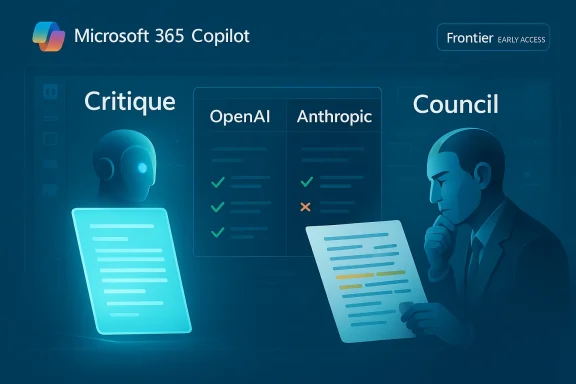
Critique is the more consequential of the two modes because it addresses one of the deepest weaknesses in AI research tools: confident but uneven output. According to the description circulating around Microsoft’s latest Copilot update, Critique uses one model to draft a report and a second model to review and refine it. That second pass emphasizes source reliability, completeness, and evidence grounding, which is a meaningful step beyond simply asking a model to “check its work.”Dual-model drafting and review
This two-model structure is strategically important because it separates generation from evaluation. In practice, that means the first model can focus on exploration and synthesis, while the second model can behave more like a skeptical editor. The design is especially suited to research workflows where completeness matters as much as fluency, and where a polished answer can still be wrong if the underlying sourcing is weak.The broader significance is that Microsoft is treating verification as a first-class feature. That is a subtle but important distinction, because most consumer-facing AI tools still rely on a single model to do both the creative and critical work. By separating those responsibilities, Microsoft is implicitly acknowledging that enterprise users do not just want answers; they want defensible answers.
- Drafting is optimized for breadth and speed.
- Review is optimized for factual discipline and source quality.
- Refinement becomes a separate layer rather than a hidden assumption.
- Evidence grounding becomes part of the UX, not just the backend.
- Reliability is framed as an output quality metric, not a compliance afterthought.
Why this matters for enterprise research
Enterprise customers are often less concerned with novelty than with repeatability. A report that sounds impressive but misses a source, overstates a claim, or ignores a key counterpoint can create more work than it saves. Critique’s value proposition is therefore not merely accuracy; it is reducing the hidden labor of post-generation editing and verification.The timing is also notable. Microsoft has been working to position Copilot as an orchestration layer for work, not just an assistant that answers prompts. A model that can critique another model fits that worldview perfectly, because it mirrors the actual behavior of high-value knowledge work: draft, challenge, revise, and only then publish.
Council and Model Comparison
If Critique is about internal quality control, Council is about visible model plurality. Microsoft’s description of Council says it can run the same prompt through multiple models at the same time, then compare the results side by side and summarize where they agree, diverge, or contribute unique insights. That is a remarkably transparent way to expose model behavior to users, and it turns model choice into a practical analytical tool.Side-by-side reasoning, not hidden routing
Council is important because it removes some of the mystery from AI output. Instead of silently routing a prompt to one model and presenting a single answer, Microsoft is surfacing the variation itself. For research, strategy, and policy work, that can be incredibly useful because the differences between models often reveal the boundaries of the evidence, the framing assumptions, or the style of reasoning being used.This is also a subtle competitive move. Many AI systems are still optimized around a single “best” response, even when the underlying task would benefit from disagreement. Microsoft is suggesting that for enterprise research, the best answer might be a structured comparison of multiple answers. That is a very different product philosophy, and it could appeal strongly to teams that want to understand uncertainty rather than hide it.
- Consensus can show what is stable across models.
- Divergence can expose weak assumptions or ambiguous evidence.
- Unique insights can surface model-specific strengths.
- Comparison helps users judge depth instead of just polish.
- Transparency makes the output easier to audit.
Anthropic and OpenAI side by side
The most interesting detail in Council is the reported comparison between Anthropic and OpenAI outputs. Microsoft has recently been broadening model access in Copilot, and that makes Council feel less like a novelty and more like a logical extension of the platform. If users can already choose different model families for different tasks, the next step is naturally to compare them on the same task.That comparison could become especially useful for enterprise teams that are still figuring out which model behaves best for specific categories of work. A legal team may care about caution and structure, while a strategy team may care about synthesis and breadth. Council gives users a way to inspect those differences instead of guessing at them.
Frontier as the Delivery Channel
Microsoft is clearly using the Frontier program as the initial release vehicle for Critique and Council. That matters because Frontier is specifically designed for experimental and emerging AI features, with access controlled by license status, tenant settings, and feature toggles. The program is not merely a beta label; it is Microsoft’s governance mechanism for shipping capabilities that are still evolving. (adoption.microsoft.com)Controlled rollout, not broad release
This kind of rollout is exactly what enterprise software buyers expect from a large platform vendor. Microsoft can gather usage data, collect feedback, refine prompts and model orchestration, and watch for safety or reliability issues before a wider launch. It also gives administrators the ability to decide whether the preview belongs in their tenant at all, which is critical in organizations that treat AI rollout as an IT and risk-management exercise.For users, the practical implication is that Critique and Council are likely to feel more experimental than fully baked. That is not necessarily a weakness. In AI, especially in productivity software, preview status often means customers are getting a look at the future before the interface, defaults, and policy guardrails have fully stabilized.
Why Microsoft keeps pushing preview experiences
Microsoft’s current product strategy depends on keeping the innovation pipeline visible. The company wants customers to see that Copilot is not a static product but a rapidly evolving set of experiences. Frontier makes that evolution legible, and it also creates a kind of selective opt-in culture around AI adoption.That can be advantageous for Microsoft in two ways. First, it creates a sense of momentum, which is valuable in a market where AI feature velocity is part of the competitive story. Second, it lets Microsoft test whether advanced features actually help enterprise workflows before committing to broader distribution.
- Faster feedback loops improve feature quality.
- Tenant controls reduce enterprise risk.
- Preview labeling sets the right expectation.
- Optional access supports phased adoption.
- Experimentation becomes part of the product culture.
Why Multi-Model Matters
The arrival of Critique and Council reflects a deeper shift in AI design: the move from “Which model is smartest?” to “How do we make multiple models useful together?” That question is now central to enterprise AI, because no single model is consistently best at every task, and no single output is sufficient for every decision. Microsoft’s answer is to make model diversity part of the workflow rather than a hidden backend detail. (blogs.microsoft.com)From model competition to model orchestration
This is a significant philosophical change. Earlier AI products often behaved as if the user should never see the model selection layer, only the final answer. Microsoft is going the opposite direction in Copilot, especially in Frontier, by making model variety visible and letting users inspect how different systems reason about the same prompt.That could help solve a longstanding problem in enterprise AI adoption: trust through opacity rarely lasts. If the system is right but inscrutable, users may still hesitate. If the system is explainable through comparison and critique, users may feel more comfortable relying on it for high-stakes work.
The other benefit is resilience. When models disagree, the disagreement itself can be informative. It can reveal missing context, overbroad assumptions, or areas where the evidence simply does not support a decisive answer. In that sense, Council may be more useful than a single “best” response because it helps users see the shape of the uncertainty.
Implications for competitors
For rivals, Microsoft’s move is a challenge on both product and positioning. Competitors have already been racing to ship deeper research modes, agentic workflows, and model-choice features. But Microsoft has a unique advantage: it sits inside the daily workflow of millions of workers, and it can embed advanced AI features directly into that context.That makes the competitive bar different. A standalone research app has to prove its value from scratch. Microsoft only needs to show that its version is good enough, secure enough, and deeply integrated enough to become the default. If Critique and Council work as advertised, they could be sticky precisely because they are not separate tools—they are part of the productivity fabric.
Benchmarks, Evaluation, and the DRACO Narrative
One of the more striking claims attached to the new modes is that Critique was evaluated against the DRACO benchmark and reportedly outperformed a Perplexity-based Claude Opus 4.6 setup by 13.88% in overall research quality. That figure should be treated cautiously unless Microsoft publishes fuller methodological details, but the direction of the claim is telling. The company wants to frame Critique not just as a feature, but as a measurable research-system upgrade.Why benchmarks matter here
Benchmarks are more than marketing in this context. They are Microsoft’s way of telling enterprise buyers that the system has been tested against a meaningful standard rather than improvised around flashy demos. For a research assistant, the benchmark question is not just whether the model can write a nice paragraph; it is whether it can gather, synthesize, and validate information in a disciplined way.That is why the evaluation story matters even if the exact percentage is hard to independently verify. Microsoft is signaling that it sees quality as something quantifiable, not just anecdotal. In an enterprise sale, that is a powerful message because buyers want evidence that the premium feature is actually improving output quality.
The limits of benchmark-driven storytelling
Still, benchmark claims should always be interpreted carefully. A benchmark can illuminate performance in one setting while hiding limitations in another. It can reward certain research styles, favor certain domains, or overstate general usefulness if the real-world tasks differ from the test conditions.That is why the practical question for customers is not whether Critique wins a benchmark, but whether it reduces editing time, catches more errors, and produces better source discipline in day-to-day work. Benchmarks matter, but workflow impact is the real test.
- Benchmark wins help establish credibility.
- Method transparency determines how much trust the numbers deserve.
- Real-world usage decides whether users feel the improvement.
- Source grounding is often more valuable than raw eloquence.
- Editing burden is a key enterprise success metric.
Enterprise vs. Consumer Impact
The immediate audience for Critique and Council is clearly the enterprise market, where research quality, auditability, and governance matter most. But Microsoft’s Frontier program now includes some consumer access as well, which means the company is slowly normalizing advanced AI features across both business and personal contexts. That dual-track strategy could reshape expectations for what productivity software should do. (support.microsoft.com)Enterprise: the larger prize
For enterprises, the attraction is obvious. Teams want systems that can research, compare, validate, and document their reasoning without requiring constant human rework. Critique and Council fit especially well in environments where analysts, consultants, product managers, and executives need a higher-confidence draft before they distribute information internally.Administrators will also appreciate the control layer. Frontier is tenant-managed, license-aware, and opt-in, which gives IT and compliance teams more room to phase adoption. That is critical in organizations where AI tools must be evaluated alongside data boundaries, retention rules, and governance policies.
Consumer: useful, but more niche
For consumers, the value proposition is narrower but still interesting. People who use Copilot for research, planning, or complex writing may enjoy the ability to see how different models compare. That said, most casual users are not trying to run structured multi-model workflows every day.The consumer story may therefore be less about immediate necessity and more about expectation setting. Once users see Microsoft’s research modes in action, they may come to expect similar critique-and-compare capabilities from other productivity tools. In that sense, even if consumers are not the first beneficiaries, they may still help normalize the product category.
Strengths and Opportunities
Microsoft’s new approach has several clear advantages. It makes Copilot more credible for serious knowledge work, and it strengthens Microsoft’s position as a platform that can combine model diversity with enterprise governance. Just as importantly, it gives the company a story that is about quality rather than sheer chatbot novelty.- Improved trust through multi-pass review and evidence emphasis.
- Better research quality by combining drafting with critique.
- Greater transparency through side-by-side model comparison.
- Stronger enterprise fit thanks to tenant-level controls and Frontier gating.
- Model flexibility without forcing customers into one ecosystem.
- Potential time savings for analysts, managers, and researchers.
- Competitive differentiation versus single-model assistants.
Risks and Concerns
The same features that make Critique and Council compelling also introduce real complexity. Multi-model systems are harder to explain, harder to tune, and harder to support when outputs differ in subtle but consequential ways. Microsoft will need to prove that these tools reduce confusion rather than create a new layer of it.- Model disagreement may confuse users who expect a single answer.
- Benchmark claims can overpromise if real-world gains are smaller.
- Preview instability may frustrate teams that need dependable workflows.
- Governance burden increases when multiple models are exposed to users.
- Cost pressure could rise if multi-model workflows become the default.
- Safety and leakage risks remain a concern in enterprise AI systems.
- Feature fragmentation may make Copilot harder to understand.
Looking Ahead
The next phase will likely determine whether Critique and Council become signature Copilot capabilities or just another preview curiosity. Microsoft now has the ingredients for a differentiated enterprise AI stack: model choice, agentic workflows, governance controls, and a preview framework that can absorb rapid experimentation. The question is whether it can translate that architecture into a daily habit for workers who are already drowning in tools and prompts.What will matter most is not the marketing around “advanced reasoning,” but the practical behavior of these modes under real workload pressure. If Critique consistently catches weak sourcing and Council consistently reveals useful divergence, Microsoft will have something far more valuable than a flashy demo. It will have a workflow that changes how people check AI, not just how they use it.
- Rollout breadth across regions, tenants, and subscription types.
- User feedback on whether Council improves decision-making.
- Evidence of productivity gains in real enterprise settings.
- Further model expansion beyond OpenAI and Anthropic.
- Integration with other Copilot experiences across Microsoft 365 apps.
Source: TestingCatalog Microsoft 365 Copilot gets Critique and Council modes
