Microsoft E7 Rumors: The AI First 365 Bundle and Enterprise Impact

  • Thread Author
Microsoft’s internal deliberations over an “E7” Microsoft 365 bundle — a premium, AI-packed suite that could combine Microsoft Copilot, a forthcoming “Agent 365” hub, and other advanced services — have surfaced in multiple market reports this week, and the implications for enterprise IT, procurement, and the vendor landscape are large, immediate, and worth a careful read.

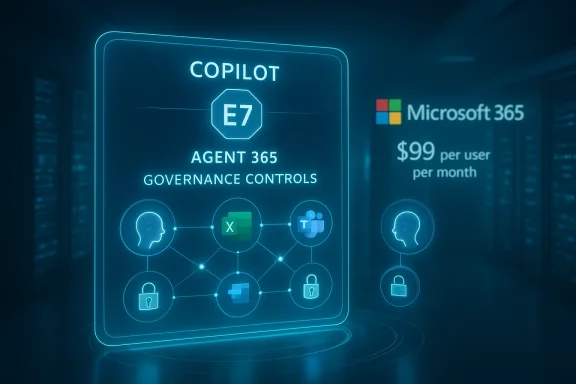
A glowing holographic sign in a data center promoting Copilot E7 Agent 365 governance controls.Background​

For years Microsoft has experimented with layering advanced security, compliance, and management features on top of its core Microsoft 365 suites. The rumored E7 package represents the next logical step: a high-end, AI-first SKU that would consolidate Copilot-level intelligence, lifecycle management for AI agents, and enterprise-grade control into a single, premium subscription. Contemporary reporting suggests Microsoft is again discussing this plan internally after shelving similar plans previously, and the price being discussed in the market is eye-catching — up to $99 per user per month in some scenarios. If true, that would place E7 well above current enterprise list pricing for Microsoft 365 E5 and the existing Copilot add-ons.
Multiple outlets have independently reported that the package under consideration would fold in Microsoft Copilot capabilities and a new agent management layer often described as Agent 365, alongside more traditional E5 capabilities. The news arrives in the context of Microsoft’s continuing effort to monetize enterprise AI, streamline Copilot packaging, and respond to competitive moves from other cloud and AI vendors.

Why this matters now​

Microsoft’s moves here are not incremental; they aim at the center of how organizations buy productivity software. A premium E7 SKU would:
  • Reshape total cost of ownership for Microsoft environments that plan to adopt AI broadly.
  • Change the calculus for third-party tools and specialized AI vendors.
  • Force IT and procurement teams to re-evaluate license portfolios, renewals, and negotiation strategies.
  • Raise urgent questions about governance, compliance, and operational controls for AI agents that act on enterprise data.
Put simply: Microsoft is packaging more of the intelligence and orchestration layer into its core productivity story. For IT leaders that have pushed AI pilots, that may be convenient. For procurement teams focused on predictable per-seat pricing, it could be a shock.

Overview of the rumor and what’s verified​

  • The central claim: Microsoft is weighing an “E7” Microsoft 365 bundle that would be a higher-priced, AI-heavy successor/companion to E5. The package being discussed reportedly includes Microsoft Copilot and an AI agent hub named Agent 365. These details come from multiple industry reports that cite people familiar with Microsoft’s strategy.
  • Reported pricing: Up to $99 per user per month is being discussed in market reporting. That price point contrasts with recent list prices for enterprise suites and Copilot add-ons and would represent a meaningful premium.
  • What is verified independently: Microsoft has been actively reorganizing and simplifying Copilot packaging, and it has rolled different Copilot specialties (Sales, Service, Finance) into consolidated Copilot offerings in recent product updates. Copilot business/enterprise pricing tiers already exist in the market. Microsoft has also been developing agent tooling — sometimes referred to in public reporting as Agent 365 or an “agent hub” — to manage programmable AI agents and the governance around them.
  • What remains unverified or speculative: The final scope of E7, precise price points, the launch timetable, and how Microsoft will carve features between existing E3/E5 and any new E7 SKU. The $99 figure and the exact inclusion list should be treated as rumor-level reporting until Microsoft makes a formal announcement.

A short history: Microsoft’s AI packaging so far​

Copilot, tiers, and recent pricing moves​

Microsoft introduced Copilot capabilities as paid add-ons to Microsoft 365 and later launched dedicated Copilot tiers for small business and enterprise customers. In recent months, Microsoft consolidated several specialized Copilots (for Sales, Service, Finance) into more unified Copilot offerings, and revised how those capabilities are priced and bundled. There are multiple Copilot SKUs — from SMB-focused, more affordable offerings to full enterprise Copilot priced per user — and some price adjustments and bundling have been used to accelerate adoption.

The agent story​

The concept of AI agents — persistent, task-oriented automations that combine model-driven reasoning with connectors to enterprise systems — has been central to many vendors’ long-term plans. Microsoft’s agent tooling initiative aims to let organizations create, manage, and secure those agents within the Microsoft 365 ecosystem. Agent management is materially different from a point Copilot query: it involves lifecycle management, permissions, data access rules, observability, and audit trails.

What E7 could include — educated reconstruction​

While no official spec exists, the probable components of a premium E7 bundle, based on current Microsoft product architecture and reported aims, would include:
  • Microsoft 365 E5 baseline features — the existing security, compliance, and management stack that large enterprises value.
  • Microsoft Copilot (enterprise tier) — full integration across Word, Excel, PowerPoint, Outlook, Teams, and enterprise data sources.
  • Agent 365 / Agent management console — tools to create, deploy, monitor, and decommission AI agents, with permissions, data handling controls, and governance policies.
  • Copilot Studio / developer and admin tooling — enhanced no-code and pro-code tools for building custom agents and workflows.
  • Expanded governance and data loss prevention (DLP) for agents — enterprise controls to limit agent actions, data exfiltration, and API access.
  • Expanded model options or model credits — hybrid pricing that might combine per-seat fees and usage-based “credits” for heavy model inference or specialized models (e.g., multimodal models or partner models).
  • Priority enterprise support and SLA guarantees — faster incident response or higher availability SLAs for AI features.
This packaging would reflect a move from selling a single Copilot add-on to offering a broader “platform + governance” subscription aimed at enterprises ready to operationalize AI beyond ad hoc use.

Strategic analysis: Strengths of an E7 approach​

  • Simplicity for buyers
    A single premium SKU that combines productivity apps, Copilot, and agent management reduces the need for multiple contracts and licensing lines, simplifying procurement for organizations wanting a turnkey AI solution.
  • Friction reduction for IT adoption
    Pre-bundled governance and agent tooling can reduce friction for IT teams that previously had to stitch together disparate products, third-party tools, and custom automation.
  • Monetization aligned with value
    If Microsoft can deliver materially higher productivity and automation value, a premium price is defensible. Enterprises that save thousands of staff hours via integrated AI could view per-seat premiums as a net benefit.
  • Centralized security model
    When agent lifecycle, access control, and DLP are native to the platform, enterprises can gain stronger, centralized controls versus ad hoc integrations with external AI tools.
  • Competitive positioning
    Bundling advanced AI widely into Microsoft 365 puts pressure on competing productivity and AI vendors. For customers already deeply invested in M365, the incremental lock-in is a strong retention lever.

Risks and downsides — what IT teams must consider​

  • Pricing shock and budget impact
    A $99-per-user-per-month SKU would dramatically raise license bills. For organizations with thousands of licenses, the year-over-year bill increase is potentially enormous and could force difficult tradeoffs.
  • Potential for cannibalization and confusion
    Microsoft already has multiple Copilot SKUs and standalone AI offerings. Introducing E7 could create packaging overlap, complicating renewals and making it harder for procurement to compare apples to apples.
  • Vendor lock-in escalation
    The more functionality Microsoft bundles natively — especially agent orchestration tightly coupled to M365 data planes — the harder it becomes for organizations to adopt neutral or multi-cloud AI strategies.
  • Governance complexity and false security
    Tooling labelled “governance” does not automatically imply safe behavior. Organizations still need mature processes, staff, and audits. Relying solely on vendor-provided governance layers risks complacency.
  • Operational and cost unpredictability (usage-based components)
    If E7 pricing mixes per-seat fees with usage-based credits for model inference, finance teams will face variable costs that are hard to forecast.
  • Regulatory and data residency concerns
    Enterprises in regulated industries will need to validate how agent actions, model training, and telemetry comply with laws (data protection, export controls, sector-specific regulation). Bundled AI may increase scrutiny from compliance teams.
  • Model provenance and multi-vendor models
    Using third-party models (e.g., Anthropic, OpenAI) inside Copilot-style experiences raises questions about model updates, performance variability across tasks, and contractual SLAs tied to model vendors that Microsoft may or may not be able to control.

Likely business scenarios and their implications​

Below are three plausible ways Microsoft might roll an E7 offering out, with implications for IT buyers.
  • Scenario A — Conservative: E7 as an add-on bundle for large enterprises
  • Microsoft launches E7 as an optional add-on to E5 customers who want agent capabilities and premium Copilot features.
  • Implication: Existing E5 customers have a path for staged adoption; procurement can opt in selectively. Less disruption, slower revenue upside for Microsoft.
  • Scenario B — Aggressive: Reprice and reposition, pushing AI into the suite
  • Microsoft repackages tiers, moving substantial capabilities into a new, higher-priced suite and nudging customers toward E7 for future AI features.
  • Implication: Strong price pressure; many customers will renegotiate or consider third-party alternatives. Large enterprises could save money by carefully segmenting seats and using mixed licensing.
  • Scenario C — Hybrid: Per-seat base plus usage credits for heavy agent workloads
  • Microsoft introduces a two-part model: a guaranteed per-seat fee for baseline Copilot/agent features and usage credits for intensive agent orchestration or advanced multimodal models.
  • Implication: Predictability for light users, open-ended costs for heavy automation use cases. Requires new chargeback and governance processes.

Practical steps IT leaders should take now​

If you manage procurement, licensing, or AI governance for your organization, begin planning now:
  • Inventory your current Microsoft estate.
  • Determine who has E3, E5, which Copilot SKUs, and where third-party integrations exist.
  • Map sensitive data sources and workflows that could be exposed to agent activity.
  • Create a license segmentation plan.
  • Identify which users absolutely need full Copilot/agent capabilities and which users can remain on lower tiers.
  • Use role-based segmentation to avoid paying per-seat premiums universally.
  • Pilot governance controls.
  • Build policies for agent approval, least-privilege access, logging, and audit trails.
  • Consider a “safe list” of agent templates and a central approval board for production use.
  • Prepare procurement strategies.
  • Open dialogues with resellers and Microsoft account teams about staged rollouts, caps on usage-based costs, and volume discounts.
  • Get renewal timelines in a calendar to avoid sticker-shock mid-term.
  • Run legal and compliance checks.
  • Ask vendors for model provenance, data handling descriptions, and SOC/ISO attestations that cover agent telemetry and model training.
  • Start a TCO model for E7 scenarios.
  • Build cost models that include seat counts, expected usage credits, Azure compute costs (if relevant), and estimated productivity gains.
  • Run sensitivity analyses for various adoption levels.

Governance checklist for buying AI-first bundles​

  • Define permitted agent actions and data scopes before deployment.
  • Require role-based access controls and approval workflows for agent creation.
  • Enforce immutable audit logs for agent activity and data exfiltration attempts.
  • Implement DLP and contextual data filtering tied to agent requests.
  • Establish an incident response playbook specific to agent misbehavior (hallucinations, leaks, unauthorized actions).
  • Require contractual obligations for model change notifications, performance regressions, and data retention rules.
  • Run periodic red-team testing of agents and their connectors.

Impact on Microsoft's partner ecosystem and ISVs​

A premium E7 SKU could benefit some partners and pressure others:
  • Managed Service Providers (MSPs) and Systems Integrators: Opportunity to offer migration, governance, and agent lifecycle services to customers adopting E7.
  • Independent Software Vendors (ISVs) offering specialized automation: Risk of displacement if Microsoft provides built-in, high-quality agent templates and connectors.
  • Security vendors: Opportunity to integrate richer telemetry and compliance tooling, but also pressure to interoperate deeply with Microsoft’s native governance APIs.
Partners should develop differentiated value — for example, verticalized agent templates, deeper operational playbooks, and stronger audit capabilities — that complement rather than compete with Microsoft’s bundled offering.

Financial markets and investor implications​

Speculative reports of a premium E7 SKU are likely to influence investor sentiment in two ways:
  • Positive: If Microsoft can successfully monetize enterprise AI at higher price points without triggering churn, the revenue upside is substantial and strategically defensible.
  • Negative: If customers react to high prices by delaying purchases, migrating to mixed providers, or demanding significant discounts, Microsoft could see margin pressure in sales and longer sales cycles.
From a corporate finance perspective, a successful E7 launch could shift Microsoft’s mix toward higher recurring revenue per seat, but it requires delicate balance between value delivery and customer pushback.

Technical deep-dive: What Agent 365 (or similar) must deliver to be credible​

To justify a premium and to be trusted inside enterprise environments, Agent 365-style tooling must deliver:
  • Fine-grained identity & access — agents should act as principals with specific, auditable permissions.
  • Context-aware data access — agents must only access the minimal data required for their tasks; context isolation is crucial.
  • Observable behavior — telemetry and explainability features that allow admins to replay actions and rationales.
  • Runtime sandboxing — limit cross-tenant or cross-service lateral movement from agent executions.
  • Governed model selection — ability to pin agents to specific, validated model versions; model change management tooling.
  • Human-in-the-loop controls — for high-risk actions require signoff or approval workflows.
Absent these properties, organizations will be right to treat any “agent hub” with suspicion — it must be more than a convenience layer; it must be an enterprise control plane.

What to watch for next — signals that an E7 is coming​

  • Microsoft’s public product roadmap and Ignite announcements mentioning Agent 365, unified Copilot bundles, or new enterprise SKUs.
  • Changes in Microsoft 365 commercial price lists or new SKU announcements tied to AI governance features.
  • Partner communications and early-access programs that provide hands-on previews of agent management tooling.
  • Microsoft documentation describing new governance, compliance, and DLP controls specifically for agents.
If these signals appear, the rumor is moving from “internal discussion” to “market reality.”

Final assessment​

Microsoft’s deliberations over an E7 bundle reflect a strategic moment: the company is trying to convert the productivity promise of AI into a monetized, enterprise-ready platform. The strengths of such an approach are obvious: convenience, centralized governance, and a clear path for organizations that want to operationalize AI at scale. But the risks are just as concrete: material price increases, licensing complexity, potential lock-in, governance gaps, and unpredictable usage-based costs.
At present, the E7 story should be treated as a credible market-level development but not as a confirmed product offering. The reported $99 per-user-per-month figure in market coverage is a powerful headline and should be handled cautiously — it is a planning number until Microsoft provides formal SKU and pricing documentation.
For organizations, the right posture is proactive but measured:
  • Inventory, segment, and pilot before you buy.
  • Strengthen governance and audit before you scale agent use.
  • Treat E7-like offerings as part of an overall automation and vendor-lock strategy, not as an automatic upgrade path.
If Microsoft does launch E7, it will reshape licensing conversations and enterprise AI roadmaps. The smartest customers will be those who plan for multiple outcomes: negotiate early, scope pilots tightly, and insist on contractual protections that limit variable costs and guarantee governance controls. The next few quarters will reveal whether E7 becomes a revenue blockbuster or another high-profile product experiment — and the answer will matter for every enterprise using Microsoft 365.

Source: TipRanks Microsoft weighs releasing AI-loaded software bundle for 365, BI says - TipRanks.com
 

Microsoft appears to be preparing the next big step in its enterprise AI playbook: internal discussions and media reports say the company is weighing a premium Microsoft 365 “E7” enterprise SKU that would fold together Microsoft 365’s highest-tier productivity, security and analytics features with deeper, seat-based AI capabilities — most obviously Microsoft Copilot and the new Agent 365 agent-management plane — into a single, top‑end bundle. The chatter suggests a headline price materially above existing E5 subscriptions, reflecting a clear push to reframe Microsoft 365 as not just a suite of apps but a managed, agent-ready AI platform for the enterprise.

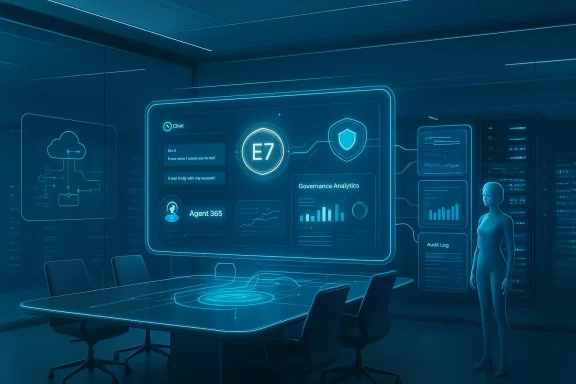
Futuristic boardroom with neon holographic dashboards and a standing AI figure.Background / Overview​

Microsoft’s commercial Microsoft 365 lineup has long been split across tiers (E3, E5 and related variants) that let organizations trade off app access, advanced security and compliance, and analytics. Over the last two years Microsoft has systematically moved generative AI — Copilot capabilities, agent modes, and governance tools — from optional add‑ons into the mainstream product story. Recent product waves (Copilot embedded in Office apps, Copilot Chat, Copilot Studio and an Agent 365 control plane) made the next logical question unavoidable for customers and partners alike: how will Microsoft package and price these new capabilities for large enterprises?
The rumored E7 SKU would be Microsoft’s answer to that question: a single enterprise bundle that combines advanced security and analytics with full Copilot features and native agent management. Early reporting ties the idea to internal strategy debates about how to monetize AI broadly while simplifying purchase decisions for large customers that want to turn AI into repeatable, governed workflows across the organization.

What the rumored E7 would include​

Microsoft’s product moves over the last year give us a sensible baseline for what a true “AI‑first” enterprise bundle could contain. Based on company rollouts and product names in play, an E7 bundle would likely bundle:
  • Microsoft 365 E5 core features — the highest current enterprise feature set for security, compliance, and analytics.
  • Microsoft Copilot (full enterprise seat) — the conversational, contextual AI assistant integrated across Word, Excel, PowerPoint, Teams, Outlook and other apps, with agent and Agent Mode features.
  • Agent 365 / Agent management plane — a centralized control and governance layer for agent deployment, lifecycle, identity, auditing and entitlements across Microsoft 365 and Azure.
  • Expanded governance and telemetry — enhanced auditing, activity analytics, and risk controls to make agentic automation auditable and compliant.
  • Operational tooling for IT — provisioning templates, policy bundles, model routing controls, cost/usage dashboards and fail-safe controls so IT can limit agent actions and costs.
  • Potentially, higher usage quotas or premium model access for tenants that need more compute-backed interactions, private tuning, or greater prompt throughput.
These pieces reflect Microsoft’s public roadmap toward “agentic” productivity: Copilot as an assistant, Copilot agents as workforce teammates, and an enterprise control plane to manage agent sprawl. Packing them into a single SKU would simplify commercial conversations for customers who want the whole agent stack rather than buying Copilot seats and governance add-ons piecemeal.

Pricing and the arithmetic that matters​

One of the most consequential details in the rumor is the potential price point. Reported figures place a potential E7 headline at a premium — numbers circulating in the market headline around $99 per user, per month. That’s materially higher than current list prices for E5 and than the per‑seat cost of Copilot when added onto E5 today.
Why the math matters:
  • For many organizations, the comparison isn’t E7 versus E5 alone; it’s E7 versus E5 plus the Copilot add‑on (and whatever governance/agent add‑ons they currently buy).
  • If customers are already paying for E5 and a separate Copilot seat-by-seat add‑on, a packaged E7 could save procurement complexity. But at a substantial premium it may only make sense where usage, governance and agent management are strategic priorities.
  • Seat-based vs. consumption-based economics: Microsoft has been experimenting with both per-seat pricing and usage-tiered models. A fixed, high‑end E7 seat price signals Microsoft expects customers to prefer predictable per-user bills for an enterprise AI experience.
Practical example (illustrative):
  • Existing E5 list price (example enterprise list figure) + Copilot seat add-on = current all-in seat cost for fully enabled Copilot users.
  • E7 at a reported $99 per seat would need to be judged against the combined cost of E5 + Copilot + any third‑party governance tooling customers currently buy.
  • For teams deploying agents widely, the cost of shadow agent sprawl (hidden compute, API calls, data leakage risks) and the value of consolidated governance could justify a higher per-seat rate — but that calculation is company‑specific.
Importantly, product pricing and add‑on structures have been dynamic: Microsoft has announced commercial pricing updates and different Copilot price tiers for SMB vs enterprise customers in recent months. That makes any single publicized figure provisional until Microsoft publishes final SKUs and effective dates.

Strategic rationale: why Microsoft would offer E7​

There are clear, strategic reasons for Microsoft to consider an E7 bundle:
  • Simplify enterprise buying: Large customers repeatedly asked for packaged, predictable solutions. E7 would make it easier for procurement and finance teams to approve “AI‑first” deployments without juggling multiple add‑ons.
  • Capture more margin on AI: As AI becomes a primary source of value, Microsoft can monetize not just the app surface but the compute, model access and agent governance that power automated workflows.
  • Corner the enterprise agent market: By combining Copilot and Agent 365 into a single SKU, Microsoft positions itself as the platform for agentic automation; customers who standardize on E7 are more likely to commit to Microsoft’s model routing, identity and governance stacks.
  • Defend and extend market share: Competitors are embedding generative AI in their stacks; a premium E7 gives Microsoft a clear enterprise product to pitch against rivals offering AI features piecemeal.
  • Channel and partner alignment: Offering an enterprise bundle simplifies partner conversations and upsell plays around managed services, migration and agent deployment.
Those are powerful forces pushing Microsoft toward bundled enterprise offerings. But strategic clarity doesn’t guarantee easy adoption — the product and commercial design must address risk, governance and partner economics.

What E7 would mean for IT, procurement and finance​

Adopting an AI‑heavy E7 SKU would change the way enterprises plan, secure and bill AI usage.
Key operational impacts:
  • Budgeting and forecasting: Fixed seat pricing simplifies monthly forecasting, but organizations must decide whether to license every knowledge worker for E7 or to create a tiered mix of E3/E5/E7 seats based on role and AI usage.
  • License segmentation: Expect fine-grained seat allocation strategies: only teams that actively use Copilot agents in production workflows might be licensed E7, while others remain on E3/E5.
  • Governance-first deployment: Agent 365’s promise is centralized control; IT will need to define lifecycle, approval, and audit processes to avoid uncontrolled agent sprawl.
  • Training and enablement costs: To realize E7’s value, organizations must invest in change management — training knowledge workers, mapping processes to agents, and building templates for safe automation.
  • Data access and least‑privilege: Agents that act across mail, SharePoint, Teams and other data sources require careful data minimization and identity policies to avoid over‑privileged access.
  • Cost versus value measurement: Finance teams will demand clear KPIs showing how Copilot/agent usage reduces FTE time, increases throughput, or avoids external consulting costs.
A careful adoption plan that includes pilot programs, staged rollout, and a chargeback model for high-volume operations will be essential.

Channel and partner implications​

E7 would also reshape the commercial ecosystem:
  • Resellers and MSPs would lose some complexity for customers who want a turn-key AI bundle — but they would need to rework margins and service offerings around E7.
  • Value-added services would focus more on rapid agent deployment, verticalized agent templates, compliance accelerators, and cost governance.
  • Partner enablement: Microsoft’s partner network will want clear guidance on seat migration, promotional programs and co-sell incentives to avoid friction at customer renewal windows.
  • High-volume deals: Large enterprise deals and volume licensing negotiations will remain a negotiation zone; customers may press for custom usage terms if AI compute/throughput is a sizeable cost driver.
For partners, E7 is both an opportunity to deliver packaged AI solutions and a challenge to recalibrate pricing and service models.

Technical and security considerations​

Turning Microsoft 365 into an agentic platform raises several technical issues that enterprise IT teams must evaluate before committing to a large-scale E7 roll‑out.
Critical technical factors:
  • Model routing and isolation: Enterprises should know which models Copilot is using, whether prompts or data leave the tenant boundary, and how routing decisions are made for sensitive content.
  • Data residency and compliance: Agent actions often touch PII, regulated records, or cross-border data. Enterprises will need clear guarantees about where inference and training happen and what data is retained.
  • Auditability and provenance: Robust logging, action provenance, and explainability will be required for audits, investigations and regulatory compliance.
  • Rate limiting and cost controls: Agents and Copilot interactions create cloud compute costs. IT must be able to set throttles, quotas and limits to prevent runaway bills.
  • Identity and delegation: Agents acting on behalf of users must obey least-privilege principles, with clearly defined service identities, consent flows and emergency kill switches.
  • Resilience and safety: Enterprises need rollback, simulation and dry-run tooling so agents can be validated before they take production actions that could impact billing, configurations or data integrity.
Agent governance is not optional. Without operational guardrails, what starts as productivity gain can become a security and compliance incident.

Risks, downsides and open questions​

The E7 rumor raises legitimate concerns. Organizations contemplating such a SKU should watch for these risks:
  • Price shock and inequality: A $99 seat price would outstrip many existing budgets and could exacerbate internal inequality: only certain teams would get E7, potentially creating shadow workflows and fractured collaboration.
  • Vendor lock‑in: Deep integration of agent logic into the Microsoft graph, data connectors, and model routing would increase switching costs if organizations later decide to move to alternative AI platforms.
  • Overcentralization of control: Centralizing agent control is positive for governance but could become a bottleneck if IT lacks the resources to manage approving and maintaining hundreds of specialized agents.
  • Unclear per-seat economics for heavy users: Organizations with heavy programmatic or machine‑to‑machine agent usage may find per‑seat pricing inefficient compared to usage-based or API pricing models.
  • Regulatory flak: As regulators scrutinize AI behavior and data handling, enterprises running agent fleets must demonstrate robust compliance — something still being operationalized across industries.
  • Product maturity and reliability: Agentic systems are new; early adopters will face teething issues such as incorrect actions, hallucinations, and integration bugs that need human oversight.
Enterprises should treat E7 as a strategic option, not an automatic upgrade.

Recommended adoption patterns for IT leaders​

If E7 ships, here are pragmatic steps IT leaders should follow to protect value and reduce risk:
  • Start with a limited pilot: license a single team or function and measure time saved, error rates, and governance overhead.
  • Create an agent catalog: require discovery, description, and owner assignment for each agent you publish to production.
  • Build a chargeback model: align seat allocation and cost recovery to actual business outcomes and usage patterns.
  • Harden auditing: ensure every agent action is logged, versioned, and traceable to a human approver or policy.
  • Define sensitive data boundaries: classify data and restrict agents’ access by category, not just by app or folder.
  • Train human-in-the-loop patterns: ensure agents escalate or require confirmation for decisions beyond defined thresholds.
  • Negotiate contract protections: when discussing E7 pricing, include SLAs, data residency guarantees, and cost control terms for high-usage scenarios.
These steps turn E7 from a checkbox purchase into a measurable capability.

Likely rollout scenarios and commercial permutations​

There are multiple ways Microsoft could position an E7 SKU, and each has different operational and financial effects for customers:
  • Packaged seat: E7 as a single, predictable per‑user seat that includes E5 capabilities + Copilot + Agent 365 governance. This simplifies buying but could be expensive for light users.
  • Hybrid license: E7 as a premium tier available only for named seats while retaining E3/E5 for the rest of the organization; this supports role‑based licensing and tiered seat mixes.
  • Consumption overlay: E7 as a base seat plus consumption fees for heavy agent compute or API calls. This reduces fixed cost but increases billing complexity.
  • Enterprise agreements and negotiated terms: Large customers can expect bespoke deals with volume discounts, usage caps and security/sovereignty guarantees.
Which path Microsoft chooses will shape partner incentives, procurement processes and how IT structures rollouts.

The broader market perspective​

Microsoft’s move to bundle AI into a top-end enterprise SKU is consistent with a broader industry trend: cloud and SaaS vendors are converging on platform-level AI offerings that do more than assist — they act. For customers, that means vendors will increasingly sell governance and platform controls alongside the models themselves.
For enterprises, the choice will come down to two core questions:
  • Do you want a single vendor to provide the app surface, the models, and the governance? (Ease of integration, single throat to choke.)
  • Or do you prefer a best‑of‑breed approach that mixes specialist models, third‑party governance and open frameworks? (Flexibility, potential cost optimization.)
There is no single right answer; the right approach depends on regulatory context, developer culture, and risk tolerance.

Conclusion​

The E7 rumor — whether it becomes a formal SKU or evolves into a different commercial construct — is an inflection point that crystallizes the long‑term shift in enterprise software: productivity is now inseparable from AI, and delivering AI at scale demands deliberate governance, identity and billing models. For CIOs and IT leaders, the immediate work is pragmatic: pilot responsibly, demand clear governance controls, and insist on contract terms that limit surprise costs and data exposure.
If Microsoft does make E7 real, it will simplify some procurement conversations while raising harder strategic questions about seat economics, where corporate data is processed, and who owns automation across the business. The organizations that plan for those questions today — mapping use cases, testing governance, and building measurable outcomes — will be best positioned to convert an expensive new SKU into sustained productivity gains.

Source: 디지털투데이 Microsoft considers launching AI-enabled Microsoft 365 E7 bundle
 

Microsoft’s enterprise product strategy appears poised for another major pivot: multiple reports now suggest the company is preparing a brand‑new top‑tier Microsoft 365 subscription—commonly referenced as Microsoft 365 E7—that would tightly bundle Microsoft 365 Copilot, the new Agent 365 governance and runtime surface, and expanded identity and compliance capabilities into a single premium SKU. m]

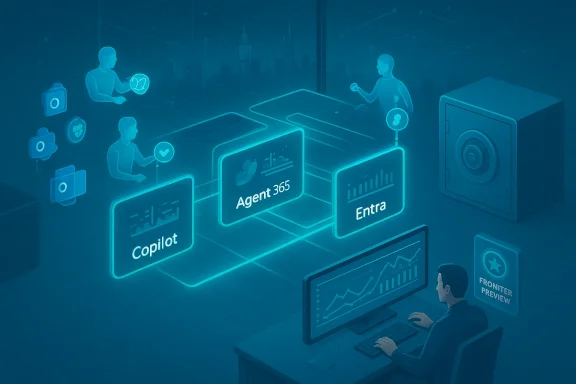
A futuristic holographic dashboard links Copilot, Agent 365 and Entra for secure data management.Background​

The current Microsoft 365 enterprise lineup is broadly organized around two main commercial tiers: E3 (the baseline enterprise productivity and device management bundle) and E5 (adds the company’s more advanced analytics, security, and compliance capabilities). Over the past 18–24 months Microsoft has layered AI features across that stack—introducing Copilot seat licenses, tenant‑aware Copilot for Microsoft 365, and a growing developer and runtime ecosystem for agentic, automatered E7 would sit above E5 as an AI‑first, identity‑centric enterprise plan.
This shift mirrors a larger industry trend: major SaaS vendors are packaging generative AI and automation platforms as premium capabilities, and enterprise customers are wrestling with how to budget, govern, and operationalize those capabilities without creating unmanaged data leakage or runaway costs. Recent market reporting indicates Microsoft is weighing per‑seat and consumption‑oriented pricing models for E7—either could materially change procurement and adoption patterns.

What the reports say E7 will include​

Core components (reported)​

  • Microsoft 365 Copilot: the tenant‑aware Copilot seat that offers cross‑document reasoning, deep access to tenant data, and higher throughput AI usage.
  • Agent 365: a unified management and governance plane for agentic workloads across Microsoft 365 and Azure.
  • Expanded Microsoft Entra (identity) capabilities: Agent identities, conditional access and lifecycle controls aimed at agents as first‑class identities.
  • Additional governance, observability, and compliance tooling drawn from the Microsoft Frontier preview ecosystem.
These inclusions are consistent across the market reporting and the vendoibing Agent 365’s preview status and Entra integration—though Microsoft has not publicly confirmed an E7 product or a launch date at the time of reporting.

Why Copilot + Agent 365 together matters​

Bundling Copilot and Agent 365 signals a strategic view: Microsoft treats agents—automated, multi‑step AI assistants that can access apps and data—as the next layer of enterprise compute and productivity. Packaging the agent governance layer alongside tenant‑aware Copilot both simplifies procurement (one SKU that covers the worker seat and agent controls) and forces IT to think of agents as managed, auditable entities instead of ad‑hoc bots. Microsoft’s own developer materials show an emerging stack—Copilot Studio, Microsoft Foundry, Agent Framework and the Agent 365 SDK—for building, publishing, and governing agents at scale.

What is Agent 365? (technical overview)​

Agent 365 is not a single standalone product in the classic sense; it’s a control plane and SDK ecosystem that enables identity, lifecycle, observability, and policy enforcement for agentic applications that operate across Microsoft 365 surfaces. In practice, that means:
  • Agents can be assigned Microsoft Entra Agent IDs so they have identities and permissions distinct from human users.
  • Agents become first‑class entities in tenant inventories with administrative observability in the Microsoft 365 admin center.
  • Developers can use the Agent 365 SDK to add telemetry, notifications, and policy‑aware tool calls to agents built on varying runtimes.
Microsoft documentation and developer blogs clearly describe Agent 365 as a Frontier preview capability—built to make agent deployments enterprise‑grade by adding identity and governance around otherwise loosely controlled bot workflows. That preview status matters: features, limits, and licensing intentions can and do change between preview and general availability.

Identity, governance and compliance: the Entra angle​

Identity is where Agent 365 changes the mental model for IT teams. Instead of treating bots as service accounts or API keys, Agent 365 assigns agents identity artifacts that integrate with Microsoft Entra (Azure AD) features such as:
  • Conditional access and risk‑based policies for agents
  • Lifecycle management (provisioning/deprovisioning) and role assignments
  • Observability and logging tied to agent actions for audits and DLP integration
Microsoft’s own materials describe the Entra‑backed Agent identity model as central to making agents auditable and safe for enterprise data. If E7 includes deeper Entra functionality (as reports suggest), that would bring these identity controls into the same subscription that provides Copilot seats and agent governance tooling, theoretically simplifying procurement and license alignment for organizations that deploy both people‑facing Copilot seats and large fleets of automated agents.

Pricing: rumor versus verifiable facts​

Multiple outlets reporting on internal Microsoft discussions indicate a possible headline price for E7 that is well above existing enterprise tiers—figures have circulated that the SKU could approach $99 per user per month. That would place E7 in a materially different cost bracket compared with Microsoft 365 E5 and current Copilot seat add‑ons. However, these are rumors and internal pricing deliberations reported by the press; Microsoft has not published an E7 price list or a public roadmap for general availability. Treat the $99 figure as unconfirmed and indicative of the magnitude of premium Microsoft appears to be targeting.
Why this matters: shifting from a $20–$30 add‑on (Copilot seat) to a $99 bundled tier changes budgeting for many organizations. The listed price—if true—would push E7 toward a small set of seats per tenant (high‑value knowledge workers, automation owners, or developer teams), instead of organization‑wide rollouts without explicit financial planning.

Strategic implications for enterprise licensing and procurement​

If Microsoft releases an E7 tier with the rumored packaging and pricing, procurement and IT teams must approach three questions immediately:
  • Who needs full E7 seats? — Organizations will have to segment user populations: a limited set of E7 seats for AI orchestration and agent ownership, broader E5/E3 seats for general users, and possibly Copilot or agent usage . How will pricing interact with consumption pricing? — Microsoft has been piloting seat‑based and consumption‑based Copilot pricing models; E7 could be a per‑seat premium, a consumption bundle, or a hybrid. That requires new cost‑modeling assumptions to forecast monthly usage and unexpected agent invocation spikes.
  • What concessions or incentives will Microsoft offer? — Large enterprises often negotiate enterprise agreements and volume discounts; the negotiability of E7 (if launched) will be a major procurement lever.
These are not theoretical headaches: the shift from feature add‑ons to bundled, high‑end SKUs will influence ROI calculations, pilot sizing, and the speed at which organizations expand agent‑based automation.

Technical and operational risks​

Data exposure and compliance​

Agents that can access mailboxes, SharePoint libraries, Line‑of‑Business systems, and external connectors multiply the attack surface. Even with Entra Agent IDs and centralized observability, improper policy configuration or permissive connector settings could create high‑impact data leakage pathways. The risk profile increases when agents call external LLMs or third‑party services.

Cost runaway and unpredictability​

If agents are metered or charged per invocation (or if E7 mixes seat and consumption models), organizations may encounter unexpected monthly bills when automation scales or when agents are abused by line‑of‑business teams. Tight cost governance and monitoring will be essential.

Vendor lock‑in and ecosystem consolidation​

A single bundled SKU that includes Copilot, Agent 365 tooling, and deep Entra integration strengthens Microsoft’s platform lock‑in. For organizations that want multi‑cloud or multi‑vendor agent strategies, the friction of mixing ecosystems could be a strategic downside.

Regulatory and legal challenges​

Regulated industries (healthcare, financial services, government) must validate whether agent actions, logs, and model decisions comply with audit and retention mandates. Handling of customer data through generative models remains a high‑risk area requiring careful legal review and formalized guardrails.
Each of these risks is addressable, but not trivial; enterprises must treat agent adoption as a platform change, not a feature rollout. Microsoft’s preview documentation emphasizes observability and governance as mitigations—yet operational maturity and configuration discipline fall to customers.

Opportunities and potential benefits​

  • Streamlined governance: A single SKU that bundles Copilot seats and an agent governance plane could simplify licensing for organizations that plan to deploy both human‑facing Copilots and automated agents.
  • Faster automation: Integration across Copilot Studio, Foundry, and Agent 365 can reduce friction between prototyping and production for agentic workflows.
  • Clearer auditability: Agent identities and unified telemetry enable improved auditing, incident investigation, and compliance reporting versus custom ad‑hoc bots.
  • Productivity gains where it matters: Focused rollout of seats for high‑impact workers (sales, service, finance, legal) could yield quick ROI if automations are well scoped and governed.
Microsoft’s documentation for Foundry, Copilot Studio and the Agents SDK envisions a full‑stack agent lifecycle—from design through runtime and publish—aimed at enterprise scale. Organizations that already rely on Microsoft 365, Azure, and Entra stand to gain the most from tight integration.

Practical guidance for IT leaders (what to do now)​

If you run procurement, security, or automation programs, start with a short list of actions you can take today to prepare for a potential E7 offering:
  • Conduct a runbook inventory of current automation and bot usage (who owns them, what data they access, and how they are monitored).
  • Define a seat segmentation plan: identify Which roles would benefit from E7 capabilities and why (e.g., automation owners, R&D, legal reviewers).
  • Run a small Agent 365 pilot under the Frontier preview (where available) to understand operational telemetry, identity lifecycle, and logging behavior.
  • Build cost‑governance policies and alerts around agent invocation to detect runaway scenarios early.
  • Review compliance policies: map agent actions to retention, DLP, and audit rules and identify gaps in tooling.
  • Start conversations with procurement and Microsoft account teams about potential EA add‑ons and negotiation levers for agent usage.
  • Establish a cross‑functional steering committee (security, legal, finance, automation owners) to approve agent blueprints and production deployment criteria.
These steps reduce the risk of surprise costs, compliance violations, or unmanaged agent sprawl once E7 (or similar bundles) becomes generally available. The Microsoft Agent 365 SDK and Foundry docs are useful technical references while piloting.

Vendor and ecosystem considerations​

  • ISVs and systems integrators will likely reposition around agent deployment services, agent lifecycle management, and model governance consulting. Expect new partner offerings and accelerator kits.
  • Cloud economics teams (FinOps) must adapt to hybrid license/consumption models: E7 could combine per‑seat entitlements with metered runtime charges.
  • Security vendors will need to integrate with agent observability outputs; SIEM and SOAR pipelines must be updated to include agent identity artifacts and agent‑specific telemetry.
Microsoft’s own partner ecosystem—Frontier partners, Foundry integrators, and the Agent Framework community—already shows activity in this areaorming marketplace around agent delivery.

How to pilot agents responsibly: a short checklist​

  • Define a narrow, measurable business outcome (time saved, transaction throughput).
  • Require least‑privilege access for agent identities; avoid broad read/write connectors during early stages.
  • Log every agent decision and external call with traceability to the agent identity.
  • Add human‑in‑the‑loop approvals for actions with legal or financial impact.
  • Monitor cost metrics and set hard invocation quotas during pilot.
  • Conduct a post‑pilot security and compliance review before scaling.
Following this checklist reduces blast radius and creates measurable evidence for broader investment decisions.

Critical analysis: strengths, trade‑offs, and unanswered questions​

Strengths​

  • Operational simplicity for some buyers: A single premium bundle that includes Copilot, agent governance, and identity tools reduces the number of discrete purchases and integrations for teams already committed to Microsoft’s ecosystem.
  • Enterprise‑grade governance baked in: Agent 365’s identity and observability model directly targets core enterprise concerns about unmanaged bots and data access. Microsoft’s preview docs emphasize these guardrails.
  • Developer productivity: The Foundry/Agent Framework/Agents SDK toolchain can accelerate the path from prototype to production for complex agentic workflows.

Trade‑offs and risks​

  • Price‑driven adoption limits: A premium price point (rumored near $99/user/month) could mean E7 is used sparingly rather than broadly, which undermines the promise of organization‑wide automation unless carefully targeted.
  • Platform risk: The bundle increases dependence on Microsoft’s stack for both runtime and identity. Multi‑cloud or multi‑vendor strategies become more expensive and operationally complex.
  • Preview → GA uncertainty: Agent 365 is in Frontier preview; features and licensing may change substantially before GA. Relying on preview capabilities for core business processes carries risk.

Unanswered questions​

  • Exact pricing and licensing model: Per‑seat? Consumption credits? Hybrid? The industry reporting points to deliberations, but the final model will determine adoption patterns.
  • Seat limits and metering specifics: Will E7 include unlimited agent invocations for assigned seats, or will metering still apply?
  • **Interoperability guaranteeill Microsoft enable agents built in third‑party stacks to interoperate under Agent 365 without forcing migration to Foundry or Copilot Studio? Microsoft claims interoperability is a goal, but real world friction remains to be seen.
Where information is not yet public or confirmed, organizations should treat press reporting as indicative of direction—not definitive license or SLA commitments.

Bottom line and recommended next steps​

Microsoft’s reported E7 plan is a meaningful inflection point: it aligns the company’s most advanced AI tooling, agent governance, and identity controls in a single, premium offering. That combination is compelling for organizations that want tightly integrated productivity automation and governance, but it will force hard choices about who receives what level of access and how to control cost and compliance.
Practical next steps for IT and procurement teams:
  • Inventory current automation and bot usage now.
  • Pilot Agent 365 under the Frontier preview to validate telemetry, identity, and governance behavior.
  • Define a seat segmentation and cost governance strategy assuming a premium E7 price.
  • Engage Microsoft account teams early for negotiation and clarification on licensing models as soon as E7 details emerge.
  • Prepare legal and compliance reviews for agent‑driven workflows that access regulated or sensitive data.
Microsoft’s own product documentation and the recent press reporting give a clear signal: agentic automation is moving from experimental to enterprise‑grade. Organizations that prepare methodically—running pilots, building governance, and incorporating cost controls—will be best positioned to extract the benefits while minimizing the risks.
In short: expect a new Microsoft 365 conversation that centers on agents and identity—and plan now to keep that conversation under your IT, legal, and finance control rather than letting it be a surprise line item on next year’s invoices.

Source: Petri IT Knowledgebase New Microsoft 365 E7 Plan to Bundle Copilot and Agent 365
 

Back
Top