Microsoft Ignite 2025 opens this week as an unmistakably “AI‑first” conference: Nov. 18–21 in San Francisco (with an optional pre‑day on Nov. 17) and a parallel digital program, a hybrid format that promises product reveals, partner playbooks, and hard technical sessions aimed at moving agentic AI, Copilot, and enterprise governance from pilot projects into repeatable production.
Microsoft has positioned Ignite 2025 as the company’s operational playbook for enterprise AI: platform primitives (Azure AI Foundry, Microsoft 365 Copilot, Entra/Intune, and Fabric), partner-driven implementations via a unified Marketplace, and elevated security and data‑residency options meant to address regulators and compliance teams. This is visible across Microsoft’s event pages and partner guidance, which emphasize hands‑on labs, partner showcases, and deep technical tracks for developers and IT pros. Expectations in the community coalesce around three themes:
What partners bring:
The event’s strengths are clear: a comprehensive platform play, meaningful data‑residency commitments, and increasingly mature agent primitives. The open questions are equally real: which models will run where, whether multi‑agent orchestration truly scales in complex environments, and how Microsoft and partners will enforce durable auditability and human oversight at production scale.
For IT leaders, the prudent posture is pragmatic skepticism: attend the show for the roadmap and partner playbooks, validate GA claims in a sandbox with observability enabled, and insist on measurable pilot KPIs that map to procurement gates. For partners, Ignite is the place to show reproducible outcomes and clear SLAs. And for enterprises in regulated jurisdictions, keep legal and privacy teams in the room when you evaluate Copilot or Foundry pilots — the technology moves fast, but compliance timelines and contracts still govern budgets and rollout.
Microsoft’s event pages, partner guidance, and the independent reporting that surrounds Ignite confirm this framing — but attendees should still verify the final program and product availability against on‑site announcements and Microsoft’s live technical pages before making deployment decisions. Conclusion: Ignite 2025 is the company’s attempt to show that agentic AI can be assembled, governed, and sold at enterprise scale — and this year’s success metric will be less about dazzling demos and more about whether customers leave with reproducible, auditable, and contractually supportable plans to move from pilot to production.
Source: Computerworld Microsoft Ignite 2025 — get the latest news and insights
 Background / Overview
Microsoft has positioned Ignite 2025 as the company’s operational playbook for enterprise AI: platform primitives (Azure AI Foundry, Microsoft 365 Copilot, Entra/Intune, and Fabric), partner-driven implementations via a unified Marketplace, and elevated security and data‑residency options meant to address regulators and compliance teams. This is visible across Microsoft’s event pages and partner guidance, which emphasize hands‑on labs, partner showcases, and deep technical tracks for developers and IT pros. Expectations in the community coalesce around three themes:- Agentic productivity — Copilot and multi‑agent systems that orchestrate workflows inside Teams, Dynamics 365, and Microsoft 365.
- Governance and observability — runtime tracing, audit trails, and labeled data controls that make generative assistants tolerable for regulated industries.
- Partner enablement and procurement — a unified Microsoft Marketplace and co‑sell mechanics that convert platform primitives into deployable customer solutions.
Key details verified (dates, format, registration)
- Dates and venue: Microsoft Ignite runs Nov. 18–21, 2025, at the Moscone Center in San Francisco; the digital program runs in parallel Nov. 18–20 and there’s an optional pre‑day on Nov. 17. These event details are published on Microsoft’s event help pages and partner materials.
- Hybrid access: Online registration is available and virtual attendance is free in the digital track. Onsite attendees can access certification testing and instructor‑led labs per Microsoft Learn guidance.
The keynote question: Nadella or Althoff? What we can verify — and what remains inconsistent
One of the most visible pre‑event storylines is a contradiction in listings for the mainstage keynote. Multiple news outlets and Microsoft partner pages contain different speaker attributions:- Some coverage and older Microsoft pages list Satya Nadella as a marquee keynote speaker and reference a leadership lineup that includes Scott Guthrie and Charlie Bell.
- Other reputable outlets report that Judson Althoff, newly elevated as CEO of Microsoft’s commercial business, will lead the Day 1 keynote in San Francisco — a visible shift in leadership optics that parallels an internal reorganization assigning commercial responsibilities to Althoff while Nadella focuses on deeper technical work. Those outlets say Microsoft confirmed Althoff will lead the opening keynote.
- The dates and hybrid format are confirmed by Microsoft and partner channels.
- Media reporting about a keynote leadership change is credible and repeated across multiple outlets, but public Microsoft pages (partner blogs and event pages) have shown inconsistencies in speaker listings in the runup to the show. That leaves a narrow window where event pages, press releases, and partner posts may not be fully synchronized. Readers should treat speaker attributions that differ across outlets as provisionally accurate until the final conference program or Microsoft’s on‑site signage confirms the lineup.
What to watch on the agenda — product and platform verifications
Several platform items have measurable, verifiable status going into Ignite. These are the announcements and features most likely to shape enterprise adoption in 2026.Azure AI Foundry and the multi‑agent story
Microsoft’s Azure AI Foundry and its Agent Service have moved from research experiments into platform plumbing: public previews and product notes indicate a Foundry Agent Service that supports multi‑agent orchestration, observability, and interoperability via Model Context Protocol (MCP) and Agent‑to‑Agent (A2A) capabilities. The Foundry Agent Service is being described in community and trade reports as generally available for production use, with tracing, diagnostics, and workload integration points for Logic Apps, Azure Functions, and telemetry. Why this is significant:- Production primitives: GA signals SLAs, SDK support, and enterprise operational features IT teams expect when moving beyond PoCs.
- Interoperability: MCP and A2A support reduce the custom plumbing needed to make agents and third‑party orchestrators cooperate — a practical necessity for heterogenous enterprise stacks.
- Confirm which runtime and SLA levels apply to your subscription tier.
- Validate third‑party compatibility (LangChain, AutoGen, Semantic Kernel) with the MCP/A2A surfaces you plan to use.
- Test Foundry observability and tracing in a pre‑production environment to ensure auditability and provenance before scaling.
Copilot Studio, BYOM, and model choices
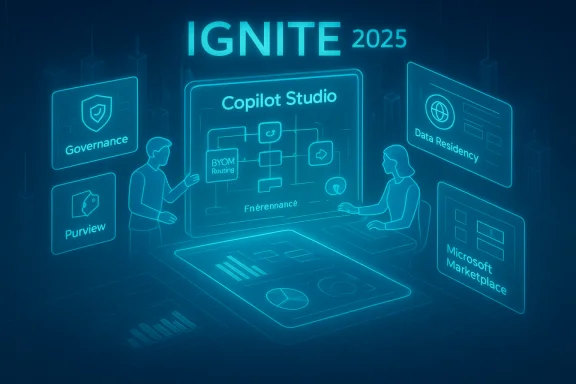
Microsoft’s Copilot Studio has steadily expanded maker controls: bring‑your‑own‑model (BYOM) routing, Dataverse connectors for Purview labeling, computer‑use automation, and in‑conversation agent recommendations are all listed in Microsoft blogs and product updates. These capabilities lower friction for enterprises that want Copilot experiences tightly governed and aligned with internal information protection policies. Notable cross‑platform model developments:- Microsoft has pushed to diversify the model supply for Copilot users: beyond OpenAI models, Microsoft announced integrations with Anthropic’s Claude family and has also incorporated model routing to let Copilot choose the best model for a task. Independent coverage confirms Anthropic models were added to Microsoft 365 Copilot and Copilot Studio options.
- BYOM and model routing offer enterprises control over where inference runs, which model is used, and how outputs are audited — but they increase governance complexity (model management, cost tracking, and data residency). Validate model SLAs, latency expectations, and data‑processing boundaries before production use.
Developer toolchain: Visual Studio, .NET, and Aspire
Developer tracks will showcase new IDE and runtime experiences that make agents and Copilot features first‑class inside development workflows. Verified preview notes show Visual Studio 2026 Insiders builds with AI‑assisted profilers, adaptive paste, and BYOM integrations for enterprise model routing. .NET 10 and C# 14 are being presented as the language/runtime anchor for cloud‑native, AI‑driven application patterns.Security, governance, and compliance posture
A thread running through the announcements is governance: labeled experiences, Purview integration, and in‑conversation masking aim to make agent outputs auditable and safer for regulated industries. Microsoft’s recent blog posts and policy commitments also add in‑country and EU data boundary options that change the risk calculus for public sector and privacy‑sensitive customers.Partners, Marketplace, and the practical route to ROI
Microsoft is doubling down on the partner ecosystem as the execution engine that converts platform primitives into customer outcomes. The Marketplace unification (Azure Marketplace + AppSource into a single Microsoft Marketplace) and curated programs like Microsoft for Startups’ Pegasus cohort are designed to shorten procurement cycles and make co‑selling viable for ISVs and systems integrators. Expect partner showcases across verticals — contact centers, manufacturing telemetry, migration tools, and endpoint security — demonstrating how Copilot + Foundry + Fabric glue together into measurable outcomes.What partners bring:
- Prebuilt connectors and templates that reduce integration time.
- Vertical IP and compliance playbooks required for regulated industries.
- Co‑sell and procurement mechanics that translate demos into sales pipeline.
- Clear SLA and support promises for integrated solutions.
- Reproducible runbooks and test harnesses for agent outputs.
- Measurable KPIs and pilot success criteria that map to procurement gates.
What journalists and IT leaders should verify on arrival
- Final keynote lineup and on‑stage participants (the pre‑event web listings have varied). Confirm via the official agenda and on‑site signage.
- Product availability vs. preview vs. GA status for named features — especially Foundry Agent Service components and BYOM model routing.
- Data‑residency options and contract language for Copilot interactions in your region — “in‑country processing” options are being expanded but may be phased by country and contract.
- Third‑party interoperability: get a compatibility statement for any orchestrator or agent framework you plan to adopt (LangChain, AutoGen, Semantic Kernel).
Strengths: Why this Ignite feels different (and credible)
- Platform completeness — Microsoft has moved beyond standalone demos toward an assembly model: Foundry for agents, Copilot for productivity, Fabric for data, and a Marketplace to sell integrated offers. That end‑to‑end view matters to enterprise buyers who need procurement and governance, not pure research novelties.
- Compliance drift toward usable options — Microsoft’s EU Data Boundary, in‑country processing commitments, and negotiations with EU authorities reduce one of the biggest blockers for public sector adoption: data residency and legal certainty. These are real engineering and contractual outcomes, not marketing promises.
- Operational tooling — Observability, tracing, and auditing surfaces for agents are now receiving as much attention as capabilities. That’s pragmatic: governance and supply‑chain controls are what turn AI pilots into enterprise features.
Risks, unknowns, and practical mitigation
- Optics vs. execution risk: A high‑profile keynote led by a commercial executive may prioritize GTM narratives over deep technical demos. That’s not inherently bad, but customers should push for engineering roadmaps, not just customer stories. The real risk is when compelling demos lack repeatable test cases and observability.
- Model supply and sovereignty: Diversifying model vendors (Anthropic, OpenAI, others) improves choice but complicates data flows. Anthropic models hosted on competing clouds raise contractual and audit complexity. Confirm where inference runs and how logs and telemetry are stored.
- Marketplace gating: The unified Marketplace reduces procurement friction, but it also raises the bar for vendors who must meet enterprise readiness checks. Expect “co‑sell ready” to require non‑trivial technical, security, and documentation gates. Plan vendor evaluation accordingly.
- Regulatory alignment is ongoing: Local regulator approvals (for example, Hesse’s positive assessment of Microsoft 365 under specified commitments) are important signals, but they are jurisdictional and conditional. Organizations should engage legal counsel and privacy officers to map local controls into deployment architectures.
- Force‑rank use cases by risk (low: internal productivity automation; medium: sales ops; high: regulated decisions).
- Require audit logs and human‑in‑the‑loop gating for any assistant that affects legal, HR, or financial decisions.
- Validate third‑party model contracts and data flows for sovereignty and incident response.
Day‑by‑day signals to watch (practical checklist)
- Day 0 / Pre‑day (Nov. 17): Deep labs and hands‑on sessions — prioritize sessions on Foundry Agent observability and Copilot governance.
- Day 1 (Nov. 18): Keynote(s) and platform priorities — confirm who leads the message and whether the emphasis is GTM or technical roadmaps.
- Day 2 (Nov. 19): Azure and infrastructure sessions — watch announcements about datacenter capacity, AI‑optimized VMs, and local inferencing runtimes.
- Day 3 (Nov. 20): Partner showcases and Marketplace reveals — look for procurement rules, co‑sell mechanics, and partner success metrics.
- Community / Student Day (Nov. 21): Developer workshops and deep dives into .NET, Visual Studio, and agent SDKs.
Final analysis — what this edition of Ignite really represents
Microsoft Ignite 2025 is less about single, headline inventions and more about turning a sprawling set of AI investments into a coherent enterprise assembly line. The practical, near‑term question for CIOs and IT leaders is not whether AI will change work — it already has — but whether their vendors and integrators can deliver agentic workflows with the governance, observability, and contractual controls that regulated enterprises demand.The event’s strengths are clear: a comprehensive platform play, meaningful data‑residency commitments, and increasingly mature agent primitives. The open questions are equally real: which models will run where, whether multi‑agent orchestration truly scales in complex environments, and how Microsoft and partners will enforce durable auditability and human oversight at production scale.
For IT leaders, the prudent posture is pragmatic skepticism: attend the show for the roadmap and partner playbooks, validate GA claims in a sandbox with observability enabled, and insist on measurable pilot KPIs that map to procurement gates. For partners, Ignite is the place to show reproducible outcomes and clear SLAs. And for enterprises in regulated jurisdictions, keep legal and privacy teams in the room when you evaluate Copilot or Foundry pilots — the technology moves fast, but compliance timelines and contracts still govern budgets and rollout.
Microsoft’s event pages, partner guidance, and the independent reporting that surrounds Ignite confirm this framing — but attendees should still verify the final program and product availability against on‑site announcements and Microsoft’s live technical pages before making deployment decisions. Conclusion: Ignite 2025 is the company’s attempt to show that agentic AI can be assembled, governed, and sold at enterprise scale — and this year’s success metric will be less about dazzling demos and more about whether customers leave with reproducible, auditable, and contractually supportable plans to move from pilot to production.
Source: Computerworld Microsoft Ignite 2025 — get the latest news and insights