

Microsoft has quietly lifted the lid on a new, premium end of its Microsoft 365 product stack — a deliberate leap from generative assistance to agentic automation that packages Anthropic-powered autonomous helpers, a dedicated agent control plane, and a bundled enterprise SKU into a single commercial offering. The move centers on three headline pieces: Copilot Cowork, an agentic Copilot built with Anthropic’s Claude family; Agent 365, a new management and governance control plane for autonomous agents; and Microsoft 365 E7 — a top-tier enterprise bundle that combines existing E5 capabilities with Copilot and Agent 365 into a $99-per-user-per-month offering, with Agent 365 also available separately at $15 per user per month.
This is not a cosmetic upgrade. Microsoft is signaling a strategic change: Copilot is no longer just a drafting or drafting-assist tool embedded in Word, Excel, and Outlook. It is being reimagined as an autonomous coworker that plans, executes, and carries work forward across applications — in short, an agentic platform meant to do work on behalf of human teams. That vision has immediate implications for licensing, security, governance, operations, cost forecasting, and vendor strategy for enterprises that rely on Microsoft 365 as their productivity backbone.
Microsoft’s Copilot program has evolved quickly from chat-driven help to deeper integrations across the productivity stack. The company refers to this latest phase as “wave three,” where Copilot moves from suggesting to doing: long-running, multi-step tasks are coordinated by agents that hold context, act over time, and interact with files and apps without constant human prompting. These agent capabilities are being demonstrated in private research previews and will be commercialized through the Agent 365 platform and the new E7 enterprise plan.
Anthropic’s Claude models have been folded into the Copilot architecture, giving enterprises a multi-model choice alongside Microsoft’s long-standing incorporation of OpenAI models. This multi-provider approach reflects a pragmatic shift by Microsoft away from single-source inference and toward orchestration of different foundational models for different workloads. It also introduces contractual, legal, and operational trade-offs that IT teams must weigh carefully.
This move turns Copilot from a tool that augments human thinking into a system that can take on responsibility for repeatable tasks. For enterprises, that multiplies the surface area for productivity gains — and for risk.
However, the same features that make agentic AI powerful also make it riskier: data access, autonomous decision-making, and distributed execution multiply the consequences of model error, misconfiguration, and governance gaps. The balance of reward and risk will be determined not by technology alone but by the rigor of enterprise governance, procurement discipline, and the patience to pilot responsibly. For IT leaders, the immediate imperative is to treat agents like another kind of worker: define identity, permissions, oversight, and a clear playbook for when they succeed and when they fail.
If your organization is considering E7 or Agent 365, begin with a narrow, measurable pilot — insist on contractual clarity about data handling from all model providers, and ensure your observability and incident response playbooks are ready. The future of productive work will include agents; getting them right is now an operational challenge and a competitive opportunity.
Source: TechRadar Microsoft 365 confirms new premium tier focused on AI and productivity
This is not a cosmetic upgrade. Microsoft is signaling a strategic change: Copilot is no longer just a drafting or drafting-assist tool embedded in Word, Excel, and Outlook. It is being reimagined as an autonomous coworker that plans, executes, and carries work forward across applications — in short, an agentic platform meant to do work on behalf of human teams. That vision has immediate implications for licensing, security, governance, operations, cost forecasting, and vendor strategy for enterprises that rely on Microsoft 365 as their productivity backbone.
 Background
Microsoft’s Copilot program has evolved quickly from chat-driven help to deeper integrations across the productivity stack. The company refers to this latest phase as “wave three,” where Copilot moves from suggesting to doing: long-running, multi-step tasks are coordinated by agents that hold context, act over time, and interact with files and apps without constant human prompting. These agent capabilities are being demonstrated in private research previews and will be commercialized through the Agent 365 platform and the new E7 enterprise plan.Anthropic’s Claude models have been folded into the Copilot architecture, giving enterprises a multi-model choice alongside Microsoft’s long-standing incorporation of OpenAI models. This multi-provider approach reflects a pragmatic shift by Microsoft away from single-source inference and toward orchestration of different foundational models for different workloads. It also introduces contractual, legal, and operational trade-offs that IT teams must weigh carefully.
What Microsoft announced — the facts, clearly
- Copilot Cowork: A new agentic Copilot designed to handle multi-step workflows, plan and execute tasks, and coordinate actions across Microsoft 365 apps and files. It is a research preview in selected enterprise channels and is being positioned as a do-it-for-me coworker rather than a help-me-write assistant.
- Anthropic Claude integration: Anthropic’s Claude models are now available inside key Copilot surfaces, including the agent-builder and researcher experiences. Enterprises will be able to select Claude models alongside OpenAI models to tailor model behavior and safety posture.
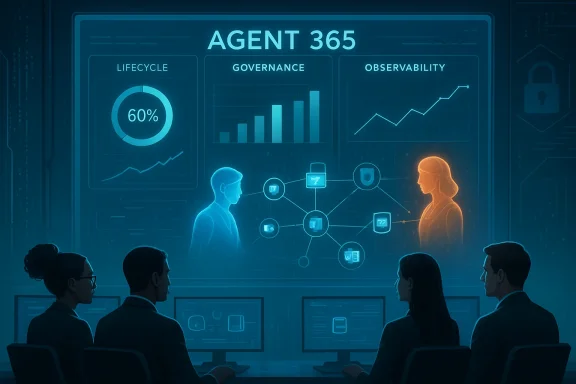
- Agent 365: A control plane for managing agent lifecycles, observability, governance, security, and access: an admin interface intended to treat agents like managed workers inside the organization. Microsoft plans to make Agent 365 generally available on May 1, with a standalone price of $15 per user per month.
- Microsoft 365 E7 (The Frontier Suite): A new top-tier enterprise SKU that bundles Microsoft 365 E5, Microsoft 365 Copilot (with agentic capabilities), and Agent 365 into a single subscription priced at $99 per user per month. Microsoft positions E7 as a cost-efficient way to acquire these capabilities together rather than buying them piecemeal.
- Adoption signals: Microsoft executives noted rapid uptake of Copilot capabilities — a 160% year-over-year increase in Copilot users and daily active users growing tenfold — positioning the company to productize broader agent management. Microsoft also claimed that “tens of millions of agents” have been registered in the Agent 365 preview registry, a point the company used to justify commercializing the control plane. Readers should treat that latter scale claim cautiously until independent verification is possible.
Why this matters: the shift from generative to agentic AI
From prompts to workflows
Generative AI in productivity apps has primarily been about accelerating content creation: drafting emails, summarizing documents, generating slide decks. Agentic AI aims to do the next step by owning a workflow — scheduling meetings, updating spreadsheets, following up on tasks, and carrying work through multiple systems until a deliverable is complete.This move turns Copilot from a tool that augments human thinking into a system that can take on responsibility for repeatable tasks. For enterprises, that multiplies the surface area for productivity gains — and for risk.
Vendor diversification and model choice
By adding Anthropic’s Claude models alongside OpenAI’s offerings, Microsoft is making its Copilot platform multi-model. That gives customers options to select models that better match their risk tolerance, safety requirements, or performance needs. It also complicates procurement and compliance: contracts, data residency, and allowed uses may differ by model provider, and enterprises will need to understand those distinctions before enabling models broadly.Governance becomes operational
Treating agents like employees — with identities, permissions, observability, and lifecycle management — is central to Agent 365’s pitch. That’s a sensible framing because these agents will touch email, calendars, files, and proprietary business data. The difference between a well-governed agent and a rogue one is not theoretical; it’s an operational challenge with legal and compliance implications.What Copilot Cowork actually does (and how it works)
Agent capabilities — what to expect
- Plan multi-step tasks that unfold over days or weeks rather than single-turn prompts.
- Orchestrate actions across Outlook, Teams, Word, Excel, PowerPoint, and shared files to collect context and produce finished outputs.
- Use plug-ins and extra “skills” to connect to internal systems and third-party data sources.
- Operate with permissioned access, allowing agents to act under explicitly granted scopes.
Technical model orchestration
Copilot Cowork’s execution model pairs an orchestration layer (Copilot Studio/agent-builder) with underlying language models (now including Anthropic’s Claude family). The orchestration layer manages memory, state, long-running processes, and the mapping of natural language instructions to app-level actions. Enterprises get the option to select which model family an agent uses, trading off raw capability, cost, and predictable behavior.Observability and audit trails
Agent 365 promises observability features akin to people-management tools: registries, activity logs, policy enforcement, and governance dashboards. Observability is critical for security, forensics, and compliance; without it, an agent that makes an erroneous change or divulges data can be difficult to trace and remediate. Microsoft has framed Agent 365 precisely as the control plane for that problem class.The commercial picture: pricing, licensing, and procurement
Microsoft has chosen a seat-based pricing model for the new E7 bundle and Agent 365. Key commercial facts announced so far:- Agent 365 standalone: $15 per user per month; generally available May 1.
- Microsoft 365 E7: $99 per user per month, bundling E5, Copilot, and Agent 365. Microsoft argues this is cheaper than assembling the components separately.
Strengths and practical benefits
- Productivity lift at scale: Agentic agents can free knowledge workers from repeatable, low-value tasks — scheduling, report consolidation, and routine research — enabling higher-value activities. Early demos show agents cleaning calendars and conducting detailed research workflows.
- Centralized governance: Agent 365 centralizes agent lifecycle management, which should reduce risk compared with ad hoc scripts and shadow automation. Integrated logging and registries can speed audit and incident response.
- Multi-model flexibility: Offering Anthropic’s Claude alongside OpenAI lets organizations choose models that better align with safety requirements or regulatory preferences. That choice can be a competitive differentiator for large regulated enterprises.
- Bundled economics: For organizations already on E5 or looking to standardize on Microsoft for both productivity and AI, E7’s bundled price may simplify licensing and reduce overall TCO.
Risks, unknowns, and areas requiring caution
Data governance and privacy
Agents that access mailboxes, calendar entries, and proprietary files multiply the vectors for data leakage. Enterprises must demand clear contracts and technical controls around data retention, model training (whether provider models see enterprise data), and data residency. Until contractual boundaries are crystal clear, conservative enablement is prudent.Operational errors and autonomy
Agentic systems can make irreversible changes at scale — e.g., updating spreadsheets, forwarding email, or changing calendar invites. Human-in-the-loop gating and strict permissioning are essential. Relying on agents without robust rollback, approval, and monitoring increases risk.Supply-chain and contract complexity
Relying on multiple model providers (Anthropic and OpenAI) reduces single-vendor risk but increases contract complexity. Enterprises must reconcile differing SLAs, security attestations, and regulatory profiles across providers. That will require legal, procurement, and security teams to collaborate early.Cost and licensing entropy
Seat-based pricing can be simple, but highly agent-heavy organizations may face unexpected consumption costs (model inference charges, plug-in licensing, or integration fees). FinOps practices and pilot programs are necessary to forecast real-world spend.Unverified scale claims
Microsoft’s claim that tens of millions of agents have appeared in the Agent 365 Registry is notable but should be treated with caution until independently verified. Large headline numbers are useful for signaling rapid adoption but do not by themselves prove durable enterprise value or mature governance at scale.Practical guidance for IT leaders: an adoption playbook
If you are evaluating Microsoft 365 E7, Agent 365, or Copilot Cowork for your organization, here is a concise, pragmatic roadmap to manage risk and realize value.- Inventory: Catalog which departments will most benefit from agents and what data those agents will need to access. Prioritize low-risk workflows for early pilots.
- Pilot: Start with a tightly scoped pilot team (e.g., HR scheduling, finance report automation) and measure time saved, error rates, and compliance impact.
- Governance: Define agent lifecycles, role-based access controls (RBAC), and approval gates. Map agents to identity and entitlement models.
- Data protection: Update DLP, retention, and model-sharing policies. Insist on encryption, and require explicit contractual terms about training data usage from model providers.
- Observability: Deploy monitoring and alerting for agent actions. Require audit logs, immutable trails, and clear rollback procedures.
- Cost modeling: Work with procurement and FinOps to model seat vs. consumption costs and negotiate caps or predictable pricing.
- Incident response: Expand IR plans to include agent-related failures and data events; simulate scenarios in tabletop exercises.
- Vendor risk management: Evaluate Anthropic and OpenAI contracts for compliance, SLA, data processing agreements, and termination clauses.
- Training: Train human workers to coexist with agents — how to supervise, correct, and improve agent behavior iteratively.
- Governance board: Form a cross-functional AI governance board (security, legal, data, product) to approve agent templates and use cases.
Suggested guardrails and technical controls
- Enforce least privilege: Agents should have the minimum scopes required and no persistent full-access keys.
- Human-in-the-loop defaults: For any modification to critical records or external communications, require human approval by default.
- Immutable audit logs: Keep append-only logs of agent actions for compliance and forensics.
- Versioned agent manifests: Maintain a registry of approved agent templates with version control and change history.
- Rate limits and quotas: Apply execution limits to agents to prevent runaway behavior and unexpected costs.
- Test harnesses and staging: Validate agents in sandboxed environments before production rollout, using synthetic data where possible.
Strategic implications for Microsoft’s competitors and the market
Microsoft’s packaging of agentic AI into an enterprise-grade SKU shifts the competitive landscape. The E7 bundle and Agent 365 position Microsoft to sell AI not as an optional add-on but as a seat-based utility comparable to identity or email. For competitors, this raises stakes in several areas:- Cloud economics: Enterprises will re-evaluate where compute and inference happen and whether to centralize agent workloads on provider-managed models versus in-house inference.
- Enterprise AI governance: Vendors that can match Microsoft’s observability and governance story will be better placed to win regulated customers.
- Model diversification: Other platform vendors will feel pressure to support multi-model orchestration to meet enterprise demand for choice and risk-management.
Closing analysis: real opportunity, measurable risk
Microsoft’s announcement crystallizes a long-expected evolution in workplace AI: from reactive co‑author to autonomous coworker. That transition unlocks genuine productivity gains, especially for repeatable, cross-application tasks that currently consume large amounts of knowledge worker time. The combination of Copilot Cowork, Agent 365, and Microsoft 365 E7 represents a coherent product and commercial strategy to make autonomous agents enterprise-first features rather than experimental add-ons.However, the same features that make agentic AI powerful also make it riskier: data access, autonomous decision-making, and distributed execution multiply the consequences of model error, misconfiguration, and governance gaps. The balance of reward and risk will be determined not by technology alone but by the rigor of enterprise governance, procurement discipline, and the patience to pilot responsibly. For IT leaders, the immediate imperative is to treat agents like another kind of worker: define identity, permissions, oversight, and a clear playbook for when they succeed and when they fail.
If your organization is considering E7 or Agent 365, begin with a narrow, measurable pilot — insist on contractual clarity about data handling from all model providers, and ensure your observability and incident response playbooks are ready. The future of productive work will include agents; getting them right is now an operational challenge and a competitive opportunity.
Source: TechRadar Microsoft 365 confirms new premium tier focused on AI and productivity