

Microsoft’s quiet move toward treating AI agents like paid employees is more consequential than the initial headlines suggest: the company is reportedly weighing a new enterprise subscription — informally called Microsoft 365 E7 — that would bundle Microsoft 365 Copilot with the Agent 365 control plane and additional identity, compliance, and security components into a single high‑tier SKU. If the early pricing chatter proves accurate, E7 could land near $99 per user per month, reshaping licensing math for organizations that intend to run fleets of persistent, directory-backed agents alongside their human workforce.
Microsoft used its 2025 product cycle — notably Microsoft Ignite 2025 and related product announcements — to make an architectural case for an “agentic” enterprise: software entities that plan, act and collaborate on behalf of users, with lifecycle, identity and governance traits mirroring those of human employees. The company introduced Agent 365 as a control plane intended to register, provision, secure, monitor and govern such agents across Microsoft 365 and partner ecosystems, and continued integrating Copilot agent capabilities into Office apps and Windows. Those moves are now colliding with Microsoft’s commercial strategy, causing industry analysts to report that Microsoft is evaluating a new enterprise tier to capture the monetization of these agentic workloads.
At the same time, Microsoft announced a broad list‑price adjustment for commercial Microsoft 365 suites effective July 1, 2026, while preserving Copilot as a separately priced add‑on at $30 per user per month for enterprises. Those two commercial levers — base list price increases and per‑seat Copilot fees — provide the arithmetic backdrop to any E7 pricing conversation.
Beyond simple entitlement, an E7 bundle gives Microsoft a product narrative: instead of selling Copilot as an add‑on and Agent 365 as disparate capabilities, it can present a single “enterprise AI stack” with:
Put another way: if you currently license E5 and add Copilot you’re already in the $87–$90 all‑in neighborhood depending on E5 discounts and contract terms; an E7 at $99 is mostly a consolidation play — but it’s also a step function for customers who previously declined Copilot due to complexity or cost. The key commercial difference is simplicity and included governance — the peace of mind of an all‑in bundle rather than a la carte assemblies.
Caveat: the $99 figure remains a market report / rumor and Microsoft has not publicly confirmed an E7 announcement. Until Microsoft comments publicly or publishes product pages and licensing matrices, the price is best treated as plausible reporting, not finalized fact.
The tug‑of‑war will be between two dynamics:
E7, at a rumored $99 per user per month, could simplify procurement and accelerate responsible agent deployments for organizations that are ready. For those still in planning stages, it raises urgent questions about budgeting, governance, vendor lock‑in and operational maturity. The wisest course for enterprise IT leaders is to treat this as a transition window: define governance and financial controls now, run tightly scoped pilots that generate measurable ROI, and use those outcomes to negotiate sensible long‑term contracts. The agent era promises productivity gains — but only teams that pair the right governance with the technology will turn those gains into durable business value.
Source: theregister.com Microsoft reportedly eyes E7 tier for AI agents
 Background / Overview
Microsoft used its 2025 product cycle — notably Microsoft Ignite 2025 and related product announcements — to make an architectural case for an “agentic” enterprise: software entities that plan, act and collaborate on behalf of users, with lifecycle, identity and governance traits mirroring those of human employees. The company introduced Agent 365 as a control plane intended to register, provision, secure, monitor and govern such agents across Microsoft 365 and partner ecosystems, and continued integrating Copilot agent capabilities into Office apps and Windows. Those moves are now colliding with Microsoft’s commercial strategy, causing industry analysts to report that Microsoft is evaluating a new enterprise tier to capture the monetization of these agentic workloads.At the same time, Microsoft announced a broad list‑price adjustment for commercial Microsoft 365 suites effective July 1, 2026, while preserving Copilot as a separately priced add‑on at $30 per user per month for enterprises. Those two commercial levers — base list price increases and per‑seat Copilot fees — provide the arithmetic backdrop to any E7 pricing conversation.
Why an E7 tier makes sense to Microsoft — the commercial logic
Microsoft’s reported rationale for E7 is straightforward: as enterprises begin to run persistent AI agents that require identities, mailboxes, Teams presence, OneDrive storage and administrative controls, those agents will need some form of licensed entitlement in tenant directories. Historically those entitlements have been tied to human user subscriptions; a new SKU that explicitly covers agents is an elegant way for Microsoft to monetize the new class of workload while offering customers a consolidated purchasing option.Beyond simple entitlement, an E7 bundle gives Microsoft a product narrative: instead of selling Copilot as an add‑on and Agent 365 as disparate capabilities, it can present a single “enterprise AI stack” with:
- bundled governance and security features (Entra/Defender/Purview)
- Copilot seat coverage across productivity apps
- agent lifecycle tooling (Agent 365)
- potential premium SLAs, support and consumption credits
That packaging reduces procurement friction for customers who want the whole stack and ensures Microsoft captures more of the value created by agent‑driven productivity.
What Agent 365 is — the control plane for an agentic enterprise
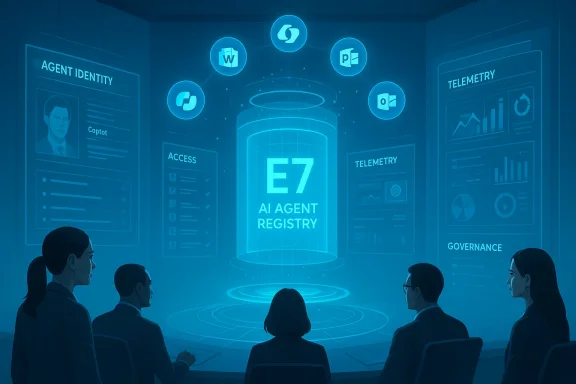
At its core, Agent 365 is Microsoft’s answer to the operational problems that come with scaled agent deployments: discovery, identity, policy enforcement, telemetry, observability and interoperability. The product was introduced in preview as part of Microsoft’s Frontier and partner programs and is described as providing:- a registry / single source of truth for agents
- access controls that limit an agent’s resource and data access
- dashboards and analytics that visualize agent behavior and connections to people and data
- security tooling to detect, investigate and remediate agent‑targeted threats
Agent 365 is intentionally vendor‑agnostic in ambition — supporting agents built with Copilot Studio, Microsoft Foundry, partner tools and some open‑source frameworks — because the fundamental operational requirements apply regardless of an agent’s model vendor.
What E7 might include — reconstructing the likely spec
No official spec exists, but public roadmaps, preview features and analyst reporting let us make an evidence‑based reconstruction of an E7 bundle’s likely contents:- Microsoft 365 E5 baseline (security, compliance, voice and management features).
- Microsoft 365 Copilot enterprise seats (full Copilot across Word, Excel, PowerPoint, Outlook, Teams).
- Agent 365 control plane features (registry, access control, visualization, interoperability, security).
- Expanded Entra identity features to treat agents like managed identities (directory objects, service principals and scoped credentials).
- Enhanced Purview data protection, Defender XDR telemetry and policy enforcement baked into the agent lifecycle.
- Copilot Studio and developer/admin tooling for building, deploying and monitoring agents, possibly with included message or inference credits.
- Premium enterprise support, SLAs and potentially hybrid seat + consumption billing options (analysts suggest Microsoft could mix per‑seat fees with consumption credits for heavy inference workloads).
Pricing reality check: where the $99 figure comes from and what it means
Reports circulating in the trade press and analyst blogs place a likely E7 headline price around $99 per user per month. That number aligns with a simple mental model: E5 list price rising to $60 (Microsoft’s announced July 1, 2026 list price) plus Copilot’s $30 add‑on still gets you to $90 — so $99 as a bundled premium is within plausible range for a single SKU that replaces E5+Copilot while adding Agent 365 and other extras. Microsoft’s own December 2025 pricing update made clear that E5 will increase to $60 on July 1, 2026; Copilot remains a $30 enterprise add‑on in public list pricing.Put another way: if you currently license E5 and add Copilot you’re already in the $87–$90 all‑in neighborhood depending on E5 discounts and contract terms; an E7 at $99 is mostly a consolidation play — but it’s also a step function for customers who previously declined Copilot due to complexity or cost. The key commercial difference is simplicity and included governance — the peace of mind of an all‑in bundle rather than a la carte assemblies.
Caveat: the $99 figure remains a market report / rumor and Microsoft has not publicly confirmed an E7 announcement. Until Microsoft comments publicly or publishes product pages and licensing matrices, the price is best treated as plausible reporting, not finalized fact.
Enterprise impact: budgets, procurement and the math of agentization
A $99 seat is not trivial. For organizations with thousands of seats, moving a broad class of users to E7 could multiply license spend quickly. Consider the following simplified scenarios (illustrative):- 1,000 knowledge workers — Copilot for all:
- E5 at $60 × 1,000 = $60,000/month
- Copilot $30 × 1,000 = $30,000/month
- Combined today ≈ $90,000/month ($1.08M/year)
- E7 at $99 × 1,000 = $99,0) — an incremental $108k/year over E5+Copilot list prices.
- 10,000 seats selectively licensed for agent roles (e.g., HR bots, helpdesk agents, finance agents): even modest per‑seat adoption can drive six‑figure monthly bills if E7 is deployed widely.
Product and platform risks for customers
No technology rocal — licensing and governance choices create operational, legal and strategic exposures. Key risks companies should plan for:- Price shock and budget elasticity: sudden movement to E7 can create internal allocativor siloed adoption (pockets of E7 users), which can cause tool fragmentation and inconsistent governance.
- Vendor lock‑in: bundling identity, telemetry, connectors and agent orchestration tightly with Microsoft 365 makes it harder to migrate agents to alternative control planes later. Organizations should assume higher switching costs as agents accumulate business context and system integrations.
- Operational complacency: buying an “Agent governance” SKU does not substitute for rigorous governance processes, human oversight, change control, privacy impact assessments, and technical audits. Tooling can help, but it can’t replace accountable processes.
- Usage‑based unpredictability: if E7 mixes per‑seat entitlements with consumption credits for heavy model inference, finance teams must model bursty agent workloads to avoid surprise bills.
- Regulatory and compliance exposure: agents that act autonomously on data raise meaningful compliance questions in finance, healthcare, government and regulated industries. Ensure the agent control plane supports required audit trails, data residency and provenance controls.
- Security gaps: preview reports from community researchers and independent testers have already highlighted governance blind spots and enforcement gaps; enterprises should treat Agent 365 as a starting point, not a turnkey shield.
Technical considerations — how to treat agents in your architecture
For architecture and security teams, agents are a different class of workload. They are long‑lived, stateful, integrated and often require cross‑system privileges. Design principles to apply now:- Treat each agent as a named, auditable identity object in your directory (not as a service account tacked onto an application). Use Entra (Azure AD) primitives to scope credentials, secrets and permissions tightly.
- Implement least privilege and just‑in‑time access for agent‑to‑syhould be able to request approvals or escalate to human operators where high‑risk actions are involved.
- Require strong telemetry and immutable audit logs for all agent activity, including prompt inputs, data accessed, external calls and output actions; assume investigators will need to replay agent behavior for compliance and incident response.
- Segregate agent execution environments wherever possible (sandboxing, ephemeral compute, dedicated Cloud PCs for high‑risk agents) and apply automated rollback and remediation tooling to contain misbehaving agents.
- Model costs: create chargeback or showback models that attribute agent compute and inference credits to business units that request and benefit from the agent. If E7 introduces consumption pricing, integrate that into your internal FinOps.
Procurement and negotiation playbook — practical steps for IT leaders
If your organization is evaluating Copilot, Agent 365 or an emerging E7 SKU, follow a staged approach to control spend and risk:- Inventory current AI & automation usage: map current automation, Power Platform workflows, RPA bots, Azure Functions and any third‑party agents. Treat them as candidate migrations into a managed agent program.
- Define agent governance guardrails: approve a policy template for agent creation, access provisioning, data sourcing, human‑in‑the‑loop gates and audit requirements. Make this policy a precondition for procurement of any agent seat.
- Model licensing scenarios: compare E5 + Copilot + add‑ons versus a rumored E7. Build three‑year TCO models that include licensing, support, training, and expected inference consumption. Factor in projected agent population growth.
- Negotiate hybrid pricing: for large or heavy agent consumers, push for hybrid deals that add usage caps or predictable consumption buckets rather than unbounded per‑seat + pay‑as‑you‑go exposure. Ask for pilot pricing floors and consumption credits during early runs.
- Lock pricing windows where possible: if your EA renewal precedes July 1, 2026, evaluate whether locking current rates or staging renewals gains leverage. Microsoft’s announced price date is real and will affect negotiations.
- Insist on contractual auditability: require vendor commitments about agent telemetry retention, data residency controls, and rights to inspect model prompts and outputs for compliance investigations.
- Start small with high‑value agents: prioritize pilots that automate repetitive, low‑risk workflows with clear metrics — e.g., knowledge base triage agents, meeting summarization agents — and measure real ROI before broad rollout.
Governance maturity: what success looks like
Enterprises that succeed with agent fleets will treat governance as an organizational capability, not a checkbox. Key indicators of maturity:- A centralized Agent Registry (or Agent 365 adoption) that lists every active agent, owner, scope, and last audit date.
- Role‑based entitlement models that separate agent development, deployment and approval privileges.
- Automated telemetry pipelines that feed security, compliance and business‑metric dashboards (so you can measure safety, accuracy, and business outcomes).
- Financial governance that ties agent consumption to business owners and includes cost‑containment controls for model inference.
The strategic long view — Microsoft, customers and the agent economy
Microsoft’s potential E7 SKU is more than a productization of features — it’s a statement of how the vendor expects the enterprise to evolve. If agents proliferate as Microsoft expects, licensing models will follow the work model: vendors will try to capture incremental value created by agentic productivity. For customers, that means the corporate digital‑worker conversation moves from “can we experiment?” to “how do we govern, cost and scale?”The tug‑of‑war will be between two dynamics:
- Microsoft’s incentive to simplify and monetize agent operations at scale (packaged value, lower procurement friction, higher ARPU), and
- Customers’ incentive to preserve architectural choice, control costs, and maintain multi‑model / multi‑vendor flexibility.
Recommendations — what IT leaders should do this quarter
- Run an Agent Readiness Audit: map candidate processes and identify the first 5–10 agents to pilot.
- Build a pilot governance pack (policy, approval flow, audit checklist) and require it for any vendor agent deployment.
- Model three licensing scenarios (status quo E5/E3 + Copilot, rumored E7, and a mixed consumption approach) and stress‑test against expected agent growth.
- Engage procurement early: request pilot pricing, consumption caps and audit language for telemetry and data residency.
- Invest in FinOps for agent workloads: start tagging agent workloads and build internal chargeback rules.
- Train security/IR teams on the forensic needs of agent incidents (prompt logging, replayability, context linkage).
Conclusion
The prospect of a Microsoft 365 E7 tier — bundling Copilot with Agent 365 and deeper identity and governance features — marks the next phase of enterprise AI commercialization: moving from discrete add‑ons to platformized, agent‑first licensing. That shift is predictable given the product announcements Microsoft made in 2025 and the company’s public decision to raise list prices in July 2026. But predictable doesn’t mean painless for customers.E7, at a rumored $99 per user per month, could simplify procurement and accelerate responsible agent deployments for organizations that are ready. For those still in planning stages, it raises urgent questions about budgeting, governance, vendor lock‑in and operational maturity. The wisest course for enterprise IT leaders is to treat this as a transition window: define governance and financial controls now, run tightly scoped pilots that generate measurable ROI, and use those outcomes to negotiate sensible long‑term contracts. The agent era promises productivity gains — but only teams that pair the right governance with the technology will turn those gains into durable business value.
Source: theregister.com Microsoft reportedly eyes E7 tier for AI agents
