

Microsoft confirmed a full restoration of Microsoft 365 services on January 22, 2026 after a wide-reaching outage that disrupted Outlook, Teams, OneDrive, Entra-backed sign‑ins and several management portals for many customers worldwide.
The January outage is the latest instance in a pattern of high‑visibility cloud incidents where a single configuration or routing change in an edge control plane propagated broadly and produced user‑visible failures across multiple services. Modern hyperscale clouds place a lot of shared functionality—TLS termination, global HTTP(S) routing, Web Application Firewall (WAF) enforcement and identity frontends—into global edge fabrics, and that concentration increases the blast radius when something goes wrong. Several investigations of recent incidents show the same recurring mechanics: a configuration change, routing anomaly or control‑plane fault at the edge causes authentication and portal failures that look like application downtime even though many backend services remain healthy.
Microsoft’s response during the incident followed a classical containment-and-rollback playbook: stop further configuration rollouts to the edge fabric, roll back to the last known good configuration, rebalance traffic away from unhealthy Points of Presence (PoPs) and apply tenant‑specific mitigations where necessary. Those steps surfaced quickly in the public timeline and were instrumental in restoring service for the majority of customers.
Microsoft’s public messages during the event referenced a recent Azure infrastructure change and described rebalancing and rollback activities; internal incident identifiers and status updates were used to coordinate mitigations. Engineers also applied targeted tenant‑level actions for isolated customers after the main rollback to clear lingering edge or DNS cache effects.
Caveat: the precise low‑level misconfiguration (specific rule, hostname change, or propagation artifact) is typically disclosed only in a formal post‑incident root cause analysis; the initial public messaging focused on rollback and traffic rebalancing rather than internal configuration details. Until Microsoft publishes the post‑incident report, certain technical specifics remain unverified in the public record.
Weaknesses that surfaced during the incident included the downstream effects of DNS caching and global routing convergence, which produced a “long tail” of intermittent issues that required tenant‑by‑tenant attention. Additionally, when admin portals themselves are affected by the same ingress fabric, administrators lose some of their primary troubleshooting tools—an ironic but recurring challenge that complicates rapid recovery.
Cautionary note: a single public report that quoted a specific 25,000‑report peak on one monitoring site is plausible as a near‑term snapshot, but that figure wasn’t consistently mirrored across all aggregator feeds in the records reviewed; the more conservative framing is that tens of thousands of user reports spiked on public trackers during the early hours of the outage. Treat any single reported number as a snapshot with sampling limitations unless corroborated by multiple independent telemetry feeds or Microsoft’s own published impact summary.
Microsoft’s forthcoming post‑incident reports will be essential reading: they should explain the exact configuration failure, the propagation mechanics, and what checks will be added to prevent reoccurrence. For customers, the episode reinforces the need for contingency communications, clear authentication recovery paths and a real‑world plan for long‑tail cleanup after any widespread routing or DNS correction.
The immediate work now is straightforward: verify tenant health, clear lingering caches and tokens, and treat the company’s promised root cause report as both a learning opportunity and a roadmap for practical resilience improvements.
Source: express-dz.com Microsoft Outage Resolved: Microsoft 365, Outlook, Teams Fully Restored After January 23 Disruption
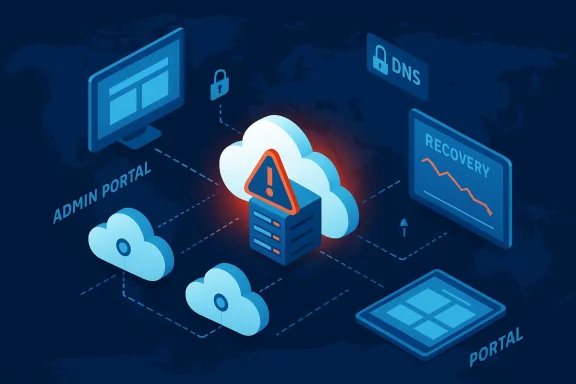 Background
The January outage is the latest instance in a pattern of high‑visibility cloud incidents where a single configuration or routing change in an edge control plane propagated broadly and produced user‑visible failures across multiple services. Modern hyperscale clouds place a lot of shared functionality—TLS termination, global HTTP(S) routing, Web Application Firewall (WAF) enforcement and identity frontends—into global edge fabrics, and that concentration increases the blast radius when something goes wrong. Several investigations of recent incidents show the same recurring mechanics: a configuration change, routing anomaly or control‑plane fault at the edge causes authentication and portal failures that look like application downtime even though many backend services remain healthy.Microsoft’s response during the incident followed a classical containment-and-rollback playbook: stop further configuration rollouts to the edge fabric, roll back to the last known good configuration, rebalance traffic away from unhealthy Points of Presence (PoPs) and apply tenant‑specific mitigations where necessary. Those steps surfaced quickly in the public timeline and were instrumental in restoring service for the majority of customers.
What happened (concise timeline)
- Early reports of access failures and sign‑in errors appeared in the morning UTC work window on the day of the incident; public outage trackers recorded a rapid surge in user complaints. The pattern and timing reported across multiple monitoring services showed a clear spike in sign‑in and connectivity issues.
- Microsoft acknowledged the issue via its Microsoft 365 status channels and incident records (public incident entries were referenced in troubleshooting summaries). Initial public messaging described a networking-related change that was under investigation and stated engineers were rebalancing traffic across affected infrastructure as an initial mitigation step.
- Engineers proceeded with a rollback of the suspect configuration and rebalanced traffic across the edge fabric and PoPs. As rollback and traffic redistribution progressed, many users and tenants began to see services recover. Microsoft reported that the rollback had completed and that recovery was in progress during the day.
- By mid‑afternoon UTC a large majority of customers had regained full functionality; isolated tenant‑specific issues persisted into the afternoon and were addressed via targeted mitigations. Microsoft committed to a post‑incident review and a preliminary report to be shared in the days following the incident.
Scope and impact — who and what was affected
The outage had a broad surface because multiple first‑party Microsoft services share ingress and identity flows that are fronted by global edge components. Reported impacts included, but were not limited to:- Email send/receive delays and inability to access mailboxes on Outlook / Exchange Online.
- Calendar access failures and issues within Teams calendar and meeting joins.
- Interruptions to Teams connectivity and virtual meetings for many users during business hours.
- OneDrive and SharePoint web access difficulties and file share connectivity problems.
- Admin consoles and portal blades (Azure Portal, Microsoft 365 admin center) showing blank or incomplete pages for some administrators, complicating recovery.
What caused it — technical root cause and mechanics
Multiple independent investigations into comparable incidents point to the same technical mechanism that appears to be at play here: an inadvertent or problematic configuration change in Microsoft’s edge routing/control plane—commonly implemented as Azure Front Door or a similar global Layer‑7 fabric—propagated to many PoPs and induced routing and TLS/DNS anomalies that broke access to identity issuance and management surfaces. When identity endpoints (Entra ID/Azure AD token services) and admin portals sit behind the same edge fabric as customer‑facing apps, a control‑plane misconfiguration can:- Produce incorrect DNS or hostname mappings at PoPs;
- Cause TLS handshake failures or hostname mismatches;
- Introduce asymmetric routing or packet loss that prevents clients from reaching token endpoints; and
- Break the sequence of calls required for successful Entra/Azure AD token issuance and redirection flows.
Microsoft’s public messages during the event referenced a recent Azure infrastructure change and described rebalancing and rollback activities; internal incident identifiers and status updates were used to coordinate mitigations. Engineers also applied targeted tenant‑level actions for isolated customers after the main rollback to clear lingering edge or DNS cache effects.
Caveat: the precise low‑level misconfiguration (specific rule, hostname change, or propagation artifact) is typically disclosed only in a formal post‑incident root cause analysis; the initial public messaging focused on rollback and traffic rebalancing rather than internal configuration details. Until Microsoft publishes the post‑incident report, certain technical specifics remain unverified in the public record.
How Microsoft handled recovery and communications
Microsoft’s operational playbook for this incident closely matched established best practices for edge/control-plane faults:- Immediate containment by halting further configuration rollouts to the affected edge service.
- Rapid rollback to a validated last known good configuration where possible.
- Rebalancing and rerouting traffic away from unhealthy PoPs to stabilize client request paths.
- Applying tenant‑specific mitigations (for example, selective DNS/prune or local failovers) for remaining isolated issues.
- Frequent status updates through the Microsoft 365 service health channels and public status posts to keep admins and customers informed.
Weaknesses that surfaced during the incident included the downstream effects of DNS caching and global routing convergence, which produced a “long tail” of intermittent issues that required tenant‑by‑tenant attention. Additionally, when admin portals themselves are affected by the same ingress fabric, administrators lose some of their primary troubleshooting tools—an ironic but recurring challenge that complicates rapid recovery.
Measured scope and the “numbers” question
Published counts from outage aggregators and social trackers were used extensively in early coverage. Those trackers showed very high volumes of user reports during the incident window, and multiple outlets cited peak report counts in the thousands to tens of thousands. However, it’s important to treat those aggregates as indicators of scale rather than precise counts of affected tenants or users, because each tracker uses different ingestion models and sampling windows. Microsoft’s internal telemetry is the definitive source for exact customer impact figures; that detail typically appears in the company’s post‑incident report rather than in real‑time tracker snapshots.Cautionary note: a single public report that quoted a specific 25,000‑report peak on one monitoring site is plausible as a near‑term snapshot, but that figure wasn’t consistently mirrored across all aggregator feeds in the records reviewed; the more conservative framing is that tens of thousands of user reports spiked on public trackers during the early hours of the outage. Treat any single reported number as a snapshot with sampling limitations unless corroborated by multiple independent telemetry feeds or Microsoft’s own published impact summary.
What this means for enterprises and IT teams
The disruption serves as a practical reminder that cloud dependence has operational risks and that resilience planning must include contingencies for shared‑plane failures. Key takeaways for IT leaders:- Maintain and test secondary communication channels and escalation paths. Outages that affect email and calendar services for a broad user base make tools like Slack, Zoom, SMS, or telephony essential stopgaps.
- Establish clear runbooks for identity failures. Authentication outages are uniquely disruptive; have procedures for alternative authentication steps, recovery of service accounts and token refresh strategies.
- Implement and test DNS and cache‑flushing procedures. Because DNS cache TTLs can produce lingering client‑side failures after a routing fix, test how to clear local caches and advise end users on staged rollbacks.
- Validate admin plane redundancy. Consider configuring separate control paths (where supported) or ensuring emergency access methods to management consoles that aren’t routed through the same ingress fabric used by production apps.
- Keep incident response playbooks current. Simulate large‑scale identity/edge failures in tabletop exercises to verify that teams can coordinate with cloud providers and perform tenant‑level mitigations quickly.
- Restart affected client apps and devices after public restoration messages to clear transient auth tokens.
- Flush DNS caches on client machines or advise users to reboot their network equipment when post‑incident symptoms linger.
- Contact Microsoft support if tenant‑specific artifacts persist after public service restoration; targeted mitigations are often required to clear tenant caches or reissue service tokens.
Technical implications — why edge fabrics are both powerful and fragile
Edge fabrics like Azure Front Door are highly useful because they centralize global routing, caching and security enforcement, which improves latency, simplifies configuration and provides scalability. But their advantages create a coupling risk:- Shared control plane: when the same control plane pushes routing and hostname directives for many services, a single faulty change can ripple broadly.
- Identity coupling: many cloud services route authentication flows through the same entry points as application traffic; a broken handshake at the edge can block token issuance and make otherwise healthy backend APIs inaccessible.
- Propagation and caching effects: global PoP propagation and DNS TTLs mean that a rollback can take time to converge everywhere, producing a multi‑hour tail of intermittent failures that are difficult to fully control in real time.
Strengths and shortcomings of Microsoft’s incident handling (critical analysis)
Strengths- Rapid identification of the change vector and decisive rollback actions limited the outage duration for most customers.
- Visibility through public status channels and incident identifiers helped admins track progress even when some admin blades were impaired.
- The commitment to a preliminary report and a full root cause analysis is the right transparency posture for a failure of this scale.
- Shared ingress for admin and service traffic reduces the ability of administrators to triage when admin consoles are affected; designing separate recovery paths or bypass mechanisms would reduce this friction.
- DNS and PoP convergence effects produced a long tail that required manual tenant remediation—this reveals residual fragility even after a successful rollback.
- The incident highlights the systemic risk of coupling many services to a single global control plane; while cloud providers balance efficiency and isolation, customers must assume the possibility of shared‑plane incidents and build compensating controls.
What to watch next — the post‑incident process
Microsoft’s promise to publish a preliminary incident report and a full root cause analysis in the coming days and weeks is an important transparency step and will be the authoritative source for the event’s technical minutiae and customer impact statistics. Those reports should be examined closely for:- The precise configuration change and propagation pathway that caused the disruption.
- Why automatic safeguards (if any) failed to stop the problematic change prior to broad propagation.
- The telemetry signals that detected the fault and the thresholds used to trigger rollback.
- Tenant remediation patterns and whether Microsoft will recommend or provide tooling to avoid similar tenant‑specific lingering issues in future events.
Practical checklist for administrators (actionable takeaways)
- Immediately after a service‑wide restoration, instruct users to:
- Close and reopen Outlook/Teams clients to renew authentication tokens.
- Reboot local DNS‑caching devices or flush DNS on endpoints if symptoms persist.
- For IT teams:
- Validate mail flow and meeting joins for a representative set of users across regions.
- Check conditional access and token issuance logs for anomalies and reissue service credentials where necessary.
- Prepare a communication template for business units explaining outage cause (as published by Microsoft) and what was done to remediate.
- Strategic:
- Run a tabletop exercise simulating an edge control‑plane outage and confirm your secondary communication and support channels.
- Review multi‑region failover settings for critical endpoints and consider creating out‑of‑band admin access paths if supported by your provider.
Final assessment
The January outage was a reminder of both the power and fragility of modern cloud architectures. Microsoft’s engineers identified the suspect networking change, executed a rollback and rebalanced traffic to restore service for most customers within hours—a competent operational response. But the outage also highlighted persistent systemic risks tied to shared edge fabrics, DNS propagation behavior and the coupling of identity and control planes with administrative surfaces. Enterprises must treat cloud outages not as remote hypotheticals but as operational risks to be mitigated through planning, redundancy and tested runbooks.Microsoft’s forthcoming post‑incident reports will be essential reading: they should explain the exact configuration failure, the propagation mechanics, and what checks will be added to prevent reoccurrence. For customers, the episode reinforces the need for contingency communications, clear authentication recovery paths and a real‑world plan for long‑tail cleanup after any widespread routing or DNS correction.
The immediate work now is straightforward: verify tenant health, clear lingering caches and tokens, and treat the company’s promised root cause report as both a learning opportunity and a roadmap for practical resilience improvements.
Source: express-dz.com Microsoft Outage Resolved: Microsoft 365, Outlook, Teams Fully Restored After January 23 Disruption
