

Microsoft’s Advanced Shader Delivery is now broadly available for recent AMD Radeon GPUs through the Xbox app on Windows, after a June 2026 expansion that adds older RDNA cards while Nvidia and Intel support remains on a slower, staggered track. That is the factual news; the bigger story is that Microsoft is trying to turn one of PC gaming’s messiest runtime problems into a distribution problem. Shader compilation stutter has always been a tax paid at the worst possible moment: first launch, driver update, new area, new effect, new hitch. Microsoft’s fix is promising, but its first real-world shape also reveals the limits of trying to console-ify Windows without owning the whole PC stack.
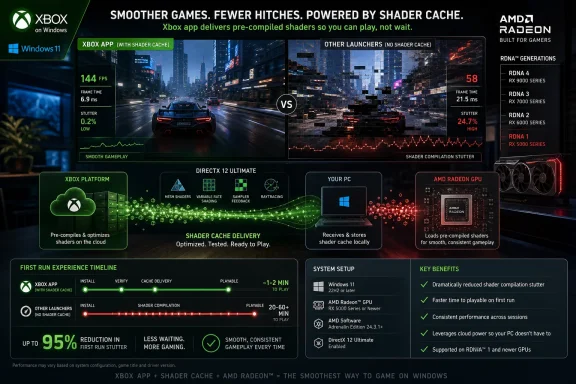
Advanced Shader Delivery, or ASD, is Microsoft’s attempt to stop games from asking every individual PC to do the same expensive shader-preparation work at the worst possible time. Instead of waiting for a game to compile shaders locally on first launch, the system allows precompiled shader data to be generated ahead of time and delivered with the game or after driver changes.
That sounds procedural, almost boring, but it attacks a deeply visible problem. Modern DirectX 12 games often give developers more control over the graphics pipeline, which can mean better performance ceilings and more explicit resource management. It can also mean that, if shader preparation is mishandled, the player gets a beautiful frame followed by a frozen one.
The irritation is not just the familiar “compiling shaders” progress bar. The real damage is psychological: a high-end PC can feel less reliable than a console because a game’s first hour becomes a dress rehearsal for the cache rather than the experience the player paid for. When a game hitches during a cutscene, a boss fight, or the first sweep across an open world, the hardware looks guilty even when the pipeline is the culprit.
Microsoft’s wager is that Windows can borrow one of the console’s structural advantages. Consoles have fixed hardware targets, so platform holders and developers can know in advance what shader variants they need. The PC has historically traded that certainty for flexibility, and ASD is an effort to recover some of the certainty without giving up the flexibility.
That is a meaningful cutoff. RDNA 1 dates back to 2019, so this is not a boutique feature reserved for buyers of the newest GPU generation. It covers a large chunk of active Radeon gaming PCs, including systems that are old enough to be sensitive to long compilation steps but new enough to remain viable for modern DirectX 12 games.
AMD also benefits politically from being first. In desktop gaming, Nvidia dominates mindshare and market share, but a platform-level quality-of-life feature arriving first on Radeon lets AMD tell a more flattering story than raw frame-rate charts usually allow. The claim is not that Radeon is suddenly faster than GeForce in every game; it is that Radeon owners can get a smoother first-run experience in supported Xbox app titles right now.
That distinction matters because stutter is not always captured cleanly by averages. A GPU can post impressive mean frame rates while still delivering a poor experience if frame pacing breaks under shader pressure. If ASD removes a meaningful amount of that first-run turbulence, AMD gets a user-visible advantage in a category that players actually feel.
This is the uncomfortable truth behind Microsoft’s rollout: the most technically attractive fixes in PC gaming often arrive first where the variables are easiest to control. Microsoft began with Xbox-branded handhelds, moved to newer AMD architectures through Insider testing, and is now expanding across Radeon’s RDNA generations. That is a rational engineering path, but it is not the same as instant ecosystem repair.
Nvidia has its own adjacent work in the form of Auto Shader Compilation in the Nvidia app beta. The difference is subtle but important. Nvidia’s approach can help preserve or refresh compiled shaders around driver updates, but Microsoft’s ASD is designed around delivering precompiled shader material through the platform as part of the game and driver ecosystem.
That distinction will be lost in some marketing, because both efforts are aimed at the same user complaint. But for administrators, reviewers, and technically minded players, implementation matters. A cache that survives driver updates is useful; a distribution system that prevents the first-run compilation burden from landing on the local machine is a more ambitious play.
Right now, ASD’s practical availability is tied to games distributed through Microsoft’s PC gaming stack. That includes Game Pass and Microsoft Store-style distribution, but it does not automatically extend the benefit to Steam, Epic Games Store, GOG, Battle.net, or other launchers where much of the PC gaming audience actually lives.
This gives Microsoft a clean proving ground. It can coordinate with Xbox, game developers, GPU vendors, and driver packages under a more controlled delivery path. If something breaks, the company can reason about the store, package, driver, and hardware relationship more easily than it could across the whole open PC market.
But the same control makes the feature feel less like a Windows improvement and more like an Xbox app advantage. That perception will matter. PC gamers have long memories when platform features appear to solve a general Windows problem only inside a preferred Microsoft storefront.
The comparison to Steam Deck is unavoidable. Valve’s handheld benefits from a relatively fixed hardware target and a tightly integrated distribution model, allowing shader pre-caching to feel like part of the platform rather than a separate feature. Microsoft is trying to bring a similar idea to Windows, but Windows is not a handheld appliance; it is the chaotic middle of PC gaming.
The load-time improvement is only one part of the story. Reducing first-run wait time is welcome, but eliminating just-in-time shader compilation during gameplay may be the more important win. A four-second launch is nice; avoiding a hitch when the game introduces a new effect is what makes the experience feel more premium.
Still, “up to” deserves its usual skepticism. The impact will vary by game, driver, GPU, CPU, storage, cache state, and how aggressively the title already manages shader compilation. Some games may show dramatic gains, while others were never badly affected in the first place.
There is also a category problem. Not all stutter is shader stutter. Games can hitch because of asset streaming, CPU scheduling, memory pressure, background tasks, anti-cheat, network events, or engine-level traversal spikes. ASD can be a major fix without being a magic wand.
But platform mechanisms only matter if developers and publishers adopt them. The PC has seen many technically sound improvements fail to become universal because they require coordination across engine teams, store infrastructure, QA labs, and vendor relations. The shader problem is exactly the sort of cross-boundary issue that everyone agrees should be fixed and nobody fully owns.
Microsoft’s advantage is that it can force the issue inside its own ecosystem. Game Pass gives the company a catalog, a launcher, and leverage. First-party games give it showcases. Xbox-branded devices give it controlled hardware.
The disadvantage is that PC gaming’s center of gravity is not entirely Microsoft’s. If Steam support remains uncertain or slow, ASD risks becoming a feature that is technically general but socially niche. A Windows feature that does not show up where most Windows gamers buy and launch games will be judged as partial, even if the engineering is impressive.
That does not make the move sinister. Someone has to coordinate the shader pipeline, and stores are a logical place to do it. They already deliver the game, the updates, and often the metadata that determines what hardware-specific payloads a player receives.
But the optics are delicate. PC gamers resist anything that looks like a soft enclosure of an open platform. If Microsoft wants ASD to be seen as a Windows ecosystem fix rather than an Xbox app moat, it will need credible momentum beyond its own launcher.
That means documentation, SDK maturity, vendor support, and store participation all have to converge. It also means Microsoft should resist the temptation to treat ASD as merely a Game Pass perk. The shader stutter problem is bigger than Game Pass, bigger than Radeon, and bigger than any one title.
The same philosophical question appears in patching, driver deployment, application packaging, and endpoint provisioning. How much work should happen centrally before delivery, and how much should be left to the client after install? ASD is a gaming-specific answer to that broader Windows problem.
It also highlights the growing importance of driver-aware content delivery. A shader cache is only useful if it matches the right GPU architecture, driver assumptions, game version, and graphics pipeline state. That is a surprisingly enterprise-like coordination problem inside a consumer feature.
For IT pros who support gaming-adjacent environments, esports labs, education PCs, demo rigs, or creator workstations, the practical takeaway is simple: the quality of the Windows experience increasingly depends on the health of ecosystems around Windows, not just Windows itself. GPU vendors, stores, game engines, and Microsoft services now share responsibility for whether the machine feels fast.
The next winners may be handhelds and living-room PCs, where first-run smoothness matters disproportionately. A handheld gaming device that spends less time compiling and more time playing feels more console-like, which is exactly the experience Microsoft has been chasing with Xbox-branded Windows handhelds.
The losers are not exactly Nvidia users, because support is coming, and they have interim tools. The real losers are players whose libraries live outside Microsoft’s distribution path. They can read about the future of shader delivery while still waiting through the old compilation grind in the launcher they actually use.
That split is why the news should be read as both progress and pressure. Microsoft has shown that the Windows shader problem can be attacked at the platform level. Now it has to prove that the platform is Windows, not just Xbox on PC.
 Microsoft Moves Shader Pain From the Player’s PC to the Platform
Advanced Shader Delivery, or ASD, is Microsoft’s attempt to stop games from asking every individual PC to do the same expensive shader-preparation work at the worst possible time. Instead of waiting for a game to compile shaders locally on first launch, the system allows precompiled shader data to be generated ahead of time and delivered with the game or after driver changes.That sounds procedural, almost boring, but it attacks a deeply visible problem. Modern DirectX 12 games often give developers more control over the graphics pipeline, which can mean better performance ceilings and more explicit resource management. It can also mean that, if shader preparation is mishandled, the player gets a beautiful frame followed by a frozen one.
The irritation is not just the familiar “compiling shaders” progress bar. The real damage is psychological: a high-end PC can feel less reliable than a console because a game’s first hour becomes a dress rehearsal for the cache rather than the experience the player paid for. When a game hitches during a cutscene, a boss fight, or the first sweep across an open world, the hardware looks guilty even when the pipeline is the culprit.
Microsoft’s wager is that Windows can borrow one of the console’s structural advantages. Consoles have fixed hardware targets, so platform holders and developers can know in advance what shader variants they need. The PC has historically traded that certainty for flexibility, and ASD is an effort to recover some of the certainty without giving up the flexibility.
AMD Gets the First Real Windows Win
The June expansion matters because AMD support is no longer limited to the newest Radeon hardware. With AMD Software: Adrenalin Edition 26.6.1 or newer, Advanced Shader Delivery now reaches RDNA 1, RDNA 2, RDNA 3, RDNA 3.5, and RDNA 4 devices, which effectively means Radeon RX 5000-series cards and newer.That is a meaningful cutoff. RDNA 1 dates back to 2019, so this is not a boutique feature reserved for buyers of the newest GPU generation. It covers a large chunk of active Radeon gaming PCs, including systems that are old enough to be sensitive to long compilation steps but new enough to remain viable for modern DirectX 12 games.
AMD also benefits politically from being first. In desktop gaming, Nvidia dominates mindshare and market share, but a platform-level quality-of-life feature arriving first on Radeon lets AMD tell a more flattering story than raw frame-rate charts usually allow. The claim is not that Radeon is suddenly faster than GeForce in every game; it is that Radeon owners can get a smoother first-run experience in supported Xbox app titles right now.
That distinction matters because stutter is not always captured cleanly by averages. A GPU can post impressive mean frame rates while still delivering a poor experience if frame pacing breaks under shader pressure. If ASD removes a meaningful amount of that first-run turbulence, AMD gets a user-visible advantage in a category that players actually feel.
Nvidia’s Wait Exposes the Cost of PC Variety
Nvidia users are not locked out forever, but they are being asked to wait. Support for GeForce RTX hardware is expected later, and that delay is awkward because Nvidia owners make up the overwhelming majority of discrete desktop PC gamers.This is the uncomfortable truth behind Microsoft’s rollout: the most technically attractive fixes in PC gaming often arrive first where the variables are easiest to control. Microsoft began with Xbox-branded handhelds, moved to newer AMD architectures through Insider testing, and is now expanding across Radeon’s RDNA generations. That is a rational engineering path, but it is not the same as instant ecosystem repair.
Nvidia has its own adjacent work in the form of Auto Shader Compilation in the Nvidia app beta. The difference is subtle but important. Nvidia’s approach can help preserve or refresh compiled shaders around driver updates, but Microsoft’s ASD is designed around delivering precompiled shader material through the platform as part of the game and driver ecosystem.
That distinction will be lost in some marketing, because both efforts are aimed at the same user complaint. But for administrators, reviewers, and technically minded players, implementation matters. A cache that survives driver updates is useful; a distribution system that prevents the first-run compilation burden from landing on the local machine is a more ambitious play.
The Xbox App Is Both the Showcase and the Cage
The largest caveat is not AMD or Nvidia. It is the Xbox app.Right now, ASD’s practical availability is tied to games distributed through Microsoft’s PC gaming stack. That includes Game Pass and Microsoft Store-style distribution, but it does not automatically extend the benefit to Steam, Epic Games Store, GOG, Battle.net, or other launchers where much of the PC gaming audience actually lives.
This gives Microsoft a clean proving ground. It can coordinate with Xbox, game developers, GPU vendors, and driver packages under a more controlled delivery path. If something breaks, the company can reason about the store, package, driver, and hardware relationship more easily than it could across the whole open PC market.
But the same control makes the feature feel less like a Windows improvement and more like an Xbox app advantage. That perception will matter. PC gamers have long memories when platform features appear to solve a general Windows problem only inside a preferred Microsoft storefront.
The comparison to Steam Deck is unavoidable. Valve’s handheld benefits from a relatively fixed hardware target and a tightly integrated distribution model, allowing shader pre-caching to feel like part of the platform rather than a separate feature. Microsoft is trying to bring a similar idea to Windows, but Windows is not a handheld appliance; it is the chaotic middle of PC gaming.
The 95 Percent Claim Is Impressive, but It Is Not the Whole Benchmark
Microsoft’s headline-friendly claim is that ASD can reduce initial load time in a supported title such as Forza Horizon 6 by up to 95 percent. That is the kind of number that cuts through noise, especially for anyone who has watched a game chew through a shader compilation screen before the main menu becomes useful.The load-time improvement is only one part of the story. Reducing first-run wait time is welcome, but eliminating just-in-time shader compilation during gameplay may be the more important win. A four-second launch is nice; avoiding a hitch when the game introduces a new effect is what makes the experience feel more premium.
Still, “up to” deserves its usual skepticism. The impact will vary by game, driver, GPU, CPU, storage, cache state, and how aggressively the title already manages shader compilation. Some games may show dramatic gains, while others were never badly affected in the first place.
There is also a category problem. Not all stutter is shader stutter. Games can hitch because of asset streaming, CPU scheduling, memory pressure, background tasks, anti-cheat, network events, or engine-level traversal spikes. ASD can be a major fix without being a magic wand.
Developers Still Have to Care
The most optimistic reading of ASD is that Microsoft has built an ecosystem mechanism rather than a one-off workaround. Developers generate shader database information, GPU vendors and Microsoft help compile and validate the right data, and the platform delivers it before the player needs it. In theory, the result is a better first-run experience without every game inventing its own ritual.But platform mechanisms only matter if developers and publishers adopt them. The PC has seen many technically sound improvements fail to become universal because they require coordination across engine teams, store infrastructure, QA labs, and vendor relations. The shader problem is exactly the sort of cross-boundary issue that everyone agrees should be fixed and nobody fully owns.
Microsoft’s advantage is that it can force the issue inside its own ecosystem. Game Pass gives the company a catalog, a launcher, and leverage. First-party games give it showcases. Xbox-branded devices give it controlled hardware.
The disadvantage is that PC gaming’s center of gravity is not entirely Microsoft’s. If Steam support remains uncertain or slow, ASD risks becoming a feature that is technically general but socially niche. A Windows feature that does not show up where most Windows gamers buy and launch games will be judged as partial, even if the engineering is impressive.
The Storefront Battle Hides Inside a Performance Feature
Microsoft will likely describe ASD as a gamer benefit, and that is true. But performance features on PC are rarely neutral once they depend on distribution. If the Xbox app version of a game launches faster and stutters less than the Steam version, the difference becomes a platform differentiator whether Microsoft says so or not.That does not make the move sinister. Someone has to coordinate the shader pipeline, and stores are a logical place to do it. They already deliver the game, the updates, and often the metadata that determines what hardware-specific payloads a player receives.
But the optics are delicate. PC gamers resist anything that looks like a soft enclosure of an open platform. If Microsoft wants ASD to be seen as a Windows ecosystem fix rather than an Xbox app moat, it will need credible momentum beyond its own launcher.
That means documentation, SDK maturity, vendor support, and store participation all have to converge. It also means Microsoft should resist the temptation to treat ASD as merely a Game Pass perk. The shader stutter problem is bigger than Game Pass, bigger than Radeon, and bigger than any one title.
Enterprise Lessons From a Gaming Fix
At first glance, this is a gaming story with no enterprise angle. Sysadmins do not usually lose sleep over shader compilation in Forza. But the underlying pattern is familiar to anyone who manages Windows at scale: local machines repeatedly performing expensive, user-visible work because the platform has not moved enough preparation upstream.The same philosophical question appears in patching, driver deployment, application packaging, and endpoint provisioning. How much work should happen centrally before delivery, and how much should be left to the client after install? ASD is a gaming-specific answer to that broader Windows problem.
It also highlights the growing importance of driver-aware content delivery. A shader cache is only useful if it matches the right GPU architecture, driver assumptions, game version, and graphics pipeline state. That is a surprisingly enterprise-like coordination problem inside a consumer feature.
For IT pros who support gaming-adjacent environments, esports labs, education PCs, demo rigs, or creator workstations, the practical takeaway is simple: the quality of the Windows experience increasingly depends on the health of ecosystems around Windows, not just Windows itself. GPU vendors, stores, game engines, and Microsoft services now share responsibility for whether the machine feels fast.
Radeon Owners Get the Preview of a Less Annoying PC
For now, the clearest winners are Radeon users who play supported games through the Xbox app. They get the broadest ASD support first, and the hardware coverage is generous enough to include several generations of real-world gaming PCs.The next winners may be handhelds and living-room PCs, where first-run smoothness matters disproportionately. A handheld gaming device that spends less time compiling and more time playing feels more console-like, which is exactly the experience Microsoft has been chasing with Xbox-branded Windows handhelds.
The losers are not exactly Nvidia users, because support is coming, and they have interim tools. The real losers are players whose libraries live outside Microsoft’s distribution path. They can read about the future of shader delivery while still waiting through the old compilation grind in the launcher they actually use.
That split is why the news should be read as both progress and pressure. Microsoft has shown that the Windows shader problem can be attacked at the platform level. Now it has to prove that the platform is Windows, not just Xbox on PC.
The Fine Print Is Where the Future Gets Decided
The practical state of Advanced Shader Delivery is clearer than the marketing gloss. It is promising, it is real enough to matter, and it is still fenced by hardware, drivers, titles, and storefront participation.- Radeon RX 5000-series and newer AMD GPUs can now use Advanced Shader Delivery with AMD Adrenalin 26.6.1 or newer in supported Xbox app games.
- Nvidia RTX support is expected later, while Nvidia’s separate Auto Shader Compilation feature addresses part of the same pain from a different angle.
- Intel has also signaled support, which matters because shader delivery only becomes a Windows norm if all major GPU vendors participate.
- The biggest limitation is not raw technology but distribution, because ASD currently depends on Microsoft’s Xbox app ecosystem rather than the full PC gaming market.
- The feature can dramatically reduce first-launch load times and shader-related stutter, but it will not fix every cause of uneven frame pacing.
- Microsoft’s long-term challenge is turning ASD from a showcase feature into plumbing that players never have to think about.
References
- Primary source: TechSpot
Published: Sat, 13 Jun 2026 17:17:00 GMT
Loading…
www.techspot.com - Official source: developer.microsoft.com
Loading…
developer.microsoft.com - Official source: devblogs.microsoft.com

Introducing Advanced Shader Delivery - DirectX Developer Blog
This year at gamescom, Microsoft is highlighting new gaming features coming for Windows, particularly for handheld devices. We want to highlight one ofdevblogs.microsoft.com - Related coverage: tomshardware.com
Loading…
www.tomshardware.com - Related coverage: overclock3d.net
Loading…
overclock3d.net - Related coverage: engadget.com
Loading…
www.engadget.com
- Related coverage: arstechnica.com
Loading…
arstechnica.com - Related coverage: tweaktown.com
Loading…
www.tweaktown.com - Related coverage: fanaticosdelhardware.com
Loading…
fanaticosdelhardware.com - Related coverage: xboxera.com
Loading…
xboxera.com - Related coverage: pcgamer.com
Loading…
www.pcgamer.com - Related coverage: club386.com

Microsoft debuts Advanced Shader Delivery on Windows 11 with Forza Horizon 6, promising 95% faster loading | Club386
Microsoft partners with AMD to expand its Advanced Shader Delivery service to Windows 11 PCs, delivering faster initial loading on RDNA 3 and newer GPUs. www.club386.com
- Official source: download.microsoft.com
Loading…
download.microsoft.com