

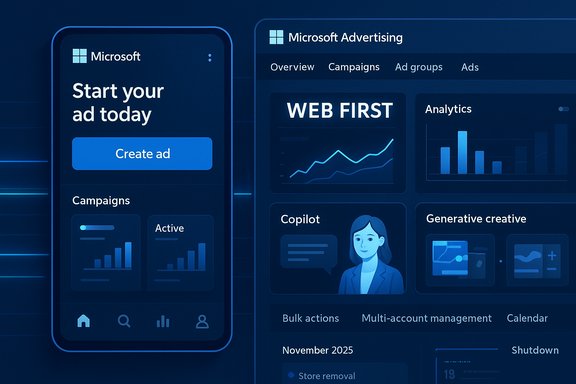
Microsoft has confirmed that the Microsoft Advertising mobile app will be retired early next year, with app-store removal already scheduled for November 2025 and full shutdown of functionality in January 2026 — a shift that forces advertisers to move mobile workflows to the web-based Microsoft Advertising interface and accelerates the platform’s consolidation around AI-powered, browser-first management tools.
Background / Overview
The retirement notice, sent to advertisers in late November 2025, states that the mobile app will be removed from the Apple App Store and Google Play in November 2025 and that installed apps will continue to receive security updates only until the final termination in January 2026. Microsoft’s message clarified that while existing campaigns and account data remain intact in the Microsoft Advertising platform, campaign creation and management via the native mobile app will end. This decision arrives as Microsoft increasingly places Copilot and web-first AI features at the center of its advertising stack — rolling out conversational analytics and generative creative tools on the web interface during 2025. The company’s larger strategic pivot toward agentic, browser-based ad experiences is a key context for understanding why a standalone mobile app no longer fits their roadmap.What Microsoft announced — the essentials
- The Microsoft Advertising mobile app will be removed from app stores in November 2025.
- Installed copies of the app will continue to function and will receive security updates until January 2026.
- As of January 2026, the app will cease to operate for campaign creation and management.
- All campaign data and accounts remain accessible through the Microsoft Advertising web interface; Microsoft directs advertisers to use the web UI going forward.
Timeline — key dates to plan around
- November 2025 — the mobile app is removed from the Apple App Store and Google Play for new downloads. Existing installations remain.
- November 24, 2025 — industry reporting captured Microsoft’s email notices to advertisers (the notice date appears in industry coverage).
- January 2026 — the app stops functioning for campaign management and will no longer be supported beyond security updates.
Why Microsoft is doing this (analysis)
Microsoft’s stated rationale centers on consolidating campaign management around web-first, AI-enhanced workflows and Copilot-driven campaign surfaces. The company shipped several major web-based capabilities in 2025 — notably conversational performance analytics and generative creative tools — which are explicitly targeted at removing friction in campaign setup, creative production, and performance analysis. Those features live in the web Ads Studio and Copilot experiences rather than in a lightweight native mobile interface. Strategic drivers include:- Feature consolidation: The web UI supports richer analytics, bulk operations, and generative APIs that are difficult to replicate in a small mobile app UI without fragmenting the product experience.
- Operational scale for AI: Generative creative and conversational analytics scale better within a web and API model that integrates with enterprise pipelines (and partner APIs) than across native mobile client variants.
- Resource prioritization: Maintaining platform parity across iOS, Android, and web is expensive; Microsoft appears to prefer investing engineering effort into Copilot, Ads Studio, and the web management layers rather than a separate native app.
What the mobile app offered — and what’s lost
For advertisers who used the app, the native client supplied fast, on-the-go capabilities designed for quick adjustments:- Monitor performance for favorite campaigns and view top-line metrics.
- Pause/reactivate campaigns, adjust budgets and bids for urgent corrections.
- Receive push notifications for automated rules, billing alerts, or credit card expirations.
- Side-by-side metric comparisons and direct access to Microsoft Advertising support.
What’s verifiable — and what needs caution
Several specific claims about the app and Microsoft’s environment are documented in industry reporting and press releases, but not every number or detail in early coverage can be independently verified from public primary sources. Confirmed and corroborated items:- The retirement schedule (store removal in November 2025; functional end in January 2026) is reported by multiple industry outlets and originates from screenshots of Microsoft’s email to advertisers.
- Microsoft’s emphasis on web/Copilot-driven ad tooling — including Performance Comparison and Image Animation — and the November 17, 2025 product updates are documented in Microsoft’s Ads Studio/Copilot communications and industry coverage.
- DoubleVerify’s DV Campaign Automator and expanded Microsoft integration were publicly announced in October 2025 and confirm a broader partner-driven shift toward programmatic and web-based automation.
- The precise Google Play rating counts and download numbers (for example, “4.0 rating from 4,830 reviews” and “over 100,000 downloads”) were reported by industry outlets summarizing store metadata; these figures can fluctuate and should be validated directly on the App Store / Google Play listing for authoritative counts. If those exact numbers matter to operational planning, advertisers should check the app listing in the respective store for the current record.
- Any first-party performance numbers about Copilot-driven CTR or conversion lifts (for example, the platform’s published 73% CTR improvement) are drawn from Microsoft’s internal analyses; treat these as directional and replicate with controlled tests on your own accounts before assuming identical outcomes. Microsoft’s internal measurements are useful signals but can reflect selection biases.
Impact on advertisers — operational and strategic
Short-term operational impacts- Teams that rely on the mobile app for urgent adjustments must migrate processes to the Microsoft Advertising web UI or adopt API-driven tools to replicate mobile convenience. Expect a short-term spike in support requests and in-the-moment workflow friction for teams not already fluent with the web interface.
- Agencies with distributed teams that used the app for quick approvals and status checks will need to formalize delegation via web access, alerts, and role-based access controls in the web console.
- The retirement nudges advertisers toward deeper adoption of web-first Copilot tools, generative creative automation, and third-party programmatic integrations that scale across accounts and markets. This favors advertisers that can operationalize API-based automation and integrate generative creative into production pipelines.
- Vendors like DoubleVerify are extending automation and measurement into Microsoft’s ad ecosystem — tools such as DV Campaign Automator remove many of the manual tasks previously convenient in a mobile app and replace them with programmatic workflows suited for enterprise-scale operations.
Practical checklist — what advertisers should do now
- Inventory: Identify all team members who rely on the mobile app for campaign tasks and list the specific operations they perform (pause/reactivate, budget edits, alerts, simple reporting).
- Access: Ensure every relevant user has web access credentials with appropriate role and permission settings for Microsoft Advertising. Test account access on mobile browsers to confirm usability.
- Alerts and automations: Convert push-notification habits into web alerts, email digests, or Slack webhook notifications. Use automated rules inside Microsoft Advertising to catch conditions previously monitored by app alerts.
- API / partner tooling: Evaluate whether partner automation (e.g., DV Campaign Automator or your MMP/agency platform) can replicate mobile workflows programmatically. Consider implementing API-driven approval flows for fast-turn changes.
- Training: Run short training sessions to familiarize teams with the web UI’s quick-actions and with Copilot performance-monitoring flows (Performance Comparison), which can replace some mobile monitoring tasks.
- Verify: If your operation used the app for billing alerts or card expiration notices, confirm that billing notifications are enabled in the web UI and that finance contacts receive direct alerts.
Alternatives and third-party options
- Microsoft Advertising Web UI: The full-featured console remains the canonical place to manage campaigns, reporting, and AI features. It supports bulk edits, richer analytics, and the Copilot conversational surfaces announced in 2025.
- Microsoft Advertising APIs and Ads Studio: For agencies and enterprise advertisers, the API and Ads Studio generative capabilities enable automated campaign creation, creative generation, and programmatic trafficking. These paths are more scalable than a single-device-native app.
- Third-party automation and verification: Tools like DoubleVerify’s DV Campaign Automator integrate measurement and trafficking automation directly with Microsoft Advertising, replacing manual app-driven workflows with repeatable programmatic operations. Other MMPs and ad-tech vendors offer connectors and dashboarding that can be used from mobile via responsive dashboards or Slack/Teams integrations.
- Mobile browser: If a full web UI migration is not immediately possible, using the Microsoft Advertising web console in a mobile browser (with saved homescreen links or progressive web app behaviors) is a pragmatic stopgap, though native UX limitations may reduce efficiency.
Strengths of Microsoft’s web-first direction
- Unified feature set: Web and API models allow Microsoft to deliver complex features (bulk exclusions, AI creative generators, conversational analytics) without fragmenting functionality across platform-specific apps. This reduces engineering debt and support surface area.
- Scale for generative workflows: APIs and Ads Studio enable high-volume creative generation and localization (as in enterprise examples) that a small native client cannot practically manage.
- Ecosystem integration: Consolidating on web and API surfaces facilitates deeper integrations with partners (measurement, trafficking, attribution tools), which benefits advertisers running multi-platform, enterprise campaigns.
Risks and downsides
- Loss of instant mobile convenience: Native apps excel at quick micro-tasks; shifting to web or APIs increases friction for hands-on, time-sensitive adjustments. Small teams and solo advertisers may feel the loss acutely.
- Mobile UX gaps: Microsoft has not announced a mobile-optimized web shell specifically to fill the native-app gap; the absence of a purpose-built mobile web experience could degrade usability for phone-based users unless the web UI is enhanced.
- Third-party dependency: Relying on partner automation can shift operational control and introduce vendor lock-in risks. Evaluate SLAs, data residency, and verification procedures before outsourcing critical trafficking tasks.
- Measurement and claims caution: Platform-reported performance improvements tied to Copilot and generative tools are promising but derive from first-party analyses; advertisers should run controlled A/B tests to validate lifts against their own KPIs.
Technical notes and verifiability caveats
- App-store metadata (ratings, review counts, last update timestamps) changes dynamically. Industry coverage cited specific numbers (for example, a 4.0 Google Play rating and a July 17, 2025 update), but those figures should be validated on the App Store / Google Play page if they are material to your decision-making. Early reporting sometimes snapshots metadata at a point in time that will change.
- Microsoft’s internal performance figures for Copilot (CTR lifts, conversion improvements) are first-party metrics and therefore useful but ultimately require advertisers’ own testing and validation to confirm relevance and magnitude for different verticals and placements.
Quick-read recommendations for teams
- If you rely on the app for urgent edits: Create web-based alerting and delegated access now. Test mobile browser flows and automations this week.
- If you’re an agency or enterprise: Evaluate partner programmatic tooling (DV Campaign Automator and API-based trafficking) to automate urgent tasks and scale creative.
- For measurement skeptics: Run small A/B randomized experiments using Copilot features and Performance Comparison before large-scale rollouts.
Final assessment — what this means for the advertising ecosystem
The Microsoft Advertising mobile app retirement marks a pragmatic, if inconvenient, inflection point: Microsoft is trading a small, purpose-built native convenience layer for a single, web-and-API-centric product strategy designed to scale AI-led campaign management. That trade-off benefits advertisers who can operationalize web tools and programmatic automation, while penalizing those who have built workflows around a pocket-sized client for quick reactive work.This change is not isolated. The ad ecosystem is moving toward centralized, API-first tooling and third-party automation that treats the user interface as one surface of many — rather than the product itself. Partners like DoubleVerify are capitalizing on that shift with automation and measurement integrations, and Microsoft’s Copilot investments amplify the appeal of a unified, browser-based control plane. Advertisers should treat the November–January window as an opportunity: use it to audit mobile-dependent processes, test Copilot-driven web capabilities, and decide whether to increase in-house web proficiency or deploy partner automation. The operational cost of not adapting will be measured in missed opportunities and slower responses when campaigns require immediate action.
Microsoft’s migration away from a native mobile client is a clear signal that the future of campaign management — at least on Microsoft’s platform — is web-first, AI-enabled, and programmatically integrated. Plan accordingly, verify critical numbers on primary sources (app stores and your account consoles), and use the transition period to validate Copilot and partner automation on your own metrics before committing scale.
Source: PPC Land Microsoft Advertising retires mobile app in January 2026
