

Satya Nadella’s wager on agents — “SaaS will dissolve into a bunch of agents” — is suddenly less a provocative slogan and more an existential test for Microsoft’s productivity franchise. In a week of high‑stakes fixes, frank security guidance and fresh research showing how agents can be abused, the company has begun to treat agentic automation as both an opportunity and a threat: a route to new markets if Microsoft can own the orchestration layer, or a source of erosion for Office’s centrality if third‑party agents simply read and write Office file formats without the apps themselves. The debate is now public, technical, and urgent, and it’s driving a cascade of product changes, security advisories and governance controls from Redmond. (siliconangle.com)
Microsoft’s vision of agents — autonomous or semi‑autonomous software actors that can read, reason and act on behalf of people — has moved from research demo to product reality across Copilot, Copilot Studio and preview features in Windows 11 such as Copilot Actions and the Agent Workspace. Those capabilities promise to reduce repetitive work, synthesize data across systems and automate multi‑step workflows. But they also change the endpoint threat model: an agent that can click, open files, call APIs or send email becomes a new attack surface that needs its own identity, permissioning and telemetry. Microsoft’s own documentation and public briefings have begun to call out these novel risks explicitly.
The SiliconANGLE analysis that kicked off this conversation frames the issue as strategic: if agents can perform productivity tasks by manipulating Office file formats and cloud data directly, Office apps risk becoming mere plug‑ins, and Microsoft must choose whether to “protect the Office annuity” or “sacrifice” its app‑centric model to build a governed agent platform and new work surface. That framing captures the business stakes behind what might otherwise read as a technical security problem. (siliconangle.com)
For organizations, the immediate imperative is clear: treat agents as first‑class identities, inventory and remediate risky configurations, harden consent flows, and demand tamper‑evident governance for any agent that touches regulated data. For Microsoft, the strategic decision that SiliconANGLE framed as “Satya’s sacrifice” — whether to protect Office’s annuity or to recast the company as the owner of a governed agent platform — will play out in product design, pricing and developer relations. Whichever path prevails, the technical reality is unchanged: agents change the game, and the winners will be those who secure the orchestration layer while preserving the productivity gains that made agents worth building in the first place. (siliconangle.com)
Source: SiliconANGLE Satya's sacrifice: Why agents threaten Office and how Microsoft responds - SiliconANGLE
 Background / Overview
Microsoft’s vision of agents — autonomous or semi‑autonomous software actors that can read, reason and act on behalf of people — has moved from research demo to product reality across Copilot, Copilot Studio and preview features in Windows 11 such as Copilot Actions and the Agent Workspace. Those capabilities promise to reduce repetitive work, synthesize data across systems and automate multi‑step workflows. But they also change the endpoint threat model: an agent that can click, open files, call APIs or send email becomes a new attack surface that needs its own identity, permissioning and telemetry. Microsoft’s own documentation and public briefings have begun to call out these novel risks explicitly.The SiliconANGLE analysis that kicked off this conversation frames the issue as strategic: if agents can perform productivity tasks by manipulating Office file formats and cloud data directly, Office apps risk becoming mere plug‑ins, and Microsoft must choose whether to “protect the Office annuity” or “sacrifice” its app‑centric model to build a governed agent platform and new work surface. That framing captures the business stakes behind what might otherwise read as a technical security problem. (siliconangle.com)
What “agents” mean for Office and productivity software
Agents vs. apps: a quick primer
- Agent: an automated actor driven by a model (LLM or similar) that can orchestrate actions across systems, consume documents, call APIs, and produce or alter artifacts (documents, emails, datasets).
- App: a human‑facing program (Word, Excel, PowerPoint, Teams) that exposes user interfaces and APIs; historically the primary execution surface for knowledge work.
- Work surface: a new UI/UX paradigm where humans and agents interact in a shared “space” that orchestrates apps, data and agents.
The Windows 11 shift: Copilot Actions and Agent Workspace
Microsoft is prototyping agentic features that let models act on the desktop: scheduled tasks, UI interactions, and bounded runtimes called Agent Workspaces. The stated intent is to provide runtime isolation and per‑agent identity so actions are auditable and revocable, and so agents don’t become indistinguishable from native processes. But the moment agents can open files, click UIs, or call mail APIs, the security model must evolve beyond classic endpoint protection. Microsoft itself has warned that agentic features introduce novel risks such as cross‑prompt injection.How agents threaten Office — technical vectors
1) Direct file‑format access and disintermediation
Agents can read and write Office file formats (DOCX, XLSX, PPTX). If a third‑party agent or open‑source engine learns file internals and can generate quality artifacts, users may not need the Office apps to produce business outcomes. That undermines licensing, telemetry and the “Copilot inside Office” distribution model. SiliconANGLE paints this as a strategic risk that forces a choice between defending Office’s centrality and enabling a new platform work surface. (siliconangle.com)2) Cross‑prompt injection (XPIA) and prompt‑stack attacks
Agent architectures add an instruction stack: user intent, agent instructions, tool outputs and context. If an attacker can inject crafted content into any of those contexts (a malicious document, a web page loaded by the agent, or an unchecked knowledge source), they may be able to change the agent’s behavior — tricking it to exfiltrate data, forward files, or invoke privileged connectors. Microsoft and independent researchers call this class of attack cross‑prompt injection (XPIA), and it’s now central to the threat model for agentic systems.3) OAuth/token abuse and social‑engineering flows
Researchers and incident reports show attackers leveraging Copilot Studio agents and agent endpoints to harvest OAuth consents and tokens. Because many agents are hosted on legitimate Microsoft domains, a carefully crafted topic or workflow can entrap users into approving OAuth scopes that grant access to mail, files and calendars. Datadog and others have demonstrated “CoPhish”‑style tricks that trade on the implicit trust users place in Microsoft‑hosted sign‑in flows. The consequence: a seemingly innocuous agent becomes a vector for lateral tenant access.4) Author / maker authentication and privilege escalation
When an agent runs with the creator’s credentials (author authentication), every invocation may act with elevated permissions. Makers often enable author authentication for convenience during development; when those agents are published, the agent’s operations can bypass least‑privilege policies and become a path to sensitive data. Microsoft’s guidance explicitly flags author authentication as a top risk.5) Dormant agents, hard‑coded secrets and forgotten connectors
Organizations accumulate agents in tests, proof‑of‑concepts and pilot projects. These dormant agents often escape operational oversight. If they contain hard‑coded credentials, stale connectors or risky HTTP actions, attackers can revive them to pivot deeper into environments. Microsoft’s Copilot Studio and Copilot agent guidance lists exactly these misconfigurations as high‑priority detection targets.Evidence from the wild: bugs and attacks that make this academic problem operational
- A recently disclosed Microsoft 365 Copilot bug allowed the product to summarize confidential emails despite policy settings intended to prevent that access. Microsoft logged the issue and deployed a global configuration fix after the vulnerability surfaced in January. The incident shows how retrieval and policy enforcement gaps can lead to sensitive data exposure even when controls are nominally in place.
- Security researchers documented a phishing technique weaponizing Copilot Studio agents to steal OAuth tokens. Dubbed “CoPhish” in industry write‑ups, the attack abuses legitimate Microsoft domains to trick users into consenting to permissions, then uses the tokens to access tenant‑level data. Microsoft confirmed the issue is social‑engineering based and announced product updates to mitigate the risk.
- Microsoft’s own defensive guidance and product roadmaps (Copilot Studio release notes and threat lists) now include explicit mitigations for XPIA, maker authentication misuse, risky HTTP actions and dormant agents — indicating the vendor recognizes both the impact and the urgency. These are operational controls: engineering fixes, admin‑only policies, and detection telemetry.
How Microsoft is responding (and where its response is strong)
Microsoft’s public posture combines three threads: candid threat acknowledgement, product controls, and enterprise governance tooling.1) Public, specific security guidance
Microsoft has published proactive, prescriptive guidance for Copilot Studio and agent creators that enumerates the top‑10 risk patterns (broad sharing, unauthenticated agents, HTTP actions, maker authentication, hard‑coded secrets, MCP tool misconfigurations, etc.). That level of specificity is rare and useful — it tells defenders exactly what to hunt for and gives makers actionable rules.2) Platform protections and product updates
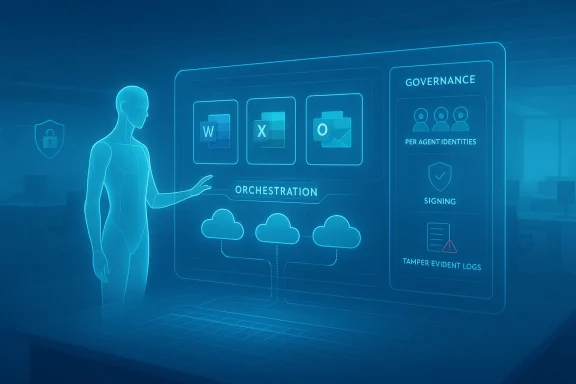
On the product side, Microsoft is rolling mitigations into Copilot Studio and Windows agent tooling: authentication gating, model‑context protections, built‑in UPIA and XPIA defenses, tamper‑evident logs and per‑agent digital signing. Those controls shift the model from “trust but hope” to “verify and constrain.” Microsoft also plans additional threat protection integrations and detection hooks for external monitoring systems.3) Enterprise governance primitives
Microsoft is extending admin controls to manage agent discovery, distribution and permissioning. Think of these as “agent identity and lifecycle” features: admin registration, publishing rules, per‑agent scopes, and auditing. These are necessary for large organizations that must enforce separation of duties, data residency, and regulatory compliance.Strengths in Microsoft’s approach
- Transparency: Microsoft’s willingness to publish a risk taxonomy and operational guidance—rather than burying the problem—helps the ecosystem respond faster.
- Integrated controls: Adding per‑agent identity, signing and isolation at the OS and cloud level is the correct architectural response because it treats agents as first‑class principals.
- Rapid fixes: The global configuration update for the Copilot bug and the fast policy updates for Copilot Studio show a capability to push mitigations across cloud and device stacks quickly.
Where Microsoft’s response still leaves exposure — the gaps and risks
Governance will lag usage
Agent creation is low friction. Copilot Studio and Agent Builder make it easy to spin up agents. Governance systems, audits and least‑privilege reviews are historically slow to roll out and even slower to be adopted by teams under time pressure. The net result: a period of high exposure where shadow agents are the path of least resistance for automating work.Human factors and social engineering remain the weak link
Many of the successful proofs‑of‑concept (CoPhish and the OAuth consent traps) exploit user trust in Microsoft domains and consent dialogs. Product fixes can harden flows, but social engineering will always be an attacker lever unless consent paradigms are redesigned to be frictionless for legitimate users and resistant to manipulation for risky flows.The platform vs. app economics problem
Even if Microsoft builds a secure, governed agent platform, businesses and developers will still have a choice. Agents that act on file formats or connect to databases via public APIs may flourish outside Microsoft’s economic model. That’s the strategic risk SiliconANGLE emphasized: the cloud logic could shift to a different stack if the economics favor other agent platforms. Microsoft can mitigate this via superior governance, integrated authentication, and pricing, but the threat is structural — not purely technical. (siliconangle.com)Tooling complexity and false sense of safety
Per‑agent sandboxes, signing and logs are necessary but not sufficient. If logs are voluminous and investigators lack context, tamper‑evident logs can become noise. Signed agents can still be misconfigured. The combination of powerful automation and complex configurations will generate both false positives and false negatives, placing new burdens on security operations.Practical guidance for defenders and IT leaders
Microsoft’s guidance and the recent attacks point to a pragmatic checklist enterprises should adopt immediately.- Inventory and classify agents now. Treat agents like any other identity: list creators, knowledge sources, connectors, and publishing scope. Prioritize dormant and broadly shared agents for teardown.
- Enforce admin approval for consumption of any agent that uses tenant Graph data, mailboxes, or connectors that touch regulated data. Use conditional access and require MFA for consent where possible.
- Disable author/maker authentication for production agents. Require agents to run with explicit per‑user or service principals and apply least privilege.
- Hunt for hard‑coded secrets and HTTP actions. Scan agent definitions and CI artifacts for embedded keys, tokens and direct HTTP calls to internal endpoints. Replace with managed connectors and Key Vault integrations.
- Deploy XPIA-aware content sanitization and contextual validation. Introduce checks for documents and web content that will be processed by agents, and require explicit human confirmation for any agent action that touches sensitive destinations.
- Monitor OAuth app registrations and suspicious consents. Build detections for unexpected token usage from agent domains and require admin consent for high‑privilege scopes.
- Provide a secure agent lifecycle: registration, signing, runtime attestation, revocation and tamper‑evident logging. Make revocation fast and observable.
- Train end users and makers. Teach consent hygiene, the risks of broad agent sharing, and the red flags for social‑engineering traps around agent prompts and UI. Human behavior is the cheapest and often most effective control.
Strategic tradeoffs: Nadella’s sacrifice and the business playbook
SiliconANGLE’s framing — that Microsoft must choose whether to protect Office’s annuity or to sacrificially recenter around a governed agent platform — is a useful way to think about the long game. The options are not binary, but each carries consequences:- Keep Office central and push Copilot inside apps: preserves licensing and telemetry but may limit agents’ capabilities if the apps aren’t fully instrumented for agentic access. It relies on customers accepting agents as an add‑on inside Office rather than a new work surface. (siliconangle.com)
- Embrace the agent‑first work surface and recast Office as a component: opens avenues for platform revenue (agent orchestration, governance, identity) but risks short‑term erosion of app licensing if third parties can deliver superior agent experiences outside Microsoft’s ecosystem. (siliconangle.com)
The broader industry impact and what comes next
- Expect more public disclosures and third‑party research. As researchers explore Copilot Studio, Agent Builder tooling and Windows agent previews, we will see more attack patterns emerge and more vendor patches follow. The early disclosures are already informing Microsoft’s product roadmap and enterprise guidance.
- Standards conversations will accelerate. Model Context Protocol (MCP) and agent tool interoperability need security norms: signed capabilities, attested runtimes and consent semantics that are resistant to deception. Microsoft’s emphasis on MCP governance is an early sign that the industry will push for protocol‑level defenses.
- Enterprises will bifurcate: risk‑averse organizations will lock agent capabilities behind strict admin controls and slow adoption; innovation‑oriented teams will experiment with guarded sandboxes and managed connectors to reap productivity gains. The net effect is likely to be heterogeneity — and opportunity for professional services, security vendors and governance platforms.
Conclusion
Agents are both the future of productivity and a fundamentally new class of endpoint. They promise automation, synthesis and scale — but they also shift the security perimeter and amplify human error. Microsoft has taken the right early steps: naming the risks, publishing specific developer and defender guidance, and adding identity and runtime controls. Those actions are necessary, but not sufficient.For organizations, the immediate imperative is clear: treat agents as first‑class identities, inventory and remediate risky configurations, harden consent flows, and demand tamper‑evident governance for any agent that touches regulated data. For Microsoft, the strategic decision that SiliconANGLE framed as “Satya’s sacrifice” — whether to protect Office’s annuity or to recast the company as the owner of a governed agent platform — will play out in product design, pricing and developer relations. Whichever path prevails, the technical reality is unchanged: agents change the game, and the winners will be those who secure the orchestration layer while preserving the productivity gains that made agents worth building in the first place. (siliconangle.com)
Source: SiliconANGLE Satya's sacrifice: Why agents threaten Office and how Microsoft responds - SiliconANGLE
