

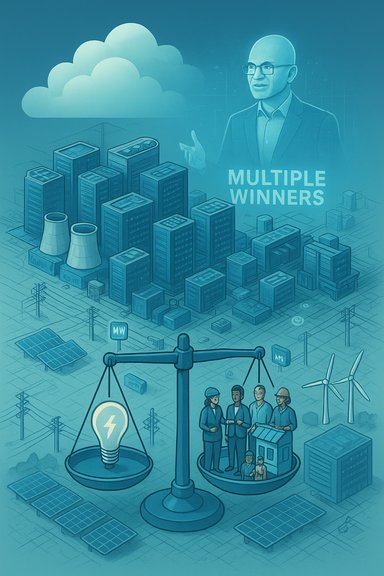
Microsoft’s CEO Satya Nadella issued a blunt reminder this week: the AI boom cannot be a winner-takes-all sprint limited to a handful of companies or regions, and it must earn the public’s permission to consume vastly more energy — or risk running headlong into political and social pushback that could slow or reshape the industry’s trajectory.
Microsoft reported a powerful start to its fiscal year, with first-quarter revenue of roughly $77.7 billion and Azure and other cloud services growing about 40% year-over-year, underscoring how AI workloads are now central to hyperscale cloud demand. Alongside that growth, the company disclosed a massive buildout of infrastructure: hundreds of new data center investments, a sharply higher capital-spend run rate, and a commercial backlog (remaining performance obligation) that climbed materially, all of which point to a company executing at scale to supply the AI economy.
But that same scale is generating new, hard limits. Nadella warned that expanding AI data centers are “putting a lot of pressure” on local grids and that the industry must earn social permission to consume energy — a phrase that crystallizes political and environmental anxieties now shadowing AI growth. He also said this wave needs multiple winners across industries and geographies, not concentrated returns for a few firms, or “it’ll be a road to nowhere.”
This feature examines what Nadella’s statements mean in practice: the business case behind Microsoft’s AI investments, the energy and grid consequences of hyperscale AI, the broader market and regulatory risks implied by concentration, and the practical takeaways for IT professionals, enterprise buyers, and policy makers. The analysis weighs Microsoft’s strengths — scale, product integration, and enterprise traction — against structural risks: energy supply constraints, geopolitical pressures, political backlash, and the economic hazards of concentrated returns.
The implied risk is that if AI benefits are captured only by a few, voters and policymakers may seek to curb the industry’s privileges (from energy access to regulatory carve-outs), slowing the very expansion big tech is pursuing.
That said, rhetoric alone won’t solve the technical and political constraints. The balance sheet shows Microsoft is willing to spend aggressively; the market will judge whether those investments translate to durable, broad-based economic gains rather than concentrated rents. Investors care about returns per dollar of capex, not just topline growth.
For Microsoft, the path ahead balances three imperatives: delivering AI value broadly across customers and partners, converting massive infrastructure spend into durable returns, and ensuring that growth does not provoke a political or environmental correction that would slow the entire sector. For IT leaders and developers, the practical response is clear: optimize workloads, diversify architectures, and work transparently with local communities and utilities so AI’s benefits are visible and its costs are managed.
If the industry follows that playbook — broad diffusion of AI benefits, tighter energy coordination, and relentless efficiency gains — Nadella’s cautious optimism may be vindicated. If not, the very energy and concentration that enabled the current boom could become the constraints that force a painful reset.
Source: Benzinga Microsoft CEO Says AI Sector Needs Multiple Winners: 'Otherwise It'll Be A Road To Nowhere' - Microsoft (NASDAQ:MSFT)
 Background / Overview
Microsoft reported a powerful start to its fiscal year, with first-quarter revenue of roughly $77.7 billion and Azure and other cloud services growing about 40% year-over-year, underscoring how AI workloads are now central to hyperscale cloud demand. Alongside that growth, the company disclosed a massive buildout of infrastructure: hundreds of new data center investments, a sharply higher capital-spend run rate, and a commercial backlog (remaining performance obligation) that climbed materially, all of which point to a company executing at scale to supply the AI economy.But that same scale is generating new, hard limits. Nadella warned that expanding AI data centers are “putting a lot of pressure” on local grids and that the industry must earn social permission to consume energy — a phrase that crystallizes political and environmental anxieties now shadowing AI growth. He also said this wave needs multiple winners across industries and geographies, not concentrated returns for a few firms, or “it’ll be a road to nowhere.”
This feature examines what Nadella’s statements mean in practice: the business case behind Microsoft’s AI investments, the energy and grid consequences of hyperscale AI, the broader market and regulatory risks implied by concentration, and the practical takeaways for IT professionals, enterprise buyers, and policy makers. The analysis weighs Microsoft’s strengths — scale, product integration, and enterprise traction — against structural risks: energy supply constraints, geopolitical pressures, political backlash, and the economic hazards of concentrated returns.
Microsoft’s AI moment: scale, economics, and the numbers that matter
The scale of investment and the revenue picture
Microsoft’s recent quarterly results make two facts clear: demand for AI-enabled cloud services is real and accelerating, and Microsoft is committing very large sums of capital to meet it. Key financial signals include:- Total revenue growth in the high-teens year-over-year, driven largely by cloud and AI services.
- Azure / cloud growth in the realm of 40% year-over-year in the referenced quarter — a rate that outpaces many legacy enterprise software businesses and signals heavy enterprise adoption.
- Microsoft Cloud revenue well into the tens of billions for the quarter, and a commercial backlog (remaining performance obligation) that expanded sharply, demonstrating contracted future revenue that underpins current capital commitments.
- Capital expenditures running far above historical norms, with a large share directed to GPUs/CPUs and data center finance leases required for AI-scale hardware and sites.
Why Microsoft says “multiple winners” matters
Nadella’s plea for multiple winners is a two-part argument. First, concentrated returns — where a small set of firms or one region captures the lion’s share of AI economic gains — can trigger political backlash, antitrust scrutiny, and protectionist policy responses. Second, the long-term macro benefit of AI depends on broad diffusion: productivity gains that lift broad classes of firms, sectors, and workers sustain demand, political support, and capital flows.The implied risk is that if AI benefits are captured only by a few, voters and policymakers may seek to curb the industry’s privileges (from energy access to regulatory carve-outs), slowing the very expansion big tech is pursuing.
Energy, data centers, and the grid: why the “social permission” line matters
The energy equation in plain terms
Hyperscale AI workloads are intensely energy‑hungry for two reasons: training state-of-the-art models requires enormous compute over long periods, and inference at scale (serving billions of queries) multiplies operational draw across datacenter fleets. Key dynamics:- Modern AI‑optimized data centers can reach capacities of tens to hundreds of megawatts apiece — roughly equivalent to the annual consumption of many thousands of homes.
- Global estimates indicate data center electricity demand has risen significantly in recent years and is projected to climb sharply through the end of the decade as AI workloads scale.
- Energy growth is geographically concentrated: a handful of regions and countries account for the majority of data center electricity use, which magnifies local grid impacts.
Local effects, public reaction, and policy risks
The phrase earn social permission summarizes the simple political calculus: communities and regulators will accept higher energy use only if the benefits — jobs, tax revenue, productivity, supply chain gains — are broad and visible. Absent that, local opposition can take practical forms:- Moratoria or zoning restrictions on new data center builds.
- New taxes, fees, or stricter permitting conditions tied to power use or environmental impact.
- Pressure on utilities and regulators to favor residential and industrial customers over private hyperscalers when capacity is constrained.
Strengths in Microsoft’s strategy
Integrated enterprise play and product diffusion
Microsoft’s advantage is its integrated stack — OS, productivity suites, developer platforms, cloud infrastructure, and enterprise relationships. This integration enables an enterprise-focused diffusion of AI:- Copilots and first‑party integrations embed AI into high-volume enterprise workflows, increasing the marginal value of Azure-hosted inference and prompting customers to commit to platform-level consumption.
- Microsoft 365, Dynamics, and LinkedIn offer natural vectors for scaling AI-driven features across knowledge work, sales, and talent workflows.
- Commercial contracts and large bookings create a degree of revenue visibility that justifies infrastructure investments.
Capital discipline plus strategic flexibility
Although capex is large, Microsoft has signaled a mix of short-lived and long-lived spending: a meaningful share of spending goes to rapidly depreciating GPUs and CPUs (short-lived), while another portion funds long-term datacenter sites via finance leases. That mix gives the firm flexibility to adapt hardware refresh cycles as model architectures or chip generations evolve.Structural risks and fault lines
1) Energy supply and grid constraints
The biggest systemic risk is the mismatch between rapid data center demand growth and the slower pace of grid expansion and renewable deployment. If new generation and transmission capacity don’t keep pace, expect:- Local shortages and politically motivated limits on expansion.
- Increased reliance on older baseload sources or fossil-fuel peaker plants to meet immediate demand, undermining climate goals.
- Higher input costs as data centers compete with other large industrial users.
2) Concentration of benefits and the political backlash
Nadella’s warning about concentration is strategic: when benefits are perceived as narrow, public tolerance for the industry’s externalities — from noise and traffic to energy draw — falls. Political responses can include:- Regional prohibitions on new builds.
- National or supranational restrictions on data transfers or foreign cloud dominance.
- New regulatory frameworks that could require neutral access to critical infrastructure (power, fiber) or impose taxation on data center energy use.
3) Bubble dynamics and the growth vs. returns disconnect
Rapid investment expectations can create a valuation gap: if infrastructure comes online faster than demand monetizes, returns will contract. An AI “bubble” in valuations becomes a risk when:- Funding flows chase capacity before steady enterprise monetization cycles complete.
- A handful of companies capture a disproportionate share of returns, prompting corrective regulation or investor retrenchment.
- Model and product adoption plateau in real-world workflows, reducing the anticipated TAM (total addressable market).
4) Supply-chain and component constraints
A second technical risk is chip availability and supply-chain tightness. GPUs and other AI accelerators are finite and subject to geopolitical risk, export controls, and long lead times — which can inflate costs and slow planned capacity expansions. Microsoft has tried to mitigate this through proprietary clusters and diversified supplier relationships, but scarcity pressures remain a potential bottleneck.What this means for Windows users, IT pros, and enterprise buyers
For enterprises and IT leaders
- Expect tighter scrutiny of cloud contracts: commercial customers will negotiate consumption guarantees, data residency, and pricing structures that reflect the scale economics of AI.
- Plan for hybrid architectures: on-prem inference and edge computing will become more attractive where latency, privacy, or energy constraints favor local processing.
- Build in energy awareness: procurement and capacity planning should factor in the energy profile of AI workloads and consider scheduling, batching, or model optimization to reduce peak load.
For Windows developers and platform vendors
- Opportunities to integrate lightweight, on-device models into Windows and edge products will grow. Developers who can deliver efficient, optimized inference will have an advantage where cloud access is constrained.
- Tooling that reduces inference cost (quantization, pruning, efficient runtimes) will be in high demand.
- Copilot-style integrations that lower the friction for enterprise users will accelerate adoption of paid, platform-tier services.
For operators and data center managers
- Workload orchestration must become energy-aware. Scheduling compute during low-demand windows, leveraging demand-response programs, and coordinating with utilities will be essential.
- Renewable procurement and long-term offtake contracts will not just be PR moves; they’ll be strategic shields against local opposition and utility rate shocks.
Practical solutions and industry responses
The industry has a menu of realistic mitigation strategies that can blunt energy conflict and distribute benefits more broadly:- Grid investments and coordinated planning: Hyperscalers should co-invest with utilities and governments in transmission upgrades, energy storage, and localized generation capacity.
- Demand-response collaboration: Data center operators can enroll in grid flexibility programs, allowing temporary curtailment or shifting of non-critical workloads to ease peaks.
- Renewables + firming capacity: Long-term renewable PPAs coupled with storage or firming supply (including responsibly managed nuclear offtake where appropriate) can reduce reliance on fossil backup.
- Regional economic contributions: More visible investment in local supply chains, workforce training, and tax contributions helps align community benefits with energy use.
- Technical efficiency gains: Continued investment in model efficiency, compilers, and hardware-software co-design reduces per-inference energy cost.
Balanced assessment: why Nadella’s stance is both pragmatic and politically savvy
Nadella’s comments accomplish two strategic goals. First, they acknowledge a real constraint — energy and political risk — that could impede long-term growth. Admitting the problem publicly frames Microsoft as a responsible steward rather than an indifferent consumer of power, which matters for political capital. Second, his call for multiple winners reframes the AI debate away from winner-take-all winner narratives toward diffusion and inclusion — an argument that supports policy choices favoring broader economic diffusion and can ease antitrust and political pressures.That said, rhetoric alone won’t solve the technical and political constraints. The balance sheet shows Microsoft is willing to spend aggressively; the market will judge whether those investments translate to durable, broad-based economic gains rather than concentrated rents. Investors care about returns per dollar of capex, not just topline growth.
Risks to watch and warning signs for the next 12–24 months
- Local grid stress events: sustained capacity constraints or publicized outages linked to nearby data center demand would trigger immediate regulatory scrutiny.
- Policy pushback and regional moratoria: if several jurisdictions tighten permitting or impose new charges, expansion plans could slow materially.
- Margin compression caused by overbuild: if capex outpaces monetization, margins will erode and investor sentiment may turn, setting up a re-rating risk.
- Continued chip shortages or export controls: disruption in GPU supply would raise costs and delay planned expansions, giving smaller players or on-prem alternatives a breathing window.
- Perception gap: if the public narrative focuses on energy misuse without visible community benefits, political actions could follow.
What IT decision-makers should do now — recommended action steps
- Audit AI workload energy impact
- Measure energy and cost per model/inference. Prioritize optimization for the heaviest workloads.
- Negotiate cloud contracts with flexibility and transparency
- Include clauses for locality of compute (regional failover), predictable pricing tiers for AI inference, and shared sustainability metrics.
- Invest in hybrid architectures
- Move latency-sensitive or high-volume inference to edge or on-prem where it reduces cost or grid strain.
- Engage with local stakeholders
- Coordinate with utilities and local governments to align deployment timelines with grid upgrades and community benefits.
- Focus on model efficiency
- Adopt quantization, distillation, and optimized runtimes to reduce energy per query without degrading user experience.
Conclusion
Satya Nadella’s dual message — that AI needs both social permission to consume more energy and a marketplace of multiple winners to avoid concentrated returns — captures a crucial inflection point for the industry. Large cloud providers are proving that AI can scale rapidly and create substantial revenue streams, but scaling responsibly will require technical innovation, strategic capital allocation, and proactive engagement with energy systems and public stakeholders.For Microsoft, the path ahead balances three imperatives: delivering AI value broadly across customers and partners, converting massive infrastructure spend into durable returns, and ensuring that growth does not provoke a political or environmental correction that would slow the entire sector. For IT leaders and developers, the practical response is clear: optimize workloads, diversify architectures, and work transparently with local communities and utilities so AI’s benefits are visible and its costs are managed.
If the industry follows that playbook — broad diffusion of AI benefits, tighter energy coordination, and relentless efficiency gains — Nadella’s cautious optimism may be vindicated. If not, the very energy and concentration that enabled the current boom could become the constraints that force a painful reset.
Source: Benzinga Microsoft CEO Says AI Sector Needs Multiple Winners: 'Otherwise It'll Be A Road To Nowhere' - Microsoft (NASDAQ:MSFT)
