

Space-based data centers are moving from speculative thought experiment to near-term engineering program: the idea of putting compute where the sun never sets, where radiative cooling is abundant, and where regulatory and land-use bottlenecks vanish has crystallized into concrete company roadmaps, white papers, and demonstration launches. What was once an academic curiosity is now an industrial playbook for “orbital edge” — a new layer of the cloud that promises ultra-scale, energy-first compute, targeted in-orbit processing, and a radically different risk profile for large-scale AI training and satellite operations.
The push toward spaceborne computing responds to two converging pressures on terrestrial infrastructure. First, global demand for computation — driven by generative AI, high-resolution Earth observation, and pervasive telemetry — is growing at a pace that challenges grid capacity, water resources, and permitting regimes. Recent national energy studies show data centers already consume a nontrivial share of U.S. electricity and are projected to grow rapidly. Second, advances in launch economics, small-satellite platforms, space-hardened electronics, and optical inter-satellite networking have reduced the technical and commercial barriers to operating heavy compute payloads beyond Earth.
At its core, the space data center concept reimagines the data center as a modular, networked cluster deployed in orbit that sits physically close to other space assets (sensors, relays, comms constellations) and uses orbital advantages — abundant solar irradiance and vacuum radiative cooling — to drive down marginal operating cost and environmental impact. The result is a hybrid model: in-orbit edge compute for space-native workloads and selective Earth-facing services such as off-planet disaster recovery, overflow AI training, and global communications routing.
Important operational nuance: GEO satellites are not in constant sunlight year-round. Geostationary platforms commonly experience eclipse seasons around the equinoxes, during which Earth’s shadow can block sunlight for tens of minutes per day for a several-week window. Orbit selection therefore requires careful engineering for battery sizing, power redundancy, and mission planning.
Some space-focused white papers and company analyses present aggressive per-watt pricing for orbital silicon PV cells (figures sometimes cited in marketing material). Those numbers are estimates that depend on supply chain assumptions, radiation degradation rates, deployment scale, and amortized launch and replacement costs. Treat manufacturer or operator price claims as company estimates until published, third-party lifecycle cost analyses are available.
Several important claims deserve skepticism or at least careful validation:
For enterprises and hyperscalers, the immediate takeaway should be pragmatic: pursue partnerships and pilot programs that prove the value of in-orbit preprocessing and routing for space-native data flows, treat orbital compute as a complementary capability for specific high-value workloads, and design procurement and operational models that account for the unique lifecycle and risk profile of space infrastructure.
The coming decade will determine whether orbital data centers become a mainstream part of the cloud fabric or remain a niche, high-cost alternative for specialized workloads. The technology envelope is closing rapidly; the deciding factors will be launch economics, the maturity of in-orbit servicing and modular assembly, and disciplined engineering that converts the promise of limitless sun and vacuum cooling into safe, reliable, and cost-effective compute in orbit.
Source: TechTarget Space-based data centers: Edge computing in space | TechTarget
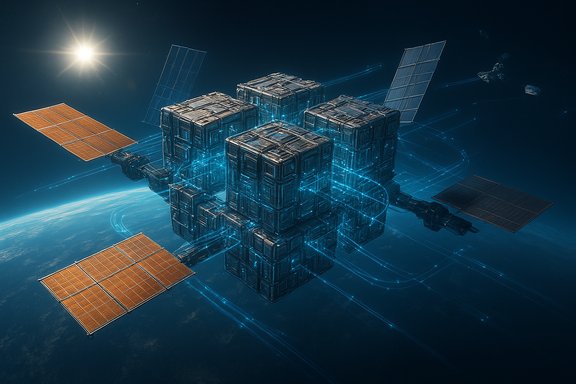 Background / Overview
The push toward spaceborne computing responds to two converging pressures on terrestrial infrastructure. First, global demand for computation — driven by generative AI, high-resolution Earth observation, and pervasive telemetry — is growing at a pace that challenges grid capacity, water resources, and permitting regimes. Recent national energy studies show data centers already consume a nontrivial share of U.S. electricity and are projected to grow rapidly. Second, advances in launch economics, small-satellite platforms, space-hardened electronics, and optical inter-satellite networking have reduced the technical and commercial barriers to operating heavy compute payloads beyond Earth.At its core, the space data center concept reimagines the data center as a modular, networked cluster deployed in orbit that sits physically close to other space assets (sensors, relays, comms constellations) and uses orbital advantages — abundant solar irradiance and vacuum radiative cooling — to drive down marginal operating cost and environmental impact. The result is a hybrid model: in-orbit edge compute for space-native workloads and selective Earth-facing services such as off-planet disaster recovery, overflow AI training, and global communications routing.
Why “edge computing in space” matters
The fundamental value proposition
- Lower marginal energy cost. Solar arrays in orbit avoid terrestrial day/night cycles and atmospheric attenuation, delivering far higher capacity factors than Earth-based PV. In-space arrays can produce continuous irradiance and peak insolation not achievable on the ground.
- Radiative cooling as a free heatsink. The vacuum of space enables thermal rejection via radiators without energy-hungry chillers, shifting more of generated power directly to compute.
- Proximity to space data sources. Many satellites generate high-bandwidth, raw sensor streams that currently require costly backhaul. Processing those streams in orbit reduces downlink bandwidth and latency between sensors and analytic systems.
- Regulatory and siting freedom. Orbital deployments avoid terrestrial land-use constraints, zoning fights, and local opposition — enabling more agile, modular scaling if the economics work.
- New network topologies. Optical inter-satellite links now enable high-throughput, low-jitter mesh networks in space; a properly sited orbital data hub can act as a traffic router, buffer, or rendezvous node for constellations.
Core use cases for orbital edge
- On-orbit image preprocessing: convert raw sensor packets to georeferenced products and transmit only relevant frames (e.g., wildfire detections, maritime anomalies).
- In-orbit AI inference/filtering: run trained models next to sensors to discard non-actionable data and forward only high-value outputs to Earth.
- Satellite traffic coordination and collision avoidance: centralize telemetry reporting to compute nodes that predict conjunctions and coordinate avoidance maneuvers.
- Communications hubs for constellations: act as regional route-optimizers or store-and-forward buffers for networks whose ground interconnect is limited.
- Energy-rich AI training bursts: use orbital arrays to run contiguous high-power training sessions when demand or pricing (or regulatory conditions) make terrestrial operation costly.
Technical foundations: orbits, power, cooling, and networking
Orbit choices and telemetry latency
Selecting the orbital regime is a central tradeoff. Low Earth Orbit (LEO) offers low latency to ground — often measured in tens of milliseconds one-way depending on altitude — but suffers from frequent eclipse cycles per orbit and smaller contiguous coverage footprints. Geostationary Earth Orbit (GEO), at roughly 35,786 km (≈22,300 miles) above the equator, offers continuous coverage of large swaths of Earth and consistent sun exposure for long periods, but introduces significant latency: one-way photon transit time to GEO is on the order of ~100–140 milliseconds and round-trip communications architecture can lead to hundreds of milliseconds of added delay. For communications-sensitive ground services, that latency rules out some real-time uses; for space-native edge workloads, the proximity to other orbiting sensors may justify GEO or medium Earth orbits (MEO).Important operational nuance: GEO satellites are not in constant sunlight year-round. Geostationary platforms commonly experience eclipse seasons around the equinoxes, during which Earth’s shadow can block sunlight for tens of minutes per day for a several-week window. Orbit selection therefore requires careful engineering for battery sizing, power redundancy, and mission planning.
Power: in-orbit solar economics and capacity
A principal attraction of orbital data centers is the improved photovoltaic yield in vacuum: no atmospheric scattering, no clouds, and the ability to orient panels optimally yields materially higher energy per unit area than on Earth. Proponents model space PV capacity factors above 90% for well-chosen orbits, compared with terrestrial solar farms that are constrained by night, weather, and seasonal changes.Some space-focused white papers and company analyses present aggressive per-watt pricing for orbital silicon PV cells (figures sometimes cited in marketing material). Those numbers are estimates that depend on supply chain assumptions, radiation degradation rates, deployment scale, and amortized launch and replacement costs. Treat manufacturer or operator price claims as company estimates until published, third-party lifecycle cost analyses are available.
Thermal control: radiators, heat pipes, and working fluids
In vacuum, heat must be rejected by radiation. Spacecraft use deployable radiator panels, fluid loops, and heat pipes to transport heat from electronics to radiative surfaces. Established spacecraft (including long-duration platforms) use ammonia or other working fluids in pumped loops and large dedicated radiators sized to the expected waste-heat flux. Because radiative heat rejection scales with surface area and emissivity — and increases with higher radiator temperature — the thermal architecture for a gigawatt-scale orbital cluster is not trivial: radiator area and mass become a major driver of system size and deployment cost.Networking: optical mesh and ground gateways
Optical inter-satellite links (free-space optical, FSO) enable high-throughput, low-latency routing across constellations without immediately touching terrestrial ground stations. Modern constellations routinely deploy FSO crosslinks that carry tens to hundreds of Gbps per terminal. An orbital data center can act as a transit and compute node in an optical mesh, offering services such as content caching, routing optimization, and in-orbit load balancing. Integration with terrestrial networks requires gateway infrastructure, regulatory frequency planning for RF backup, and robust keying/authentication for secure transit.Economics: capex, opex, and the launch amortization problem
Space-based compute shifts the cost model:- Upfront capital is dominated by launch and spacecraft hardware (bus, shielding, radiators, deployables).
- Operating costs are dominated less by energy (once in orbit, solar is effectively “free” aside from degradation) and more by maintenance, replacement launches, and in-space servicing complexity.
- Amortization horizon is a key variable: a longer effective on-orbit life spreads launch and hardware costs over more compute-hours, improving per-kWh economics.
- Modular designs that enable in-orbit replacement or deorbiting of obsolete modules can materially improve lifecycle economics relative to monolithic, single-launch systems.
Strengths and opportunities
- Sustainability gains. Moving high-consumption compute to an environment with continual solar irradiance and no freshwater cooling needs can reduce terrestrial emissions and avoid large water withdrawals used by some data centers.
- Bandwidth efficiency for remote sensing. On-orbit preprocessing reduces backhaul by sending only value-added data to Earth, saving costly ground-link capacity.
- Rapid scalable expansion. A modular, assembly-based approach can allow incremental growth without long terrestrial permitting cycles.
- New network topologies. Integration with inter-satellite optical meshes creates a backbone that is resistant to ground-based outages and allows direct space-space routing.
- Disaster and sovereignty resilience. An off-planet copy of critical workloads can act as a geographically independent recovery site, albeit with nontrivial access and regulatory considerations.
Risks, constraints, and open engineering problems
While the upside is large, the downside and operational complexity are significant.1. Radiation and hardware resilience
Spacecraft electronics must be hardened or shielded against ionizing radiation and single-event effects. Radiation shielding adds mass, and radiation-hardened processors lag behind terrestrial silicon in performance-to-power ratio, although some approaches use COTS GPUs within shielded enclosures plus redundancy and error-correcting strategies. Radiation risk increases lifetime replacement frequency and complicates the use of top-tier GPU hardware without costly mitigations.2. Thermal rejection scale and mass
Radiator area and mass scale closely with compute load. Designing radiators that remain deployable, collision-resistant, and compact for launch is nontrivial. For multi-gigawatt clusters, radiator mass and deployment complexity could be among the largest engineering challenges.3. Launch and logistics costs
Even with falling launch prices, the per-kilogram cost to LEO and beyond is material. Business cases often assume dramatic reductions in launch cost or reuse of heavy-lift vehicles at scale. Unexpected launch delays, failures, or regulatory hold-ups can materially affect ROI.4. Orbital debris and collision liability
Large orbital structures with expansive solar arrays increase the cross-sectional area subject to micrometeoroids and orbital debris. Operators must comply with national orbital-debris assessment procedures, guarantee maneuverability, and potentially bear liability under international conventions if objects they control cause damage.5. Regulatory, legal, and sovereignty complexity
Space objects remain under jurisdiction of their state of registry, and international treaties create liability frameworks. Data sovereignty, export controls, and national security concerns complicate where and how workloads originate and how custody of data is managed when processing happens beyond national territory.6. Space weather and operational availability
Solar storms, increased radiation flux, and charged particle events can degrade performance or force protective safe modes. GEO platforms may be vulnerable to extended eclipse seasons and solar energetic particle events. Operators will require robust forecasting, hardened subsystems, and failover strategies.7. Cybersecurity and data control
Remote, hard-to-physically-access infrastructure introduces novel security vectors. Physical deorbiting risks, side-channel vulnerabilities in optical links, and multi-tenant isolation in a constrained environment require rigorous architectures for cryptography, key management, and provenance.Players, proofs-of-concept, and timelines
The idea is no longer purely theoretical. Multiple startups and research programs are moving from lab to orbit with demonstrators:- Startups are actively designing and (in several cases) booking launches for demonstrator satellites that carry large GPU payloads, space-hardened compute modules, and deployable solar/radiator hardware.
- Large cloud and edge vendors have fielded experiments in extreme environments (e.g., subsea experiments) and have research teams focused on spaceborne compute architectures.
- Space-heritage vendors and constellations are already deploying optical inter-satellite links that make high-throughput space meshes possible.
- Small-scale demonstrators to validate cooling, shielding, and optics.
- Micro-data center modules for niche customers (e.g., preprocessors for Earth observation).
- Larger modular clusters assembled in orbit or serviced by on-orbit logistics providers.
Operational models and deployment scenarios
- Edge-as-a-service for satellite OEMs: Operators buy dedicated compute time for their satellites’ raw-stream processing, reducing downlink needs and accelerating mission responsiveness.
- Burst compute for AI training: Customers schedule non-latency-sensitive training runs in orbital micro-clusters where energy cost arbitrage and cooling efficiencies justify launch.
- Resilient global routing: Large constellations use orbital hubs to maintain routing and buffering during terrestrial outages or to optimize paths for global clients with tight latency/throughput SLAs.
- Hybrid ground/orbit cloud: Workloads are split across terrestrial and orbital clusters; critical low-latency interactions remain ground-based while high-bulk, long-run training moves to space for economic or environmental reasons.
Practical recommendations for hyperscalers, enterprise IT, and satellite operators
- Treat orbital compute as a complementary layer, not a wholesale replacement. The best early use cases are space-native workloads (imagery preprocessing, constellation orchestration) rather than replacing low-latency user services.
- Model full lifecycle costs rigorously. Include launch, replacement cadence driven by radiation and mechanical wear, radiator mass, insurance, and risk premiums for delays or debris events.
- Design for modularity and in-orbit serviceability. Modules that can be deorbited and replaced reduce long-term technical risk and align capital expenditure with evolving technology (e.g., new GPU generations).
- Invest in hardened networking and identity systems. Optical crosslinks and gateways must be paired with robust encryption, anti-spoofing, and distributed authentication that respect export controls and jurisdictional boundaries.
- Plan redundancy across orbits. Combine LEO for low-latency routing and GEO/MEO for power-rich, wide-coverage compute, balancing availability, latency, and cost.
- Engage early with regulators and space-traffic-management entities. Orbital coordination, debris mitigation, and licensing will be as important as the engineering.
Where the hype meets hard reality
Space-based data centers contain genuine technological leverage: continuous sunlight, vacuum cooling, and proximity to space data sources are real advantages that shift some economic variables in favor of orbital deployment. However, many of the most optimistic cost claims rest on assumptions about launch price declines, in-orbit assembly, and long on-orbit life that remain only partially proven at commercial scale.Several important claims deserve skepticism or at least careful validation:
- Per-watt solar cell pricing quoted in startup white papers reflects component assumptions and large-scale procurement that have not yet been realized in production-grade, radiation-tolerant space arrays.
- Multi-gigawatt orbital clusters are an architectural long-term vision; credible near-term business cases are more plausibly in the tens to low hundreds of megawatts per constellation.
- The claim of continuous 24/7 sunlight depends strongly on orbit selection. GEO has long eclipse seasons twice per year; LEO and other orbits have regular day/night cycles that must be accommodated by batteries or scheduling.
- Focus on space-native workloads with clear value from in-orbit processing.
- Build demonstrators that validate thermal control, radiation mitigation, and optical networking in flight.
- Design modular systems that tolerate partial failures and permit incremental upgrades.
Conclusion
The migration of compute to space is an architectural leap that addresses real constraints of terrestrial data centers — chiefly energy, water, and siting — while creating a fresh set of engineering, legal, and operational challenges. Edge computing in space is not a single technology but an ecosystem: solar arrays and radiators, optical meshes and gateways, hardened GPUs and resilient software stacks, and regulatory frameworks for liability and orbital stewardship.For enterprises and hyperscalers, the immediate takeaway should be pragmatic: pursue partnerships and pilot programs that prove the value of in-orbit preprocessing and routing for space-native data flows, treat orbital compute as a complementary capability for specific high-value workloads, and design procurement and operational models that account for the unique lifecycle and risk profile of space infrastructure.
The coming decade will determine whether orbital data centers become a mainstream part of the cloud fabric or remain a niche, high-cost alternative for specialized workloads. The technology envelope is closing rapidly; the deciding factors will be launch economics, the maturity of in-orbit servicing and modular assembly, and disciplined engineering that converts the promise of limitless sun and vacuum cooling into safe, reliable, and cost-effective compute in orbit.
Source: TechTarget Space-based data centers: Edge computing in space | TechTarget
