

2025 closed the loop on an idea that had long been the province of white papers and science fiction: orbital cloud infrastructure — solar‑powered AI compute, data centers, and blockchain nodes operating in low Earth orbit — moved decisively from theoretical framing to demonstrator launches and national programs. Early month launches and government initiatives in late 2025, together with bullish market forecasts for tokenization and space‑solar markets, have pushed the notion of an energy‑compute stack that pairs space‑based solar power with in‑orbit AI compute into boardroom planning and policy debates.
The last 12 months produced three tightly coupled developments that explain why the orbital cloud argument now commands serious attention: a) major public‑sector AI initiatives that direct large‑scale compute demand; b) demonstrator launches and industry press statements that prove early technical feasibility at small scale; and c) rapidly evolving market forecasts that assign meaningful economic opportunity to both tokenization and space‑based solar power (SBSP). Those three forces — policy, prototypes, and market expectations — form the backbone of the orbital cloud thesis.
Yet engineering caveats matter:
Yet the path from demonstrator to durable platform is neither linear nor guaranteed. The model stacks several high‑leverage, high‑risk bets: on rectenna and SBSP conversion efficiencies, on sustained launch‑cost deflation, on in‑orbit hardware reliability and serviceability, and on clear legal frameworks for cross‑border cloud transactions and tokenized services. Early adopters who fund demonstrators and insist on transparency, independent telemetry, and conservative lifecycle modeling will learn fastest. For everyone else, the correct posture is pragmatic curiosity — engage in targeted pilots, require independent verification, and bake regulatory and tax scenarios into procurement decisions.
If the orbital cloud becomes a new energy‑compute layer of the global fabric, it will be because engineering, economics, and public policy converged in a sustained, verifiable way — not because of one launch, one white paper, or one market forecast. The early milestones of late 2025 are significant and real, but they are the first chapters of a long, uncertain story that will be written in launch telemetry, rectenna field trials, and the hard accounting of TCO over many replacement cycles.
Source: crypto.news Tokenization: The emergence of orbital cloud infrastructure
 Background / Overview
The last 12 months produced three tightly coupled developments that explain why the orbital cloud argument now commands serious attention: a) major public‑sector AI initiatives that direct large‑scale compute demand; b) demonstrator launches and industry press statements that prove early technical feasibility at small scale; and c) rapidly evolving market forecasts that assign meaningful economic opportunity to both tokenization and space‑based solar power (SBSP). Those three forces — policy, prototypes, and market expectations — form the backbone of the orbital cloud thesis. - The U.S. Department of Energy launched the Genesis Mission, a cross‑agency, DOE‑led program to accelerate discovery science through integrated AI and computing resources, backed by an Executive Order and follow‑on awards for infrastructure and partnerships. This federal push is designed to marshal national labs, supercomputers, and private sector partners around ambitious AI‑for‑science goals.
- Corporations and startups deployed the first generation of orbital compute demonstrators: PowerBank Corporation’s announcement of the DeStarlink Genesis‑1 satellite (December 10, 2025) is being positioned as an initial step toward a decentralized LEO compute and connectivity fabric that Orbit AI (a.k.a. Smartlink AI) hopes will scale into an Orbital Cloud.
- Market research firms issued forward projections for both tokenization and SBSP that underpin investor enthusiasm and business‑case modeling: high single‑ to multi‑trillion dollar notional estimates for tokenized assets and multi‑billion forecasts for SBSP capacity prompted venture and corporate capital to test prototypes.
What exactly is an “orbital cloud”?
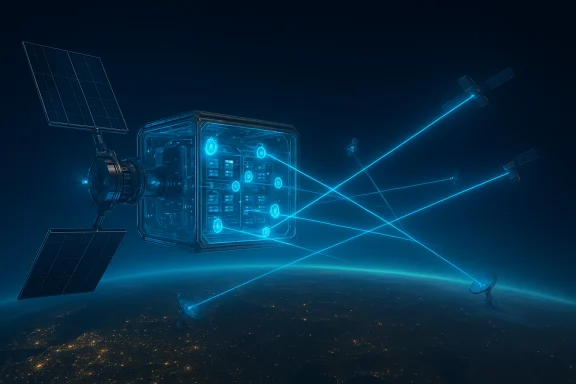
An orbital cloud is an architectural stack that combines several distinct technologies and operational models into a single, integrated service layer:- Space‑based solar power (SBSP): large orbital photovoltaic arrays that harvest sunlight with higher capacity factors than terrestrial PV and either power on‑board compute directly or beam energy to ground rectennas.
- LEO compute modules: hardened racks or modular compute payloads designed for radiation tolerance, vacuum cooling via dedicated radiators, and periodic refresh or deorbit and replacement.
- Inter‑satellite networking: optical crosslinks and microwave backhauls that enable mesh fabrics to stitch orbital compute into global application topologies.
- On‑board verification and tokenization primitives: blockchain nodes or wallets collocated with compute to provide provenance, auditability, and tokenized service billings executed in, or recorded from, orbit.
Why the timing feels different in 2025
Three factors changed the pragmatic calculus during 2025:- Policy pull: The U.S. Genesis Mission — backed by an Executive Order and rapid DOE investments — programs national demand for massive AI compute and binds government laboratories, vendors, and hyperscalers into a concentrated procurement horizon that can reshape capacity planning. Genesis Mission press materials and DOE announcements made in November–December 2025 emphasize AI for science and security and show immediate funding awards and partner agreements.
- Demonstrators: The DeStarlink Genesis‑1 launch on December 10, 2025, and similar small demonstrator flights moved the conversation from blueprint to flight‑test telemetry. While these are early steps and not yet commercial at scale, they materially lower the perceived risk of basic subsystems (solar deployables, vacuum radiators, in‑orbit compute payloads). PowerBank’s corporate press release about DeStarlink Genesis‑1 and Orbit AI’s public positioning provide the first commercial narrative that investors can evaluate.
- Market signal: Research firms issued high growth projections for adjacent markets that make the orbital cloud more investable on paper. For example, several reports place the asset tokenization market at roughly $865.54 billion in 2024 and project it to exceed $1.24 trillion in 2025, and forecast dramatic growth by the end of the decade; similarly, certain SBSP forecasts model a multi‑billion market by 2040. These numbers feed financial models that justify prototype funding and pilot partnerships. (Readers should note that different research houses produce divergent estimates — this variance inflates headline optimism and must be understood when modeling risk).
Technical architecture and engineering realities
Power: the SBSP promise and practical limits
Orbital solar arrays enjoy several real physical advantages over terrestrial PV: no atmosphere, no weather, and the possibility of continuous sunlight depending on orbital regime. Those attributes increase potential energy per unit area and reduce the need for terrestrial storage for roughly continuous operations. Vacuum radiative cooling also shifts thermal‑management costs away from energy‑intensive chillers, improving PUE (power usage effectiveness) on a per‑compute‑watt basis.Yet engineering caveats matter:
- Continuous sunlight is orbit‑dependent. GEO offers longer illumination windows but introduces high round‑trip latency; LEO delivers low latency but sees frequent eclipse cycles and smaller continuous coverage windows. Any claim of ‘24/7 sunlight’ must be qualified by orbit selection and battery sizing.
- Wireless power transmission (microwave or laser) has physics and safety constraints. Market reports that assume rectenna conversion efficiencies above 90% rely on optimistic lab advances in metamaterials and rectenna design and require robust, independent field validation before delivering utility‑scale economics. Mordor Intelligence’s forecast cites conversion and cost improvements as drivers, but those remain technical and regulatory dependencies to be proven in ground trials.
Cooling and thermal control
Operating dense accelerator hardware in vacuum solves the energy cost of evaporative or chilled‑water cooling, but replaces it with radiator mass, surface‑area, and attitude control requirements. Radiators must reject heat to deep space efficiently and the overall thermal architecture becomes part of the mass and launch cost equation. Failure modes differ from terrestrial data centers: radiator micrometeoroid damage, radiator fouling, or attitude‑control failure can have mission‑critical consequences.Compute and hardware availability
Modern generative AI relies on tight integration of GPUs and accelerators that are subject to export controls, vendor allocations, and thermal/power envelopes unsuitable for simple lift‑and‑fly approaches. Building space‑qualified accelerators or ruggedizing commodity GPUs raises cost and development time. Hyperscalers’ experiments with hardened micro‑modules and modular replaceable payloads are an encouraging path, but mass deployment still faces significant supply and certification hurdles.Economics: where the numbers come from — and what they really mean
Several market reports have been widely cited in industry narratives and press accounts; understanding what the figures represent — and their limitations — is essential.- Tokenization. Market research from The Business Research Company and aggregated reporting repeatedly place the assets tokenization market at roughly $865.54 billion in 2024 and projecting ~$1.24 trillion in 2025 (with multi‑trillion projections by 2029). Those numbers largely reflect notional asset values under tokenization (the total value of assets tokenized), not immediate software or service revenues that vendors will capture. Using that notional figure as a proxy for immediate cloud revenue is misleading; the actual software and services market remains much smaller and will grow as a fraction of notional value.
- Space‑based solar power (SBSP). Mordor Intelligence projects a $0.63 billion SBSP market in 2025, rising to $4.19 billion by 2040 at ~13.46% CAGR. Other research houses produce different trajectories (MarketsandMarkets and MarketResearchFuture offer alternative timelines and varying CAGR estimates), underscoring that SBSP forecasting is sensitive to assumed launch costs, rectenna performance, and political backing. Use multiple scenarios in financial models.
- Distinguish notional asset value under tokenization from service‑market revenue. Headlines that cite trillion‑dollar tokenization totals usually reference the former.
- Test sensitivity to launch‑cost trajectories. Many orbital cloud models depend on continued steep reductions in payload‑to‑orbit costs; if launch economics plateau, the business case changes dramatically.
- Insist on independent field validations for SBSP efficiency claims. Lab efficiencies and optimistic rectenna numbers are necessary but not sufficient to justify capital‑intensive deployments.
Policy, taxation, and cross‑border compliance
The orbital cloud thesis is inseparable from national policy and tax rules that determine where demand sits and how economic value is captured.- Government procurement can create demand‑pull quickly. The DOE’s Genesis Mission — launched by executive order and followed up by $320M+ awards and partner MOUs — signals the U.S. government is willing to underwrite AI‑driven discovery platforms that will consume hyperscale compute capacity. That kind of procurement can influence hyperscaler planning and incentivize private partnerships.
- Cross‑border taxation of cloud income changed materially in 2025. Final IRS regulations effective January 14, 2025, classify income from cloud transactions as service income and introduce new sourcing rules that affect withholding, foreign tax credits, and structuring for multinational cloud providers. This is a live tax‑planning issue for any organization designing cross‑border offerings — including hypothetical orbital cloud services that source revenue across jurisdictions. Law‑firm summaries and regulatory notices emphasize the need for immediate counsel and scenario analysis.
- Renewable tax credits and start/placed‑in‑service deadlines also alter the calculus for solar‑driven projects. Recent legislative changes tightened eligibility windows and safe‑harbor tests for commercial solar credits: projects that fail to meet the statutory “begin construction” or “placed in service” timelines will face reduced or eliminated credits, compressing financing windows for large deployments. This dynamic matters for SBSP projects that plan to use terrestrial tax incentives or public‑private financing vehicles.
Strengths: where orbital cloud can truly add value
- Space‑native efficiency: For satellite operators and Earth‑observation use cases, on‑orbit preprocessing and model inference close to sensors can reduce downlink costs and accelerate time‑to‑action for urgent events (wildfires, maritime anomalies, disaster response). This is a clear, low‑risk commercial path to early revenue.
- Energy arbitrage for non‑latency workloads: For non‑interactive, scheduled AI training bursts, orbital power combined with vacuum cooling offers a plausible lower‑marginal‑cost execution environment in specific scenarios — provided launch and maintenance costs scale favorably.
- Regulatory and resilience plays: Orbital nodes can provide sovereign or censorship‑resistant compute islands for sensitive workloads, and act as redundant routing or disaster‑recovery paths when terrestrial infrastructure is disrupted. For governments and regulated industries, that resilience has value that is hard to price into traditional cloud SLAs.
Major risks and unresolved challenges
- Engineering and lifecycle risk. Radiation damage, micrometeoroid impacts, component wear, and the pace of GPU obsolescence make long in‑orbit lives expensive and operationally complex. Many cost estimates assume decades of reliable service; realistic models should assume module replacement every few years and include launch and servicing costs.
- Debris and traffic management. Large deployments of compute‑dense satellites increase collision risk, registerable assets, and regulatory scrutiny. Active debris‑removal commitments and predictable end‑of‑life deorbit plans must be fundamental to any serious program.
- Energy transmission and safety constraints. Ground rectennas for microwave/laser beaming require land, regulation, and community acceptance. RF safety, electromagnetic interference, and zoning challenges make ground infrastructure nontrivial to deploy at scale. Mordor and other reports underline the dependence on rectenna breakthroughs that still need independent field validation.
- Commercial and market timing risk. The business case stacks three assumptions: continued launch‑cost deflation, rectenna/beam‑transmission conversion efficiencies, and hyperscalers willing to accept latency/operational tradeoffs. If any of those assumptions fail to materialize at scale, the economics rapidly become unfavorable.
- Data sovereignty and export controls. Running advanced accelerators and cryptographic services in orbit creates thorny legal questions: which nation’s laws apply, how export controls on advanced chips are honored, and how key management and identity are enforced. Those concerns are particularly acute where on‑orbit nodes claim to be “resilient to geopolitical controls.” Independent legal analysis and robust contractual models are required before enterprises will entrust regulated workloads to orbital providers.
What enterprises and hyperscalers should do now
- Treat orbital cloud as complementary — not replacement — infrastructure. Prioritize space‑native workloads (image preprocessing, constellation orchestration) for early pilots.
- Demand independent telemetry and benchmarks. Insist on public or audited mission telemetry for demonstrator launches (power curves, thermal performance, compute throughput) before buying capacity or signing long‑term purchase commitments. DeStarlink Genesis‑1’s telemetry will be an important early datapoint to validate vendor claims.
- Run rigorous lifecycle cost models. Include launch, insurance, maintenance, spare parts, replacement cadence (accelerator obsolescence), and contingency for regulatory delays in any TCO model.
- Engage tax and compliance counsel early. The IRS final regulations classifying cloud transactions as service income (effective January 14, 2025) alter cross‑border tax planning, and solar tax timelines affect incentive eligibility — both are material to project finance.
- Harden identity and provenance for tokenized services. Tokenization and in‑orbit blockchain verification increase the need for robust cryptographic key management, distributed identity, and auditable provenance — all of which must be designed for remote patching and revocation scenarios.
Independent validation: the evidence we have and what remains to be seen
There are verifiable milestones: DOE public announcements establishing the Genesis Mission, corporate press releases confirming DeStarlink Genesis‑1’s launch, and market reports projecting SBSP and tokenization growth. These are real and material. But a number of headline claims are not yet independently verifiable at commercial scale:- The long‑term delivered cost of SBSP energy (dollars per MWh to the grid) remains a projection that depends on rectenna performance, regulatory approvals, and large‑scale manufacturing economies. Until independent field trials and cost‑of‑energy audits are published, treat conversion and delivery numbers with caution.
- Per‑watt costs and expected service life for space‑qualified accelerator modules are ambiguous in public materials; most vendors publish optimistic assumptions about hardware life and refurbishment cadence that require mission telemetry and third‑party audits to validate.
- The oft‑cited trillion‑dollar tokenization headlines describe notional asset values under tokenization rather than immediate cloud‑service revenue pools. Use those figures to gauge market potential, not immediate TAM for cloud or infrastructure providers.
Looking forward: plausible timelines and mission‑level milestones
- 0–2 years (2026–2027): Small demonstrators and on‑orbit preprocessing services. Expect additional single‑satellite or small‑constellation launches that validate optical crosslinks, radiator designs, and modest AI inference payloads. Independent telemetry becomes available for purchase or audit.
- 3–7 years (2028–2032): Modular clusters and limited commercial offerings. If launch costs continue to fall and in‑orbit servicing matures, operators may field tens to low‑hundreds of megawatts equivalent across mixed orbits, focused on niche commercial and government contracts. Early SBSP ground trials may validate field efficiencies.
- 8+ years (2033+): Utility‑scale SBSP and broader orbital cloud capacity. This outcome requires stable regulatory regimes, demonstrated long‑term reliability, and economics that compete with terrestrial generation — a plausible but still contingent scenario. Multiple research houses offer growth paths to a multi‑billion SBSP market by 2040, but these are contingent on successful prototype scaling.
Conclusion
Orbital cloud infrastructure is no longer purely speculative — 2025 produced concrete signals: federal AI programs (the DOE’s Genesis Mission), demonstrator satellite launches (DeStarlink Genesis‑1), and market forecasts that together move the concept from the whiteboard to pilotable reality. That matters because it forces enterprises, hyperscalers, and regulators to incorporate orbital scenarios into capacity, tax, and sovereignty planning.Yet the path from demonstrator to durable platform is neither linear nor guaranteed. The model stacks several high‑leverage, high‑risk bets: on rectenna and SBSP conversion efficiencies, on sustained launch‑cost deflation, on in‑orbit hardware reliability and serviceability, and on clear legal frameworks for cross‑border cloud transactions and tokenized services. Early adopters who fund demonstrators and insist on transparency, independent telemetry, and conservative lifecycle modeling will learn fastest. For everyone else, the correct posture is pragmatic curiosity — engage in targeted pilots, require independent verification, and bake regulatory and tax scenarios into procurement decisions.
If the orbital cloud becomes a new energy‑compute layer of the global fabric, it will be because engineering, economics, and public policy converged in a sustained, verifiable way — not because of one launch, one white paper, or one market forecast. The early milestones of late 2025 are significant and real, but they are the first chapters of a long, uncertain story that will be written in launch telemetry, rectenna field trials, and the hard accounting of TCO over many replacement cycles.
Source: crypto.news Tokenization: The emergence of orbital cloud infrastructure
