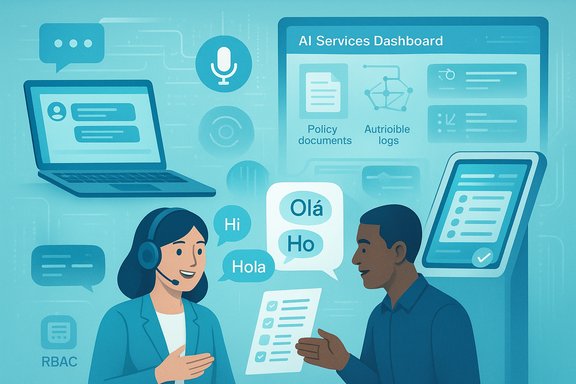
Microsoft’s pitch is simple and urgent: use AI-powered, omni‑channel citizen engagement to give residents and caseworkers immediate access to services and information — across web, phone, messaging and in-person kiosks — so people can connect when, how and where they want. This is not a speculative roadmap; it is a suite of commercial products and architectures—Microsoft 365 Copilot, Copilot Studio, Microsoft Foundry, Azure AI services and Power Platform—packaged as a turnkey approach for social services and public‑sector case management. The vendor claims these systems can surface eligibility, pre-fill forms, reduce drop‑offs, and let virtual agents guide residents through complex applications while freeing staff to focus on higher‑value, discretionary work.
AI in government has shifted from proof‑of‑concept pilots to production rollouts at national scale. Vendors and governments are now deploying conversational agents, retrieval‑augmented knowledge services and agent orchestration platforms as part of digital public infrastructure. Microsoft’s public materials position a stack of tooling — Copilot, Copilot Studio, Microsoft Foundry, Azure OpenAI Service, and Power Platform components (Power Pages, Power Automate, Dataverse, Dynamics 365) — as the building blocks for omni‑channel citizen engagement and caseworker assistance. At the same time, governments and public‑sector IT communities are increasingly demanding governance, auditability and compliance: the NIST AI Risk Management Framework is now a de facto playbook for managing AI risk in public programs, and cloud compliance baselines such as FedRAMP and sovereign cloud options are central procurement considerations for federal and national deployments.
AI‑enabled omni‑channel citizen engagement is an important tool in modern social services — but it is a tool, not a substitute for policy judgment, legal safeguards or human accountability. The technology can reduce friction, expand access and scale services, but only when deployed with rigorous technical grounding, meaningful human oversight, and contractual protections that put public interest first. The moment for responsible, evidence‑based adoption is now; the cost of getting it wrong is borne by the people most dependent on public services.
Source: Microsoft AI in Government: Enabling Access to Information
 Background
AI in government has shifted from proof‑of‑concept pilots to production rollouts at national scale. Vendors and governments are now deploying conversational agents, retrieval‑augmented knowledge services and agent orchestration platforms as part of digital public infrastructure. Microsoft’s public materials position a stack of tooling — Copilot, Copilot Studio, Microsoft Foundry, Azure OpenAI Service, and Power Platform components (Power Pages, Power Automate, Dataverse, Dynamics 365) — as the building blocks for omni‑channel citizen engagement and caseworker assistance. At the same time, governments and public‑sector IT communities are increasingly demanding governance, auditability and compliance: the NIST AI Risk Management Framework is now a de facto playbook for managing AI risk in public programs, and cloud compliance baselines such as FedRAMP and sovereign cloud options are central procurement considerations for federal and national deployments. What Microsoft offers and how it maps to citizen services
Omni‑channel citizen engagement: components and promises
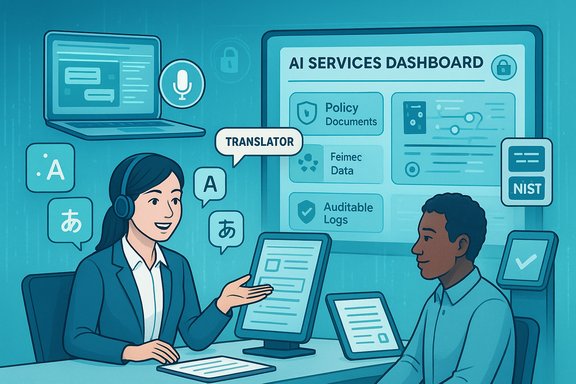
Microsoft’s product messaging for government layers several capabilities:- Virtual assistants and conversational front doors that run on web chat, voice, messaging and kiosks to guide users through queries and form workflows.
- AI‑powered front‑line agents for caseworkers that surface relevant documents and eligibility checks across silos, speeding decisions and case resolution.
- Multilingual interfaces and translation (Microsoft Translator, integrated language services) to support non‑English speakers and preserve linguistic access.
How it’s built: the technical pattern
Typical architectures follow a pattern used in production deployments:- A conversational front end receives user input (text/voice).
- Retrieval‑Augmented Generation (RAG) or a knowledge‑grounding layer queries authoritative knowledge bases (policy docs, case records stored in Dataverse, Dynamics 365 records).
- A language model generates a response, annotated and linked to retrieved evidence.
- Agents orchestrate follow‑up actions (pre‑filling forms, initiating workflow in Power Automate, or escalating to a human) while logging actions for audit.
Real‑world implementations (what’s already in production)
Several high‑profile projects demonstrate the pattern and help validate Microsoft’s claims.India: e‑Shram and National Career Service (NCS)
Microsoft announced integrations with India’s e‑Shram registry and the National Career Service to add multilingual, AI‑assisted features: chatbots for registration help, automated résumé creation, skills gap analysis and job matching at population scale. Indian reporting and Microsoft publications indicate the platforms use Azure and Azure OpenAI Service, plus in‑country language tools (Bhashini) to reach hundreds of millions of informal workers. These systems are explicitly framed as digital public infrastructure for welfare and employment services.Regional and municipal examples: Bolzano (myCIVIS)
A European example shows a pragmatic, production‑grade design: the Bolzano province built a citizen portal (myCIVIS) that integrates Power Platform, Dynamics 365 and Foundry for a multilingual AI assistant (EMMA) that helps residents find services, pre‑fill forms and instantiate governed back‑office workflows. The project ties conversational outputs directly to Dataverse and Dynamics records and includes human‑in‑the‑loop checkpoints to reduce automated decision risk.Other adopter stories
Microsoft’s site lists customer stories spanning social services and small government entities — for example, Nunavut’s language access work and Samhall’s outcome improvements — showing the vendor’s marketing case that AI companions can increase accessibility and staff productivity when integrated with Dynamics 365 and Power Platform.Benefits for social services and citizen access
AI‑enabled omni‑channel systems can deliver practical and measurable improvements:- Lower friction and higher take‑up: Conversational guides reduce form abandonment, improving completion rates for complex benefit applications.
- Multilingual access: Integrated translation and localized knowledge reduce language barriers and support inclusion.
- Faster front‑line response: Caseworkers get immediate retrieval of relevant policy and client data, shrinking decision time and rework.
- Scalability: Cloud infrastructure scales to serve large populations and multiple channels without linear staff increases.
- Data for policy: Aggregated, de‑identified interaction data can guide service design and targeted outreach.
Risks and failure modes — what policymakers must not ignore
While the technological case is strong, the risk profile of AI in public services is also significant. Any responsible deployment for social services must treat the following as first‑order constraints.1. Hallucinations and factual errors
Large language models can produce plausible but incorrect statements — so‑called hallucinations. Even with RAG grounding, studies and practitioner reporting show hallucinations persist unless retrieval quality, model evaluation and output verification are rigorously engineered. In public‑service contexts, a wrong answer about eligibility, benefits amount or legal steps is not just inconvenient — it can cause financial harm and legal exposure.2. Algorithmic bias and fairness
Models trained or tuned on historical administrative data can replicate and amplify social inequities. Automated résumé tools or job‑matching algorithms may disadvantage women, minorities or informal‑sector workers if fairness testing and countermeasures are not in place. Independent policy experts stress that public agencies must monitor outcomes across demographics and publish impact evaluations.3. Data protection, privacy and sovereign control
Large, centralized registries and cross‑system data flows increase attack surface and raise data sovereignty questions. Governments using commercial clouds must verify where PII is stored and processed, how access is controlled, and whether secondary uses or analytics are contractually prohibited. FedRAMP, sovereign cloud boundaries and explicit contractual SLAs for data handling are non‑negotiable for many deployments.4. Vendor lock‑in and operational dependence
Relying on a single vendor for infrastructure, models, tooling and operational runbooks creates procurement and continuity risk. Several government programs have flagged vendor lock‑in as an operational challenge when cloud migration or re‑procurement is required. Agencies should demand portability, open APIs and clear export/exit provisions to preserve future policy autonomy.5. Security and attack surface
AI systems introduce new vectors: prompt injection, data exfiltration via model APIs, and compromised retrieval indices. Centralized registries can be high‑value targets; hardening, logging, third‑party red team exercises and continuous monitoring are essential.6. The digital divide and unequal benefits
Conversational AI often improves access for digitally connected citizens while leaving offline or low‑literacy populations behind. Successful public deployments must combine AI channels with staffed mediators at community centres, phone‑assisted registration and in‑person touchpoints to avoid widening inequities.Governance, standards and technical controls
To manage these risks, adopt layered technical and policy safeguards that reflect the NIST AI RMF and good cloud compliance practice.- Follow NIST AI RMF practices: adopt risk‑based mapping, TEVV (testing, evaluation, verification, validation), and ongoing monitoring to measure accuracy, fairness and robustness.
- Use sovereign or FedRAMP‑certified clouds where required, and insist on in‑country processing when statutes demand data residency. Azure Government and other sovereign offerings can provide essential compliance baselines.
- Implement retrieval‑grounding and citation of evidence: design agents to return verifiable sources and attach them to automated responses, with human‑readable provenance. This reduces hallucination risk and helps with contestability.
- Human‑in‑the‑loop (HITL) for high‑risk steps: any decision with legal, financial or entitlement consequences must require human approval. Log rationale and provide clear recourse paths.
- Independent algorithmic audits: third‑party audits and transparent summary reports help build public trust and detect distributional harms.
- Data minimization and purpose limitation: limit model access to only the fields necessary for the task; avoid broad cross‑indexing unless legally justified.
- Contractual guardrails against commercialization of public data: require explicit prohibitions on vendor reuse, resale or model training on sensitive public datasets without consent.
Practical deployment checklist for Directors of Social Services
- Map use cases by risk: low‑risk (information, translation), medium‑risk (pre‑fill forms, recommendations), high‑risk (eligibility denials, automated benefit calculations).
- Start with low‑risk pilots that provide measurable KPIs: completion rates, time‑to‑case resolution, user satisfaction.
- Require RAG architecture with verifiable citations and an explainable provenance layer.
- Mandate HITL review for high‑impact outcomes and a transparent appeals pathway.
- Insist on federated logging, audit trails, and role‑based access controls tied to a central governance committee.
- Contractual demands: data residency, no commercial reuse, portability clauses, breach notifications, and third‑party audit rights.
- Invest in digital mediators — community centers, phone agents and outreach — to bridge the digital divide.
Technical caveats: RAG is necessary but not sufficient
Retrieval‑augmented generation is widely promoted as the technical solution to hallucinations, and it does reduce some classes of factual error. But academic and industry research shows RAG systems still hallucinate when retrieval fails, when retrieval is noisy, or when the generator over‑relies on parametric knowledge. Recent reviews and experiments find that improvements in retrievers, hybrid retrieval strategies and post‑generation verification reduce hallucinations — but they do not eliminate them. Production deployments must therefore combine RAG with multi‑stage verification, evaluator models, and human oversight.Strengths and notable advantages
- Comprehensive stack reduces integration time: Microsoft’s end‑to‑end tooling (Copilot, Foundry, Power Platform, Azure) speeds time‑to‑value for agencies already running Microsoft estates.
- Operational governance features: Foundry and the Agent Service emphasize enterprise governance, RBAC, auditability and managed hosting — features necessary for public‑sector production.
- Language and accessibility reach: Integrations with real‑time translation and localized language platforms can materially increase access for non‑English speakers on national programs.
- Proven scale cases exist: National‑scale programs (for example, India’s e‑Shram/NCS initiatives) provide concrete evidence that AI can be integrated into public social‑protection plumbing at population scale — but these projects surface the need for governance and audits alongside technical work.
Where governments must push back or demand stronger commitments
- Portability and open standards: insist on open APIs, exportable data formats and a clear exit plan to reduce vendor lock‑in risk. Recent procurement reviews show embodied lock‑in can become costly and strategic.
- Independent verification and public reporting: require independent audits, published executive summaries of bias tests and impact monitoring dashboards.
- Contractual safeguards on data reuse and model training: do not rely solely on vendor goodwill; embed prohibition of model training on sensitive registries without explicit consent or public notice.
- Clear human accountability: technical logs, explainable outputs and named human decision‑makers for any action that materially affects benefits or legal status.
Bottom line — realistic optimism, conditioned on governance
Microsoft and other hyperscalers have produced a credible set of products that can materially improve citizen access to information and reduce friction in social‑services delivery. When correctly engineered, the combination of omni‑channel virtual agents, RAG grounding, and governance tooling can reduce barriers for residents and accelerate caseworker throughput. Real deployments — from municipal portals to national registries — demonstrate meaningful benefits when the technology is integrated with human workflows and policy guardrails. But the promise is inseparable from the risk. Hallucinations, algorithmic bias, data sovereignty, vendor lock‑in and security exposures are real and present. Public officials and program managers must adopt a risk‑first posture: build pilots that measure outcomes, require independent audits, enforce contractual protections on data use, and keep humans in control of decisions that materially affect lives. These are not optional niceties — they are the operational preconditions of trustworthy, equitable AI in government.Recommended next steps for Directors of Social Services and Program Managers
- Commission a short, risk‑scoped pilot that targets a clearly defined user journey (e.g., benefit pre‑screening and pre‑fill) and sets success metrics for completion rate, drop‑off reduction, and error rate.
- Require a TEVV plan and AI RMF mapping for any procurement, with independent third‑party auditable checkpoints.
- Ensure contractual clauses for data residency, non‑reuse, portability and breach notification are included before any PII leaves government boundaries.
- Design HITL checkpoints for any outcome that influences eligibility or payments and document human accountability.
- Build an inclusive roll‑out plan that pairs AI channels with in‑person and phone‑assisted options to avoid widening the digital divide.
- Publicly publish summary audit results and create a transparent appeals pathway for citizens affected by automated guidance.
AI‑enabled omni‑channel citizen engagement is an important tool in modern social services — but it is a tool, not a substitute for policy judgment, legal safeguards or human accountability. The technology can reduce friction, expand access and scale services, but only when deployed with rigorous technical grounding, meaningful human oversight, and contractual protections that put public interest first. The moment for responsible, evidence‑based adoption is now; the cost of getting it wrong is borne by the people most dependent on public services.
Source: Microsoft AI in Government: Enabling Access to Information