

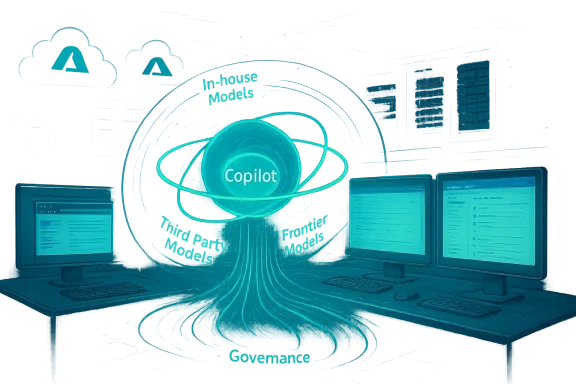
Microsoft’s pivot from an exclusive reliance on OpenAI toward a broader, more self-sufficient AI stack is the most consequential product- and platform-level inflection point the company has made since it embedded cloud services into its enterprise DNA. What started as a strategic bet — investing heavily in OpenAI and baking GPT models into Bing, GitHub Copilot, and Microsoft 365 Copilot — is now evolving into a multi‑pronged architecture that combines internal models, third‑party alternatives, and continued selective use of “frontier” partners. The result is a deliberate move toward AI self-sufficiency designed to control cost, performance, risk, and long‑term product differentiation for Microsoft’s expansive software and cloud ecosystem.
Since 2019 Microsoft and OpenAI forged a close partnership that transformed Microsoft’s product roadmap and, arguably, the trajectory of enterprise AI adoption. The deal gave Microsoft privileged access to OpenAI’s models and made Azure the backbone for much of OpenAI’s compute needs. Over time that relationship deepened into multibillion‑dollar investments and deep product integrations — a collaboration that helped mainstream generative models across Microsoft 365, Bing, and developer tools. Yet, over the last two years, multiple signals have made it clear Microsoft is recalibrating that dependence and planning for a future where OpenAI is a partner among several, rather than the single engine powering its AI ambitions.
The business rationale is straightforward: large foundation models are powerful, but they’re also expensive to run, slow in some real‑world enterprise contexts, and inflexible when you want tight product‑level customization or cost predictability. Early adopters of Copilot and similar features flagged concerns about cost, speed, and predictable scale, especially for enterprise rollouts measured in tens or hundreds of thousands of seats. Microsoft’s answer has been to blend models — building smaller, optimized in‑house models for specific tasks, hosting alternative vendors’ models within Azure, and reserving OpenAI and other frontier models where their capabilities justify the cost or strategic value. Reuters and other outlets captured this multi‑vector approach in late 2024 and throughout 2025.
Microsoft has publicly tested and announced experimental MAI models (Microsoft AI) in areas such as speech and text preview releases, signaling its intent to produce production‑grade components rather than research prototypes alone. These moves confirm a strategic priority: when a model’s job is well‑defined inside Office apps — for example, summarizing meeting notes, extracting tasks from email threads, or generating charts in Excel — a smaller task‑specific model can provide nearly equivalent user value at lower cost and latency.
That bet is sensible — and necessary — for an enterprise software giant that must deliver predictable outcomes for millions of users. But it raises hard questions about quality consistency, governance, and the commercial shape of the AI ecosystem going forward. The next year will be decisive: successes will validate Microsoft’s orchestration playbook and expand Copilot adoption; missteps will expose the limits of model hybridization and hand more leverage back to frontier model providers.
Readers and IT leaders should watch two things closely: whether Microsoft can demonstrably lower Copilot’s operating cost without hurting user experience, and how OpenAI responds commercially and technically to preserve its role as a frontier partner. Both outcomes will shape the economics and architecture of enterprise AI for years to come.
Microsoft’s strategy marks a pivotal moment in how large technology companies will build and monetize AI: not as a single monolithic model powering every interaction, but as a layered, policy‑driven system that routes tasks to the most appropriate compute, model, and provider for the job. The promise is efficiency, the risk is complexity, and the prize is the future of productivity itself.
Source: Neowin Microsoft aims to reduce dependency on OpenAI, as it pushes for "AI self-sufficiency"
 Background
Since 2019 Microsoft and OpenAI forged a close partnership that transformed Microsoft’s product roadmap and, arguably, the trajectory of enterprise AI adoption. The deal gave Microsoft privileged access to OpenAI’s models and made Azure the backbone for much of OpenAI’s compute needs. Over time that relationship deepened into multibillion‑dollar investments and deep product integrations — a collaboration that helped mainstream generative models across Microsoft 365, Bing, and developer tools. Yet, over the last two years, multiple signals have made it clear Microsoft is recalibrating that dependence and planning for a future where OpenAI is a partner among several, rather than the single engine powering its AI ambitions.The business rationale is straightforward: large foundation models are powerful, but they’re also expensive to run, slow in some real‑world enterprise contexts, and inflexible when you want tight product‑level customization or cost predictability. Early adopters of Copilot and similar features flagged concerns about cost, speed, and predictable scale, especially for enterprise rollouts measured in tens or hundreds of thousands of seats. Microsoft’s answer has been to blend models — building smaller, optimized in‑house models for specific tasks, hosting alternative vendors’ models within Azure, and reserving OpenAI and other frontier models where their capabilities justify the cost or strategic value. Reuters and other outlets captured this multi‑vector approach in late 2024 and throughout 2025.
What Microsoft is doing now: diversification, internal models, and partner breadth
Building and testing in‑house models
Microsoft has accelerated work on proprietary models intended to be faster, cheaper, and task‑tuned for Microsoft 365 experiences. Internal model families — described in reporting as competitive with state‑of‑the‑art alternatives — are being trialed in controlled deployments and benchmarks. These include compressed or specialized models that can handle reasoning, code, summaries, and domain‑specific tasks at a fraction of the compute and latency of the largest frontier models. Bloomberg and Windows Central have both reported on Microsoft’s in‑house model builds and early test results that made them confident these models could carry parts of Copilot’s workload.Microsoft has publicly tested and announced experimental MAI models (Microsoft AI) in areas such as speech and text preview releases, signaling its intent to produce production‑grade components rather than research prototypes alone. These moves confirm a strategic priority: when a model’s job is well‑defined inside Office apps — for example, summarizing meeting notes, extracting tasks from email threads, or generating charts in Excel — a smaller task‑specific model can provide nearly equivalent user value at lower cost and latency.
Plugging in third‑party models (Anthropic, others)
Alongside its own models, Microsoft is expanding support for external AI vendors within Copilot and other experiences. Notably, the company has integrated models from Anthropic and indicated plans to host other vendors and open‑weight models in Azure, giving enterprises choice and Microsoft greater negotiation leverage in product economics. This is no theoretical diversification: Microsoft has already enabled Anthropic models in parts of Copilot and allows administrators to opt models in and out for organizational use. Industry reporting highlights this as a deliberate tactic to avoid single‑vendor lock‑in and to create a more modular AI supply chain.Maintaining access to frontier models while reducing exposure
Crucially, Microsoft has not abandoned OpenAI. The company continues to view OpenAI as its strategic partner on frontier capabilities — the highest‑capability models that push the envelope on reasoning and generalization. At the same time, Microsoft is hedging: it is preparing to run many day‑to‑day productivity features on a blend of lower‑cost internal models, hosted third‑party models, and specific frontier calls only when necessary. This reduces throughput costs and improves product responsiveness without cutting off bleeding‑edge functionality. Reuters noted Microsoft’s comments that OpenAI will remain a partner for frontier models even as Microsoft diversifies the models used inside Copilot.Why Microsoft is doing this: a strategic deep dive
Microsoft’s push for AI self‑sufficiency rests on several interlocking drivers.- Cost optimization and unit economics. Large models like GPT‑4 incur heavy inference costs when used at scale. Running Copilot across millions of enterprise seats can become prohibitively expensive if much of the workload hits a frontier model for routine tasks. Smaller, optimized models materially lower the operating cost per query. Reuters and other outlets consistently cite cost and speed as primary motivations.
- Performance and latency for enterprise workflows. Real work inside Word, Excel, and Outlook often requires snappy, deterministic responses. Microsoft’s engineering teams can tailor in‑house models to particular workflows and integrate them tightly with local cache, indexing, and client‑side inference strategies to reduce perceived latency. Early MAI performance claims emphasize low latency and efficient GPU usage.
- Resilience and vendor risk management. Being deeply dependent on one partner creates strategic fragility. Contract shifts, pricing changes, governance disputes, or access constraints on frontier models could disrupt product roadmaps. Microsoft’s multi‑vendor approach reduces single points of failure and strengthens negotiating leverage. Internal reporting and industry analysis underline that Microsoft’s scale and stake in the AI race make resilience a pressing priority.
- Data governance and enterprise control. Enterprises want assurances about where their data is processed and how models use sensitive information. Microsoft can offer more granular contractual protections and on‑prem or Azure‑centric deployments with proprietary models. That control is a selling point for customers in regulated industries who are wary of sending sensitive content to a third‑party model provider.
- Competitive positioning and product differentiation. Owning a unique AI stack allows Microsoft to ship differentiated value across Windows, Office, Teams, and Azure. Proprietary models tailored for Microsoft’s product semantics — for example, deep Office document understanding — become defensible features that competitors can’t replicate by simply licensing the same third‑party model. Bloomberg’s reporting about Microsoft’s confidence in its in‑house model performance reflects this competitive logic.
Technical tradeoffs: smaller models vs. frontier models
A central technical tension underlies Microsoft’s strategy: capability vs. cost and speed.- Frontier models excel at general reasoning, creativity, and cross‑domain synthesis. They are indispensable where a request requires broad knowledge, deep reasoning, or emergent capabilities. However, their compute profile is costly and their latency for interactive use can be high.
- Smaller or specialized models are cheaper, faster, and easier to fine‑tune for narrow tasks. They can outperform larger models on constrained problem sets by optimizing architecture, training data, and inference path. The tradeoff is that they may fail at edge cases requiring broad knowledge or nuanced emergent reasoning.
Implications for OpenAI: partnership, competition, and governance
Microsoft’s diversification is not an open‑and‑shut break with OpenAI; it is a maturation of the relationship into a more complex commercial architecture.- Microsoft still values OpenAI for frontier R&D and marquee capabilities. The company continues to fund and license frontier models where the business case is compelling. But Microsoft is unwilling to let a single provider dictate unit economics across its flagship productivity suite.
- Microsoft’s move increases competitive pressure on OpenAI to demonstrate clear, differentiated value for heavier usage tiers. If OpenAI’s largest models remain substantially costlier without commensurate business benefits for routine enterprise workloads, customers and platform partners will seek alternatives. Bloomberg and Reuters coverage emphasized that Microsoft’s tolerance for exclusive dependence has limits.
- Contractual dynamics and governance matter. Microsoft’s multi‑billion investments in OpenAI — reported at varying figures in public accounts — have been central to the companies’ close ties, yet corporate restructuring and renegotiations on both sides create room for new commercial terms that reflect Microsoft’s need for resilience and cost certainty. That negotiation backdrop helps explain Microsoft’s urgency to build optionality.
Customer impact: performance, price, and control
For IT administrators and enterprise buyers, Microsoft’s strategy has three practical consequences.- Potential for lower costs at scale. If Microsoft can materially reduce inference costs for common Copilot operations and pass savings to customers, the ROI for broad Copilot rollouts improves. That’s crucial for enterprises that hesitated to adopt Copilot widely due to per‑user pricing concerns. Reuters and industry commentary explicitly link cost reduction to broader adoption goals.
- More model choice and administrative control. Organizations will have more say over which model families power which agents or workstreams. Administrators can opt for models that meet their security, latency, or regulatory needs and gate access through policies. Early Copilot choices to permit Anthropic models for Researcher point to real administrative controls already in place.
- Fragmentation risk and user experience consistency. With multiple model types in play, Microsoft must invest heavily in orchestration to ensure consistent user experience across different models. Differences in tone, factuality, or output quirks between vendors could confuse users if not smoothed by interface design and normalization layers.
Risks and open questions
Microsoft’s plan reduces strategic risk in some ways but introduces new operational and product risks.- Quality assurance at scale. Orchestrating multiple model families and fallback logic means more surface area for failures. Instrumentation, automatic rollback, and human review systems become critical. If model routing is miscalibrated, quality could degrade for routine features.
- Regulatory and antitrust scrutiny. As Microsoft expands its own model capabilities and hosts competing vendors on Azure, regulators will scrutinize whether preferential treatment or bundling distorts competition. At the same time, Microsoft’s deep investments in GPU infrastructure and compute could raise systemic questions about concentration in AI compute supply chains.
- Interoperability and vendor governance. Hosting rival models inside a single product raises complex licensing, data usage, and contractual governance questions — especially if models run on different clouds or require different data sovereignty controls. Anthropic’s models, for example, run on AWS and other clouds in some deployments, introducing cross‑cloud considerations.
- OpenAI’s strategic response. OpenAI can respond by optimizing model costs, offering enterprise contracts, or developing more explicit product hooks that make switching less attractive. Microsoft’s move accelerates this commercial pressure on OpenAI to prove differentiated value for heavier enterprise usage.
Where this leaves the AI ecosystem: competition, specialization, and platform design
Microsoft’s recalibration signals a broader industry pivot away from the “one model to rule them all” mentality toward a more modular, polyglot AI ecosystem:- Expect more product teams to combine multiple models, using specialized agents for classification, reasoning, code generation, or domain extraction, and contacting frontier models only when necessary.
- Hyperscalers will compete on two fronts: model capability and model economics. Firms that can deliver comparable capability at lower cost — either through novel model architectures, better data pipelines, or superior hardware utilization — will win enterprise deployments.
- The market will see a bifurcation: a narrow but deep class of models optimized for enterprise workloads, and a smaller number of frontier models competing on raw, eThis modularization will push the next wave of tooling around model orchestration, explainability, and observability — areas where Microsoft has an opportunity to productize its internal lessons and sell the tooling to enterprises and partners.
What Microsoft must get right next
- Robust orchestration and seamless routing so users don’t feel the underlying churn in models.
- Transparent governance, compliance, and data protections for customers who must know exactly how their data flows across models and vendors.
- Clear commercial terms with OpenAI and other vendors that align incentives and avoid surprise cost escalation.
- Continuous investment in model evaluation and fine‑tuning to close any capability gaps between internal models and frontier alternatives.
Conclusion
Microsoft’s push for AI self‑sufficiency is less a repudiation of OpenAI than a pragmatic repositioning for a new phase of productization. The company recognizes that to make AI a mass enterprise platform — fast, affordable, and secure — it cannot treat frontier models as the sole engine for every task. By combining proprietary models, third‑party alternatives, and selective frontier usage, Microsoft aims to balance capability with cost, resilience, and product differentiation.That bet is sensible — and necessary — for an enterprise software giant that must deliver predictable outcomes for millions of users. But it raises hard questions about quality consistency, governance, and the commercial shape of the AI ecosystem going forward. The next year will be decisive: successes will validate Microsoft’s orchestration playbook and expand Copilot adoption; missteps will expose the limits of model hybridization and hand more leverage back to frontier model providers.
Readers and IT leaders should watch two things closely: whether Microsoft can demonstrably lower Copilot’s operating cost without hurting user experience, and how OpenAI responds commercially and technically to preserve its role as a frontier partner. Both outcomes will shape the economics and architecture of enterprise AI for years to come.
Microsoft’s strategy marks a pivotal moment in how large technology companies will build and monetize AI: not as a single monolithic model powering every interaction, but as a layered, policy‑driven system that routes tasks to the most appropriate compute, model, and provider for the job. The promise is efficiency, the risk is complexity, and the prize is the future of productivity itself.
Source: Neowin Microsoft aims to reduce dependency on OpenAI, as it pushes for "AI self-sufficiency"
