

Microsoft’s latest push into skills and education is as strategic as its product play: the company is pairing large, visible investments in cloud and generative AI infrastructure with aggressive, region-specific training programs designed to seed AI fluency, certifications, and pathway-to-work outcomes across diverse national contexts.
Microsoft’s AI product stack — from Azure AI and Azure OpenAI Services to Microsoft 365 Copilot and Copilot Studio — has become the company’s vector for growth across enterprise and public-sector markets. But technology adoption at scale requires people who know how to use it, integrate it, and govern it. Over the past 18 months Microsoft has shifted from broad, global skilling campaigns to a mix of universal learning assets and targeted, government‑partnered programs that try to account for language, sector needs, and local labor-market realities. This hybrid approach is now visible across multiple high-profile initiatives announced or expanded in 2024–2025. These are not small piloted experiments. The commitments announced publicly include concerted investments in infrastructure (data centers and cloud regions), integrated education pipelines, and in some cases formal partnerships with ministries and national training bodies. The stated goals are ambitious: hundreds of thousands to millions of citizens trained in AI fluency and technical skills, locally adapted curricula and certifications, and measurable pathways into the labor market. The scale and public nature of these programs make them essential to assess — both for what they promise and for the systemic risks they could generate.
In short, Microsoft’s doubling down on regional AI training could be transformative — provided governments and civil society insist on concrete measures that protect learners’ long‑term interests and national digital sovereignty while harnessing the scale and technical resources a vendor like Microsoft can uniquely provide.
Source: Cloud Wars Microsoft Doubles Down on Global AI Training with Targeted, Region-Specific Initiatives
 Background
Microsoft’s AI product stack — from Azure AI and Azure OpenAI Services to Microsoft 365 Copilot and Copilot Studio — has become the company’s vector for growth across enterprise and public-sector markets. But technology adoption at scale requires people who know how to use it, integrate it, and govern it. Over the past 18 months Microsoft has shifted from broad, global skilling campaigns to a mix of universal learning assets and targeted, government‑partnered programs that try to account for language, sector needs, and local labor-market realities. This hybrid approach is now visible across multiple high-profile initiatives announced or expanded in 2024–2025. These are not small piloted experiments. The commitments announced publicly include concerted investments in infrastructure (data centers and cloud regions), integrated education pipelines, and in some cases formal partnerships with ministries and national training bodies. The stated goals are ambitious: hundreds of thousands to millions of citizens trained in AI fluency and technical skills, locally adapted curricula and certifications, and measurable pathways into the labor market. The scale and public nature of these programs make them essential to assess — both for what they promise and for the systemic risks they could generate.Regional deep dives: what Microsoft is actually doing
Thailand — 150,000 workers; Thai-language courses and government partnership
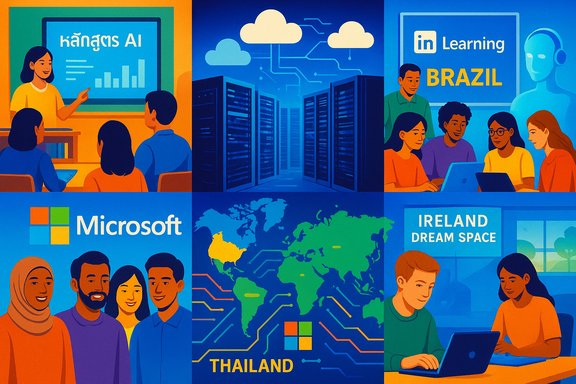
Microsoft and Thailand’s Ministry of Labour, through the Department of Skill Development (DSD), launched an “AI for Workforce” collaboration that aims to provide AI skills and industry-recognized certifications to 150,000 workers. The program leverages the DSD Online Training platform and Microsoft’s localized AI resources, with over 280 Thai-language AI courses adapted for short-form learning and certification pathways. The initiative also includes capacity-building for policymakers and train‑the‑trainer programs intended to scale instruction across provinces. Why this matters: Thailand’s program is explicitly designed to tackle language and access barriers. Converting content into Thai and aligning it with the Department’s certification system reduces friction for learners who would otherwise face English-language or context-mismatched materials. Local partnerships — including classroom delivery via DSD centers, public-sector training for civil servants, and outreach to at-risk workers — expand the program’s reach beyond the urban tech workforce. Independent Thai outlets covering the rollout point to an ecosystem approach (government, Microsoft, training centers) that aims to reach workers in varied sectors. Key claims verified:- 150,000 worker target and 280+ Thai-language courses are public Microsoft announcements and corroborated by local media reports.
Ireland — an incremental €4 million in AI skilling, Dream Space expansion
Microsoft marked a 40‑year Irish milestone by committing an additional €4 million to AI skilling over the next three years, building on a prior €8 million of investment since 2018. The money will fund broad AI fluency programs and expand Microsoft’s Dream Space education initiative — including a new €1 million Dream Space hub at Grange Castle to serve thousands of students and teachers. Microsoft framed the investment as part of a socio‑economic impact narrative that ties jobs, regional hubs, and responsible AI adoption to local growth. Why this matters: Ireland is not a marginal market for Microsoft — it is a strategic operational hub for the company in Europe. The €4 million pledge is modest relative to Microsoft’s revenue footprint, but it’s targeted: educators, students, and young people are the primary beneficiaries, and the Dream Space model delivers hands-on STEM and AI exposure rather than only self‑paced online modules. The investment helps Microsoft maintain local political and workforce goodwill while strengthening talent pipelines that could feed its European operations. Key claim verified:- The additional €4 million commitment and Dream Space expansion were announced by Microsoft and reported by national press.
Brazil — ConectAI: training 5 million Brazilians and major cloud investment
Microsoft’s ConectAI program — part of a broader “Mais Brasil” engagement — targets 5 million Brazilians for AI skills training over a three‑year window, and the company paired that goal with a very large infrastructure commitment: BRL 14.7 billion (roughly $2.6 billion) over three years for cloud and AI infrastructure investments in Brazil. Microsoft reports that roughly 2.5 million Brazilians had already taken training through ConectAI‑linked activities since the program’s launch in September 2024, with hundreds of partner organizations (26 partners named by Microsoft) delivering courses via LinkedIn Learning and local platforms. Why this matters: ConectAI is Microsoft’s broadest national-scale program in Latin America to date. The mix of infrastructure investment (data centers and cloud capacity) and mass skilling positions Microsoft as both the platform provider and ecosystem builder for Brazil’s AI future. The program explicitly references local partners — SENAI, government labor ministries, UNICEF partnerships for youth, and civil-service training — which increases distribution reach and local legitimacy. Independent Brazilian outlets and industry publications have covered ConectAI’s scope and the claimed progress metrics. Important note on timing and targets: Microsoft’s official materials and multiple coverage items state ConectAI’s skilling target as 5 million Brazilians by the end of 2027; some outlets or summaries have misstated the endpoint as 2028. The most authoritative primary Microsoft pages cite the 2027 target; when program timelines matter for policy or funding decisions, the 2027 date should be treated as the canonical commitment.Microsoft ecosystem events: the AI Agent & Copilot Summit
Beyond government programs, Microsoft’s AI ecosystem is reinforced through events that train and align partners, integrators, and enterprise buyers. The AI Agent & Copilot Summit — a community event focused on Microsoft Copilot, Agents, and related tooling — is scheduled March 17–19, 2026 in San Diego, with public agendas, masterclasses, and Microsoft speakers. These events are tactical: they educate high‑touch audiences (partners, B2B buyers) and accelerate adoption of Microsoft’s Copilot tooling and agent frameworks.Strategy analysis — why Microsoft is doubling down on regional skilling
1) Demand and supply: creating market-ready users for its stack
Microsoft’s skilling programs are not charity; they are demand‑generation mechanisms that align human capital with Microsoft’s technology stack. By training millions in AI fluency and Azure fundamentals, Microsoft expands the pool of developers, IT professionals, and business users who are predisposed to use Microsoft tools and cloud infrastructure — reducing friction for adoption and increasing ecosystem lock‑in. In markets where talent shortages are a barrier to cloud migration, this is a direct business strategy as much as a social one. Evidence for this strategic alignment appears repeatedly in Microsoft’s program materials, which explicitly couple skilling with infrastructure investments and certification paths.2) Localization and trust: language, certification, and institutions matter
Global skilling programs can fail when they ignore local languages, certification regimes, or institutional partners. Microsoft’s approach — translating curricula into Thai, building formal recognition with Thailand’s DSD, or opening Dream Space hubs in Irish communities — demonstrates an understanding that adoption accelerates when content maps to local labor‑market signals. That localized approach lowers barriers for learners and signals public‑sector partners that Microsoft is a collaborator rather than a remote vendor.3) Multiple channels: online, classroom, and partner networks
Microsoft is using a multi‑channel delivery model: LinkedIn Learning and AI Skills Navigator for online access, government training centers and Dream Space hubs for in‑person outreach, and partner networks (SENAI, DSD trainers) to distribute training at scale. This layered distribution increases the program’s resilience and reach across urban and regional populations.4) Political economy: positioning as national partner of choice
By entering long‑term partnerships with ministries and national training bodies, Microsoft secures a seat at the table for public‑sector digital transformation. The public declarations (and the publicity value of large job‑training targets) create political incentives for governments to favor Microsoft cloud solutions in procurement and digital services discussions. That positioning has downstream commercial value that extends beyond classroom outcomes.Measurable strengths — what Microsoft brings that others typically don’t
- Scale: Microsoft can combine global content libraries with local delivery partners and data‑center investments to reach millions at speed. ConectAI’s headline figures and the Thailand commitments demonstrate scale ambitions few vendors can match.
- Certification and credentialing: joint certification with national agencies gives learners signals that employers recognize, increasing the likelihood of employment outcomes.
- Infrastructure + skills bundling: pairing skilling with local cloud capacity investments reduces latency, data residency issues, and gives Microsoft commercial leverage for Azure and platform services.
- Partner network activation: working with institutions like SENAI, UNICEF, national departments, and local NGOs amplifies reach and legitimacy.
Key risks and blind spots
1) Vendor lock-in and ecosystem concentration
Large-scale, vendor‑driven skilling runs the risk of creating workforce expertise tightly coupled to one cloud and one set of tools. That concentration can disadvantage learners if market demand shifts, and it raises public‑policy concerns about dependency on a single vendor’s platform and proprietary APIs. Industry analyses have repeatedly flagged vendor lock‑in as a structural issue in cloud markets; training programs that emphasize partner‑specific certifications without portability guardrails can compound that risk. Governments and training partners should demand multi‑vendor fundamentals and transferable competencies alongside vendor‑specific paths.2) Measuring impact beyond vanity metrics
Counting course enrollments or certificates is one thing; measuring meaningful employment transitions, wage gains, or enterprise productivity improvements is another. Past mass‑training campaigns sometimes report high registration numbers but scant long‑term outcome data. Programs must publish longitudinal metrics: completions, placement rates, wage differentials, employer uptake, and attrition. Without that transparency, it’s difficult to know whether investments are delivering sustainable, equitable outcomes.3) Inequality in access and digital divides
Even with localized content, structural barriers remain: broadband access, device affordability, foundational numeracy and literacy, and geographic isolation can exclude populations from online modules. Programs need offline, classroom, and low‑bandwidth options, plus targeted outreach for underserved groups to avoid exacerbating existing inequalities. Microsoft’s mixed delivery approach helps, but governments must fund the ‘last mile’ infrastructure.4) Privacy, cybersecurity, and governance
Training people to use AI and cloud services at scale increases the surface area for security incidents and creates new governance needs. In Brazil, surveys and analysts flagged privacy and cybersecurity as adoption barriers; Microsoft’s programs include cybersecurity curricula but national programs must be matched with governance frameworks (data residency, public‑service vetting, incident response) to prevent misuse or harm.5) Political and procurement optics
Publicly funded or politically endorsed training programs can be challenged on procurement fairness grounds if governments appear to favor a single commercial vendor. Clear procurement processes, open standards commitments, and multi‑vendor training components reduce the political risk of future legal or policy pushback. Independent oversight or auditor verification of program procurement is advisable for national initiatives.Practical recommendations for policymakers and IT leaders
- Require outcome reporting: mandate publicly accessible, machine‑readable reporting on completions, placements, and employer uptake at 6‑, 12‑, and 24‑month intervals.
- Insist on transferable fundamentals: ensure curricula include vendor‑agnostic modules (AI ethics, data literacy, software engineering fundamentals) alongside platform‑specific training.
- Build multi‑vendor pathways: include rival cloud vendors and open-source tooling in national skilling plans to reduce lock‑in risks.
- Fund last‑mile infrastructure: pair skilling investments with targeted funding for broadband, devices, and in‑person hubs in underserved regions.
- Protect data and privacy: require that any training which involves real public data adhere to national privacy laws and vetted sandbox environments to prevent leakage and misuse.
- Audit procurement and curricula alignment: include third‑party audits of vendor‑led programs to ensure pedagogical rigor and market neutrality where appropriate.
Conclusion — a conditional win for national AI readiness
Microsoft’s region‑specific skilling push is a substantial, strategic bet: combine cloud infrastructure investment with mass training and local partnerships to accelerate AI adoption while shaping the talent pipeline. The approach offers clear advantages — scale, local language delivery, recognized credentials, and partner networks — that can power real workforce gains. But the model carries tradeoffs. Without rigorous outcome measurement, explicit multi‑vendor and portability safeguards, and investments to close the digital divide, these programs risk producing credentialed workers whose skills are narrowly aligned to one platform, or training statistics that don’t translate into sustainable employment improvements. Public‑sector partners must negotiate hard on transparency, portability, and accountability while preserving the benefits of private‑sector scale. Independent audits, multi‑vendor curricula, and clear outcome metrics will be the difference between headline counts and enduring economic impact.In short, Microsoft’s doubling down on regional AI training could be transformative — provided governments and civil society insist on concrete measures that protect learners’ long‑term interests and national digital sovereignty while harnessing the scale and technical resources a vendor like Microsoft can uniquely provide.
Source: Cloud Wars Microsoft Doubles Down on Global AI Training with Targeted, Region-Specific Initiatives
