

Microsoft’s AI and environmental goals are compatible only if the company makes clean power, water efficiency, and low-carbon construction move faster than its Azure expansion, a test sharpened this week in Redmond as Microsoft promoted greener data center technology while pursuing gas-backed AI capacity. That is the uncomfortable answer behind the feel-good science fair. The company can point to real engineering progress, but the physics of AI infrastructure are now moving faster than the public-relations grammar of sustainability. Microsoft’s climate promise has become less a destination than a stress test of whether Big Tech can grow without outsourcing the consequences.
When Microsoft announced in 2020 that it intended to become carbon negative, water positive, and zero waste by 2030, the pledge sounded aggressive but legible. Cloud computing was already energy-intensive, but the corporate sustainability playbook had recognizable tools: buy renewable energy, improve server efficiency, reuse hardware, reduce concrete and steel emissions, and invest in carbon removal.
Then generative AI arrived and changed the denominator. The cloud stopped being merely a utility layer for business software and became the factory floor for training and running large models. Every new assistant, coding agent, image generator, meeting summarizer, and enterprise copilot had to run somewhere, and increasingly that “somewhere” meant vast GPU clusters drawing power and shedding heat at a density traditional data centers were not built to handle.
That is why KUOW’s dispatch from Microsoft’s Redmond research and development lab lands with more force than a routine sustainability feature. Microsoft scientists showed off low-carbon steel and microfluidic cooling systems that move liquid through tiny channels inspired by the veins of a leaf. These are not gimmicks. They are the kind of advances a hyperscale cloud provider will need if AI is to become less wasteful per unit of computation.
But the same story also points to the contradiction Microsoft cannot science-fair its way around. While it works to reduce water and energy demand inside the data center, the company is also signing deals tied to gas-powered data center capacity. The question is no longer whether Microsoft has clever engineers. It plainly does. The question is whether those engineers can outrun Microsoft’s own sales forecast.
Cooling is a particularly important front. AI chips are power-hungry, densely packed, and increasingly difficult to cool with conventional air systems. Liquid cooling can move heat more efficiently, reduce reliance on evaporative water cooling, and allow data centers to operate at higher densities without turning facilities into thermal liabilities. If Microsoft can make those systems reliable at hyperscale, the environmental gains could be meaningful.
The same is true for construction materials. Data centers are not ethereal clouds; they are buildings full of concrete, steel, copper, transformers, batteries, racks, and chips. A company can claim renewable energy for operations and still carry a large embedded carbon burden from the supply chain that produces its facilities and hardware. Low-carbon steel and alternative concrete are therefore not side quests. They go directly to Microsoft’s Scope 3 problem.
Yet the lab story becomes misleading when it is presented as though efficiency alone solves growth. A more efficient engine can still burn more fuel if the fleet doubles, triples, or runs all day. This is the rebound problem dressed in hyperscale clothing: the cheaper and more efficient computation becomes, the more businesses find ways to consume it.
That is Microsoft’s dilemma. The company is not trying to run the same Azure with lower impact. It is trying to run a much larger Azure, with AI workloads that customers are only beginning to understand, on a timeline dictated by competitive pressure from Google, Amazon, Meta, OpenAI, Anthropic, and a rolling cast of model labs. The numerator may improve. The denominator is exploding.
A gas plant built to serve AI demand does not disappear when a press release about carbon removal lands. It has a financial life, a permitting trail, fuel contracts, emissions, and local environmental consequences. Even if Microsoft later offsets those emissions or matches consumption with renewable energy credits elsewhere, the infrastructure choice still shapes the grid and the market.
This is where corporate climate accounting and public climate reality begin to diverge. Microsoft can buy renewable power purchase agreements in one region, fund carbon removal in another, and improve water efficiency at a facility in a third. Those tools may be valid within reporting frameworks. But communities hosting data centers experience the physical plant, the water use, the grid constraints, the transmission upgrades, the backup generation, and the opportunity cost of electricity that might otherwise serve homes, factories, or electrified transport.
That does not make Microsoft uniquely villainous. It makes Microsoft representative. The AI boom has arrived faster than the clean energy buildout needed to support it, and hyperscalers are discovering that the grid does not move at software speed. Permitting transmission lines, building renewables, restarting nuclear units, or developing next-generation geothermal and long-duration storage all takes time. GPUs can be ordered faster than substations can be completed.
The problem for Microsoft is that its own ambition leaves it less room to hide behind the system. A company that promises to be carbon negative by 2030 is not merely promising to be better than average. It is promising to bend its own growth curve against the carbon curve of the economy. Gas-backed AI expansion says, in effect, that product urgency has priority when the two curves collide.
That is the key fact. Microsoft is not failing because it has done nothing. It is struggling despite doing many of the things climate-minded observers have asked technology companies to do. It has purchased renewable energy at scale. It has supported carbon removal markets. It has improved data center design. It has worked on lower-carbon materials. And still, the overall footprint has moved in the wrong direction.
This should puncture the lazy version of the debate. The issue is not that Microsoft forgot to install solar panels or that AI servers are wasteful because engineers lack imagination. The harder truth is that the AI buildout is so capital-intensive and infrastructure-heavy that even serious mitigation efforts can be overwhelmed by growth.
Scope 3 emissions are the giveaway. Those are the emissions embedded in Microsoft’s supply chain: construction, hardware manufacturing, logistics, purchased goods and services, and other value-chain impacts. For software companies, the easy mythology is that emissions come from electricity alone. For AI companies, the supply chain becomes inseparable from the product. Every accelerator, rack, cooling loop, data hall, and concrete slab has a carbon history before the first token is generated.
Carbon removal adds another complication. Microsoft has been one of the most important corporate buyers in the emerging market for durable carbon removal, and that market needs demand if it is ever to scale. But removals are not a permission slip for uncontrolled growth. If a company’s gross emissions rise while it promises that future removals will catch up, the climate benefit depends on timing, quality, durability, and whether those removals are truly additional.
The climate system does not care about brand architecture. It responds to cumulative emissions. A ton emitted now and a ton removed years later are not morally or physically identical if the intervening years push warming higher, stress ecosystems, and lock in infrastructure choices.
Microsoft’s water-positive pledge is therefore both admirable and difficult to interpret. Replenishment projects can restore wetlands, improve watersheds, fund conservation, and expand access to clean water. Those are real benefits. But replenishing water somewhere is not always the same as reducing stress where a data center operates.
AI intensifies the issue because thermal management is no longer a background facilities concern. The denser the compute, the more important cooling becomes. Liquid cooling can reduce some water demands, particularly when it replaces evaporative cooling, but the broader system still needs electricity generation, and power plants themselves may require water depending on technology and location.
This is why the “green data center” phrase can do too much work. A facility can be efficient and still be large. It can use advanced cooling and still increase total regional power demand. It can be matched with renewable energy and still rely on local grid resources during certain hours. It can support a global AI service while imposing very local tradeoffs.
For communities, the fairness question is straightforward: Who gets the jobs, who gets the tax base, who gets the heat, who gets the water stress, and who gets the power bill? Microsoft often emphasizes community investment around its data centers, and those investments can matter. But local benefits do not erase the need for transparent accounting of resource demand.
If AI becomes a default layer in Windows, Office, Azure, GitHub, security products, search, gaming, and enterprise workflows, then water use is not merely a facility issue. It is a product strategy issue. The environmental impact is baked into decisions about what features are turned on by default, how often models are queried, how large those models are, and whether smaller specialized models can do the job.
The optimistic case should not be dismissed. Software has repeatedly changed the efficiency frontier in logistics, manufacturing, research, and infrastructure. If AI helps discover lower-carbon cement, improve fusion simulations, reduce data center cooling loads, or make power grids more resilient, its environmental value could be substantial.
But there is a difference between a possible offsetting benefit and a demonstrated one. Most AI consumption today is not obviously climate-directed. It is productivity software, coding assistance, customer service automation, ad targeting, search augmentation, content generation, internal enterprise experimentation, and consumer novelty. Some of that may reduce waste. Some may simply produce more digital activity.
This matters because Microsoft’s environmental argument increasingly depends on system-level benefits that are hard to measure. If the company says AI will help the world decarbonize, it should show not only isolated case studies but aggregate evidence that AI-driven reductions are material, additional, and larger than the infrastructure burden. Otherwise, the claim risks becoming the new version of “the internet will reduce paper.”
The burden of proof is higher for Microsoft because the company is not a neutral research lab. It is selling AI capacity, embedding AI into products, and competing to make AI usage habitual. That commercial reality does not invalidate the technology’s potential, but it does mean the environmental case cannot rest on best-case applications alone.
A serious accounting would distinguish between AI that reduces emissions, AI that merely shifts emissions, and AI that increases consumption in the name of convenience. Microsoft is well positioned to do that work. It has telemetry, customers, researchers, and infrastructure knowledge. Whether it wants to publish conclusions that might complicate sales is another question.
That means the environmental footprint of personal and enterprise computing is changing. In the old model, a feature’s resource cost was mostly local: CPU cycles, battery drain, disk space, maybe a little telemetry. In the AI model, a simple user action may trigger remote inference in a data center hundreds or thousands of miles away. The interface feels weightless because the weight has moved.
This does not mean every Copilot prompt is an ecological sin. It means users and IT departments need a more mature vocabulary for digital efficiency. Not every task needs a frontier model. Not every workflow needs AI by default. Not every query should leave the device. Smaller models, local inference, caching, batching, and workload-aware scheduling are not just engineering optimizations; they are environmental controls.
Enterprise IT will eventually ask these questions in procurement language. What is the carbon cost of enabling AI features across 50,000 seats? Can admins control model choice by workload? Can inference be scheduled or routed based on carbon intensity? Are there reporting dashboards that connect AI usage to emissions and water estimates? Can organizations set policies that reserve expensive AI calls for tasks with demonstrable value?
Microsoft has a chance to make this boring, which is the highest compliment in enterprise software. If AI resource governance becomes as manageable as identity, compliance, and endpoint policy, customers can make rational choices. If it remains a black box hidden behind a sparkle icon, the environmental debate will become another trust problem.
The company’s environmental compatibility test therefore runs through product design as much as data center design. A sustainable AI strategy is not only greener buildings and better power contracts. It is also restraint, default settings, transparency, and giving administrators the ability to say no.
That sequencing is the central problem. If Microsoft builds demand faster than clean energy supply, it will either lean on fossil generation, strain grids, or depend on accounting instruments that may not reduce emissions in the same place and hour that consumption occurs. If it waits for perfectly clean infrastructure, it risks losing ground in a market it sees as existential. The company is trying to do both: sprint commercially while describing the climate plan as a marathon.
There is a version of this strategy that could work. Microsoft could overbuild clean power, fund grid upgrades, invest in long-duration storage, use flexible workloads to absorb surplus renewables, commit to hourly carbon-free energy matching, and place data centers where clean power and water conditions make sense rather than where land and politics are easiest. It could also slow or limit AI deployments that lack clear value.
But that would require treating sustainability as a constraint, not merely an optimization target. Constraints change decisions. They say some locations are unsuitable, some timelines are too aggressive, some features are too expensive environmentally, and some growth is not worth having at any cost.
The evidence so far suggests Microsoft is more comfortable with optimization than constraint. It wants greener steel, better cooling, more renewables, and carbon removal, but it also wants enough AI capacity to meet demand wherever demand materializes. That is not hypocrisy in the cartoon sense. It is the normal logic of a growth company colliding with planetary math.
Both sides are true. That is what makes the story important. If Microsoft were doing nothing on sustainability, the conclusion would be easy. If it were refusing fossil-backed expansion categorically, the conclusion would also be easy. Instead, it is doing serious sustainability work while making growth decisions that may swamp that work.
The lesson is not that corporate climate goals are useless. It is that goals without binding operating rules become elastic under pressure. A 2030 pledge can guide strategy, but when AI demand surges in 2026, the real policy is revealed in leases, power contracts, construction schedules, and product defaults.
Microsoft’s defenders will argue that abandoning AI leadership would not reduce global AI demand; it would merely shift it to competitors that may be less transparent or less committed to clean energy. There is truth in that. A dirtier rival running the same workloads would not help the climate.
But that argument only goes so far. Leadership is not the right to expand first and reconcile later. Leadership means proving that the path to AI scale can be cleaner in practice, not just in procurement decks. If Microsoft cannot make its own 2030 math work, smaller companies and less scrutinized operators will have even less incentive to try.
The company must reduce the energy and water intensity of each unit of AI computation while also controlling total demand. It must decarbonize construction materials while building at unprecedented scale. It must buy and enable clean power in ways that change real grids, not just annual accounting. It must use carbon removal as a backstop for hard-to-abate emissions, not as a growth anesthetic.
That is a far more demanding task than the original 2020 pledge implied. Back then, Microsoft’s climate goals looked like a corporate transformation plan. In the AI era, they look like a test of whether the cloud business model itself can mature beyond “more.”
For Windows users and IT pros, the practical implication is simple: AI is no longer just a feature category. It is infrastructure consumption made invisible. Every organization adopting AI at scale should ask Microsoft for clearer reporting, finer administrative controls, and evidence that the AI being switched on delivers enough value to justify its resource cost.
Source: KUOW Are Microsoft’s AI and environmental goals compatible?
 Microsoft Built the Perfect Climate Promise for the Pre-AI Cloud
When Microsoft announced in 2020 that it intended to become carbon negative, water positive, and zero waste by 2030, the pledge sounded aggressive but legible. Cloud computing was already energy-intensive, but the corporate sustainability playbook had recognizable tools: buy renewable energy, improve server efficiency, reuse hardware, reduce concrete and steel emissions, and invest in carbon removal.Then generative AI arrived and changed the denominator. The cloud stopped being merely a utility layer for business software and became the factory floor for training and running large models. Every new assistant, coding agent, image generator, meeting summarizer, and enterprise copilot had to run somewhere, and increasingly that “somewhere” meant vast GPU clusters drawing power and shedding heat at a density traditional data centers were not built to handle.
That is why KUOW’s dispatch from Microsoft’s Redmond research and development lab lands with more force than a routine sustainability feature. Microsoft scientists showed off low-carbon steel and microfluidic cooling systems that move liquid through tiny channels inspired by the veins of a leaf. These are not gimmicks. They are the kind of advances a hyperscale cloud provider will need if AI is to become less wasteful per unit of computation.
But the same story also points to the contradiction Microsoft cannot science-fair its way around. While it works to reduce water and energy demand inside the data center, the company is also signing deals tied to gas-powered data center capacity. The question is no longer whether Microsoft has clever engineers. It plainly does. The question is whether those engineers can outrun Microsoft’s own sales forecast.
The Lab Story Is Real, but It Is Not the Whole Story
The most generous reading of Microsoft’s position is that sustainability at AI scale must be engineered, not wished into existence. Microfluidics, direct-to-chip liquid cooling, low-carbon building materials, hybrid timber construction, carbon-free power procurement, and advanced grid management all attack genuine bottlenecks. In an industry where small efficiency gains multiply across millions of servers, the technical work matters.Cooling is a particularly important front. AI chips are power-hungry, densely packed, and increasingly difficult to cool with conventional air systems. Liquid cooling can move heat more efficiently, reduce reliance on evaporative water cooling, and allow data centers to operate at higher densities without turning facilities into thermal liabilities. If Microsoft can make those systems reliable at hyperscale, the environmental gains could be meaningful.
The same is true for construction materials. Data centers are not ethereal clouds; they are buildings full of concrete, steel, copper, transformers, batteries, racks, and chips. A company can claim renewable energy for operations and still carry a large embedded carbon burden from the supply chain that produces its facilities and hardware. Low-carbon steel and alternative concrete are therefore not side quests. They go directly to Microsoft’s Scope 3 problem.
Yet the lab story becomes misleading when it is presented as though efficiency alone solves growth. A more efficient engine can still burn more fuel if the fleet doubles, triples, or runs all day. This is the rebound problem dressed in hyperscale clothing: the cheaper and more efficient computation becomes, the more businesses find ways to consume it.
That is Microsoft’s dilemma. The company is not trying to run the same Azure with lower impact. It is trying to run a much larger Azure, with AI workloads that customers are only beginning to understand, on a timeline dictated by competitive pressure from Google, Amazon, Meta, OpenAI, Anthropic, and a rolling cast of model labs. The numerator may improve. The denominator is exploding.
Gas Is the Tell Microsoft Cannot Explain Away
The gas-backed data center deals are the part of the story that turns a sustainability challenge into a credibility problem. Natural gas is often described in industry language as a bridge fuel: dispatchable, familiar, and cleaner than coal at the point of combustion. But in the context of a 2030 carbon-negative pledge, new gas capacity is not a bridge so much as a clock.A gas plant built to serve AI demand does not disappear when a press release about carbon removal lands. It has a financial life, a permitting trail, fuel contracts, emissions, and local environmental consequences. Even if Microsoft later offsets those emissions or matches consumption with renewable energy credits elsewhere, the infrastructure choice still shapes the grid and the market.
This is where corporate climate accounting and public climate reality begin to diverge. Microsoft can buy renewable power purchase agreements in one region, fund carbon removal in another, and improve water efficiency at a facility in a third. Those tools may be valid within reporting frameworks. But communities hosting data centers experience the physical plant, the water use, the grid constraints, the transmission upgrades, the backup generation, and the opportunity cost of electricity that might otherwise serve homes, factories, or electrified transport.
That does not make Microsoft uniquely villainous. It makes Microsoft representative. The AI boom has arrived faster than the clean energy buildout needed to support it, and hyperscalers are discovering that the grid does not move at software speed. Permitting transmission lines, building renewables, restarting nuclear units, or developing next-generation geothermal and long-duration storage all takes time. GPUs can be ordered faster than substations can be completed.
The problem for Microsoft is that its own ambition leaves it less room to hide behind the system. A company that promises to be carbon negative by 2030 is not merely promising to be better than average. It is promising to bend its own growth curve against the carbon curve of the economy. Gas-backed AI expansion says, in effect, that product urgency has priority when the two curves collide.
The Carbon Math Has Already Stopped Cooperating
Microsoft’s recent environmental reporting has been unusually candid by Big Tech standards, and that transparency deserves credit. The company has acknowledged that its total emissions have risen significantly from its 2020 baseline even as it invests in renewables, carbon removal, efficiency, and greener materials. It has also linked that increase to cloud and AI growth.That is the key fact. Microsoft is not failing because it has done nothing. It is struggling despite doing many of the things climate-minded observers have asked technology companies to do. It has purchased renewable energy at scale. It has supported carbon removal markets. It has improved data center design. It has worked on lower-carbon materials. And still, the overall footprint has moved in the wrong direction.
This should puncture the lazy version of the debate. The issue is not that Microsoft forgot to install solar panels or that AI servers are wasteful because engineers lack imagination. The harder truth is that the AI buildout is so capital-intensive and infrastructure-heavy that even serious mitigation efforts can be overwhelmed by growth.
Scope 3 emissions are the giveaway. Those are the emissions embedded in Microsoft’s supply chain: construction, hardware manufacturing, logistics, purchased goods and services, and other value-chain impacts. For software companies, the easy mythology is that emissions come from electricity alone. For AI companies, the supply chain becomes inseparable from the product. Every accelerator, rack, cooling loop, data hall, and concrete slab has a carbon history before the first token is generated.
Carbon removal adds another complication. Microsoft has been one of the most important corporate buyers in the emerging market for durable carbon removal, and that market needs demand if it is ever to scale. But removals are not a permission slip for uncontrolled growth. If a company’s gross emissions rise while it promises that future removals will catch up, the climate benefit depends on timing, quality, durability, and whether those removals are truly additional.
The climate system does not care about brand architecture. It responds to cumulative emissions. A ton emitted now and a ton removed years later are not morally or physically identical if the intervening years push warming higher, stress ecosystems, and lock in infrastructure choices.
Water Is the Local Problem Carbon Accounting Can Obscure
Carbon dominates the climate conversation because it is global, measurable, and politically familiar. Water is different. It is local, seasonal, emotional, and inseparable from place. A data center’s water use may look modest on a global spreadsheet and still become explosive in a drought-prone basin or fast-growing community.Microsoft’s water-positive pledge is therefore both admirable and difficult to interpret. Replenishment projects can restore wetlands, improve watersheds, fund conservation, and expand access to clean water. Those are real benefits. But replenishing water somewhere is not always the same as reducing stress where a data center operates.
AI intensifies the issue because thermal management is no longer a background facilities concern. The denser the compute, the more important cooling becomes. Liquid cooling can reduce some water demands, particularly when it replaces evaporative cooling, but the broader system still needs electricity generation, and power plants themselves may require water depending on technology and location.
This is why the “green data center” phrase can do too much work. A facility can be efficient and still be large. It can use advanced cooling and still increase total regional power demand. It can be matched with renewable energy and still rely on local grid resources during certain hours. It can support a global AI service while imposing very local tradeoffs.
For communities, the fairness question is straightforward: Who gets the jobs, who gets the tax base, who gets the heat, who gets the water stress, and who gets the power bill? Microsoft often emphasizes community investment around its data centers, and those investments can matter. But local benefits do not erase the need for transparent accounting of resource demand.
If AI becomes a default layer in Windows, Office, Azure, GitHub, security products, search, gaming, and enterprise workflows, then water use is not merely a facility issue. It is a product strategy issue. The environmental impact is baked into decisions about what features are turned on by default, how often models are queried, how large those models are, and whether smaller specialized models can do the job.
AI’s Environmental Defense Is Plausible but Not Yet Proven
Microsoft’s strongest argument is not that AI is environmentally cheap. It is that AI may help solve problems whose climate benefits outweigh the footprint of the systems that run it. Better grid forecasting, faster materials discovery, improved building efficiency, precision agriculture, climate modeling, battery chemistry, industrial optimization, and methane detection are all plausible AI-for-sustainability use cases.The optimistic case should not be dismissed. Software has repeatedly changed the efficiency frontier in logistics, manufacturing, research, and infrastructure. If AI helps discover lower-carbon cement, improve fusion simulations, reduce data center cooling loads, or make power grids more resilient, its environmental value could be substantial.
But there is a difference between a possible offsetting benefit and a demonstrated one. Most AI consumption today is not obviously climate-directed. It is productivity software, coding assistance, customer service automation, ad targeting, search augmentation, content generation, internal enterprise experimentation, and consumer novelty. Some of that may reduce waste. Some may simply produce more digital activity.
This matters because Microsoft’s environmental argument increasingly depends on system-level benefits that are hard to measure. If the company says AI will help the world decarbonize, it should show not only isolated case studies but aggregate evidence that AI-driven reductions are material, additional, and larger than the infrastructure burden. Otherwise, the claim risks becoming the new version of “the internet will reduce paper.”
The burden of proof is higher for Microsoft because the company is not a neutral research lab. It is selling AI capacity, embedding AI into products, and competing to make AI usage habitual. That commercial reality does not invalidate the technology’s potential, but it does mean the environmental case cannot rest on best-case applications alone.
A serious accounting would distinguish between AI that reduces emissions, AI that merely shifts emissions, and AI that increases consumption in the name of convenience. Microsoft is well positioned to do that work. It has telemetry, customers, researchers, and infrastructure knowledge. Whether it wants to publish conclusions that might complicate sales is another question.
The Windows Angle Is Bigger Than Copilot
For WindowsForum readers, this is not an abstract hyperscaler morality play. Microsoft’s AI infrastructure choices are now connected to the everyday software stack. Windows, Microsoft 365, Edge, Teams, GitHub, Defender, Azure, and developer tooling are all being reshaped around cloud-connected AI services.That means the environmental footprint of personal and enterprise computing is changing. In the old model, a feature’s resource cost was mostly local: CPU cycles, battery drain, disk space, maybe a little telemetry. In the AI model, a simple user action may trigger remote inference in a data center hundreds or thousands of miles away. The interface feels weightless because the weight has moved.
This does not mean every Copilot prompt is an ecological sin. It means users and IT departments need a more mature vocabulary for digital efficiency. Not every task needs a frontier model. Not every workflow needs AI by default. Not every query should leave the device. Smaller models, local inference, caching, batching, and workload-aware scheduling are not just engineering optimizations; they are environmental controls.
Enterprise IT will eventually ask these questions in procurement language. What is the carbon cost of enabling AI features across 50,000 seats? Can admins control model choice by workload? Can inference be scheduled or routed based on carbon intensity? Are there reporting dashboards that connect AI usage to emissions and water estimates? Can organizations set policies that reserve expensive AI calls for tasks with demonstrable value?
Microsoft has a chance to make this boring, which is the highest compliment in enterprise software. If AI resource governance becomes as manageable as identity, compliance, and endpoint policy, customers can make rational choices. If it remains a black box hidden behind a sparkle icon, the environmental debate will become another trust problem.
The company’s environmental compatibility test therefore runs through product design as much as data center design. A sustainable AI strategy is not only greener buildings and better power contracts. It is also restraint, default settings, transparency, and giving administrators the ability to say no.
The Real Conflict Is Between Speed and Sequencing
Microsoft executives often describe sustainability goals as a North Star, and that metaphor is revealing. A North Star helps with direction, but it does not determine pace. AI competition, by contrast, is all pace. The fear of falling behind drives companies to secure power first and solve the cleanliness of that power later.That sequencing is the central problem. If Microsoft builds demand faster than clean energy supply, it will either lean on fossil generation, strain grids, or depend on accounting instruments that may not reduce emissions in the same place and hour that consumption occurs. If it waits for perfectly clean infrastructure, it risks losing ground in a market it sees as existential. The company is trying to do both: sprint commercially while describing the climate plan as a marathon.
There is a version of this strategy that could work. Microsoft could overbuild clean power, fund grid upgrades, invest in long-duration storage, use flexible workloads to absorb surplus renewables, commit to hourly carbon-free energy matching, and place data centers where clean power and water conditions make sense rather than where land and politics are easiest. It could also slow or limit AI deployments that lack clear value.
But that would require treating sustainability as a constraint, not merely an optimization target. Constraints change decisions. They say some locations are unsuitable, some timelines are too aggressive, some features are too expensive environmentally, and some growth is not worth having at any cost.
The evidence so far suggests Microsoft is more comfortable with optimization than constraint. It wants greener steel, better cooling, more renewables, and carbon removal, but it also wants enough AI capacity to meet demand wherever demand materializes. That is not hypocrisy in the cartoon sense. It is the normal logic of a growth company colliding with planetary math.
Microsoft’s Redmond Science Fair Meets the Gas Plant Test
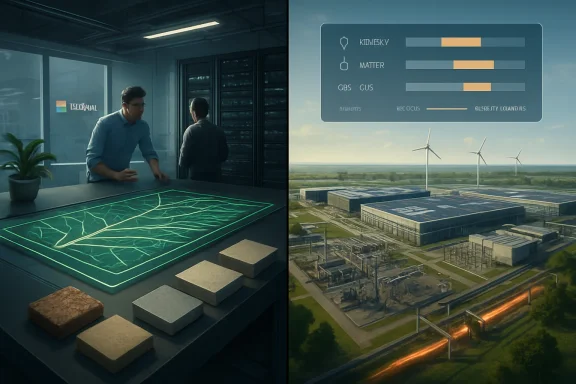
The most concrete way to read the KUOW story is as a split-screen image. On one side, Microsoft researchers are trying to make the data center of the future less thirsty, less carbon-intensive, and more efficient. On the other, the company is securing power arrangements that risk extending the life and scale of fossil infrastructure.Both sides are true. That is what makes the story important. If Microsoft were doing nothing on sustainability, the conclusion would be easy. If it were refusing fossil-backed expansion categorically, the conclusion would also be easy. Instead, it is doing serious sustainability work while making growth decisions that may swamp that work.
The lesson is not that corporate climate goals are useless. It is that goals without binding operating rules become elastic under pressure. A 2030 pledge can guide strategy, but when AI demand surges in 2026, the real policy is revealed in leases, power contracts, construction schedules, and product defaults.
Microsoft’s defenders will argue that abandoning AI leadership would not reduce global AI demand; it would merely shift it to competitors that may be less transparent or less committed to clean energy. There is truth in that. A dirtier rival running the same workloads would not help the climate.
But that argument only goes so far. Leadership is not the right to expand first and reconcile later. Leadership means proving that the path to AI scale can be cleaner in practice, not just in procurement decks. If Microsoft cannot make its own 2030 math work, smaller companies and less scrutinized operators will have even less incentive to try.
The Compatibility Test Now Has Names, Dates, and Megawatts
Microsoft’s AI and environmental goals are not inherently incompatible. They are conditionally compatible. The conditions, however, are becoming more stringent with every new data center announcement and every new AI feature pushed into mainstream software.The company must reduce the energy and water intensity of each unit of AI computation while also controlling total demand. It must decarbonize construction materials while building at unprecedented scale. It must buy and enable clean power in ways that change real grids, not just annual accounting. It must use carbon removal as a backstop for hard-to-abate emissions, not as a growth anesthetic.
That is a far more demanding task than the original 2020 pledge implied. Back then, Microsoft’s climate goals looked like a corporate transformation plan. In the AI era, they look like a test of whether the cloud business model itself can mature beyond “more.”
For Windows users and IT pros, the practical implication is simple: AI is no longer just a feature category. It is infrastructure consumption made invisible. Every organization adopting AI at scale should ask Microsoft for clearer reporting, finer administrative controls, and evidence that the AI being switched on delivers enough value to justify its resource cost.
The Ledger Microsoft Cannot Hand-Wave Away
The useful way to judge Microsoft now is not by whether it says the right things, but by whether its next infrastructure decisions make the 2030 pledge more believable or less. The science fair matters. The gas deals matter more.- Microsoft’s sustainability engineering is real, and technologies such as liquid cooling, low-carbon steel, and lower-impact construction can reduce the footprint of AI data centers.
- Microsoft’s AI expansion is also real, and rising energy demand can overwhelm efficiency gains if total compute consumption keeps accelerating.
- Gas-backed data center capacity is the clearest sign that AI urgency is colliding with the company’s carbon-negative promise.
- Water-positive accounting must be judged locally, because replenishment projects do not automatically erase water stress near data center communities.
- Enterprise customers should demand AI usage controls and environmental reporting that connect Copilot-style features to measurable infrastructure impact.
- Microsoft’s 2030 goals remain technically possible only if sustainability becomes a hard constraint on growth rather than a parallel marketing narrative.
Source: KUOW Are Microsoft’s AI and environmental goals compatible?
