

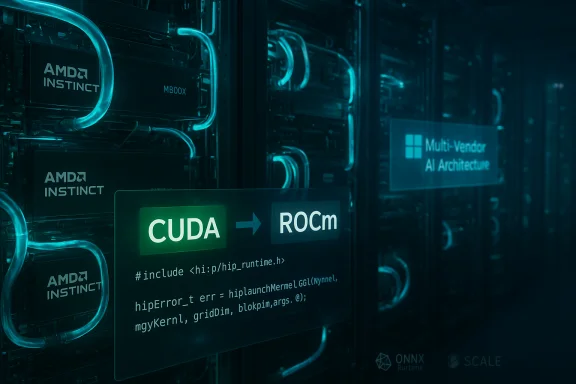
Microsoft appears to be quietly assembling software to let AI models built for NVIDIA’s CUDA ecosystem run on AMD’s ROCm-powered accelerators — a development first reported this week and already rippling through the cloud, chip and AI communities. If true, the effort would be a direct, strategic attempt to erode the software lock‑in that has helped make NVIDIA the dominant commercial force in AI datacenters, and it would accelerate a broader industry push toward hardware choice and lower inference costs.
Conversely, AMD’s ROCm is open-source and steadily improving, but historically it lacked parity across every API surface and optimization path. Moving mature CUDA workloads to ROCm without losing performance, stability or determinism has therefore been the key technical and commercial challenge. Microsoft’s alleged toolkit — if real — aims squarely at that challenge.
If Microsoft actually ships a robust CUDA→ROCm toolkit and integrates it into Azure’s stack, the effect will be immediate: cheaper inference options for customers, a looser software moat for NVIDIA, and a faster path toward multi‑vendor AI infrastructure. If the toolkit proves brittle or expensive to operate, the industry will still learn from the effort — and smaller compiler and compatibility projects will continue chipping away at lock‑in.
For now, the right posture is cautious optimism: the economics and incentives line up for a conversion play, existing tooling proves the problem is solvable in principle, and the hyperscalers have the scale to make it matter — but independent benchmarks, vendor confirmation and production case studies are required before declaring the CUDA moat truly breached.
Source: WinBuzzer Microsoft Apparently Wants to “Break” Nvidia’s Moat, Making CUDA Available to AMD AI Chips - WinBuzzer
 Background
Why CUDA matters — and why breaking it would be consequential
For more than a decade, CUDA has been the practical lingua franca of GPU compute. Its libraries, optimized kernels and ecosystem integrations (cuDNN, cuBLAS, a vast corpus of tuned code and research) make it the path of least resistance for AI development. That software investment — not just the silicon — is what gives NVIDIA a durable commercial moat.Conversely, AMD’s ROCm is open-source and steadily improving, but historically it lacked parity across every API surface and optimization path. Moving mature CUDA workloads to ROCm without losing performance, stability or determinism has therefore been the key technical and commercial challenge. Microsoft’s alleged toolkit — if real — aims squarely at that challenge.
The leak and the coverage so far
Reporting about Microsoft’s work traces to a transcript circulating online that is said to come from a Third Bridge expert transcript; the specific language quoted describes internal “toolkits to help convert like CUDA models to ROCm” and active cooperation with AMD around MI300/MI400/MI450‑class hardware and rack cooling. Multiple outlets have picked up the circulating transcript and screenshots, treating the claim as credible but unconfirmed by Microsoft publicly. That distinction matters: the only public confirmations so far are ecosystem moves and commercial contracts that make such engineering efforts plausible.What Microsoft would have to solve
Two broad technical approaches
Moving CUDA workloads to AMD hardware can be attempted in two general ways:- A compiler/re‑compile approach — convert or recompile CUDA source into a form that targets ROCm or directly emits AMD‑compatible binaries. Tools that follow this strategy aim for near‑native performance because they produce code the target toolchain can optimize aggressively.
- A runtime/translation approach — intercept CUDA runtime and API calls and translate them on the fly to ROCm equivalents (or provide a compatibility shim). This is faster to deploy for closed‑source binaries but often incurs overheads and brittleness at scale.
Existing projects and what they teach us
A surge of tooling already exists and is instructive:- SCALE (Spectral Compute) — a compiler‑style toolkit that aims to make CUDA sources compile and run on AMD hardware without developer rewrites. SCALE is positioned as a near drop‑in replacement for nvcc and has drawn attention and investment because it takes a source‑first approach. Independent coverage and the SCALE project documentation show this is a real and maturing route to reduce CUDA lock‑in.
- ZLUDA and similar shims — an interception/translation runtime that maps CUDA calls to ROCm at runtime. These can run some CUDA binaries without source changes, but they can be fragile and incur overhead; regulatory and licensing nuances have also complicated some projects that relied on intercepting proprietary binaries.
- HIP and HIPIFY — AMD’s own compatibility layer and conversion tooling that helps ports CUDA code to ROCm/HIP. HIP helps bridge much common CUDA code, but low‑level kernel differences and inline PTX still need careful attention.
- ONNX Runtime / Execution Providers — Microsoft’s ONNX Runtime already supports multiple execution backends, including ROCm execution providers for running portable ONNX models on AMD GPUs. ONNX Runtime is a practical abstraction for serving models across vendors; Microsoft’s investments here show an existing internal capability to manage multi‑vendor runtimes at scale.
The transcript claim: what it says, what remains unverified
What the leaked text reportedly states
The circulating transcript (attributed to a Third Bridge interview snippet and shared on social platforms) quotes an unnamed Microsoft insider describing:- Internal “toolkits” to convert CUDA models to ROCm so they can run on AMD Instinct hardware (examples cited: MI300X, MI400X, MI450X).
- Collaboration with AMD to “maximize” those chips for inference workloads.
- Rack‑level engineering challenges — particularly density and liquid cooling — when deploying these accelerators at hyperscale.
What is corroborated independently — and what is not
Corroborated:- There is abundant public evidence that hyperscalers and large AI consumers are adding AMD to their vendor mix and signing large deals (see Oracle and OpenAI partnerships below), creating a commercial incentive to enable CUDA→ROCm compatibility.
- Microsoft already runs a multi‑pronged AI hardware strategy that includes first‑party accelerators (Maia), custom host CPUs (Cobalt) and hybrid use of third‑party GPUs — so an internal toolkit aimed at portability and cost reduction would fit that architecture. Internal summaries and forum archives describe Microsoft’s systems approach and rack/cooling experiments, supporting the plausibility of the transcript’s cooling/density comments.
- Microsoft has not publicly confirmed a specific “CUDA→ROCm conversion toolkit” branded or released by the company.
- The exact engineering design, coverage of CUDA APIs, endurance in production and performance tradeoffs — crucial claims in the transcript — are not independently validated. Until Microsoft issues an official statement or independent benchmarks appear, those details should be treated as reported but unconfirmed.
Why Microsoft — if it’s doing this — has technical and business leverage
- Azure operates at hyperscale: Microsoft can perform controlled, vertical experiments across millions of inference requests and can amortize engineering work that smaller cloud or enterprise customers cannot. That gives Azure two practical advantages: they can (1) build and test conversion tooling at real production scale, and (2) offer converted workloads on AMD infrastructure with negotiated pricing that internalizes those engineering costs. This combination could materially reduce customers’ cost per inference if the performance tradeoffs are small.
- Microsoft controls model‑serving runtimes (ONNX Runtime, Triton integrations) and developer tooling that can be extended with vendor‑specific Execution Providers and optimized kernels. That existing software surface reduces the marginal work needed to serve converted models at scale. ONNX Runtime’s ROCm Execution Provider is an example of how model portability already exists at Microsoft’s software layer.
The data‑center reality: cooling, density and the cost equation
AI inference at hyperscale isn’t just about chip price — it’s about rack watts, floor space, and thermal management. The transcript’s emphasis on liquid cooling and rack density is apt: as you increase accelerator density (more GPUs per rack, higher TDP per device), the economics shift only if cooling and power deliverability keep pace. Microsoft’s publicly described Maia/Cobalt systems work and microfluidic cooling experiments point to this systems‑level tradeoff — solving software portability alone is necessary but not sufficient to earn sustained cost advantage.Market context: why AMD is suddenly a strategic partner for hyperscalers
Two public commercial developments make this moment distinctive:- OpenAI—AMD strategic partnership: AMD and OpenAI announced a multi‑year partnership to deploy up to 6 gigawatts of AMD GPUs across OpenAI’s infrastructure, including an equity‑aligned warrant structure that could vest up to 160 million AMD shares. That deal is official and well documented in AMD press materials and financial filings. It is a signal that major AI workloads will run on AMD hardware at scale.
- Oracle’s planned MI450 deployment: Oracle public statements and reporting indicate an initial deployment of roughly 50,000 AMD Instinct MI450 GPUs beginning in late 2026 — a clear commercial bet on AMD as a competitive alternative to NVIDIA for many workloads. These announcements change the incentive landscape for software portability by increasing the addressable base of AMD hardware in hyperscaler fleets.
Technical and operational risks
Performance and correctness
- Conversion is not binary: some CUDA kernels map well to ROCm and run with negligible overhead; others — particularly kernels that exploit vendor‑specific instructions, inline PTX or deeply tuned cuBLAS/cuDNN calls — require rework. For latency‑sensitive inference (millisecond SLAs), even modest regressions are unacceptable. Independent reports and community experiences with ZLUDA and HIPIFY show variable results across workloads.
Software maturity and ecosystem gaps
- ROCm’s library and tooling coverage has improved rapidly, but ecosystem parity with CUDA remains a moving target. ONNX Runtime and MIGraphX help for many model serving scenarios, but migrating full training stacks or custom operators is still nontrivial. Microsoft’s own ONNX Runtime work demonstrates adaptability, but migration is workload‑specific and requires validation.
Reliability and maintenance
- Runtime translation layers can be brittle, and DLL injection approaches have historically interacted poorly with security tooling and platform updates. A hyperscaler‑grade solution must be robust across driver versions, OS updates and kernel changes — a heavy engineering lift. ZLUDA‑style approaches offer short‑term viability but require constant maintenance.
Legal and licensing
- Projects that try to run proprietary NVIDIA binaries without source changes raise contractual and licensing questions. Clean‑room compilers (source‑driven approaches) avoid many of those concerns, while interception approaches must be carefully vetted against EULAs and IP constraints. The public record shows both technical and legal caution in this space.
Strategic implications for the industry
- Less vendor lock‑in: Wider availability of robust conversion pathways would reduce the economic hold NVIDIA’s software ecosystem exerts, forcing vendors to compete more on price and effective value for specific workloads rather than on software captivity.
- Faster commoditization of inference: Inference — already the dominant cost center for deployed models — could become cheaper and more regionally flexible if hyperscalers can choose between NVIDIA and AMD backends without rewriting models.
- Acceleration of multi‑vendor tooling: If Microsoft (or large cloud providers generally) succeeds at production‑grade conversions, an ecosystem of compilers, profilers and portability layers will consolidate faster. That benefits startups like Spectral Compute and other compiler projects that want to become the “translation layer” of choice.
- Bigger R&D and procurement plays: Microsoft’s own first‑party Maia and Cobalt initiatives underscore a hybrid strategy: buy and interoperate with third‑party GPUs where appropriate, develop custom silicon for captive internal workloads, and invest in portability so customers aren’t forced into a single‑vendor lock. The net result is a more heterogeneous datacenter topography.
What enterprises and engineers should do now
- Inventory CUDA dependencies. Catalog models, custom ops and pipelines that assume CUDA‑native libraries. This will tell you which workloads are migration candidates and which will require deeper engineering.
- Pilot migrations on non‑critical models. Use HIP, SCALE or ONNX Runtime+ROCm to run small experiments; measure latency, throughput, memory behavior and numerical parity.
- Standardize model packaging. Adopt ONNX, containerized runtimes and CI hooks that can test multiple execution providers automatically.
- Negotiate cloud SLAs for portability. If your vendor offers conversion credits or migration assistance, include performance and capacity guarantees.
- Watch hyperscaler announcements. When providers publish validated benchmarks or conversion tool documentation, treat those as the first hard signals of production readiness.
Conclusion: plausible, powerful — but not yet proven
The circulating transcript and subsequent coverage make a persuasive case that Microsoft engineers are actively exploring — and perhaps prototyping — toolchains to run CUDA workloads on AMD hardware at scale. Those efforts align with a visible industry shift: OpenAI’s multi‑gigawatt AMD deal and Oracle’s MI450 rollout create a strong commercial incentive for software portability. At the same time, the claim remains unconfirmed by Microsoft, and all technical triumphs will be judged by one hard metric: real‑world cost/performance and operational reliability at hyperscale.If Microsoft actually ships a robust CUDA→ROCm toolkit and integrates it into Azure’s stack, the effect will be immediate: cheaper inference options for customers, a looser software moat for NVIDIA, and a faster path toward multi‑vendor AI infrastructure. If the toolkit proves brittle or expensive to operate, the industry will still learn from the effort — and smaller compiler and compatibility projects will continue chipping away at lock‑in.
For now, the right posture is cautious optimism: the economics and incentives line up for a conversion play, existing tooling proves the problem is solvable in principle, and the hyperscalers have the scale to make it matter — but independent benchmarks, vendor confirmation and production case studies are required before declaring the CUDA moat truly breached.
Source: WinBuzzer Microsoft Apparently Wants to “Break” Nvidia’s Moat, Making CUDA Available to AMD AI Chips - WinBuzzer
