

AMD’s ROCm stack has quietly but substantially tightened its grip as a viable open-source alternative to NVIDIA’s CUDA, delivering a run of platform and developer-facing improvements that matter to cloud operators, AI researchers, and Windows users eager to run GPU-accelerated workloads outside the CUDA ecosystem.
ROCm (Radeon Open Compute) has been AMD’s strategic answer to CUDA: an open-source software stack that spans drivers, runtime libraries, and developer tooling designed to run high-performance compute and AI workloads on AMD GPUs. Recent point releases and strategic announcements have accelerated ROCm’s reach beyond Linux data centers into hybrid cloud deployments and, notably, into Windows client environments. These moves are the result of parallel engineering work across AMD, hyperscalers, and open-source projects—and they’re starting to produce tangible, verifiable changes in what developers can do with AMD hardware today. This feature walks through what changed, why it matters, and where risks remain—drawing on official ROCm release notes, AMD’s public announcements, independent technical reporting, and community coverage to cross‑check claims and highlight the practical impact for the Windows and Linux audiences.
The strengths are tangible—open-source design, targeted runtime improvements, and a clear push toward Windows parity—but so are the constraints: incomplete hardware coverage, remaining library and tooling gaps vis-à-vis CUDA, and migration complexity for deeply tuned CUDA workloads. For teams evaluating ROCm today, the right approach is pragmatic: validate against real workloads, follow the official compatibility matrices and release notes closely, and treat unverified third‑party claims as speculative until vendors publish production-grade toolkits or SDKs.
ROCm is no longer an optional experiment; it’s an increasingly credible contender. Whether it dethrones CUDA in the long term will depend on continued technical parity, ecosystem uptake, and whether the cloud providers and open-source projects converge on pragmatic, supported migration paths. For now, AMD’s momentum—backed by concrete releases and expanding Windows support—deserves serious attention from developers and infrastructure teams planning their next-generation AI stacks.
Source: Neowin https://www.neowin.net/news/amd-roc...val-gets-massive-windows--linux-improvements/
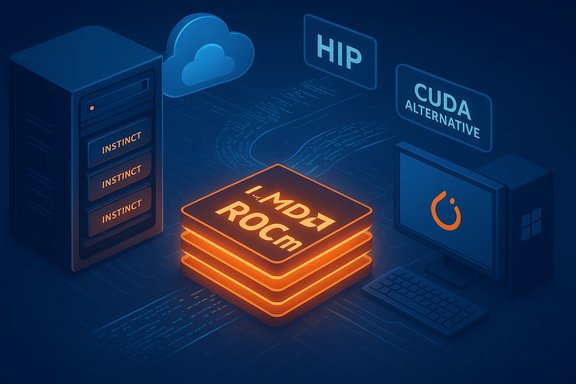 Background / Overview
ROCm (Radeon Open Compute) has been AMD’s strategic answer to CUDA: an open-source software stack that spans drivers, runtime libraries, and developer tooling designed to run high-performance compute and AI workloads on AMD GPUs. Recent point releases and strategic announcements have accelerated ROCm’s reach beyond Linux data centers into hybrid cloud deployments and, notably, into Windows client environments. These moves are the result of parallel engineering work across AMD, hyperscalers, and open-source projects—and they’re starting to produce tangible, verifiable changes in what developers can do with AMD hardware today. This feature walks through what changed, why it matters, and where risks remain—drawing on official ROCm release notes, AMD’s public announcements, independent technical reporting, and community coverage to cross‑check claims and highlight the practical impact for the Windows and Linux audiences.What’s new: verified technical changes and platform support
ROCm 6.3.2 — cloud compatibility, HIP optimizations, documentation
ROCm 6.3.2 is a point release that focuses on operational and developer ergonomics rather than new GPU silicon support. The key, verifiable items in the release notes are:- Support for Azure Linux 3.0 (kernel 6.6 LTS) — this is explicitly called out in the ROCm 6.3.2 documentation and in independent coverage; support is limited to AMD Instinct accelerators (Instinct MI300-class), and it does not extend to Radeon consumer GPUs on that Azure Linux distribution.
- HIP (Heterogeneous-Compute Interface for Portability) improvements — the release brings optimized handling for HSA callbacks, improved multi-threaded dispatch paths, reduced CPU idle waits during device synchronization, and other runtime optimizations intended to reduce dispatch latency and improve throughput on multi-GPU, multi-threaded workloads. These changes are aimed to make HIP-based apps behave more predictably and perform better for model inference and heavy graph workloads.
- Documentation and ecosystem clarity — the release reorganizes and enhances HIP docs and adds clearer guidance on framework compatibility (PyTorch, TensorFlow, JAX), which helps bridge the knowledge gap for developers migrating projects or validating deployments.
- Operational bug fixes and known issues — as with all point releases, several bug fixes are included along with a few known issues noted in the official release notes (for example, a gfortran dependency fix for Azure Linux). The Linux Radeon Software release notes tied to ROCm 6.3.2 list model- and framework-specific notes (Hugging Face transformers support, FlashAttention-2 improvements, and known intermittent failures in specific TensorFlow/Triton examples). The official Linux release notes are dated and verifiable.
ROCm on Radeon and PyTorch on Windows — the Windows story
In a more strategic move, AMD published a roadmap and incremental releases that demonstrate ROCm’s expansion to client GPUs and Windows:- PyTorch on Windows (preview) — AMD confirmed a public preview of PyTorch on Windows for a selection of Radeon RX 7000/9000 series GPUs and certain Ryzen AI APUs; AMD’s blog post and accompanying Windows preview release notes describe this preview as the beginning of broader Windows support for ROCm-based frameworks, explicitly targeting local AI development and inference workflows on consumer hardware. These materials are published by AMD and linked in their documentation and release notes.
- Compatibility matrices and incremental ROCm components for Windows — the ROCm ecosystem now maintains per-version Windows support matrices and preview documentation for install paths (native wheels, drivers, and framework builds). The ROCm “Use ROCm on Radeon and Ryzen” documentation shows explicit Windows matrices for PyTorch compatibility and cautions that the full ROCm stack is progressively being ported to Windows (PyTorch support is present in preview, while other components remain in development).
- ComfyUI and application support — downstream projects and some third-party applications (for example ComfyUI) have begun shipping updates or installer flows that detect and optionally select ROCm stacks for Windows, signalling that the ecosystem is adopting the Windows preview in real tooling. This is independently corroborated by application notices and community posts.
Why this matters — practical impacts for different audiences
For cloud operators and enterprise AI teams
- Native cloud integration — official Azure Linux 3.0 support for ROCm simplifies deployment of AMD Instinct nodes on Microsoft Azure, reducing the friction of OS/kernel mismatches and improving the predictability of driver and runtime behavior in managed VMs and containers. This matters when you’re running large-scale inference fleets where OS baseline stability and known-good driver stacks cut deployment risk.
- Cost and vendor choice dynamics — as hyperscalers increasingly mix AMD Instinct hardware into their racks, a robust ROCm stack backed by solid OS support reduces the architecture lock-in that historically favored NVIDIA. Tools that make ROCm a production-grade option can translate into meaningful procurement leverage when negotiating price-per-inference for large deployments. Independent reporting and industry signals point toward this trend—while the commercial outcomes depend on many variables, the software coverage is now a necessary prerequisite to that competition.
For researchers and developers
- Better multi-threaded and multi-GPU performance — the HIP runtime optimizations reduce dispatch overheads and improve HSA callback behavior, which should translate to real performance gains in certain hybrid CPU/GPU workloads (large model inference, batched transformer serving, graph execution patterns in PyTorch). That’s a direct win for teams that previously considered AMD hardware only for raw cost-effectiveness.
- Windows-native development workflow — the PyTorch-on-Windows preview removes the need for dual-boot or Linux-only development setups for many local, iterative experiments. Developers who use Windows as their primary desktop can now spin up ROCm-backed PyTorch environments more easily, reducing barriers for creators building and validating LLMs, diffusion models, and other AI workloads on local machines. AMD’s preview notes and compatibility matrices document this explicitly.
For hobbyists and the wider Windows community
- Growing accessibility — pre-release ROCm wheels for Windows and growing application support (ComfyUI, community installers) mean hobbyist users can experiment with large models on consumer AMD GPUs without resorting to cloud-only options. This expands the democratization of AI tooling and lowers entry costs for experimentation. Community reports and confirmation in AMD’s public materials corroborate growing availability.
Critical analysis — strengths and limitations
Strengths (what ROCm gets right)
- Open-source model and transparency — ROCm’s openness is a structural strength. Projects, researchers, and vendors can inspect, build, and patch the stack; that reduces single-vendor lock-in and enables community-driven fixes and optimizations. The contrast with CUDA’s proprietary model gives ROCm an ideological and practical advantage in certain markets.
- Focused runtime optimizations — the HIP and HSA enhancements target the real-world pain points of multi-threaded dispatch and graph execution. Those are high-leverage improvements: relatively modest code changes in the runtime can produce outsized gains for common AI workloads that are dispatch-heavy. ROCm’s changelogs and release notes confirm these targeted optimizations.
- Cloud-first pragmatism — supporting Azure Linux 3.0 and packaging drivers and kernels for cloud distributions signals that AMD and ROCm are prioritizing hyperscaler readiness—precisely where large inference workloads live. This is a sensible, business-oriented approach.
Limitations and risks (what to watch out for)
- Partial hardware coverage — ROCm’s Azure Linux 3.0 support is limited to Instinct accelerators; consumer Radeon GPUs remain a separate, staggered journey into full production support. AMD’s Windows PyTorch preview is limited to specific Radeon models and APUs in early builds—this is progress, but not yet parity with CUDA’s ubiquity. Make deployment plans with careful attention to the compatibility matrices.
- Ecosystem parity and specialized libraries — CUDA’s mature library ecosystem (cuDNN, cuBLAS, cuFFT, vendor-tuned kernels) remains broader and, for some workloads, more performant. Ported or recompiled code may hit subtle numerics or performance cliffs where vendor-specific optimizations are deep. Expect per-workload validation and benchmarking; “it works” is different from “it performs exactly the same.” Independent tests and community experiments continue to show varying outcomes by workload.
- Migration complexity for large projects — translating a production stack built against CUDA into ROCm (even using HIPify or source-level compilers) can reveal hidden dependencies on inline PTX, CUDA-specific kernels, or third-party CUDA-only libraries. For teams running production training pipelines, the migration cost can be significant in time and engineering effort.
- Unverified external claims — there are circulating reports about Microsoft developing internal toolkits to convert CUDA models to ROCm for Azure use. These stories (based on leaked transcripts) are significant if true, but at the time of reporting they remain unconfirmed by Microsoft; treat these specific claims as unverified. If implemented at hyperscaler scale, such a toolkit would be strategically consequential—yet technical, operational, and legal complexities remain substantial. Exercise caution and require vendor confirmation before making procurement decisions based on those claims.
Practical advice: how to evaluate ROCm for your use case
- Identify the target GPU and ROCm version required. Consult ROCm’s compatibility matrix and AMD’s Windows preview notes to confirm support for specific Radeon/Instinct models and OS versions.
- Run microbenchmarks on real workloads. Don’t rely on synthetic or cross-vendor numbers—use your models (training/inference) and datasets to capture latency, throughput, memory utilization, and numerical fidelity.
- Validate framework compatibility (PyTorch/TensorFlow/JAX). Install the ROCm-provided wheels or containers and run end‑to‑end validation flows (accuracy checks, gradient stability, and toolchain reproducibility).
- Build a rollback plan. If migrating production services, stage ROCm deployments behind feature flags or as canary clusters; keep a tested CUDA path available until parity is proven.
- Budget for engineering time. Even with HIP and conversion tools, expect developer time for kernel tuning, operator porting, and performance debugging.
Roadmap signals and what to watch next
- Windows expansion — AMD’s public commitments and preview releases indicate a multi‑phase rollout for the ROCm stack on Windows. Expect broader PyTorch / ComfyUI support in successive ROCm versions and incremental driver/tooling updates that fill gaps. Keep an eye on AMD’s ROCm docs and the Windows compatibility matrices for version-by-version changes.
- Hyperscaler tooling and potential conversion layers — if cloud providers pursue robust CUDA-to-ROCm conversion toolchains (whether via compilers, shims, or runtime layers), that will materially lower migration costs for customers and accelerate AMD’s adoption in inference fleets. But those efforts are complex, and early reporting is not yet definitive—look for vendor announcements or concrete SDKs before counting on them.
- Ecosystem maturation — expect incremental wins in framework support (TensorFlow, JAX) and library coverage (optimized BLAS, cuDNN-equivalent primitives). Critical mass will require both vendor effort and community contributions (wrappers, optimized kernels, and CI coverage). Watch for expanded CI/CD and nightly builds integrating ROCm on Windows and Linux in major framework repositories.
Conclusion
ROCm’s recent updates are less about a single headline feature and more about cumulative engineering that reduces operational friction and widens platform choice. Support for Azure Linux 3.0, HIP runtime optimizations, and the early availability of PyTorch on Windows mark an important inflection: ROCm is moving from a Linux/cloud-first curiosity to a cross‑platform, developer‑oriented stack that can realistically host production and local development workloads.The strengths are tangible—open-source design, targeted runtime improvements, and a clear push toward Windows parity—but so are the constraints: incomplete hardware coverage, remaining library and tooling gaps vis-à-vis CUDA, and migration complexity for deeply tuned CUDA workloads. For teams evaluating ROCm today, the right approach is pragmatic: validate against real workloads, follow the official compatibility matrices and release notes closely, and treat unverified third‑party claims as speculative until vendors publish production-grade toolkits or SDKs.
ROCm is no longer an optional experiment; it’s an increasingly credible contender. Whether it dethrones CUDA in the long term will depend on continued technical parity, ecosystem uptake, and whether the cloud providers and open-source projects converge on pragmatic, supported migration paths. For now, AMD’s momentum—backed by concrete releases and expanding Windows support—deserves serious attention from developers and infrastructure teams planning their next-generation AI stacks.
Source: Neowin https://www.neowin.net/news/amd-roc...val-gets-massive-windows--linux-improvements/
