

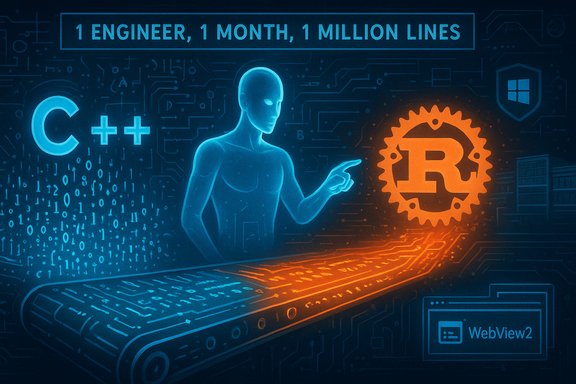
Microsoft’s engineering playbook has a new headline goal: eliminate “every line of C and C++ from Microsoft by 2030” — and the company is openly recruiting for the program. The plan, as described by Distinguished Engineer Galen Hunt in a public hiring post, combines algorithmic program analysis with AI agents to translate massive C/C++ codebases into Rust, with a striking productivity north star of “1 engineer, 1 month, 1 million lines of code.”
Background / Overview
Microsoft’s movement toward Rust and AI-assisted code transformation is the convergence of several long-running trends inside the company: rising use of AI in developer workflows, ongoing pilots that integrate Rust into Windows and Azure, and an increasing tendency to surface web-based UIs inside Windows via WebView2. These shifts are visible in both Microsoft’s public repositories and in executives’ statements about AI’s growing role in code production. In April 2025, CEO Satya Nadella stated that roughly 20–30% of Microsoft’s code is already being generated or materially created by AI — a datum the company repeatedly cited in public forums as context for expanding AI’s role in engineering. The immediate public hint of a company‑scale migration plan arrived in a LinkedIn call-to-hire from Galen Hunt. The post frames the mission as one for a CoreAI subteam (Future of Scalable Software Engineering in EngHorizons) to build a code processing infrastructure that pairs deterministic analysis with LLM-driven agents to produce Rust translations at scale. In short: build program graphs, run AI agents to propose and repair translations, and integrate staged verification and deployment pipelines. At the same time Microsoft’s public engineering footprint shows genuine investment in Rust tooling: the “Rust for Windows” project (microsoft/windows-rs) provides idiomatic Rust projections for Win32, COM and WinRT APIs, and there’s a dedicated repository for Rust driver work (microsoft/windows-drivers-rs). Both repos are active, indicate Microsoft has operational experience producing Rust bindings, and demonstrate the company is exploring Rust beyond merely user-space applications.What Microsoft has publicly said — and what’s verifiable
The hiring post and the stated objectives
Galen Hunt’s hiring post is explicit and unambiguous: the role is in Redmond, the team’s goal is to “eliminate every line of C and C++ from Microsoft by 2030,” and the strategy is to “combine AI and Algorithms to rewrite Microsoft’s largest codebases.” The post names a “North Star” productivity metric: “1 engineer, 1 month, 1 million lines of code.” Those lines are literal words in the public post. Independent outlets — community aggregators, forums and tech news sites — quickly amplified the post and summarized the intent. Those retellings corroborate that the LinkedIn post exists and that the company is actively recruiting for a systems-level Rust role with this mission framing. While the post does not deliver a formal product roadmap or engineering blog describing the migration pipeline in detail, it is an unambiguous public signal of a program charter.AI’s current role inside Microsoft
Satya Nadella’s public remark that roughly 20–30% of some Microsoft code is produced with AI is corroborated by multiple independent reports from April 2025. Nadella said that AI is “writing” that portion of code across some projects and that the share varies by language and domain. Microsoft executives have repeatedly characterized AI as an increasing contributor to code production and code review workloads. That claim provides the immediate operational rationale Microsoft uses to justify experimenting with large-scale AI-assisted transformations.Existing Rust investments
Microsoft’s “Rust for Windows” repository (the windows and windows-sys crates) is an official, production-facing effort to let Rust code call Windows APIs idiomatically. The company also maintains a windows-drivers-rs repository that aims to enable driver development in Rust, explicitly designed to support KMDF, UMDF and WDM models in a staged, experimental fashion. Those repositories are active, licensed permissively, and show Microsoft’s real engineering investment in Rust tooling.WebView2, Agenda view and UI trends in Windows 11
Parallel to the Rust story, Windows 11 is increasingly adopting web-hosted UI components. The reintroduction of the Agenda pane in the Notification Center has been observed to render content via WebView2, spawning Edge-style renderer, GPU, and utility processes when the flyout opens — behavior consistent with Microsoft Edge’s WebView2 process model. Microsoft’s WebView2 documentation explains that a WebView2 process group includes a browser process plus renderer and helper processes, which explains the transient CPU/memory spikes reported by hands-on testers. This broader WebView2 adoption in system surfaces is verifiable from Microsoft docs and multiple independent hands-on reports.Why Microsoft is doing this: promises and incentives
Microsoft’s stated case for a large-scale move to Rust is essentially threefold:- Memory-safety and security: Rust eliminates entire classes of memory-safety bugs (use-after-free, buffer overflows) that cause many security patches, so a successful migration could dramatically reduce vulnerability density in critical subsystems.
- AI as a force multiplier: With AI increasingly contributing to code production and review, Microsoft believes automated translation + verification pipelines can scale translation throughput far beyond what humans can do alone.
- Platform maintainability and modernization: Creating idiomatic Rust projections of Windows APIs and enabling Rust drivers reduces the friction for future systems development and opens a broader talent pool that prefers Rust for systems work.
Technical reality check: what makes large-scale C/C++ → Rust translation hard
The idea of automatically translating millions of lines of production systems code from C/C++ into idiomatic, safe Rust is tantalizing. But the engineering reality is far more nuanced. The key technical challenges break into several categories:1) Semantic fidelity and undefined behavior
C and C++ are permissive languages that allow undefined behavior (UB). Real-world OS and driver code sometimes relies on UB or on unspecified side effects, compiler intrinsics, or inline assembly to meet performance and ABI contracts. Translating these semantics automatically — and without behavioral change — is technically fraught. Any automated translation pipeline must detect, reason about, and handle UB explicitly. That is a research-level problem at whole-program scale.2) ABI and binary-level contracts
Drivers, kernel interfaces, and many system libraries rely on strict ABI layouts, calling conventions, and symbol names. Rust can interoperate with C ABIs, but achieving drop-in binary compatibility often requires carefully designed shims or manual porting. A naïve source-to-source transpile risks breaking third-party drivers, OEM integrations, or firmware contracts.3) Concurrency, timing and non-functional behavior
Systems code often encodes low-level timing, atomicity, and lock-free algorithms where microsecond differences matter. Rust’s safety mechanisms (bounds checks, differing panic semantics) and different default abstractions can change operational characteristics in subtle ways. Preserving throughput and latency guarantees across a mass translation is non-trivial.4) “Safety theater” from unsafe blocks
Automated converters may wrap previously-unsafe constructs in Rust’s unsafe blocks rather than redesigning them. If large swathes of generated Rust are still implemented with unsafe, the intended safety gains are reduced — and teams may be lulled into a false sense of security. Reducing unsafe surface area requires intentional redesign, not pure syntactic translation.5) Panic semantics and availability
Rust’s approach converts many memory-corruption failure modes into panics or aborts. In kernel or driver code this can mean deterministic crashes (BSOD) rather than silent memory corruption. That trade-off reduces exploitability but can increase denial-of-service risk unless error handling and containment are carefully engineered.6) Test coverage and equivalence verification
Automated translation requires substantial, realistic test harnesses (unit tests, fuzzers, integration and telemetry to detect regressions) and perhaps formal equivalence checks for the riskiest modules. Building those harnesses for legacy Windows subsystems is itself a major engineering program.Together, these constraints mean any credible approach must be a hybrid: algorithmic static analysis to define safe transformation boundaries, AI agents to produce idiomatic code, and human expert reviewers for high-risk modules. The LinkedIn post’s framing — pairing algorithms with agents and staged verification — reflects precisely that hybrid approach, but it does not eliminate the underlying technical difficulty.
Operational and organizational risks
Beyond pure technical barriers, the migration plan introduces substantial operational and organizational risks:- Scale of review and human oversight: The “1M lines per engineer per month” metric implies an enormous volume of change that must still be reviewed and validated; audit practices, code review capacity, and human expertise could become bottlenecks.
- Ecosystem compatibility: Microsoft’s OS ecosystem includes third-party drivers and firmware. Binary-level changes that affect interfaces could cascade into an ecosystem compatibility crisis if not managed carefully.
- New failure modes and incident profiles: Converting silent, exploitable memory corruption into deterministic failures may shift incident profiles from security patches to availability incidents that impact customers differently.
- Knowledge loss and tribal expertise: Legacy C/C++ subsystems contain buried engineering knowledge. A mass translation that replaces design-level intent with automated rewrites risks losing domain knowledge unless translation is accompanied by rigorous documentation and knowledge transfer.
- Talent supply and culture: Microsoft will need many experienced systems-Rust engineers and compiler/program-analysis experts. Recruiting, training, and creating reliable cross-team processes at scale take time and budget.
- Regulatory and compliance impacts: For regulated industries that require deterministic platform behavior, any change — even if safer in the long run — must be validated, documented, and possibly certified.
What AI can realistically do today — and where it will likely fail
AI tooling has come a long way since autoprompt code-completion, but there are practical limits:- AI excels at syntactic translation, boilerplate generation, and suggesting idiomatic refactorings.
- AI struggles with intent recovery: reasoning about obscure design decisions, complex invariants, or hardware-tied timing requirements.
- AI is improving at iterative repair loops (generate → compile → test → fix), especially when paired with orchestrated agents and deterministic constraints.
- For the highest-risk subsystems (kernel, drivers, storage stacks), human domain experts and formal methods remain essential.
WebView2 in the shell: why Microsoft is mixing web UIs into the OS
The Agenda view in Notification Center is a small but illustrative example of a broader trend: Windows surfaces increasingly reuse web stacks (via WebView2) for rapid iteration and parity with cloud services. WebView2’s Chromium-derived multi-process model explains why enabling Agenda can spawn GPU, renderer and utility processes and temporarily raise shell memory and CPU usage; Microsoft’s docs make this process model explicit. The trade-off is clear: faster iteration and shared web components versus larger transient resource usage and potential perception of a less-native UI. These choices interact with the Rust migration story: they reflect a company willing to accept architectural shifts where developer velocity and iteration are prioritized — sometimes at the cost of local resource efficiency.Practical implications for Windows users, IT and developers
- End users: Expect staged improvements and experiments that might increase memory/CPU usage transiently (WebView2-based surfaces) while the company experiments with faster feature rollout and Copilot integrations. For most modern hardware, these costs are manageable, but low-memory or VDI images may be more affected.
- Enterprise IT: WebView2 surfaces and independent runtime updates change application lifecycle management and imaging strategies. IT teams should track WebView2 runtime versions and test policies for copilot and web-enabled system surfaces. Translate-and-deploy initiatives that change ABIs risk broad compatibility testing cycles.
- Third-party driver and OEM partners: ABI preservation will be the critical contract area. Partners must be part of migration communication plans and pilot programs to avoid breakage.
- Developers and open-source contributors: Microsoft’s public Rust projects (windows-rs, windows-drivers-rs) are real opportunities: contribute to binding quality, sample drivers, and integration tooling to influence the migration’s shape. The open repos also give developers early access to the patterns Microsoft will favor.
What success would look like — and what failure would cost
Success is not “all C/C++ deleted from the Git history”: it is a versioned, staged modernization that:- Reduces memory-safety vulnerabilities in the most critical subsystems,
- Preserves ABI compatibility for external consumers,
- Keeps or improves performance and availability,
- Produces maintainable, idiomatic Rust with minimal unsafe surface, and
- Integrates robust testing, canarying, and rollback strategies.
- Mass automated changes that introduce subtle semantic regressions visible only in the field.
- Generated Rust that is mostly wrappers around unsafe code, delivering limited safety benefits.
- Ecosystem fragmentation if driver or firmware contracts change unexpectedly.
- Over-reliance on AI without sufficient human review capacity.
Pragmatic recommendations (what to watch for)
- Watch for published technical notes and open-source tools from the CoreAI/EngHorizons team that reveal the algorithms used for whole-program graphing and ABI preservation — those will be the first real signals of technical progress.
- Expect a series of small, low-risk migrations first (utility libraries, user-mode services, new components written in Rust) before any kernel or driver-level translations are attempted at scale.
- Track Microsoft’s telemetry/incident trends: if vulnerability counts drop while availability remains stable, the program may be delivering net benefits; the opposite trend would be a red flag.
- For enterprises, adopt strict test harnesses, join Microsoft pilot programs early, and maintain conservative ring-based deployment strategies for any device fleets subject to potential regressions.
- For systems developers, invest in Rust systems expertise and tooling familiarity; Microsoft’s hiring focus suggests both demand and influence on future Windows subsystems design.
Conclusion: ambitious, plausible — but not guaranteed
Microsoft’s public hiring post and company-wide hints show that the firm is making a serious, well-resourced bet: use hybrid algorithmic + AI pipelines to migrate C/C++ systems to Rust at unprecedented scale. The building blocks are visible — active Rust projects, driver experiments, and internal AI tooling — and Microsoft’s scale gives the effort a chance other organizations cannot easily match. But the technical, operational and ecosystem challenges are formidable. Translating language syntax is only the start; preserving intent, ABI, timing, and availability across decades of platform code is an engineering program on par with building a new OS. The “1 engineer, 1 month, 1 million lines” metric reads today as a north star for throughput, not a guarantee that each converted line will be safe and production-ready without exhaustive review. The prudent path — and the most likely successful one — is a conservative, hybrid approach that leans heavily on algorithmic verification, staged rollouts, and human expertise for the riskiest modules. In short: the goal is bold and the motives (memory-safety, modernization) are sound. The success condition will be measured in fewer security incidents and stable user experiences, not in how many megabytes of source code get renamed or rewritten. The coming years will show whether Microsoft’s scale and hybrid approach let it convert ambition into measurable, operational wins — or whether the hidden costs of mass automated rewrite will prove greater than anticipated.Source: Windows Latest Microsoft confirms "eliminate C and C++" plan, translate code to Rust using AI, as Windows 11 adopts Rust and WebView2
