

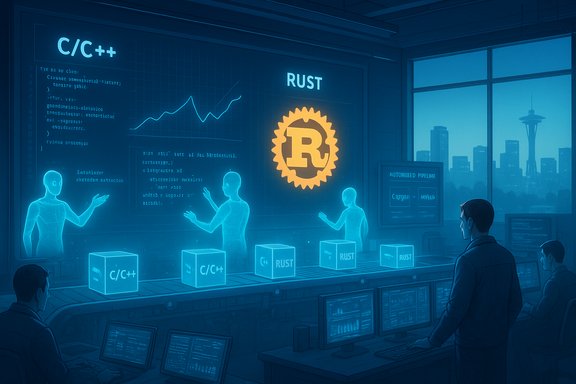
Microsoft’s engineering ranks have quietly put a stake in the ground: a LinkedIn hiring post from Distinguished Engineer Galen Hunt sets an audacious target to “eliminate every line of C and C++ from Microsoft by 2030,” and to do it by combining large-scale algorithmic program analysis with AI-driven code transformation — a plan capped by a provocative “north star” metric: one engineer, one month, one million lines of code.
Source: Neowin https://www.neowin.net/amp/microsof...very-single-line-of-cc-code-with-rust-and-ai/
 Background
What was announced and where it lives
The core public artifact for this initiative is a LinkedIn post and an associated Principal Software Engineer (IC5) job listing authored by Galen Hunt. The post describes a team within Microsoft CoreAI called the Future of Scalable Software Engineering (EngHorizons) whose mission is to build a “code processing infrastructure” that creates scalable program graphs and orchestrates AI agents to make large-scale, semantics‑aware code changes — specifically to translate Microsoft’s largest C/C++ systems into Rust. The job description explicitly requires strong production Rust experience and signals a preference for compiler, OS, or database experience. Multiple news and community outlets republished or summarized Hunt’s post, amplifying the message and the timeline (2030) and calling out the “1 engineer, 1 month, 1 million lines” metric as a guiding throughput target rather than a literal expectation of unaided human productivity.Why now: context from Microsoft’s operations and incidents
The announcement follows an already visible acceleration of Rust adoption inside Microsoft across Windows and Azure, and it comes alongside high-profile operational incidents that have sharpened concerns about reliability and system correctness. In late 2025 Microsoft published a support advisory (KB5072911) documenting a provisioning-time regression in Windows 11 where updated XAML/AppX packages sometimes failed to register in time, leaving shell components like Explorer, the Start menu and Settings in a broken state during first logon or in non‑persistent VDI environments. That advisory and the months of community reporting around the regression are frequently cited as part of the urgency behind the push for safer-by-default language choices and stronger verification tooling.Overview: what Microsoft says it will build
- Algorithmic program analysis layer — a scalable graph representation of code at repository and whole-program scale that captures symbols, control and data flow, ABI boundaries and dependency relationships.
- AI processing and agentic workflows — LLMs and specialized models used to propose translations, perform idiomatic repairs, and drive iterative compile/test/repair loops under algorithmic guidance.
- Tooling and integration — Cargo↔MSBuild interop, packaging, ABI shims, staged deployment pipelines, fuzzing and CI to validate behavioral equivalence and catch regressions.
- Organizational muscle — a Redmond‑based team hire profile focused on systems‑level Rust experience, compiler engineering and OS expertise to operate the machinery and shepherd translations into production.
Technical feasibility: what the evidence says
Progress in automated C→Rust translation
Recent academic and industrial research demonstrates meaningful progress in automated and semi‑automated C→Rust translation pipelines. Hybrid approaches that combine static-analysis skeletons with LLM-guided iterative repairs have shown significant improvement in compilation rates and test correctness compared to purely rule-based or purely generative methods. Notable examples include SafeTrans, PR2 and EvoC2Rust, which report improvements in translation success, pointer-lifting, and project-level compilation across benchmarks and selected industrial projects. These systems illustrate the value of:- skeleton generation (compile-able Rust skeletons produced by deterministic tools),
- LLM-assisted local repair and idiomification,
- iterative compile-test-repair cycles,
- and targeted pointer-lifting techniques to reduce unsafe usage.
Hard limits and unresolved challenges
Translating millions of lines of low‑level C/C++ code in a production OS or hypervisor is not the same problem as translating isolated utilities or well‑tested libraries. Production systems code introduces several hard, non‑trivial constraints:- C++ semantics and undefined behavior: templates, overloaded operators, custom allocators, inline assembly, compiler intrinsics and subtle UB assumptions are pervasive and difficult to map automatically to safe, idiomatic Rust.
- ABI and platform contracts: drivers, firmware interfaces and kernel components rely on strict binary layouts and calling conventions; preserving ABI fidelity often requires human-guided shims or carefully audited translation layers.
- Performance and timing semantics: concurrency, atomicity, and low‑latency invariants can be altered by even small semantic changes; correctness here is functional and non‑functional (latency, throughput, memory layout).
- Safety vs. availability tradeoffs: Rust’s safety model converts many memory-corruption classes into panics or deterministic aborts. In kernel mode, a bounds-check-triggered panic may produce a crash (BSOD) rather than a silently exploitable corruption — a different but still real operational hazard unless carefully handled.
Strengths of the plan
1) Large resources and staging capability
Microsoft has unique advantages few organizations can match: scale of engineering, build and test infrastructure (canary/insider rings), Azure compute for large-scale model training and CI, and direct control over deployment paths for staged rollouts. Those capabilities make it possible to attempt translations at a much larger scale — and to detect issues early across diverse telemetry and Insider rings.2) Proven pilots and incremental adoption
Rust is already present inside Windows and Azure in pilot or production components. Microsoft has shipped Rust-based modules and integrated Rust tooling; those pilots provide real-world lessons on packaging, Cargo↔MSBuild integration, and runtime behavior that can inform larger migrations. Incremental, module-by-module translation with interop shims is a pragmatic path that limits blast radius.3) Security upside
Long-term, successful migration of high‑risk subsystems (networking, drivers, font rendering, storage) to idiomatic Rust could reduce the density of memory-safety vulnerabilities and materially shrink a class of security patches and emergency fixes. For a vendor with cloud and OS responsibilities, that payoff is significant over years of operation.Risks and blind spots
1) Semantic fidelity and silent regressions
Automated translation risks introducing behavioral differences that manifest only under rare timing, concurrency, or hardware-specific conditions. Without exhaustive equivalence checks, staged canaries, and formal verification for the highest‑risk modules, invisible regressions can accumulate and surface as production incidents. Mechanical token‑level translations that leave large amounts of code inside unsafe blocks will not deliver the intended safety benefits.2) New failure modes: panics and availability
Rust shifts error modes: what would silently corrupt memory in C/C++ might become a deterministic panic in Rust. In user-space that’s generally helpful; in kernel-space or critical hypervisor components, aborts can cause denial‑of‑service. Microsoft’s own experiments have shown that while Rust can expose flaws earlier, it can also create availability risks if panic semantics are not architected for graceful degradation. Those tradeoffs must be designed into system error paths deliberately.3) LLM limitations and hallucination risks
Large language models remain probabilistic. They are strongest for languages and idioms with abundant training data (Python, JavaScript) and weaker in low‑data, low‑latency systems code. Unsupervised LLM outputs can hallucinate API calls, incorrect memory models, or mis-handle edge cases. Microsoft’s plan mitigates this by placing LLMs under algorithmic guidance and iterative test loops, but the inherent risk of over-trusting generative models on low-level systems remains.4) Ecosystem and third-party dependencies
A migration at Microsoft’s scale intersects with third‑party drivers, proprietary hardware stacks, closed-source SDKs and vendor-supplied modules. Not all third-party code can be translated or recompiled. ABI preservation and interop layers will be required, and vendor management or legal/IP constraints could slow or segment the migration.5) Human factors: skill gaps and institutional memory
Rewriting or translating massive legacy systems isn’t just a technical exercise; it’s about preserving design intent, tests, and tribal knowledge. Microsoft will need a multi-year reskilling program, careful documentation, and governance to ensure architectural decisions and historical context are not lost in automated conversions.What success looks like — a pragmatic blueprint
The initiative can succeed if the program combines automation with discipline. Recommended safeguards and program elements include:- Start with a prioritized list of high-impact, high-risk modules (network, storage, drivers) where test coverage and harnesses are strongest.
- Apply a staged pipeline:
- deterministic skeleton extraction and whole-program graphing,
- LLM-guided local translation under strict guardrails,
- automated compilation and unit/integration/fuzz testing,
- equivalence testing and operational telemetry comparison,
- phased canary rollouts through Insiders and Azure test fleets.
- Preserve and harden ABI contracts with explicit shims and conservative fallbacks; only escalate to full re-architect when the module’s behavior and performance are formally verified.
- Pair every automated change with human sign-off for safety‑critical layers; treat “automated” as augmentation rather than replacement for expert review.
- Invest heavily in instrumentation, formal methods for the riskiest modules, and regression‑first pipelines that detect semantic divergence early.
- Create a transparent governance model that documents when and why a module was translated, keeps original tests and traces, and mandates rollback plans for operational incidents.
Short-term expectations and timeline signals to watch
- Hiring: expect continued postings seeking senior Rust systems engineers, compiler engineers, and program analysis experts, especially for in‑person roles in Redmond. The job ad tied to this program already suggests in‑office collaboration for the highest‑risk work.
- Published pipelines and research: watch for Microsoft engineering blog posts, open‑source tooling from the EngHorizons/CoreAI team, or published research demonstrating their graph infrastructure, ABI-preservation techniques, or LLM‑guided repair loops.
- Pilot rollouts: early evidence will show up as incremental Rust modules in preview Windows builds or Azure components where telemetry and fuzzing demonstrate reduced vulnerability counts without increased availability regressions. Microsoft’s earlier Rust pilots and the DWriteCore modernization are precedent proof points to watch.
- Verification and stability: evidence of rigorous equivalence testing, expanded fuzzing pipelines and canary deployment patterns will be crucial to assessing the program’s real-world safety. Expect Microsoft to publish technical notes or guidance once the infrastructure demonstrates repeatable outcomes.
Bottom line: ambitious — and plausible if done conservatively
The stated objective — eliminate every line of C and C++ from Microsoft by 2030 — is audacious and intentionally provocative. It functions as a strategic rallying cry: to prioritize memory safety, recruit Rust talent, and focus investment in automated, scalable tooling for software modernization. The technical building blocks exist and are improving quickly: algorithmic graphing, LLM‑assisted repair, and hybrid transpilation research produce measurable gains on modular codebases. At the same time, the engineering reality is stark: preserving ABI contracts, timing and concurrency semantics, and availability guarantees at OS scale is exceptionally difficult. Translation is not a token-swap; it is design work — and that design work requires staged automation, human expertise, and exhaustive validation. If Microsoft treats AI as a force multiplier for engineers, pairs it with strong algorithmic constraints and verification, and stages rollouts conservatively, the program could reduce long‑term vulnerability density and modernize system engineering practices. If it treats automation as a shortcut to wholesale, fast rewrites without exhaustive testing and staged deployment, the risks to availability and subtle security regressions could be severe.Final assessment for Windows professionals and IT leaders
- Treat the announcement as a signal of Microsoft’s strategic priorities: expect more Rust in previews and more investment in automated verification tooling.
- For enterprise IT: plan for enhanced telemetry, updated servicing guidance and potential changes to driver and deployment compatibility over the coming years. KB5072911 is a reminder that update-time races and packaging lifecycle issues remain operational concerns to monitor.
- For security teams: a successful migration could reduce certain classes of vulnerabilities, but proof will come only with reproducible telemetry showing fewer high-severity memory-corruption patches without added availability regressions.
- For developers and Rust advocates: this is a major opportunity for systems engineers; the hiring emphasis is on production systems Rust and compiler/OS knowledge — not just casual Rust experience.
Source: Neowin https://www.neowin.net/amp/microsof...very-single-line-of-cc-code-with-rust-and-ai/
