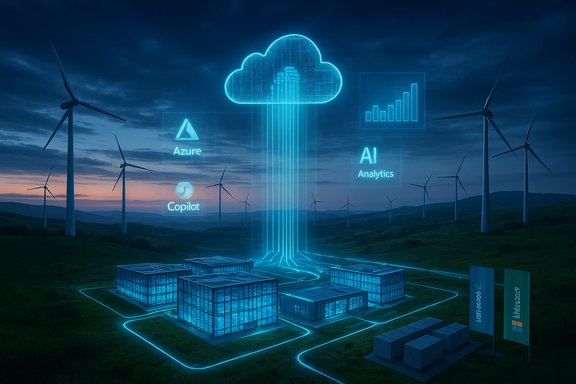
Microsoft and Iberdrola have signed two long‑term power purchase agreements (PPAs) in Spain that add 150 MW of contracted wind capacity to Microsoft’s European renewable portfolio, and the deal doubles as a strategic technology partnership that will lean on Azure, Microsoft Copilot, and joint work on energy‑to‑AI integration, waste‑heat reuse, storage and emerging hydrogen solutions. The transactions — tied to the Iglesias wind farm (circa 94 MW) in Burgos and the El Escudo wind farm (circa 101 MW) in Cantabria — are being presented as the first PPAs the two companies have struck in Europe, and they sit alongside Microsoft’s earlier PPAs with Iberdrola’s U.S. subsidiary Avangrid to form a growing transatlantic energy procurement relationship. Beyond the headline megawatts, the agreement points to a deeper trend: hyperscalers and utilities are knitting energy, cloud and AI strategies together as the electricity needs of advanced AI compute scale dramatically.
The new agreements secure renewable generation from two onshore Spanish wind projects and pair the energy procurement with broader digital collaboration. Microsoft will purchase electricity from the Iglesias and El Escudo projects under long‑term contracts while also expanding its cloud and AI footprint within the Iberdrola Group via Azure, Microsoft Copilot, and Microsoft’s security and compliance offerings. Both companies frame the move as part of a dual mission: supporting Microsoft’s push to power its European operations with renewables while enabling Iberdrola to scale its own digital and AI capabilities.
This is not an isolated transaction. Microsoft already has multiple PPAs tied to projects in the United States through Avangrid, and Iberdrola has major PPA deals with other hyperscalers, including Amazon. The latest Spanish PPAs are therefore best read as both energy contracts and as strategic industrial alliances that combine asset‑backed renewables with cloud, AI and grid‑facing technologies.
As an illustrative estimate:
The key project sizes (roughly 94 MW for Iglesias and 101 MW for El Escudo) and the total contracted capacity of 150 MW are confirmed in the involved parties’ announcements and industry reporting. The strategic elements — Azure adoption, Microsoft Copilot deployment across Iberdrola operations, exploration of heat reuse, hydrogen and battery storage — are explicitly stated in company statements and industry coverage.
When companies disclose headline numbers, readers should expect follow‑up transparency on contract structure (virtual vs physical PPA), tenor, expected commercial operation dates and how renewable attributes are allocated. Those details typically appear in subsequent project filings, regulatory documents or later press releases as projects mature.
The real work begins now: turning signed PPAs and strategic statements into operationally resilient systems that can match the temporal and reliability demands of AI compute, unlock value from waste heat, and integrate batteries or hydrogen at scale. These are complex engineering and commercial problems — solvable, but only with careful contracting, strong grid coordination, and transparent community engagement. The deal marks a practical step toward a future where the lines between energy companies and cloud providers blur, and where decarbonization becomes an industrial design problem as much as a procurement one.
Source: Data Center Dynamics Microsoft signs two PPAs with Iberdrola in Spain
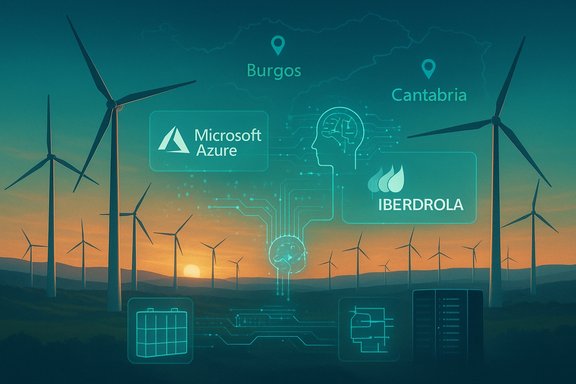 Background and overview
The new agreements secure renewable generation from two onshore Spanish wind projects and pair the energy procurement with broader digital collaboration. Microsoft will purchase electricity from the Iglesias and El Escudo projects under long‑term contracts while also expanding its cloud and AI footprint within the Iberdrola Group via Azure, Microsoft Copilot, and Microsoft’s security and compliance offerings. Both companies frame the move as part of a dual mission: supporting Microsoft’s push to power its European operations with renewables while enabling Iberdrola to scale its own digital and AI capabilities.This is not an isolated transaction. Microsoft already has multiple PPAs tied to projects in the United States through Avangrid, and Iberdrola has major PPA deals with other hyperscalers, including Amazon. The latest Spanish PPAs are therefore best read as both energy contracts and as strategic industrial alliances that combine asset‑backed renewables with cloud, AI and grid‑facing technologies.
Why these PPAs matter: the intersection of AI demand and renewable procurement
Data center and AI workloads are changing how large corporates think about energy procurement. Three forces converge here:- Explosive growth in electricity demand for large AI clusters and training farms.
- Corporate decarbonization goals that push buyers toward long‑term renewable contracts.
- The operational and technical need to match energy availability, flexibility and grid services with volatile compute loads.
Capacity and generation: realistic output expectations
A headline of 150 MW is useful, but electricity generation depends on capacity factor — the actual fraction of time a wind farm produces at rated power. Onshore wind in northern Spain commonly achieves capacity factors in the mid‑20s to mid‑30s percentage range depending on site and turbine technology.As an illustrative estimate:
- If the combined 150 MW portfolio averages a 30% capacity factor, expected generation is roughly 150 MW × 8,760 hours × 0.30 ≈ 394,000 MWh per year (≈394 GWh).
- A lower 25% factor yields ~329 GWh/year; a more optimistic 35% gives ~459 GWh/year.
The commercial anatomy of these PPAs: what they likely contain (and what they don’t)
Public announcements typically omit full PPA commercial terms, but corporate renewable contracts tend to include the following elements:- Long contract tenors (often 10–15+ years), locking in price and supply claims.
- Firm or synthetic delivery structures: physical delivery for grid‑connected offtakes versus virtual PPAs (vPPAs) that settle financially against market prices while allowing the offtaker to claim associated renewable energy certificates (RECs).
- Renewable attributes and certificate handling: specifying who owns Guarantees of Origin (GOs) / RECs and how they count toward the buyer’s renewable targets.
- Scheduling, curtailment and imbalance clauses that allocate grid and market risk between seller and buyer.
- Optional add‑ons: storage integration, co‑located assets or services to manage intermittency and provide capacity/firming.
Strategic implications for Microsoft
Microsoft is not just buying renewable electrons; it is shaping a regional energy and digital infrastructure strategy in Spain and Europe. Key implications:- Regional matching and reputation: Securing European PPAs helps Microsoft credibly claim renewable supply for Spanish and European cloud operations, improving local decarbonization narratives and regulatory positioning (for customers and governments increasingly sensitive to data locality and energy sourcing).
- Resilience and scale: Long‑term PPAs with an integrated utility reduce counterparty complexity and can provide preferential access to firming options (storage, hydrogen, or demand response) — important as Azure’s AI workloads scale and consume more energy with strict availability needs.
- Platform leverage: The deal expands Azure’s commercial footprint inside a major European utility, positioning Microsoft for further managed services, analytics, and AI‑enabled grid and asset management contracts.
- Operational alignment: Data center builds in Spain (including approvals and projects in Aragón and Zaragoza) will benefit if local renewable supply and waste‑heat reuse are coordinated with grid planning and regional environmental regulations.
Strategic implications for Iberdrola
For Iberdrola, the partnership delivers commercial, operational and technological advantages:- Stable revenue streams: Long‑term offtake agreements underpin project finance for renewables and reduce merchant exposure.
- Cloud and AI modernization: Access to Azure, Copilot and security/compliance tools accelerates Iberdrola’s digital transformation, from predictive maintenance of turbines to asset optimization and grid management.
- Market leadership: Iberdrola continues to be a leading PPA seller in Europe, expanding its corporate customer base and strengthening ties with hyperscalers.
- Innovation pathways: Joint exploration of waste‑heat reuse, hydrogen and batteries opens new value chains — for example, deploying electrolyzers alongside renewable plants for green hydrogen or co‑locating batteries for grid services and firming.
Technical opportunities highlighted by the deal
The announcement explicitly mentions several technical avenues the partners will explore. Each is promising but comes with real‑world complexity.- Waste heat from data centers: Reusing heat from data centers to warm district heating networks or industrial processes is a proven possibility in regions with demand density and matching temperature profiles. Spain’s regulatory environment is increasingly pushing waste‑heat reporting and reuse, especially for large centers. Implementation requires co‑located consumers, heat capture infrastructure (heat exchangers, piping), and agreements to share value across utilities, data center operators and municipalities.
- Battery storage: Co‑located or grid‑connected batteries can smooth generation profiles, provide capacity during peak demand, and offer grid services. Batteries reduce curtailment risk for wind farms and increase the usable value of intermittent generation for data center loads.
- Hydrogen: Using excess renewable production to make green hydrogen via electrolysis is promising for hard‑to‑electrify sectors and as multi‑day storage. Economically viable projects require low‑cost renewables, electrolyzer scale, offtake pathways and supportive regulation.
- AI and cloud to optimize energy assets: Deploying Azure‑based AI models to predict wind output, optimize dispatch, detect equipment anomalies and coordinate multi‑asset stacks (wind + storage + demand) could materially raise operational efficiency and asset availability.
Risks and operational caveats
The Microsoft‑Iberdrola PPAs look strategically sensible, yet the arrangement also surfaces several risks and practical challenges:- Intermittency and temporal mismatch: Wind generation produces variable output. Trucks of AI compute prefer reliable power windows and may need firming through storage, demand flexibility or grid services to avoid compute disruptions.
- Grid connection and congestion: Northern Spain has high renewable potential but is not immune to grid constraints. Connection queue backlogs, transmission upgrades or local congestion can delay project commissioning or increase curtailment.
- Market and price risk: If the PPA is a virtual contract, Microsoft remains exposed to wholesale price dynamics to the extent settlements don’t perfectly offset market moves. Conversely, Iberdrola assumes merchant risk if it retains market exposure beyond contracted volumes.
- Additionality and claims scrutiny: Corporates increasingly face scrutiny over what renewable contracting truly achieves. Questions of additionality (would the wind farms have been built without the PPA? and the treatment of renewable certificates influence reputational claims—especially for AI workloads that are intensely energy‑hungry.
- Permitting, community and environmental concerns: Wind projects can face local opposition, permitting complexity, or environmental mitigation obligations. These factors can affect timelines and costs.
- Regulatory shifts: New rules for data centers and energy in Spain and the EU — particularly around waste‑heat reuse, energy reporting, and grid access — may change project economics or compliance obligations.
Local and regional impact: jobs, infrastructure and community benefit
Large utility projects and data center campuses have tangible local effects. Expected impacts include:- Construction and O&M jobs: Wind farm construction and data center builds generate temporary construction employment and longer‑term operations jobs, although hyperscale data centers are relatively lean on permanent staff.
- Grid investment and regional development: New generation and data center loads often spur local grid upgrades and investment in fiber and road infrastructure.
- Environmental trade‑offs: Renewable projects carry benefits (lower lifecycle emissions) and trade‑offs (land use, habitat impacts) that must be addressed through proper siting and mitigation.
- Community energy benefits: When structured carefully, waste‑heat reuse and community energy agreements can generate direct local benefits — district heating provision, industrial heat supply or discounted power to local entities.
What the deal signals for the European PPA market and hyperscalers
This partnership illustrates several broader trends shaping Europe’s renewable and digital ecosystems:- Hyperscalers bundle energy procurement with digital partnerships: Renewable PPAs are now part of a suite of commercial services that include cloud migration, AI tools and operational digitization.
- Utilities are marketing integrated solutions: Iberdrola’s offering is not just electrons but end‑to‑end services that include storage, hydrogen pathways, and digital tools — positioning utilities as strategic tech partners.
- Europe’s PPA market remains active: Corporate demand for PPAs in Europe is strong and utilities that can pair generation with optionality (storage, hydrogen, digital services) will capture premium demand.
- Energy & AI co‑design: As compute demand grows for AI, buyers will seek contracts and infrastructure that go beyond daytime renewable matching and enable firm, resilient delivery — shifting PPA structures toward hybridized solutions.
Corrections and verification notes
Some early reports included a line stating “Iberdrola has more than 40,000 customers worldwide,” which is inaccurate and likely a transposition or misquote. Iberdrola is a global utility with tens of millions of customers and employs on the order of 40,000 people; it also manages a substantial fleet of generation and grid assets measured in the tens of gigawatts. Official corporate communications and industry reporting confirm Iberdrola’s large scale and leadership in the European PPA market.The key project sizes (roughly 94 MW for Iglesias and 101 MW for El Escudo) and the total contracted capacity of 150 MW are confirmed in the involved parties’ announcements and industry reporting. The strategic elements — Azure adoption, Microsoft Copilot deployment across Iberdrola operations, exploration of heat reuse, hydrogen and battery storage — are explicitly stated in company statements and industry coverage.
When companies disclose headline numbers, readers should expect follow‑up transparency on contract structure (virtual vs physical PPA), tenor, expected commercial operation dates and how renewable attributes are allocated. Those details typically appear in subsequent project filings, regulatory documents or later press releases as projects mature.
Practical takeaways for WindowsForum readers and industry watchers
- For cloud operators and enterprises: The deal reinforces that long‑term renewable contracts remain essential but are evolving into bundled agreements that include digitization services and operational collaboration. Buyers should evaluate not only price but optionality for storage, heat recovery and firming.
- For data center developers and operators: Expect increased pressure — and opportunity — to integrate heat reuse, storage and flexible consumption models into projects. Spain and the EU are moving toward stronger reporting and reuse expectations for large facilities.
- For utilities and renewable developers: Partnerships with hyperscalers are more than offtake contracts — they can be gateways to wider service revenue (AI/analytics, grid services) if utilities position their asset pipelines and digital capabilities accordingly.
- For regulators and local communities: Transparent benefit sharing, robust environmental assessments and early coordination on grid upgrades will be key to translating project investments into sustained local support.
What to watch next
- Project timelines and COD (commercial operation dates) for Iglesias and El Escudo — these will determine when Microsoft can count the energy toward its European renewable goals.
- Contractual clarity: whether the PPAs are physical or virtual, the contract tenor, price mechanisms, and how Guarantees of Origin or certificates will be allocated.
- Integration of storage, hydrogen pilots, or heat‑reuse trials announced as part of the partnership.
- Spain’s evolving data center rules and how waste‑heat reuse requirements shape partnerships between utilities and hyperscalers.
- Additional European PPAs from Microsoft and other hyperscalers — the market will test blended solutions (wind + storage + hydrogen) as compute demand grows.
Conclusion
The Microsoft–Iberdrola PPAs are compact in headline capacity — 150 MW — but significant in representational value. They are a clear example of how modern corporate energy procurement is morphing into strategic, cross‑sector partnerships that fuse renewable generation, cloud computing and AI tools. Microsoft secures renewable supply for its European expansion and embeds Azure deeper in a major utility; Iberdrola secures a strategic hyperscaler customer and accelerates its own digital transformation.The real work begins now: turning signed PPAs and strategic statements into operationally resilient systems that can match the temporal and reliability demands of AI compute, unlock value from waste heat, and integrate batteries or hydrogen at scale. These are complex engineering and commercial problems — solvable, but only with careful contracting, strong grid coordination, and transparent community engagement. The deal marks a practical step toward a future where the lines between energy companies and cloud providers blur, and where decarbonization becomes an industrial design problem as much as a procurement one.
Source: Data Center Dynamics Microsoft signs two PPAs with Iberdrola in Spain