• Thread Author
Microsoft and the Midcontinent Independent System Operator (MISO) announced a strategic collaboration to build a cloud-native, AI-driven unified data platform on Microsoft Azure aimed at compressing transmission planning cycles, improving forecasting accuracy, and delivering Copilot‑style decision support into both planning and real‑time operations.

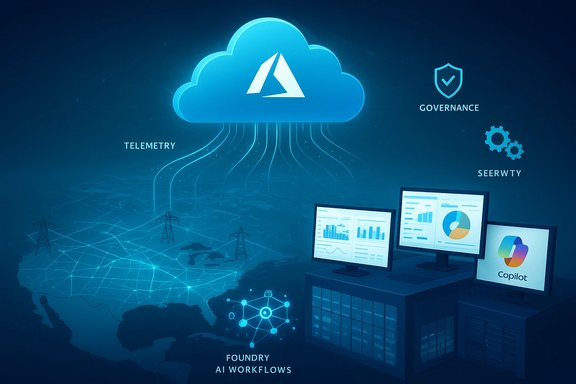
Blue cloud computing hub linking telemetry, governance, and AI workflows to data dashboards.Background​

MISO is one of North America’s largest regional transmission organizations, responsible for coordinating wholesale markets, balancing supply and demand, and planning transmission across roughly 15 U.S. states plus parts of Canada. The operator’s footprint serves on the order of tens of millions of people and has recently moved forward with a multi‑tranche transmission portfolio involving projects counted in the tens of billions of dollars and thousands of miles of new high‑voltage lines.
The partnership with Microsoft extends a prior, multiyear relationship in which Microsoft helped modernize MISO’s data estate on Azure; the new phase moves beyond data plumbing and analytics pilots into production‑oriented, operational AI with attention to model lifecycle, observability and human‑in‑the‑loop decision controls.

What the announcement actually covers​

Public summaries of the collaboration describe a practical, layered architecture that couples MISO’s domain data with Microsoft’s cloud and AI stack, rather than promising immediate replacement of mission‑critical control systems. The core elements cited by both organizations include:
  • A unified data platform on Microsoft Azure to ingest and normalize SCADA/EMS telemetry, market data, GIS/topology, asset registries, weather feeds and third‑party datasets so that analytics run from a single authoritative source.
  • Adoption of Microsoft Foundry (Azure AI Foundry) for model hosting, orchestration of multi‑agent workflows, model routing and observability to manage production ML workloads and agentic interactions.
  • Operator and stakeholder‑facing productivity and visualization built around Power BI and Microsoft 365 Copilot to surface recommendations, generate collaborative decision trails and simplify auditability.
  • Open integration paths for industry partners, DER aggregators, weather providers and other vendors so the platform can be extended iteratively.
Those components are framed as an extensible foundation to industrialize cloud‑native analytics at regional scale and to enable thousands of parallel scenario runs for planning work that historically required weeks of sequential processing.

Why this matters: the strategic drivers​

Three converging pressures explain the urgency behind the deal.
  • Rising, concentrated demand. Hyperscale data centers and broad electrification are creating new, often inflexible loads that are large at the local level and place tight constraints on transmission corridors. Regions with dense industrial and data‑center growth face acute needs for granular forecasting and transmission readiness.
  • Variable and distributed resources. The growth of renewables and distributed energy resources (DERs) increases two‑way power flows and uncertainty, complicating both long‑range planning and short‑term reliability operations.
  • Scale and cycle‑time limits of legacy workflows. Traditional planning relies on stitched‑together datasets, sequential model sweeps on on‑prem compute, and extensive manual validation. Cloud scale and managed ML tooling can make probabilistic planning and rapid sensitivity studies economically feasible at regional RTO scale.
Taken together, these drivers convert the collaboration from an IT modernization story into an operationally strategic investment for MISO members and market participants.

Technical architecture — plausible anatomy​

The public materials are intentionally high‑level, but they imply a concrete architecture that seasoned utility and cloud engineers will recognize:

Data fabric and ingestion​

A cloud‑hosted ingestion layer gathers telemetry (SCADA/EMS), market settlements, asset registers, meter/AMI data, GIS/topology and external feeds including weather and DER telemetry. Role‑based identity and access control anchor upstream in Microsoft Entra (Azure AD), while ingestion pipelines normalize and version datasets to preserve lineage.

Model lifecycle and governance​

Microsoft Foundry (Azure AI Foundry) is positioned as the model‑ops control plane: registry, observability, experiment tracking and routing for model inference and multi‑agent workflows. These primitives support auditable retraining cadences, drift detection and governance controls that are mandatory in regulated environments.

Compute and simulation layer​

Elastic Azure compute (VM scale sets, containers, and serverless orchestration) enables parallel Monte Carlo sweeps, thousands of sensitivity runs for interconnection studies, and rapid retraining/inference loops for short‑term forecasting. This is the lever that shifts some workloads from “weeks” to “minutes” in marketing narratives—when the use case is well‑scoped and data preparation is robust.

Operator UX and human‑in‑the‑loop controls​

Power BI dashboards and Microsoft 365 Copilot integrations provide summarized narratives, hypothesis generation and auditable recommendation trails that operators can accept, override or escalate. The emphasis is on decision support rather than autonomous control, keeping critical control loops unchanged while surfacing actionable intelligence.

Immediate, near‑term use cases​

Based on public statements and sector reporting, the partnership will likely prioritize these near‑term applications:
  • Weather‑aware outage risk forecasting and response: blending meteorological models with telemetry to prioritize pre‑positioning of crews and resources.
  • Congestion prediction and pre‑emptive mitigation: short‑term probabilistic models to detect where constraints will bind and enable market or operational interventions.
  • Accelerated interconnection and transmission studies: cloud‑scale scenario analysis to shorten lead times for regional projects and resource adequacy assessments.
  • Operator decision support: Copilot‑style assistants synthesizing alerts, recommending next steps and keeping auditable transaction logs for post‑event review.
  • Data hygiene and model reconciliation: automated data pipelines and model tuning to reduce errors between digital twins and field reality.
These are pragmatic, high‑value targets because they provide measurable benefits to reliability and planning velocity without requiring wholesale replacement of on‑prem control systems.

Strengths and credible opportunities​

The collaboration has several notable strengths that make the technical promise credible.
  • Domain + platform pairing. Pairing MISO’s operational domain knowledge and datasets with Microsoft’s scale engineering and model‑ops tooling addresses a common industry mismatch where cloud vendors lack domain data and utilities lack model‑ops scale. This alignment reduces integration friction and increases the likelihood of measurable outcomes.
  • Model governance primitives. Foundry’s registry, observability and routing features provide the basic tooling necessary for auditable, regulated AI deployments—lineage tracking, version control and drift detection become explicit engineering artifacts rather than afterthoughts.
  • Speed and scale for planning. Cloud elasticity makes thousands of parallel scenario runs economically feasible, enabling probabilistic transmission planning and sensitivity studies that materially shorten interconnection timelines.
  • Operator productivity gains. Well‑designed Copilot workflows can lower cognitive load, standardize triage steps and create traceable decision trails that speed incident response without ceding operational control.
These strengths create a runway for practical ROI: faster planning cycles, fewer emergency interventions through better forecasting, and more efficient interconnection processing that can reduce cost and delay for new resources.

Risks, caveats and the engineering reality​

While the benefits are plausible, the program amplifies several material risks that utilities and regulators must treat as first‑order engineering constraints.

1) Data quality remains the gating factor​

AI systems are only as good as their inputs. Mismatches in GIS, stale asset registers, intermittent telemetry, and incomplete crew/location feeds will degrade model accuracy and can lead to misleading recommendations if not addressed through rigorous data governance and cleansing. Investments in canonical datasets and reconciliation pipelines are mandatory.

2) Operational risk and human oversight​

The value proposition rests on decision support, not autonomy, and auditability plus human‑in‑the‑loop controls must be baked into every workflow. Without deterministic guardrails and rollback pathways, operator trust will erode and regulators will demand stronger evidence before approving agentic interventions.

3) Validation, testing and regulatory scrutiny​

Regulators and market participants expect reproducible, auditable results for anything that affects market outcomes or reliability. Model validation, backtesting, randomized pilots and third‑party audits will be a central plank of any credible rollout plan—these activities consume time and budget and produce political attention.

4) Vendor lock‑in and commercial dynamics​

Relying on a hyperscaler’s integrated stack raises questions about long‑term portability and procurement fairness for MISO members. Contracts must specify data ownership, egress terms, performance SLAs, and third‑party audit rights to avoid unanticipated switching costs and to preserve vendor neutrality for market participants.

5) Cybersecurity and attack surface expansion​

Extending operational analytics into the cloud enlarges the attack surface. Although Microsoft services include enterprise security controls, the system integrator model requires careful segmentation, least‑privilege access, and rigorous incident response playbooks so production AI artifacts cannot be weaponized or misused.

Implementation considerations and practical milestones​

Successful industrialization of AI in an RTO environment typically follows disciplined workstreams and milestones. A realistic rollout plan for MISO and Microsoft should include:
  • Canonical data inventory and reconciliation: establish a single source of truth for assets, topology and telemetry, with automated pipelines and lineage tracking.
  • Pilot cohort with clear success metrics: run randomized, controlled pilots that measure forecasting skill, planning cycle time and operator workload reductions.
  • Model‑ops governance and SLA framework: deploy Foundry or equivalent as the model control plane, define retraining cadences, drift detection thresholds and rollback procedures.
  • Human‑in‑the‑loop workflows and audit trails: integrate Copilot outputs into operator consoles with explicit accept/override flows and persistent decision logs.
  • Security and compliance testing: penetration testing, bespoke OT threat modeling, and contractual clarity on data residency and incident response.
These steps reflect lessons learned from prior cloud‑utility integrations and are reflected in MISO’s own public framing of the initiative as iterative and extensible rather than an overnight transformation.

Regulatory and market implications​

The move has implications beyond IT and operations. Faster, more reliable forecasting and accelerated interconnection studies could reshape market timing, congestion rents and transmission planning outcomes. That creates a need for transparency and stakeholder engagement on methodology, data inputs, and model assumptions—especially when model outputs influence market outcomes or cost allocation for multi‑billion dollar projects.
Regulators will demand evidence that AI‑assisted decisions are auditable, unbiased and reversible. That means MISO and Microsoft will need to surface not only results but also the provenance of those results—model versions, training data snapshots and sensitivity analyses—when required.

Commercial dynamics: what members and vendors should watch​

  • Negotiation of contract terms must prioritize data ownership, egress pricing, SLAs for model performance, and third‑party audit rights. Vendor lock‑in risk is non‑trivial at RTO scale and must be actively managed.
  • A modular, open integration posture will lower friction for third‑party innovation (weather vendors, DER aggregators, analytics firms) and preserve competitive procurement for specific application layers.
  • Market participants seeking to leverage the platform commercially should invest in canonical data feeds and standardized APIs to participate in shared workflows and to extract maximum value from model outputs.

Practical guidance for WindowsForum readers in IT and grid tech roles​

  • Prioritize data hygiene and canonicalization: the single most leverageable activity for improving model outcomes is systematic, automated data reconciliation and topology verification.
  • Treat Foundry/Model‑Ops as infrastructure: invest in observability, alerting on drift and disciplined retraining pipelines before scaling agentic workflows.
  • Define human‑in‑the‑loop boundaries early: design Copilot integration so that operators retain final authority and can audit recommendations easily.
  • Insist on staged pilots with rigorous A/B measurement: accept no uplift claims without randomized-control validation and transparent metrics.
  • Clarify security and incident response: extend OT security exercises to the cloud components and rehearse failure scenarios that include model or data corruption.

Where claims need verification and what to watch next​

The partners make several performance claims—shifting weeks of planning runs into minutes, materially reducing interconnection lead times, and delivering Copilot‑style incident response at scale. These are plausible but contingent on data readiness, engineering investment and governance discipline. Independent validation, vendor‑neutral benchmarking and regulatory review will be the key mechanisms to convert directional claims into verified outcomes.
Key items to monitor in the coming months:
  • Public disclosure of pilot metrics and third‑party audits showing improvements in forecasting skill or planning cycle time.
  • Contractual terms published or summarized for member review covering data ownership, egress and audit rights.
  • Demonstrated integration of external partners (weather vendors, DER aggregators) and interoperability test results.
When promises are backed by measurable, peer‑reviewed results and transparent governance, the collaboration could become a template for other regional operators. Until then, conservatism in procurement and a push for auditability are prudent.

Conclusion​

The MISO–Microsoft collaboration is a meaningful step toward industrializing cloud‑native analytics and AI in a regulated, safety‑critical domain. By combining a unified Azure data fabric, Foundry model‑ops for lifecycle governance, and Copilot‑style visualization and assistance, the initiative aims to accelerate transmission planning, deliver better forecasting and reduce decision latency across a large regional footprint.
The technical architecture and near‑term use cases are sensible and well‑aligned with industry best practices, but the ultimate value will be determined by the program’s execution: investments in data hygiene, rigorous validation, clear governance, security hardening and transparent, measurable pilot results. Stakeholders should demand those artifacts before treating vendor promises as realized outcomes.
For now, the announcement represents a credible, pragmatic roadmap for grid modernization that balances cloud‑scale simulation and AI with operator oversight—an approach that, if executed with discipline, has the potential to materially shorten planning cycles and strengthen reliability across MISO’s footprint.

Source: ERP Today https://erp.today/miso-microsoft-pa...grid-platform-to-streamline-planning-cycles/]
 

On January 6, 2026, the Midcontinent Independent System Operator (MISO) and Microsoft announced a strategic collaboration to build a cloud‑native, AI‑driven unified data platform on Microsoft Azure designed to accelerate transmission planning, improve forecasting accuracy, and embed Copilot‑style decision support into grid planning and operations across MISO’s multi‑state footprint.

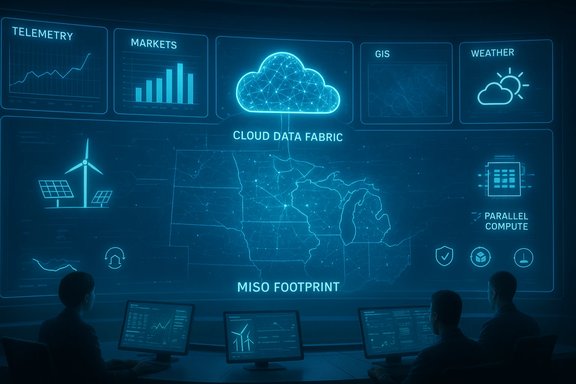
Team monitors a neon-blue dashboard displaying Cloud Data Fabric and the MISO footprint.Background / Overview​

MISO is one of North America’s largest regional transmission organizations, coordinating wholesale markets, balancing supply and demand, and planning transmission across roughly 15 U.S. states plus parts of Canada. The operator faces mounting pressures from rapid electrification, the growth of hyperscale data centers, rising renewable penetration, and the ongoing retirement of thermal capacity—trends that complicate long‑range planning and real‑time operations.
Microsoft brings Azure cloud infrastructure, Microsoft Foundry (marketed as Azure AI Foundry), Power BI, and Microsoft 365 Copilot capabilities to this collaboration. The public descriptions emphasize building a single authoritative data fabric that ingests telemetry (SCADA/EMS), market data, GIS/topology, asset registers, weather feeds and third‑party inputs, and then layers managed model lifecycle, multi‑agent workflows and operator‑facing visualization on top of that foundation.
The partners frame this work as a pragmatic modernization: keep mission‑critical control loops intact while offloading heavy analytics, scenario sweeps and ML model hosting to the cloud to compress planning cycles and provide auditable, human‑in‑the‑loop decision support.

What was announced: concrete components and capabilities​

The public summary of the collaboration outlines practical building blocks rather than grand promises. Key elements include:
  • Unified data platform on Azure to centralize telemetry, markets, GIS/topology and external feeds into an authoritative dataset.
  • Microsoft Foundry / Azure AI Foundry for model hosting, agent orchestration, observability, routing and model governance.
  • Power BI and Microsoft 365 Copilot for visualization, guided workflows, and collaborative decision trails for planners and operators.
  • Open integrations for weather providers, DER aggregators, market participants and third‑party analytics so the platform can extend into a partner ecosystem.
These components are positioned to enable several material use cases immediately relevant to MISO’s mandate: faster and more granular transmission planning, probabilistic resource adequacy analysis, weather‑aware outage and congestion forecasting, and operator decision support to accelerate incident triage and reduce cognitive load.

Why this matters: the operational and strategic case​

Modern transmission planning and bulk‑power operations are as much a data and coordination problem as an engineering one. Legacy workflows typically stitch siloed datasets together, run sequential batch simulations on on‑premises hardware, and require extensive manual validation—processes that add weeks or months to planning cycles. Moving planning and scenario analysis to a cloud‑native, governed data fabric unlocks three practical advantages:
  • Scale and speed: Elastic cloud compute enables parallelized scenario sweeps and Monte Carlo studies at a scale that makes probabilistic planning affordable and far faster than traditional approaches.
  • Model governance and observability: Foundry‑style model catalogs, routing and observability provide lineage, drift detection and retraining controls that are necessary for auditable AI inside regulated utilities.
  • Operator productivity: Copilot‑like interfaces can synthesize model outputs into succinct recommendations, freeing control‑room staff from repetitive tasks and offering consistent, documented decision trails.
Taken together, those capabilities can shorten specific parts of the planning lifecycle—from data ingestion and ETL to individual simulation runs—from weeks to minutes in discrete, well‑scoped workloads. However, broad end‑to‑end acceleration across every regulatory and multi‑stakeholder review step is a more complex proposition and requires careful governance and validation.

Technical architecture: the plausible anatomy of the platform​

The public materials are high level, but the announced building blocks permit a clear, implementable architecture:

Data fabric and ingestion​

  • Cloud‑hosted pipelines ingest SCADA/EMS telemetry, market settlements, asset registers, GIS/topology, DER telemetry and third‑party feeds.
  • Role‑based access and identity management is anchored in Microsoft Entra / Azure Active Directory.
  • Automated ETL and model reconciliation jobs reduce manual mapping and improve data hygiene.

Model lifecycle and governance​

  • Microsoft Foundry provides a registry for models, experiment tracking, observability, routing and multi‑agent orchestration.
  • Governance features include versioning, lineage, drift detection, and retraining cadences critical for regulated deployments.

Compute and simulation layer​

  • Elastic Azure compute (VMs, scale sets, containerized clusters) enables thousands of parallel contingency sweeps and faster retraining/inference loops for load and renewable forecasting.
  • This layer is the primary lever for converting historically long compute tasks into much shorter run times for scoped workloads.

Operator UX and productivity layer​

  • Power BI dashboards and Microsoft 365 Copilot integrations surface synthesized insights and recommended next steps into planner and control‑room workflows.
  • Auditable decision trails, human‑in‑the‑loop overrides and conservative guardrails are emphasized for safety‑critical contexts.

Integration and extensibility​

  • Open connectors and partner APIs allow weather vendors, DER aggregators, ISOs/RTOs and market participants to broaden analytic scope and test new applications incrementally.

Plausible near‑term use cases and measurable targets​

The announcement and industry context point to near‑term priorities that are concrete and measureable:
  • Weather‑aware outage and risk forecasting: blend higher‑fidelity meteorological data with telemetry to predict outage risk and pre‑position crews. Metrics: improvement in outage response times, confidence interval for restoration time estimates.
  • Congestion prediction and pre‑emptive mitigation: short‑term probabilistic models to identify likely transmission constraints and enable market/operational interventions. Metrics: day‑ahead and hour‑ahead congestion prediction accuracy (MAE/RMSE reductions).
  • Accelerated interconnection and transmission studies: run thousands of scenario sweeps in parallel for interconnection screens and probabilistic resource adequacy. Metrics: reduction in average study latency and queue backlog.
  • Operator decision support: Copilot‑style assistants that synthesize data, propose next steps, and keep auditable trails. Metrics: reduced operator cognitive load, fewer manual escalation steps, validated recommended‑action acceptance rates.
These use cases are both operationally meaningful and realistic as first milestones in a staged rollout.

Strengths: what the collaboration gets right​

  • Domain + Platform Pairing — MISO supplies critical operational datasets and process knowledge; Microsoft supplies cloud scale, MLOps tooling and enterprise security. This combination overcomes a common utility industry gap: domain expertise without cloud‑native engineering at scale.
  • Governance‑First Design — The emphasis on model cataloging, observability and routing (Foundry) reflects an understanding that auditable lifecycle management is a must for regulated, safety‑critical systems. This foundation reduces the risk of unchecked model drift and undocumented agent actions.
  • Pragmatic, Incremental Approach — Public messaging describes advisory and decision‑support features being operationalized before any automated closed‑loop control is permitted, which is the prudent path for mission‑critical systems.
  • Cloud Economics — Elastic compute makes probabilistic planning and large scenario sweeps affordable; this materially changes what planning teams can analyze within operationally relevant timeframes.

Risks, caveats and practical hurdles​

The value proposition is strong, but the project amplifies several technical, governance and strategic risks that must be managed upfront:
  • Scope of the “weeks to minutes” claim: Public statements that analytics cycle times can move “from weeks to minutes” are likely accurate for discrete ETL automation and parallelized simulation jobs, but they are not a blanket guarantee for end‑to‑end regulatory approvals, multi‑party reviews or physics‑intensive validation steps. Distinguish between component speedups and whole‑process acceleration.
  • Data fidelity and model accuracy: Improvements hinge on data quality, topology reconciliation and model retraining cadence. Poor topology alignment or stale asset registers produce biased simulations; active model observability and reconciliation workflows are essential.
  • Cybersecurity and attack surface expansion: Moving telemetry and asset data into a cloud fabric increases attack surface vectors. Robust zero‑trust architecture, segmentation between OT and cloud, Defender for IoT patterns and strict identity governance are mandatory.
  • Regulatory, market and vendor governance: Outsourcing core analytics to a hyperscaler raises questions around data sovereignty, vendor lock‑in, competitive neutrality among market participants and how regulators will audit model outputs for compliance and fairness. Those policy dimensions require explicit regulatory engagement.
  • Human factors and over‑automation: Copilot‑style recommendations must be integrated with clear human‑in‑the‑loop constraints to avoid operator complacency or over‑reliance on AI-generated actions. UI/UX design and staged automation limits are critical.
  • Interoperability across RTOs and vendors: Standardizing connectors, exchange formats and model interfaces will determine whether the platform can become an industry hub or remain a one‑off solution limited to MISO’s footprint. Open APIs and data standards should be prioritized.

Governance, validation and verification — required milestones​

To make the platform trustworthy and operationally reliable, the program should deliver verifiable milestones:
  • Publish measurable pilot results for specific use cases (e.g., congestion prediction MAE reduction, outage response time improvements). These should include baseline windows and rigorous test harnesses.
  • Establish a transparent model governance board composed of MISO planners, Microsoft engineers, independent experts and regulatory observers to review model performance, drift logs and retraining decisions.
  • Create an OT‑to‑cloud security blueprint with independent penetration testing, SIEM integration and incident playbooks to protect critical telemetry and control data.
  • Define clear human‑in‑the‑loop policies and UI patterns that ensure any automated recommendation remains advisory unless explicitly authorized through documented change control.
  • Deliver an interoperability roadmap and publish APIs and schema definitions to enable third‑party integrations and reduce vendor lock‑in risk.

Regulatory and market implications​

The MISO–Microsoft collaboration does not change statutory approval timelines for transmission projects or interconnection processes, but it can materially influence the inputs to those reviews. Faster, probabilistic studies and cleaner documentation can shorten internal preparation cycles and improve the quality of filings submitted to regulators. However, regulators and stakeholders will expect transparency in model assumptions, testable claims for benefits, and access to auditable decision trails—areas where Foundry’s observability and model lineage features will be particularly valuable.
Beyond speed, there are broader market implications: if hyperscalers and grid operators converge on cloud‑hosted analytics, market participants will need parity of access to prevent data and intelligence asymmetries that could influence market outcomes. Regulators should consider minimum standards for data access and model explainability in any future guidance.

Workforce impact and the path to operational adoption​

Technical change is ultimately social change. To operationalize the platform, MISO and its members will need a focused upskilling and workforce transition plan:
  • Recruit and train data engineers, cloud architects, MLops specialists and cybersecurity staff to work alongside traditional planners and operators.
  • Run cross‑discipline tabletop scenarios that pair Copilot‑style recommendations with operator decision drills to refine interfaces and handoffs.
  • Deploy phased pilots that demonstrate measurable gains, then scale via a combination of center‑of‑excellence governance and distributed adoption within regional planning teams.
This human‑centered approach reduces the risk of shadow systems and ensures new tools are adopted in formally governed workflows.

Competitive landscape and broader industry context​

MISO’s collaboration with Microsoft fits a broader industry pattern: cloud hyperscalers partnering with grid operators and utilities to bring managed AI, model lifecycle tooling and cloud scale to electricity planning and operations. Similar architectural patterns — unified data fabrics, model governance platforms and Copilot‑style operator assistants — are being trialed across multiple RTOs and large utilities. The differentiating factors will be execution discipline, governance transparency, and the ability to publish verifiable outcomes that regulators and stakeholders trust.

Practical recommendations for stakeholders​

  • For MISO members and utilities: Demand measurable pilot metrics and clear SLAs that separate data hosting from model governance responsibilities. Confirm data access, portability and exit clauses in commercial agreements.
  • For regulators and policymakers: Define minimum standards for model explainability, data access parity for market participants and audit capabilities for cloud‑hosted analytics. Require pilot transparency and third‑party validation before closed‑loop automation is allowed in operations.
  • For cloud providers and vendors: Prioritize open connectors, standardized schemas and interoperable APIs so the platform can act as an ecosystem hub rather than a proprietary silo. Invest in demonstrable security guarantees for OT data.

Conclusion​

The MISO–Microsoft collaboration is a clear, pragmatic step toward industrializing cloud‑native, AI‑driven analytics for bulk‑power planning and operations. By pairing MISO’s operational domain knowledge with Azure’s scale and Foundry’s model lifecycle tooling, the initiative addresses real and growing pain points—faster scenario sweeps, probabilistic planning at scale, and better‑documented decision support for operators.
The opportunity is real: specific parts of the planning and analytics pipeline can plausibly move from weeks to minutes once automated ETL, parallelized compute and managed model ops are in place. Yet the broader promise depends on disciplined governance, demonstrable pilot results, robust cybersecurity, and regulatory engagement to preserve market fairness and operational safety. The next 12–24 months of pilot reporting and governance maturation will determine whether this collaboration becomes a reproducible template for grid modernization or remains an instructive but limited case study.

Source: ERP Today MISO, Microsoft Partner on Azure-, AI-Powered Grid Platform to Streamline Planning Cycles
 

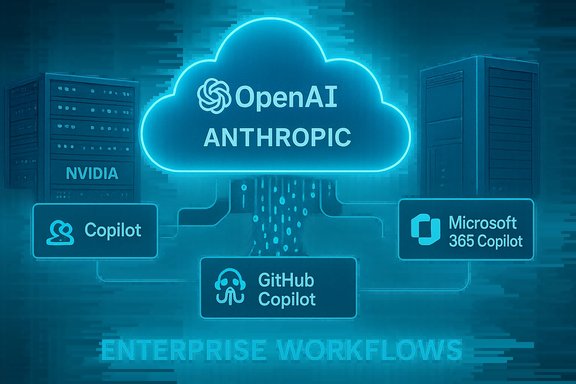
Neon-blue cloud labeled OpenAI Anthropic links Nvidia servers to Copilot tools for enterprise workflows.
Microsoft’s latest shuffle of AI bets — quietly redirecting hundreds of millions toward Anthropic while keeping a tight embrace on OpenAI — represents a deliberate shift from single‑supplier dependence toward a multi‑model, multi‑cloud strategy that will reshape Azure’s product mix, sales incentives, and the economics of enterprise AI.

Background: what changed and why it matters​

Microsoft has long been synonymous with large, strategic AI partnerships; its multi‑year alliance with OpenAI anchored the company’s Copilot ambitions and underpinned Azure’s positioning as a go‑to cloud for generative AI. That relationship evolved into a major equity and commercial arrangement during OpenAI’s 2025 recapitalization, giving Microsoft a sizeable ownership interest and long‑term product access to OpenAI technology. But in late 2025 and early 2026 Microsoft broadened that posture. Public announcements and reporting show Microsoft and partners committing new capital and distribution deals to bring Anthropic’s Claude models deeper into Azure and the Copilot family — while internal incentives were altered so Azure sales teams can count Anthropic model sales toward their quotas just as they do OpenAI models. This is not symbolic: it is a practical re‑wiring of Microsoft’s go‑to‑market motion and its internal economics.

Overview: the headline facts (verified)​

  • Multiple outlets report Microsoft is on pace to spend roughly $500 million a year to use Anthropic’s models across Microsoft products and cloud offerings; that figure comes from reporting based on people familiar with the company’s plans and internal routing of workloads.
  • Microsoft formally committed an “up to” $5 billion investment and an expanded distribution partnership with Anthropic as part of a three‑way pact that also includes NVIDIA; Anthropic pledged large multi‑year Azure compute purchases (reported in the tens of billions) in tandem with the commitment. The announcements and company statements qualify many numbers as staged, conditional, or “up to” amounts rather than immediate cash transfers.
  • Microsoft’s cumulative investments and commitments to OpenAI exceed $13 billion (funded amounts reported in SEC filings and company statements), and after OpenAI’s October 2025 restructuring Microsoft’s stake in the reorganized commercial entity is described publicly as a major minority interest. That prior investment is an important ballast to the new Anthropic expansion.
  • Microsoft reportedly captures a far larger share of sales when it resells OpenAI models to Azure customers versus its take from reselling Anthropic models — reporting has cited an ~80% capture rate from OpenAI model sales to Azure customers, compared with an unspecified, materially smaller share on Anthropic sales under current commercial terms. These figures stem from reporting that cited people briefed on the arrangements.
Each of the above points relies on public company statements or reporting from outlets that cite anonymous sources inside the industry; they are verifiable as current reporting but vary in the specificity of the public record. Where an item rests on reporting from people briefed on the matter rather than an exact public filing, it will be noted in the analysis below.

Why Microsoft is diversifying: strategy, economics and risk management​

Hedging technical and commercial concentration​

For most of Microsoft’s recent AI era, OpenAI was the critical external technology partner. That exclusivity created tremendous benefits — built‑in differentiation for Microsoft product integrations and predictable enterprise demand for Azure infrastructure — but it also exposed Microsoft to concentrated supplier and pricing risk.
Diversifying to include Anthropic (and keeping Microsoft’s own models and third‑party options in play) reduces single‑vendor dependency. Anthropic’s Claude models offer distinct tradeoffs: different safety and behavior tuning, alternative cost and latency characteristics, and unique product features that can fit workloads where Claude’s strengths align better than alternative models. The three‑way alignment with NVIDIA and Anthropic formalizes those choices by guaranteeing compute capacity and by making Claude readily available to Azure enterprise customers.

Cost, throughput and task routing​

Modern Copilot and enterprise AI services typically route requests to the model best suited for the job. Microsoft can, and does, optimize for:
  • Cost — lower per‑token inference pricing for high‑volume, low‑complexity tasks;
  • Latency and scale — specialized hardware or colocated instances to reduce round‑trip time for heavy inference workloads; and
  • Behavior and safety — selecting a model whose guardrails and output style better match the regulatory or brand constraints of a customer.
Making Anthropic models first‑class options — and incenting Azure sellers to pitch them — allows Microsoft to operationalize that routing at scale and translate model choice into commercial uptake. Reporting indicates that Microsoft is incenting sellers to treat Anthropic models like any other Microsoft product when they count toward quotas. That is a meaningful change in how Azure will be sold.

Revenue and ownership tradeoffs​

The economic tradeoff is straightforward: Microsoft benefits more financially when it sells OpenAI models under the terms of the OpenAI–Microsoft arrangements; those terms were structured around earlier investments and long‑running commercial arrangements. By contrast, Anthropic’s agreements are newer, typically carry different margins and may leave Microsoft with a smaller immediate cut of resold model revenue. But Microsoft is clearly willing to accept lower direct margins on some Anthropic sales in exchange for broader product coverage, competitive flexibility, and the business value derived from retaining enterprise customers on Azure rather than losing them to rival clouds. The public reporting that cites an 80% capture rate for OpenAI sales versus a lower rate for Anthropic sales illustrates this tradeoff.

The Anthropic pact: numbers, caveats and practical meaning​

What the announcements say​

Public statements from Anthropic and Microsoft describe an integrated agreement to scale Claude on Azure, deeper distribution across Microsoft’s Copilot product family (including GitHub Copilot and Microsoft 365 Copilot), and technical collaboration with NVIDIA to optimize models for NVIDIA’s Grace Blackwell and Vera Rubin systems. Microsoft and NVIDIA were reported to be committing substantial investments — headline figures of up to $5 billion (Microsoft) and up to $10 billion (NVIDIA) — while Anthropic has been described as committing to large multi‑year Azure compute purchases (reported around $30 billion as a headline number). These are framed in press materials as staged or “up to” commitments.

Caveats you must read​

  • The dollar figures include conditional and staged elements. “Up to” language is common in large strategic partnerships; actual cash flow and invoicing schedules will be tied to performance milestones, hardware availability, and multiyear contracts.
  • Many of the most specific commercial economics (revenue shares, discount schedules, committed volumes in teraflops/TOPS or tokens) remain undisclosed publicly and have been summarized by reporters based on conversations with industry insiders. Those claims are credible in the sense that several credible outlets have independently published similar descriptions, but they are not all spelled out in a single public contract or SEC filing. Treat the headline figures as directional, not precise arithmetic unless a specific filing or company statement confirms exact amounts.

What this means for OpenAI and Microsoft’s relationship​

Not a breakup, but a pragmatic repositioning​

Microsoft’s investments in Anthropic do not negate its investment in OpenAI; rather, they reflect a pragmatic posture: retain privileged access and upside with OpenAI while ensuring Azure and Microsoft products remain resilient and competitive if OpenAI’s availability, pricing, or roadmap shifts. The October 2025 restructuring of OpenAI’s commercial arm left Microsoft with a meaningful stake and continued product access, which remains strategically valuable. Microsoft’s multi‑model approach gives it leverage and flexibility without abandoning the economic and product benefits of the OpenAI tie.

Commercial implications​

  • Microsoft’s reported ability to capture a larger share of OpenAI model revenue (the often‑cited “~80%” figure) creates an asymmetry: selling OpenAI models is more immediately lucrative to Microsoft than selling Anthropic models under current arrangements. That asymmetry explains why Microsoft would still maximize OpenAI’s distribution where possible while also seeding Anthropic as an essential alternative.
  • The new arrangement democratizes model choice for Azure customers: enterprises can now choose Claude or OpenAI models based on functionality, data governance needs, and price, without having to switch clouds. That convenience is itself a competitive advantage Microsoft can monetize in subscription and services revenue.

Retail and productization: how Copilot and Azure will change​

Agentic commerce and intelligent automation​

Microsoft’s push to embed agentic AI into retail workflows is already public. The company launched a set of Copilot templates and a “Copilot Checkout” capability that turns conversational interactions into in‑chat purchases and adds agent templates for catalog enrichment, store operations, and fulfillment automation. These moves show how Microsoft expects to monetize model diversity: by integrating the best model for a given retail function into end‑to‑end operational workflows, delivering measurable ROI for merchants.
  • Benefits for retailers include improved personalization, faster product onboarding, and automated operational tasks that free staff for higher‑value work.
  • Microsoft’s strategy bundles model choice, system integration (Microsoft Fabric, Dynamics 365), and managed infrastructure as part of the retail cloud value proposition.

Practical outcomes for IT and procurement teams​

  1. Enterprises will be able to evaluate model choice as a functional parameter (e.g., Claude for document‑scale reasoning, OpenAI for specific generative tasks).
  2. Procurement needs to update terms to include model SLAs, data residency, and explainability guarantees.
  3. Security and compliance teams must verify how each model’s data handling aligns with industry regulations and corporate policies.

Risks, regulatory angles and market dynamics​

Financial and operational risks​

  • Short‑term profit pressure: Large, multitranche investments and increased cloud capacity commitments can depress near‑term margins, particularly if model economics (revenue per compute dollar) do not improve. Microsoft is balancing near‑term commercial concessions (smaller margins on Anthropic resales) against long‑term platform value.
  • Compute bottlenecks and hardware constraints: Anthropic’s accelerated roadmap increases demand for GPU capacity. The industry continues to face supply constraints for advanced accelerators, which can inflate costs and delay deployments. The partnership with NVIDIA is intended to alleviate technical friction but introduces deeper interdependencies.

Competition and antitrust scrutiny​

The circularity of investments (cloud provider ↔ chipmaker ↔ model developer) creates concentrated control over critical layers of the AI stack. Regulators in multiple jurisdictions are attentive to arrangements that limit competition or create tied product ecosystems; the Microsoft‑Anthropic‑NVIDIA alignment is likely to draw scrutiny if it materially forecloses market access for competitors or locks major enterprise customers into preferential deals. The complexity and scale of these relationships warrant careful monitoring.

Product integrity and safety​

Introducing multiple frontier models across Microsoft’s product surfaces raises governance questions: consistent safety policies, uniform forensics and audit trails, bias mitigation, and version control across different model vendors. Microsoft’s responsible AI commitments face scaling challenges as model provenance, retraining cadence, and mitigation strategies vary across partners. Enterprises buying Copilot‑integrated services must demand transparent behavior and incident response commitments for each model in use.

What customers and partners should watch for​

  • Contract terms: Watch for how “compute purchase” commitments are defined in SOWs, their renewal triggers, and termination penalties. Multiyear compute purchase figures can be headline numbers but hide onerous long‑term commitments if not negotiated carefully.
  • Model governance: Seek explicit SLAs and data handling guarantees for each model provider used within Microsoft‑managed products.
  • Billing and routing transparency: Request clear logs and cost attribution for which model handled which request; this is essential for cost optimization and audit trails.
  • Migration paths: Confirm portability mechanisms for models and agent workflows — how easy is it to move from one model provider to another if economics or compliance needs change?

Strategic scenarios: three plausible trajectories​

  1. Orchestration wins — Microsoft successfully becomes the neutral orchestration layer that allows enterprises to pick models by need, keeping customers locked into Azure for convenience while capturing downstream services revenue.
  2. Vertical consolidation — The circular investment pattern cements a handful of hyperscalers and chip vendors as dominant, increasing barriers to entry for independent model developers and attracting regulatory pushback.
  3. Open competition and commoditization — Model pricing and hardware improvements drive inference costs down, forcing hyperscalers to compete on integration, tooling, and support rather than model exclusivity.
Microsoft’s multi‑model play is designed to succeed across several of those futures; it prioritizes product flexibility and enterprise lock‑in, while accepting short‑term margin compressions to preserve longer term platform economics.

Final analysis: strengths, tradeoffs and what to expect next​

Microsoft’s pivot to broaden model partnerships — and its reported $500 million‑per‑year Anthropic spend — is a pragmatic adjustment to the realities of a fast‑moving, capital‑intensive AI market. It leverages Microsoft’s strengths:
  • Azure’s distribution and enterprise sales engine, now empowered to sell alternative frontier models.
  • Product integration across Copilot, GitHub Copilot and Microsoft 365, enabling real business workflows that capture value beyond raw model outputs.
  • Scale economics and deep engineering partnerships with chip vendors like NVIDIA to tune performance and reduce latency.
At the same time, the strategy accepts tradeoffs:
  • Lower immediate margins on resale of some third‑party models compared with historical OpenAI economics.
  • Complex governance costs and regulatory exposure from intertwined vendor investments.
  • Capital intensity as Microsoft underwrites compute capacity and participates in multi‑year commitments that may only pay off with broad enterprise adoption.
For CIOs, CTOs, and procurement leads, the advice is direct: treat vendor‑provided models as infrastructure components — evaluate them for cost, behavior, data governance, and portability — and require contractual clarity on SLAs, auditability, and exit pathways.
Microsoft’s multi‑front strategy is not a repudiation of OpenAI — it is an operational insurance policy and platform play rolled into one. The new balance of investments and reseller economics makes Azure a broader marketplace of frontier models, but it also raises the stakes on execution, governance, and compute economics. The immediate news is headline‑worthy; the defining story will be whether Microsoft can turn a more diversified model catalog into predictable, profitable, and responsibly governed enterprise outcomes.
Note: several of the most specific commercial numbers reported publicly—particularly the annualized $500 million Anthropic spend and the split of resale economics—are derived from reporting that cites people with direct knowledge rather than full public filings. Those figures are credible and corroborated by multiple outlets, but they should be treated as current reporting rather than final contractual evidence until confirmed by company filings or formal disclosures.
Source: cointurk finance Microsoft Diverts Resources to Compete with OpenAI - COINTURK FINANCE
 

Back
Top