

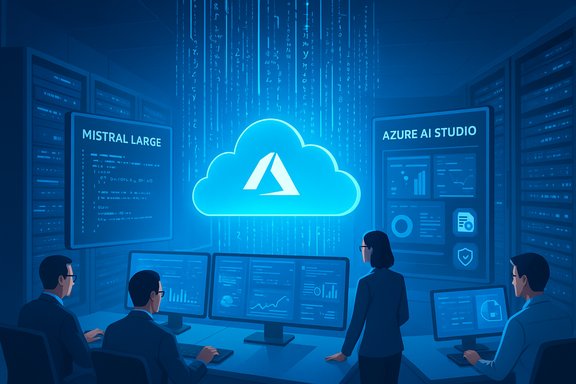
Microsoft’s multi‑year pact with Mistral AI and the launch of Mistral Large first on Azure mark a significant milestone in the cloud–AI race: Azure will provide supercomputing infrastructure, commercial distribution, and enterprise tooling while Mistral supplies both high‑performance commercial models and a continuing stream of open‑weight releases — a deal announced publicly and summarized in industry reporting and the Microsoft Azure blog.
The AI infrastructure landscape has shifted from single‑model dominance toward a multi‑model marketplace where hyperscalers embed third‑party models into cloud platforms and offer them as managed services. Microsoft’s announcement with Mistral AI formalizes that shift: the partnership covers three core areas — supercomputing infrastructure for training and inference, commercial distribution through Azure’s Models as a Service (MaaS), and collaborative R&D for purpose‑built models (including work aimed at European public‑sector workloads). Microsoft’s public announcement lays out those three pillars and positions Mistral Large as a premium offering available via Azure AI Studio and Azure Machine Learning. Mistral, a Paris‑based startup founded by former DeepMind and Meta researchers, has become a prominent European model developer. Its product lineup intentionally spans permissively licensed open‑weight models (for self‑hosting and research) and commercial, higher‑capability models offered as managed services. Industry reporting at the time also noted regulatory interest in the deal and published figures for Microsoft’s reported investment, which regulators and news outlets said was in the mid‑millions (roughly €15 million / $16 million reported by multiple outlets). Those financial details were not exhaustively detailed by the companies and remain reported figures rather than full contractual disclosure.
Enterprises and Windows‑centric IT teams should view the partnership as an opportunity to accelerate production AI workstreams, but adhere to disciplined pilots, measurable KPIs, and governance checklists before scaling. Where sovereignty, provenance, or cost control are paramount, Mistral’s open‑weight options remain an important parallel path. For those leaning into Azure, Mistral Large’s availability in the Azure AI catalog offers a convenient, enterprise‑oriented route to deploy high‑reasoning models — yet every production decision should be anchored to validated performance, contractual safeguards, and a clear exit path.
The landscape is moving fast. The Microsoft‑Mistral tie‑up is both a strategic milestone and a practical enabler; its long‑term effect will depend on execution, regulatory outcomes, and how well enterprises balance convenience with control.
Source: HPCwire Microsoft and Mistral AI Announce New Partnership to Accelerate AI Innovation and Introduce Mistral Large 1st on Azure - BigDATAwire
 Background
The AI infrastructure landscape has shifted from single‑model dominance toward a multi‑model marketplace where hyperscalers embed third‑party models into cloud platforms and offer them as managed services. Microsoft’s announcement with Mistral AI formalizes that shift: the partnership covers three core areas — supercomputing infrastructure for training and inference, commercial distribution through Azure’s Models as a Service (MaaS), and collaborative R&D for purpose‑built models (including work aimed at European public‑sector workloads). Microsoft’s public announcement lays out those three pillars and positions Mistral Large as a premium offering available via Azure AI Studio and Azure Machine Learning. Mistral, a Paris‑based startup founded by former DeepMind and Meta researchers, has become a prominent European model developer. Its product lineup intentionally spans permissively licensed open‑weight models (for self‑hosting and research) and commercial, higher‑capability models offered as managed services. Industry reporting at the time also noted regulatory interest in the deal and published figures for Microsoft’s reported investment, which regulators and news outlets said was in the mid‑millions (roughly €15 million / $16 million reported by multiple outlets). Those financial details were not exhaustively detailed by the companies and remain reported figures rather than full contractual disclosure. What Microsoft and Mistral announced — the facts
- Microsoft will host and scale Mistral’s flagship models on Azure, offering them through the Azure AI model catalog and giving customers access via Azure AI Studio and Azure Machine Learning.
- Mistral Large — positioned as a general‑purpose, high‑reasoning LLM with code and math proficiency and multilingual capabilities — was introduced as available first on Azure (and on Mistral’s own platform). Microsoft’s product pages list Mistral Large with enterprise‑oriented features such as function calling, RAG suitability, and agent support.
- The partnership includes Azure AI supercomputing access for Mistral’s training and inference workloads, and commercial distribution options, including the ability to purchase through Azure consumption commitment mechanisms.
- Regulators in Europe and the UK reviewed the arrangement; the UK Competition and Markets Authority decided not to open a probe, while other EU scrutiny was reported and monitored by regulators. Reported investment details were covered by Reuters and AP.
Why this matters: strategic and technical context
Microsoft’s strategic calculus
Microsoft’s integration of Mistral models into Azure is a clear diversification strategy. Microsoft already maintains deep ties with OpenAI, but adding Mistral achieves several goals:- Model diversity and differentiation. Enterprises increasingly want choice — different cost/performance tradeoffs, licensing models, and governance postures. Adding Mistral increases Azure’s menu of vetted options.
- Ecosystem stickiness. By embedding Mistral into Azure AI Studio, Machine Learning, and the model catalog, Azure retains control over the developer and governance layer (identity, billing, content safety) that enterprises rely on.
- Commercial leverage. Offering managed access to Mistral’s premium models is revenue‑generating and makes Azure the on‑ramp for customers who want enterprise SLAs and simpler integration than self‑hosting open‑weight models.
What Mistral gains
- Scale and speed. Access to Azure supercomputing shortens iteration cycles for model training and enables larger, more capable commercial variants that would otherwise be costly for a startup to train independently.
- Distribution and enterprise credibility. Being packaged in Azure’s model catalog — with integrated governance and security features — helps Mistral reach enterprise buyers that demand proven support, compliance signals, and purchasing mechanisms like consumption commitments.
Technical implications
Mistral Large’s marketed capabilities (reasoning, code proficiency, long‑context handling, multilingual support) make it suitable for a broad set of enterprise use cases: code assistants, document understanding, retrieval‑augmented generation (RAG), and agentic workflows. Microsoft’s catalog and Mistral’s docs show that Azure supports both serverless MaaS endpoints and quota‑based real‑time endpoints for partners’ models — giving enterprises flexibility in deployment and cost models.Cross‑checked technical claims and verifications
Key vendor claims demand independent verification. Below are the principal claims, how they were verified, and any caveats:- Claim: Mistral Large is “available first on Azure.” Verified: Microsoft’s Azure blog states Mistral Large is available first on Azure and Mistral’s platform; Azure’s model catalog lists the model and its capabilities. This is vendor messaging and consistent across Microsoft and Mistral documentation.
- Claim: Mistral’s lineup mixes open‑weight and premium commercial models. Verified: Mistral’s public documentation and Azure’s model pages clearly show open models (Mistral 7B variants, Mixtral) available as downloadable self‑hosted models and premium models available as managed services. This delineation is central to Mistral’s go‑to‑market.
- Claim: Microsoft provided funding / investment. Reported figure: media reported roughly €15 million (≈ $16M) convertible investment; Microsoft public statements were circumspect about terms. Verification: Reuters and AP reported the figure; Microsoft’s public blog does not detail financial terms. Treat the reported number as media‑reported rather than an audited contractual disclosure. Flag: the exact financial terms are not fully public.
- Claim: Regulatory scrutiny occurred. Verified: Reuters and AP reported EU scrutiny and a UK CMA review that concluded no probe was necessary. Those are independent regulatory coverage items. The broader policy environment remains active and subject to further review.
Commercial product details on Azure (what customers will see)
- Mistral models are integrated into the Azure AI model catalog and accessible in Azure AI Studio and Azure Machine Learning as managed endpoints (MaaS) or quota‑based real‑time endpoints. Enterprises can choose pay‑as‑you‑go token billing for serverless APIs or real‑time endpoints tied to chosen GPU infrastructure.
- Model categories in the Azure catalog include:
- Premium managed models (Mistral Large, Mistral Medium/Small, document/OCR variants) — offered as serverless APIs with enterprise SLAs.
- Open models (Mistral‑7B, Mixtral variants) — available either as MaaS or downloadable self‑hosted models with permissive licenses in many cases.
- Enterprise governance: Azure applies its content safety and responsible AI tooling to hosted models. That means model cards, content safety layers, identity controls, and billing integrations are available to customers using Mistral models on Azure. Those integrations are a core selling point for enterprises that must meet compliance and auditability requirements.
Real‑world signals: customers and pilots
Microsoft quoted customer examples in the announcement and marketing materials; Mistral and partners also published customer case studies where Mistral models were used for internal assistants and domain‑specific productivity gains. Independent reporting and customer quotes (e.g., from logistic and shipping customers using Mistral models to power assistants) corroborate enterprise interest. These customer testimonials indicate early production usage patterns — but they are not exhaustive proof of performance at scale across sectors. Enterprises should still run representative pilots before committing production traffic.Risks, concerns, and what to watch
1. Compute concentration and market power
The partnership illustrates a broader industry dynamic: frontier compute is scarce and hyperscalers that control large GPU fleets can influence which models scale. That concentration raises strategic and regulatory questions about competition and gatekeeping, which EU regulators and national agencies have been watching. Microsoft’s arrangement with Mistral prompted regulatory reviews and commentary about hyperscaler influence in the market. The UK CMA declined to probe the specific deal, but EU scrutiny remained active at the time of initial reporting.2. Vendor lock‑in and procurement tradeoffs
Embedding a partner’s models into a cloud vendor’s model catalog delivers convenience but also creates procurement tradeoffs: easier integration versus potential dependence on a single cloud’s governance and distribution path. Enterprises should evaluate multi‑cloud options, exportability of models, and licensing terms for use cases that require on‑prem or sovereign deployment. Mistral’s dual approach (open weights + commercial MaaS) mitigates but does not eliminate these tradeoffs.3. Transparency of technical claims
Vendor claims about parameter counts, context windows, and training data vary across announcements and media reports. Those architectural numbers often matter for cost and performance planning. Organizations should treat such claims as vendor‑reported until they are reproducible in independent benchmarks or technical papers; validate through tests on representative workloads.4. Governance and data protection
Using managed models requires careful mapping of data flows, privacy boundaries, and contractual commitments. For sensitive workloads, organizations should verify model hosting guarantees (e.g., data residency, encryption, private networking), and review whether the MaaS offering meets regulatory and internal compliance needs. Microsoft’s integration with content safety and governance tools is helpful, but contractual SLAs and technical controls must be validated for each deployment.Practical guidance for IT buyers and architects
- Run a representative pilot with production‑like data volumes and RAG patterns, measuring latency, cost per request, hallucination rate, and content safety telemetry. Prioritize business KPIs, not just benchmark scores.
- Compare deployment options: self‑hosted open models (cost control, sovereignty) vs. MaaS premium models on Azure (ease, SLAs). Document the TCO difference and compliance posture.
- Validate governance: confirm identity integration (Azure AD), telemetry (OpenTelemetry/observability), content safety tooling, and logging retention meet audit requirements. Test kill switches and human‑in‑the‑loop approval gates for high‑risk use cases.
- Negotiate transparent pricing and consumption terms, including predictable token‑billing estimates and overage protections for high‑throughput workloads. Use consumption commitment mechanisms only after proven pilots.
- Prepare an exit strategy: define how to migrate to self‑hosted or alternative cloud models if needed, and check the portability of prompt engineering, retrieval pipelines, and tooling. Ensure prompt and retrieval artifacts are version controlled and portable.
How Mistral Large fits into the broader model marketplace
Mistral Large represents the “commercial premium” bracket while Mistral’s open‑weight releases remain important for research and on‑prem use. Azure’s catalog strategy — combining OpenAI models, Microsoft’s own models, and partner/community models — is explicitly multi‑vendor. That multi‑model approach helps enterprises architect systems where cheaper mini‑models serve high‑volume tasks and pro models (like Mistral Large) handle high‑accuracy or compliance‑sensitive flows. This tiered routing supports cost optimization and predictable economics for enterprise AI.Where the story could evolve next
- More comprehensive technical disclosures or independent benchmark publications from Mistral would reduce ambiguity about performance and architecture. Vendors increasingly publish model cards and technical notes — watch for those.
- Regulatory follow‑on: EU policy discussions and national competition authorities may issue guidance or rulings that shape how hyperscalers and model developers can contract and distribute models. Expect continued scrutiny where partnerships combine compute access with distribution reach.
- Broader industry responses: other cloud providers will continue to expand their model catalogs and forge partnerships, reinforcing a market where model choice, interoperability, and portability become competitive differentiators.
Conclusion — practical judgement for WindowsForum readers and IT pros
The Microsoft–Mistral partnership and the arrival of Mistral Large on Azure accelerate a pragmatic, multi‑model era in enterprise AI: enterprises gain accessible, managed access to frontier models while cloud providers increase ecosystem stickiness. The arrangement offers clear operational benefits — integrated governance, enterprise billing, and managed scale — but also highlights enduring risks: compute concentration, procurement lock‑in, and the need to independently validate vendor claims.Enterprises and Windows‑centric IT teams should view the partnership as an opportunity to accelerate production AI workstreams, but adhere to disciplined pilots, measurable KPIs, and governance checklists before scaling. Where sovereignty, provenance, or cost control are paramount, Mistral’s open‑weight options remain an important parallel path. For those leaning into Azure, Mistral Large’s availability in the Azure AI catalog offers a convenient, enterprise‑oriented route to deploy high‑reasoning models — yet every production decision should be anchored to validated performance, contractual safeguards, and a clear exit path.
The landscape is moving fast. The Microsoft‑Mistral tie‑up is both a strategic milestone and a practical enabler; its long‑term effect will depend on execution, regulatory outcomes, and how well enterprises balance convenience with control.
Source: HPCwire Microsoft and Mistral AI Announce New Partnership to Accelerate AI Innovation and Introduce Mistral Large 1st on Azure - BigDATAwire
