

Microsoft and Mistral have quietly lowered the barrier between open-weight frontier models and enterprise production: Mistral Large 3 is now a first‑party model in Microsoft Foundry on Azure, offered under Apache 2.0 terms and packaged with the governance, observability, and agent tooling enterprises expect from a cloud platform.
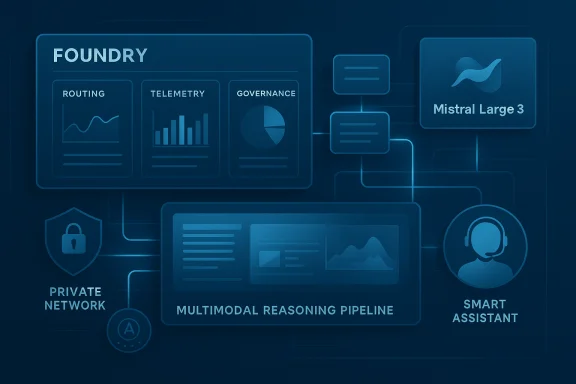
Enterprises are shifting from single‑vendor, closed‑weight AI stacks toward multi‑model strategies that value transparency, portability, and cost‑control. Microsoft’s Foundry (aka Azure AI Foundry) is designed as a cataloged, governed runtime that consolidates multiple model providers, routing policies, and agent orchestration primitives into a single control plane—so organizations can pick the right model for each workload and monitor it centrally.
Mistral Large 3 arrives into this environment claiming a unique combination of production focus, long‑context reasoning, and balanced multimodal competence. Microsoft positions the addition as part of Foundry’s goal to offer both open and commercial frontier models under a single enterprise interface, with routing, monitoring, and Responsible AI controls applied uniformly.
Open models are transforming procurement dynamics—choice is now the competitive axis: you can run models in the cloud under enterprise SLAs, export weights for sovereign deployments, or combine both approaches via hybrid workflows. Microsoft’s Foundry + Mistral Large 3 offers enterprises exactly that flexibility; success will depend on disciplined evaluation, cost engineering, and governance.
Mistral Large 3 in Foundry is not a turnkey panacea, but it is a practical and consequential addition to the enterprise AI toolkit: open‑licensed capability, agent‑ready integration, and production‑grade operational surfaces—all the ingredients most IT teams asked for when they said they wanted choice with control.
Source: Microsoft Azure Mistral 3 on Microsoft Foundry: Open, multimodal, enterprise-ready | Microsoft Azure Blog
 Background
Enterprises are shifting from single‑vendor, closed‑weight AI stacks toward multi‑model strategies that value transparency, portability, and cost‑control. Microsoft’s Foundry (aka Azure AI Foundry) is designed as a cataloged, governed runtime that consolidates multiple model providers, routing policies, and agent orchestration primitives into a single control plane—so organizations can pick the right model for each workload and monitor it centrally.Mistral Large 3 arrives into this environment claiming a unique combination of production focus, long‑context reasoning, and balanced multimodal competence. Microsoft positions the addition as part of Foundry’s goal to offer both open and commercial frontier models under a single enterprise interface, with routing, monitoring, and Responsible AI controls applied uniformly.
What Mistral Large 3 is (and what it isn’t)
The vendor case: production‑ready, open‑weight frontier model
According to Microsoft’s announcement, Mistral Large 3 is an open‑weight, Apache‑licensed frontier model optimized for instruction following, long‑context comprehension, multimodal reasoning, and stable multi‑turn dialogue performance—attributes Microsoft emphasizes as critical for production assistants, retrieval‑augmented workflows, and agentic systems. The Azure post explicitly calls out low hallucination rates, consistent output formatting, and tool calling / agent support as delivered capabilities. Mistral itself makes the licensing position clear: its open models are released under the Apache 2.0 license, which is permissive and allows use, modification, redistribution and commercial use subject to standard Apache terms. That licensing model is central to Mistral’s positioning as an alternative to closed provider stacks.Independent reporting and market context
Independent coverage from multiple outlets describes Mistral’s December 2025 model lineup as a significant European entry in the open‑model arena, emphasizing multilingual and multimodal ambitions and underscoring that Mistral is aiming for “frontier” capabilities while keeping weights open. Journalists note the strategic importance of making powerful open models available outside the China/US closed‑model duopoly. These independent reports corroborate Microsoft’s messaging that Mistral Large 3 is intended for production use, not just experiments.What to treat cautiously
Some early technical claims appearing in industry roundups and aggregators (parameter counts, exact context window sizes, internal training recipes) vary between sources. Those architecture and training‑data claims are often vendor‑reported and not always independently verifiable; treat them as vendor claims until reproducible, primary artifacts (model card, technical paper, or reproducible evaluation) appear. Where such numbers matter for procurement (e.g., memory footprint, shard topology, latency targets), validate with hands‑on tests before committing production traffic.Why Microsoft put Mistral Large 3 into Foundry
Microsoft’s pitch for Foundry is enterprise practicality: a single platform that combines model choice, routing, observability, responsible AI controls, and agent toolchains so organizations can move from prototype to production with predictable governance. Adding Mistral Large 3 does three things for customers:- It expands model choice with a fully open frontier model hosted under Azure’s SLA and governance surfaces.
- It makes a high‑capability open model available through the same model router, dashboards, SDKs, and agent runtimes customers use for other models, supporting A/B routing and cost/fidelity tradeoffs.
- It enables hybrid deployment patterns: customers can call Mistral Large 3 as a managed service in Foundry or, where licensing and operational needs require it, export and run the model weights under Apache 2.0 subject to Mistral’s distribution practices.
Capabilities Microsoft highlights (and what they mean in practice)
Reliable instruction following
Microsoft and Mistral both emphasize consistent adherence to instructions and structured outputs—key for automation, agents, and business logic integration. For enterprise use, that translates into fewer post‑processing steps, easier error handling for tool calls, and more deterministic formatting when chaining outputs into workflows. Enterprises that rely on consistent JSON, CSV or structured snippets in pipelines will find this important.Long‑context comprehension
Mistral Large 3 is marketed as a long‑context model that “processes, retains, and reasons over long documents, multi‑step sequences, and sustained dialogues.” Practically, that supports:- retrieval‑augmented generation (RAG) over long corpora,
- multi‑document synthesis and executive summarization, and
- agents that keep session‑level state across long interactions.
If real, reliable long‑context handling reduces error cascades and the need to reconstruct context across calls—an operational win for complex enterprise workflows.
Multimodal reasoning
The announcement calls out stronger cross‑modal behavior for images + text (visual Q&A, diagram interpretation, multimodal retrieval + grounding). This is increasingly important for document intelligence, support automation (screenshots + complaint narratives), and workflows that combine scanned forms, charts and narrative text. Microsoft’s Foundry integrates vision + language models and document AI tooling that help bring these multimodal features into production.Pricing and availability — practical numbers
Microsoft lists Mistral Large 3 in Foundry as available in public preview on Dec 2, 2025, with the Foundry “Global Standard” deployment in West US 3 and the following per‑million‑token list prices: Input: $0.50 per 1M tokens; Output: $1.50 per 1M tokens (public preview pricing). These published prices are the baseline Microsoft lists in its announcement and are essential to include when modeling costs for high‑volume RAG or agent workloads. Important billing notes for procurement:- Azure’s Foundry model catalog usage typically bills as a managed service; review enterprise consumption commitments, reserved capacity options, and how model routing may distribute tokens across models.
- Preview pricing can change at GA; model economics should be validated via POC runs and shadow tests to measure tokens consumed per typical query pattern.
Enterprise use cases that benefit most
- Enterprise knowledge assistants: long context + RAG to combine corporate knowledge across SharePoint, OneLake and Fabric.
- Document intelligence pipelines: multimodal scanning, structured extraction, and multi‑document synthesis with consistent output formats — good fit for compliance, legal, and finance workflows.
- Developer agents and automation: instruction reliability translates into safer code refactoring, test generation, and CI automation where deterministic outputs matter.
- Multimodal customer experiences: image + text support enables richer digital assistants and troubleshooting flows that analyze screenshots or diagrams alongside chat history.
Operational and governance considerations
Model routing and evaluation
Foundry’s model router allows intelligent routing (cost‑first / quality / balanced) and centralized benchmarking across latency, throughput, and quality. Use the router to run shadow trials and model‑level A/B tests before routing production traffic. Document and automate prompt engineering and scoring to generate apples‑to‑apples model comparisons.Observability and audit trails
Foundry provides telemetry, cost dashboards, and OpenTelemetry traces for agent/workflow runs. Enforce role‑based access, audit logs and content‑safety hooks in the control plane to meet compliance audits. Integrate Foundry telemetry with SOC tooling for runtime detection of anomalous agent behavior.Data residency and private networking
For regulated industries, Foundry supports private VNet and bring‑your‑own‑storage patterns; confirm how model calls traverse network boundaries and whether data copied to a managed endpoint remains covered by your DPA. When models are used with sensitive data, prefer in‑VNet endpoints or hybrid on‑prem deployment where you can.Cost control and token discipline
Token pricing means long contexts and multimodal inputs can escalate costs quickly. Architect RAG pipelines to:- pre‑filter and compress context,
- use smaller models for cheap retrieval/summarization passes, and
- reserve frontier model calls for high‑value reasoning steps.
Foundry’s router and tiering features are designed for this pattern; validate token counts and cost per session in POCs.
Safety, compliance, and licensing details
- Responsible AI & content safety: Microsoft applies content filters and auditability across Foundry. Use these controls to block or log high‑risk outputs and integrate legal/compliance review in your deployment lifecycle.
- Apache 2.0 license: Mistral’s open models are released under Apache 2.0, enabling redistribution, modification, and commercial use under permissive terms. This supports hybrid deployment patterns and on‑prem experiments where policy requires local control of model weights. Confirm any export or commercial constraints with your licensing counsel and Mistral’s published model card.
Risks, trade-offs and red flags
1) Vendor claims vs independent verification
Many of the model’s performance and stability claims are currently vendor‑reported (Mistral and Microsoft). Independent benchmarks, public model cards, and reproducible evaluations should be used to validate claims about hallucination rates, multi‑turn stability, and long‑context coherence. Treat vendor benchmarks as directional until proven in your workload.2) Operational complexity
Supporting many model families increases testing burden: each model has a unique hallucination profile, latency behavior, failure modes and cost pattern. Effective model orchestration requires disciplined CI for prompts, continuous monitoring, and guardrails for fallback behaviors. Without this, routing can route the wrong model for a task and generate inconsistent results.3) Cost dynamics and token inflation
Long‑context and multimodal use cases can consume large token volumes. Even low per‑input prices compound at scale. Simulate representative workloads to establish baseline consumption and estimate queue/backpressure effects under concurrency.4) Legal and data residency nuance
While Apache 2.0 permits wide use of weights, data processed by managed endpoints is still subject to the cloud provider’s processing terms and your DPA. If sovereignty or regulatory constraints are strict, plan for on‑prem deployment or explicit contractual guarantees about data handling.5) Unverifiable technical claims
Some public reports list details such as parameter counts or exotic context windows (e.g., claims of extremely large context windows). These specifics are often published by vendors or summarized in industry roundups but are not always reproducible; label such claims as vendor‑reported and validate on your own before designing architecture dependent on them.Recommended checklist for IT decision‑makers (practical steps)
- Run a scoped POC with real, representative prompts and documents; measure token consumption, latency, hallucination rate and cost per session. Use Foundry’s sandbox + router to compare models.
- Shadow‑route a subset of traffic through Mistral Large 3 and compare outputs against your incumbent model for stability and formatting. Automate scoring for factuality and structure.
- Validate security posture: confirm VNet, private endpoints, and data handling terms; require telemetry export to your SIEM.
- Lock prompt and output contracts: specify expected output schema, failure modes, and fallback logic for agent flows. Version prompts in CI and gate changes.
- Run legal review on licensing + export: Apache 2.0 is permissive, but verify that the exact weights and distributions you plan to use meet your procurement and export controls.
Verdict and outlook
Mistral Large 3 landing in Microsoft Foundry is an important milestone for enterprise AI: it pairs a leading open‑weight frontier model with a mature enterprise runtime that offers routing, governance, telemetry and agent tooling. For organizations seeking model portability, the Apache 2.0 licensing and the ability to experiment with on‑prem or hybrid deployment are meaningful differentiators. That said, prudence is required. Vendor claims about stability, multi‑turn consistency and long‑context performance should be validated under realistic production loads, token economics must be stress‑tested, and integration with an enterprise governance model is non‑negotiable. Foundry’s router, observability and control plane help close the operational gap between PoC and production, but they do not eliminate the need for careful testing, security hardening, and legal review.Open models are transforming procurement dynamics—choice is now the competitive axis: you can run models in the cloud under enterprise SLAs, export weights for sovereign deployments, or combine both approaches via hybrid workflows. Microsoft’s Foundry + Mistral Large 3 offers enterprises exactly that flexibility; success will depend on disciplined evaluation, cost engineering, and governance.
Mistral Large 3 in Foundry is not a turnkey panacea, but it is a practical and consequential addition to the enterprise AI toolkit: open‑licensed capability, agent‑ready integration, and production‑grade operational surfaces—all the ingredients most IT teams asked for when they said they wanted choice with control.
Source: Microsoft Azure Mistral 3 on Microsoft Foundry: Open, multimodal, enterprise-ready | Microsoft Azure Blog
