

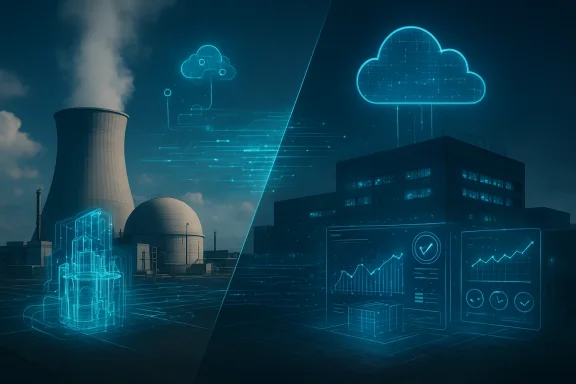
Microsoft and Nvidia are taking another step beyond the familiar AI data-center story, this time aiming their combined software stack at one of the hardest infrastructure problems in the energy sector: nuclear power. According to the companies’ announcement, the partnership will use Microsoft Azure and Nvidia’s Omniverse, CUDA-X, and AI Enterprise tools to reduce friction across the nuclear lifecycle, from permitting and design to construction and ongoing operations. That may sound like a niche industrial software play, but it is really a signal that AI is moving into regulated, capital-intensive industries where the payoff is measured in years rather than quarters. The implications reach far beyond one press release, because nuclear development has long been slowed by complexity, documentation burden, and project execution risk.
The renewed interest in nuclear energy did not begin with this announcement, and it certainly will not end with it. Over the last several years, large technology companies have increasingly treated carbon-free baseload power as a strategic necessity rather than a public-relations slogan. Microsoft has been especially active, publishing a policy brief on advanced nuclear and fusion energy in December 2023 and later updating its carbon-free energy strategy as data-center demand accelerated.
That context matters because AI has changed the scale of the electricity problem. Training and serving large models requires enormous compute, which in turn means more data centers, more grid demand, and more pressure to secure power that is both reliable and low-carbon. Microsoft’s sustainability reporting has acknowledged that energy use has risen sharply alongside AI and cloud growth, even as the company continued to contract renewable energy at scale.
Nuclear power is attractive in this environment because it offers something solar and wind alone cannot always guarantee: 24/7 firm generation. For cloud operators, that is not a philosophical point; it is an operational constraint. If AI workloads are expected to run continuously, the power source has to be equally resilient, and the nuclear industry is one of the few clean-energy sectors built around that promise.
At the same time, nuclear has traditionally been a difficult industry for digital transformation. Plant designs are highly regulated, construction schedules are notoriously volatile, and licensing documentation can be sprawling and repetitive. Microsoft’s recent work with the nuclear sector, including efforts to use AI to streamline licensing workflows and its growing engagement with energy partners, shows that the company has been building toward this moment for some time.
That kind of continuity could help reduce the human labor required to reconcile versions, compare documents, and track changes across thousands of pages. It could also improve decision speed, because engineers and compliance teams would be working from shared simulation outputs rather than manually assembled spreadsheets and reports.
That matters because nuclear is a discipline where small errors become huge liabilities. Better simulation does not eliminate risk, but it can help teams detect design issues earlier, model construction sequencing more accurately, and test operational scenarios before they become real-world problems. In that sense, the partnership is less about flashy AI demos and more about reducing the probability of expensive surprises.
This is not just about electricity supply for Microsoft’s data centers. It is also about building a software layer that can be sold into an entire nuclear ecosystem. If the tools work, the partnership could create a new category of industrial AI: not chatbot-based productivity, but regulated engineering acceleration.
If AI can help generate draft engineering reports, compare prior submissions, or identify inconsistencies before they reach regulators, the benefit could be significant. The goal would not be to automate oversight away; rather, it would be to reduce clerical drag so specialists can focus on substantive safety issues. That distinction is critical in any nuclear application.
AI-driven construction oversight could also help standardize multi-site deployment. That is important if the industry wants to move from one-off megaprojects to more repeatable fleets of reactors. Standardization is one of the few ways to make nuclear economically scalable, and software may be a key enabler.
Some of the most promising applications include:
That matters because the latest announcement should not be misread as a one-off experiment. It looks more like the maturation of a multi-year thesis: if data centers need reliable, clean power, then the software and energy industries must work together to create it.
The nuclear angle adds another layer. Renewables remain important, but they do not solve every load-profile problem, especially for AI-intensive operations that run around the clock. Nuclear therefore becomes less of a legacy technology and more of a strategic complement to the cloud economy.
In practical terms, the company is trying to ensure that AI growth is not constrained by power scarcity. That is a very real strategic risk, and it helps explain why Microsoft keeps attaching itself to energy transition narratives rather than treating them as philanthropic side projects.
In nuclear, simulation is not optional. Reactor designs, thermal behavior, plant layout, and construction sequencing all benefit from higher-fidelity modeling. The more complex the system, the more valuable the digital twin becomes.
The Microsoft partnership reinforces that shift. If Nvidia can demonstrate that its tools shorten nuclear project cycles or improve operational reliability, it gains a powerful reference case in a sector where trust and performance matter more than hype.
Regulators will likely care less about whether a system uses AI and more about whether the outputs are explainable, auditable, and reproducible. Those are non-negotiable properties in nuclear contexts, especially when licensing and operating decisions are involved.
This is one of the quiet truths of enterprise AI: the hardest part is often not the model, but the plumbing. In nuclear, that plumbing includes decades of documentation, multiple vendor systems, and a highly conservative validation culture.
Enterprises also care about repeatability. If the software can standardize processes across projects, then the industry becomes easier to finance and scale. That is where the economic upside becomes most compelling.
There is also a climate angle. If more AI demand can be met with carbon-free baseload power, consumers may see lower emissions associated with digital services. That is not a trivial benefit in a world where cloud usage keeps rising.
That means Microsoft’s move is competitive even if the announcement itself is framed as collaboration. The company is trying to make its platform indispensable to the next wave of energy infrastructure.
That is why implementation matters more than announcement. In industrial AI, the true moat comes from embedded workflows, not press coverage.
One thing to watch is whether Microsoft and Nvidia expand the effort beyond a conceptual platform into named pilot projects with utilities or reactor developers. Another is whether regulators respond positively to AI-assisted documentation and analysis, because that will determine how quickly the technology can spread. A third factor is whether this becomes part of a broader wave of AI-powered energy infrastructure deals.
Microsoft and Nvidia are not trying to reinvent nuclear energy overnight. They are trying to make the industry more legible, more connected, and ultimately more scalable in an era when AI is forcing every large institution to rethink its power needs. If they succeed, the payoff will be bigger than a single software deployment: it could help reshape how critical infrastructure is designed, financed, and operated in the age of artificial intelligence. That is an ambitious goal, but it is also the kind of ambition the AI boom is beginning to demand.
Source: Benzinga Microsoft, Nvidia Team Up To Build AI-Powered Nuclear Energy Future - Microsoft (NASDAQ:MSFT)
 Background
The renewed interest in nuclear energy did not begin with this announcement, and it certainly will not end with it. Over the last several years, large technology companies have increasingly treated carbon-free baseload power as a strategic necessity rather than a public-relations slogan. Microsoft has been especially active, publishing a policy brief on advanced nuclear and fusion energy in December 2023 and later updating its carbon-free energy strategy as data-center demand accelerated.That context matters because AI has changed the scale of the electricity problem. Training and serving large models requires enormous compute, which in turn means more data centers, more grid demand, and more pressure to secure power that is both reliable and low-carbon. Microsoft’s sustainability reporting has acknowledged that energy use has risen sharply alongside AI and cloud growth, even as the company continued to contract renewable energy at scale.
Nuclear power is attractive in this environment because it offers something solar and wind alone cannot always guarantee: 24/7 firm generation. For cloud operators, that is not a philosophical point; it is an operational constraint. If AI workloads are expected to run continuously, the power source has to be equally resilient, and the nuclear industry is one of the few clean-energy sectors built around that promise.
At the same time, nuclear has traditionally been a difficult industry for digital transformation. Plant designs are highly regulated, construction schedules are notoriously volatile, and licensing documentation can be sprawling and repetitive. Microsoft’s recent work with the nuclear sector, including efforts to use AI to streamline licensing workflows and its growing engagement with energy partners, shows that the company has been building toward this moment for some time.
Why This Partnership Matters
The most important thing about the Microsoft-Nvidia alliance is that it treats nuclear energy as a software problem as much as an engineering one. That may not be the whole truth, but it is a useful lens. If AI can reduce rework, improve simulation fidelity, and help teams move from siloed documents to connected digital workflows, then the industry could chip away at one of its biggest cost drivers: uncertainty.From Fragmented Workflows to Digital Continuity
Nuclear projects involve many moving parts, including safety analysis, supply chain coordination, civil works, reactor systems, regulatory filings, and long-term operational monitoring. Historically, those pieces have often lived in separate tools, separate teams, and separate timelines. A connected AI platform promises a more continuous digital thread across the life of a project, which is exactly what regulated industries have lacked.That kind of continuity could help reduce the human labor required to reconcile versions, compare documents, and track changes across thousands of pages. It could also improve decision speed, because engineers and compliance teams would be working from shared simulation outputs rather than manually assembled spreadsheets and reports.
Why Nvidia’s Stack Matters
Nvidia is not just lending brand power here. Omniverse is built around simulation and digital twins, CUDA-X accelerates computational workloads, and AI Enterprise provides an enterprise-grade deployment layer. Together, those tools can turn nuclear workflows into something closer to a living model than a static project file.That matters because nuclear is a discipline where small errors become huge liabilities. Better simulation does not eliminate risk, but it can help teams detect design issues earlier, model construction sequencing more accurately, and test operational scenarios before they become real-world problems. In that sense, the partnership is less about flashy AI demos and more about reducing the probability of expensive surprises.
The Strategic Signal to the Market
The market should read this as another sign that AI infrastructure and energy infrastructure are converging. Nvidia has already framed AI as a national-scale industrial transition, including major collaborations around U.S. energy and scientific infrastructure. Microsoft, meanwhile, has been deepening its own role in carbon-free power procurement and nuclear-adjacent strategy.This is not just about electricity supply for Microsoft’s data centers. It is also about building a software layer that can be sold into an entire nuclear ecosystem. If the tools work, the partnership could create a new category of industrial AI: not chatbot-based productivity, but regulated engineering acceleration.
The Nuclear Bottleneck Problem
Nuclear power has never lacked technical ambition. What it has lacked is speed, predictability, and repeatable execution. Every additional month of delay compounds financing costs, while each regulatory revision can trigger redesign, resubmission, and contractor churn. AI cannot repeal those realities, but it can potentially soften them.Permitting and Licensing Are the First Opportunity
One of the biggest choke points in nuclear development is the licensing process. Applications, safety cases, environmental reviews, and supporting engineering analysis can be expensive to produce and difficult to update consistently. Microsoft’s prior work with the nuclear sector has already pointed in this direction, including efforts to use Azure to streamline licensing workflows.If AI can help generate draft engineering reports, compare prior submissions, or identify inconsistencies before they reach regulators, the benefit could be significant. The goal would not be to automate oversight away; rather, it would be to reduce clerical drag so specialists can focus on substantive safety issues. That distinction is critical in any nuclear application.
Construction Is Where Schedules Go to Die
Even when licensing is successful, nuclear projects often encounter costly construction setbacks. Supply chain delays, quality assurance failures, and site-specific complications can cascade into schedule slippage. Here, digital twins and real-time monitoring may have the most practical value, because they can give managers a more accurate picture of progress and deviation.AI-driven construction oversight could also help standardize multi-site deployment. That is important if the industry wants to move from one-off megaprojects to more repeatable fleets of reactors. Standardization is one of the few ways to make nuclear economically scalable, and software may be a key enabler.
Operations and Maintenance Can Benefit Too
Once plants are online, the value proposition shifts from construction speed to uptime, safety, and predictive maintenance. AI systems can ingest sensor data, compare it against expected behavior, and flag anomalies before they become incidents. That is where a platform built on Azure and Nvidia’s compute stack could become operationally meaningful rather than merely strategic.Some of the most promising applications include:
- Predictive maintenance for critical equipment
- Anomaly detection in plant telemetry
- Digital twin modeling for operating scenarios
- Workforce support for documentation and decision assistance
- Consistency checks across procedures and inspection records
Microsoft’s Energy Strategy in Context
This partnership also fits neatly into Microsoft’s broader energy positioning. The company has spent years building relationships across utilities, nuclear vendors, and policy stakeholders because it sees energy not as a side issue, but as the foundation for cloud and AI expansion. Its own public materials make clear that carbon-free electricity is central to its operating strategy.A Long Build-Up, Not a Sudden Pivot
Microsoft’s nuclear strategy has been evolving through hiring, partnerships, policy work, and sustainability commitments. It has engaged with the nuclear ecosystem through industry memberships and collaboration efforts, while also signaling that advanced nuclear and fusion could help meet long-term decarbonization goals.That matters because the latest announcement should not be misread as a one-off experiment. It looks more like the maturation of a multi-year thesis: if data centers need reliable, clean power, then the software and energy industries must work together to create it.
Energy Procurement Is Becoming a Technology Story
For years, energy procurement was treated as a separate back-office function. That has changed. Hyperscale cloud companies now influence how utilities think about generation, how developers structure projects, and how policymakers discuss grid planning. Microsoft’s footprint in renewable contracts and carbon-free initiatives shows how the company has become a major actor in the power market itself.The nuclear angle adds another layer. Renewables remain important, but they do not solve every load-profile problem, especially for AI-intensive operations that run around the clock. Nuclear therefore becomes less of a legacy technology and more of a strategic complement to the cloud economy.
Why This Helps Microsoft, Not Just the Industry
There is also a competitive rationale. If Microsoft can help modernize nuclear development, it strengthens its pitch to enterprise customers that it understands the full AI stack, from chips to cloud to energy. That creates a broader moat than software alone.In practical terms, the company is trying to ensure that AI growth is not constrained by power scarcity. That is a very real strategic risk, and it helps explain why Microsoft keeps attaching itself to energy transition narratives rather than treating them as philanthropic side projects.
Nvidia’s Role in the Industrial AI Stack
Nvidia has become the default compute layer for AI, but it is also increasingly positioning itself as the backbone of industrial simulation and digital twins. Nuclear energy gives it a highly visible use case where rendering, simulation, and accelerated computing can be tied directly to a national infrastructure goal.Simulation Is Nvidia’s Native Language
Nvidia’s strongest advantage in this partnership is not merely GPUs. It is the ecosystem around them. Omniverse enables digital twin collaboration, while CUDA-X and AI Enterprise let organizations deploy accelerated workflows inside enterprise environments. That combination makes Nvidia an unusually good fit for engineering-heavy industries that need both visual simulation and computational throughput.In nuclear, simulation is not optional. Reactor designs, thermal behavior, plant layout, and construction sequencing all benefit from higher-fidelity modeling. The more complex the system, the more valuable the digital twin becomes.
Industrial Expansion Beyond Consumer AI
Nvidia has been pushing hard to show that its technology matters beyond model training and generative AI chat interfaces. Its public messaging increasingly ties AI infrastructure to national competitiveness, scientific research, manufacturing, and energy. That strategic framing helps the company move from chip supplier to industrial platform company.The Microsoft partnership reinforces that shift. If Nvidia can demonstrate that its tools shorten nuclear project cycles or improve operational reliability, it gains a powerful reference case in a sector where trust and performance matter more than hype.
What This Means for the Competitive Landscape
For rivals, this is another reminder that AI platforms are no longer competing only on inference speed or developer tools. They are competing on industry integration. That means companies like Google, Amazon, and other cloud providers will need to show equally credible stories about how their AI stacks map onto critical infrastructure. The race is now about who can operationalize AI in the real economy.The Regulatory and Safety Dimension
Any discussion of AI in nuclear energy has to start with caution. Nuclear regulation exists for good reason, and the industry’s tolerances for error are lower than almost anywhere else. That does not make AI inappropriate for the sector, but it does make governance absolutely central.AI Can Assist, Not Replace, Oversight
The safest framing is that AI should support human experts, not supplant them. It can help summarize documents, identify gaps, or simulate scenarios, but it cannot be allowed to become an unaccountable decision-maker in safety-critical processes. That is not just an ethical preference; it is a practical necessity.Regulators will likely care less about whether a system uses AI and more about whether the outputs are explainable, auditable, and reproducible. Those are non-negotiable properties in nuclear contexts, especially when licensing and operating decisions are involved.
Data Quality Will Decide the Outcome
A nuclear AI platform is only as good as the data behind it. If the source records are inconsistent, incomplete, or poorly structured, then AI will amplify noise rather than clarity. That means the industry may need to spend heavily on data cleaning and standardization before it sees large gains from automation.This is one of the quiet truths of enterprise AI: the hardest part is often not the model, but the plumbing. In nuclear, that plumbing includes decades of documentation, multiple vendor systems, and a highly conservative validation culture.
Important Safeguards the Industry Will Need
- Clear audit trails for every AI-assisted output
- Human sign-off on all safety-critical decisions
- Validation against independent benchmarks
- Role-based access controls for sensitive data
- Fallback procedures if AI systems fail or degrade
- Regulatory alignment before deployment at scale
Enterprise Versus Consumer Impact
This story is mostly about enterprise infrastructure, but the implications may still reach consumers indirectly. The average PC buyer will not interact with a nuclear licensing model, yet the downstream effect could influence energy costs, cloud reliability, and the pace at which AI services expand.Enterprise: The Immediate Winner
For enterprise customers, the value proposition is clearer. Energy developers, utilities, engineering firms, and reactor vendors could potentially use Microsoft and Nvidia’s platform to reduce design friction and improve project visibility. That could lower costs, shorten timelines, and make fleet deployment more realistic.Enterprises also care about repeatability. If the software can standardize processes across projects, then the industry becomes easier to finance and scale. That is where the economic upside becomes most compelling.
Consumer: The Indirect Benefit
Consumers may not care how a reactor gets licensed, but they care about whether AI services remain available, affordable, and fast. If the power bottleneck eases, hyperscalers can support more capacity without constantly running into energy constraints. That could, over time, improve service quality and reduce pressure on pricing.There is also a climate angle. If more AI demand can be met with carbon-free baseload power, consumers may see lower emissions associated with digital services. That is not a trivial benefit in a world where cloud usage keeps rising.
The Broader Market Message
The broader market should see this as another example of AI moving down the stack into heavy industry. The winners will not just be the companies that build the smartest models, but the ones that can integrate those models into messy, regulated, real-world systems. That is the next frontier of enterprise AI.Competitive Implications for Cloud and Energy Rivals
This partnership puts pressure on a wide range of rivals, even if they are not direct participants in nuclear energy. The cloud market has become increasingly tied to infrastructure credibility, and credibility now includes power strategy. Microsoft is signaling that it wants to be seen not merely as a cloud vendor, but as an industrial enabler.Hyperscalers Must Answer the Energy Question
Amazon, Google, and others are also chasing clean power and AI scale, which makes the energy race increasingly strategic. Recent developments across the industry show that companies are looking at nuclear, advanced geothermal, and large-scale renewable procurement as ways to secure AI growth.That means Microsoft’s move is competitive even if the announcement itself is framed as collaboration. The company is trying to make its platform indispensable to the next wave of energy infrastructure.
Software Vendors Now Compete on Industry Depth
Traditional enterprise software firms will also feel the pressure. Generic AI tools are useful, but industries like nuclear need domain-specific workflows, compliance awareness, and simulation depth. If Microsoft and Nvidia can show that their stack handles regulated infrastructure better than plain-language copilots or generic cloud analytics, they gain an advantage that is hard to dislodge.Ecosystem Effects Will Matter More Than Branding
The key question is whether third parties adopt the platform. If engineering firms, reactor developers, and utilities see real productivity gains, the ecosystem effect could become self-reinforcing. But if the tools remain a showcase without broad adoption, the competitive impact will be limited.That is why implementation matters more than announcement. In industrial AI, the true moat comes from embedded workflows, not press coverage.
Strengths and Opportunities
The partnership has several real strengths, and the opportunity set is broader than one energy segment. It sits at the intersection of AI software, cloud infrastructure, and carbon-free electricity, which gives it strategic leverage in multiple markets at once.- High-value use case: nuclear projects are expensive, slow, and documentation-heavy, so even modest efficiency gains could matter.
- Strong technical fit: Nvidia’s simulation stack and Microsoft’s cloud infrastructure align well with engineering workflows.
- Regulatory relevance: AI that improves licensing consistency could create measurable value if deployed carefully.
- Carbon-free alignment: the effort fits Microsoft’s broader sustainability and power strategy.
- Enterprise credibility: success here would strengthen both companies’ reputations in regulated industries.
- Platform expansion: the tools could be adapted for utilities, grid operators, and other critical infrastructure users.
- Long-term moat: embedded industrial workflows are harder to replace than generic software subscriptions.
Risks and Concerns
The upside is real, but so are the dangers. Nuclear is a sector where technology optimism can outrun operational discipline, and that would be a mistake here. The partnership will need to prove that it improves outcomes without creating new failure modes.- Overpromising risk: AI can support nuclear workflows, but it cannot magically fix regulatory delay or construction complexity.
- Data quality problems: legacy records and inconsistent formats could undermine model usefulness.
- Safety sensitivity: any AI error in a nuclear context would attract intense scrutiny.
- Regulatory friction: regulators may move cautiously, slowing adoption.
- Vendor lock-in: utilities and contractors may worry about becoming too dependent on a single cloud-and-chip ecosystem.
- Cybersecurity exposure: more connected digital workflows can expand the attack surface.
- Execution gap: pilot projects may look strong while large-scale deployment proves much harder.
What to Watch Next
The next phase of this story will be about deployment, not declarations. Investors, utilities, and infrastructure specialists will want to see whether the partnership produces measurable improvements in licensing time, construction visibility, or operational reliability.One thing to watch is whether Microsoft and Nvidia expand the effort beyond a conceptual platform into named pilot projects with utilities or reactor developers. Another is whether regulators respond positively to AI-assisted documentation and analysis, because that will determine how quickly the technology can spread. A third factor is whether this becomes part of a broader wave of AI-powered energy infrastructure deals.
- Pilot programs with utilities, reactor developers, or engineering firms
- Regulatory acceptance of AI-assisted documentation workflows
- Integration depth with existing nuclear engineering tools
- Evidence of schedule or cost reduction in real projects
- Broader ecosystem adoption beyond Microsoft’s own cloud base
Microsoft and Nvidia are not trying to reinvent nuclear energy overnight. They are trying to make the industry more legible, more connected, and ultimately more scalable in an era when AI is forcing every large institution to rethink its power needs. If they succeed, the payoff will be bigger than a single software deployment: it could help reshape how critical infrastructure is designed, financed, and operated in the age of artificial intelligence. That is an ambitious goal, but it is also the kind of ambition the AI boom is beginning to demand.
Source: Benzinga Microsoft, Nvidia Team Up To Build AI-Powered Nuclear Energy Future - Microsoft (NASDAQ:MSFT)
