

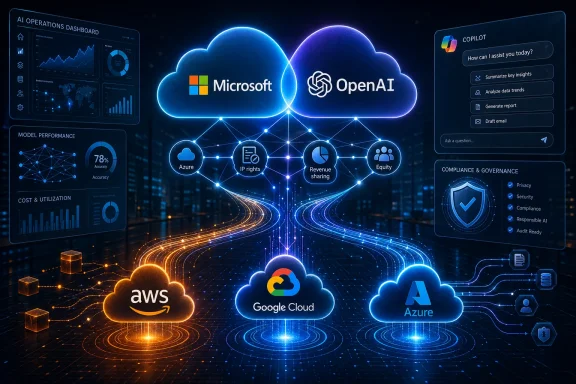
Microsoft and OpenAI have moved from a tightly coupled, quasi-exclusive alliance into a more open and strategically flexible relationship, ending one of the defining arrangements of the generative AI boom. The revised pact keeps the two companies deeply connected through Azure, intellectual property rights, revenue sharing, equity ownership, and joint infrastructure work, but it also gives OpenAI far more freedom to distribute its products across rival clouds. For Microsoft, the shift is not a surrender so much as a controlled transition from exclusive gatekeeper to major shareholder, platform partner, and AI competitor. For the wider market, it signals that the next phase of enterprise AI will be multi-cloud, multi-model, and far less dependent on a single privileged channel.
The Microsoft-OpenAI partnership began as a bold bet before generative AI became the center of the technology industry. Microsoft’s 2019 investment gave OpenAI the compute muscle it needed to train increasingly capable models, while Microsoft gained early access to technology that would eventually become the engine behind Copilot, Azure OpenAI Service, and a broad reinvention of its productivity stack.
That arrangement became far more consequential after ChatGPT’s breakout moment in late 2022. Microsoft moved quickly to integrate OpenAI models into Bing, Edge, Microsoft 365, GitHub, Windows, and Azure, effectively turning OpenAI’s research momentum into a commercial platform strategy. The result was one of the most powerful alliances in modern technology: OpenAI built the models, Microsoft supplied compute and distribution, and enterprise customers gained a familiar route to generative AI through Azure.
But the partnership always contained tension. OpenAI needed enormous amounts of capital and infrastructure, while Microsoft wanted predictable access to frontier models that could differentiate its software and cloud services. As OpenAI’s ambitions grew beyond Microsoft’s ecosystem, the original exclusivity started to look less like a moat and more like a constraint.
The latest amendment reflects that changing reality. Microsoft’s license to OpenAI intellectual property now runs through 2032 but is non-exclusive, while OpenAI can serve products through any cloud provider. This is not a clean break; it is a carefully negotiated rebalancing that preserves Microsoft’s upside while giving OpenAI room to scale globally.
Key context includes:
The new structure turns that advantage into a softer form of preference. Microsoft still has privileged status, deep technical integration, and years of accumulated enterprise trust. But OpenAI can now pursue customers and partners without treating Azure as the mandatory center of gravity.
This shift should be understood as managed openness, not a divorce. Microsoft keeps IP rights, equity exposure, and major product integration benefits. OpenAI gets distribution flexibility, a cleaner growth story, and more leverage with customers that want choice.
For enterprise buyers, the change reduces the fear of being forced into a single-vendor architecture. For rivals, it opens the door to direct OpenAI partnerships that were previously limited or impractical. For Microsoft, it creates pressure to compete on product quality, governance, integration, and cloud economics rather than contractual scarcity.
The practical changes include:
For years, CIOs have resisted vendor lock-in even while adopting platform ecosystems. In AI, that concern is sharper because models are increasingly tied to sensitive data, workflow automation, security review, and compliance obligations. A company using AWS for data lakes, Google Cloud for analytics, and Microsoft 365 for productivity does not want its AI strategy dictated by a single infrastructure provider.
The revised pact positions OpenAI to become more like a cross-cloud model layer. That does not mean every deployment will be identical across clouds, but it does mean customers can ask for OpenAI capabilities where their data, policies, and engineering teams already live. That is a major commercial unlock.
A more open OpenAI also gives enterprise architects more room to design resilient systems. If one cloud region, pricing model, or compliance pathway becomes problematic, customers can explore alternatives without abandoning OpenAI altogether. That flexibility is especially important for industries such as finance, healthcare, manufacturing, defense, and public sector operations.
Enterprise impacts include:
Microsoft also owns the most mature enterprise productivity distribution channel for OpenAI-powered experiences. Microsoft 365 Copilot, GitHub Copilot, Security Copilot, Dynamics 365, Teams, Windows, and Azure AI Foundry give Microsoft something cloud rivals cannot easily copy: direct access to daily workflows. Even if OpenAI models appear on AWS or Google Cloud, Microsoft can still embed AI where employees already work.
The key question is whether Microsoft can convert that distribution into durable product leadership. If Copilot feels indispensable, Microsoft wins regardless of OpenAI’s broader availability. If customers see Copilot as merely one wrapper around widely available models, Microsoft’s advantage narrows.
This is where Microsoft’s enterprise DNA helps. The company knows how to sell to regulated industries, support global accounts, and integrate AI into identity, productivity, device management, and security. The challenge is avoiding complacency as OpenAI itself becomes more portable.
Azure’s remaining advantages include:
The company’s recapitalization into a public benefit corporation framework already signaled an effort to reconcile mission, governance, and capital needs. The new partnership terms go further by giving OpenAI a broader commercial field. A model company pursuing an IPO needs to show that it can sell across the market, not only through one powerful shareholder’s cloud.
This is also about customer perception. OpenAI wants to be seen as an independent AI platform, not merely an innovation arm of Microsoft. The looser structure supports that message while still retaining Microsoft’s capital, infrastructure, and enterprise credibility.
However, openness does not solve the compute problem by itself. Frontier AI remains extraordinarily capital-intensive, and OpenAI’s partnerships with hyperscalers and chip providers will remain essential. The difference is that OpenAI can now spread that burden across more partners.
A cleaner IPO story may emphasize:
For AWS, the opportunity is particularly significant. Many large companies already run core workloads, data pipelines, and cloud-native applications on AWS. If OpenAI models become easily available in that environment, AWS can tell customers they no longer need to split AI strategy from cloud architecture.
Google Cloud’s opportunity is different but still meaningful. Google can combine its own AI models, TPU infrastructure, data analytics stack, and potentially OpenAI access into a broader model-choice story. The company has long argued that customers want openness, and this deal gives that argument new momentum.
This does not mean OpenAI will automatically dominate every cloud marketplace. Anthropic, Google, Meta, Mistral, Cohere, xAI, Microsoft’s own models, and open-weight systems will compete aggressively. But OpenAI’s brand recognition and developer mindshare remain enormous.
Competitive implications include:
That strategy now looks prescient. Once OpenAI can distribute more broadly, Microsoft needs proprietary differentiation inside Copilot, Azure, Windows, and security products. It can still use OpenAI where frontier reasoning matters, but it can use smaller or specialized Microsoft models where cost, latency, privacy, or task-specific accuracy matter more.
This is likely how enterprise AI will mature. Not every task requires the largest model. Many workflows need fast transcription, classification, summarization, image generation, code assistance, policy checking, or narrow domain reasoning. Microsoft can optimize those workloads with its own models while reserving frontier OpenAI models for more complex jobs.
It also gives Microsoft leverage in future negotiations. If the company can replace some OpenAI usage with internal models, it can control costs and reduce dependency. That does not mean Microsoft wants to abandon OpenAI; it means Microsoft wants strategic balance.
Microsoft’s model strategy now rests on:
Earlier partnership terms included mechanisms related to AGI declarations and verification. In theory, those provisions were designed to balance safety, mission, and commercial access. In practice, they created a high-stakes trigger around a concept no one in the industry can define with universal precision.
Removing AGI from the financial mechanics makes the partnership more stable. It prevents a future model launch from instantly becoming a legal and economic crisis over whether the system qualifies as AGI. That matters because AI capability will likely improve gradually across many dimensions rather than through one universally accepted threshold.
The revised deal substitutes clearer time horizons for speculative milestones. Microsoft retains IP access through 2032, and OpenAI continues revenue-share payments through 2030 under capped terms. Those dates are easier to model, audit, and explain.
The AGI decoupling matters because:
By ending exclusivity, Microsoft and OpenAI can argue that their partnership is less restrictive than before. OpenAI can now work across cloud providers, and Microsoft’s license is no longer a choke point. That may reduce antitrust pressure, even if it does not eliminate regulatory questions.
Regulators will still care about compute concentration, cloud credits, privileged model access, data flows, and whether hyperscalers use investment deals to shape AI competition. The market may become more open at the model-distribution layer while remaining concentrated at the infrastructure layer. That is the paradox regulators will be watching.
Still, openness on paper must translate into meaningful customer choice. If contractual terms, pricing, technical delays, or capacity limits make non-Azure deployments second-class, regulators could remain skeptical. The details of implementation will matter as much as the public announcement.
Regulatory questions to monitor include:
If OpenAI can scale across more infrastructure, consumer services could become more resilient and potentially faster in more regions. Broader cloud access may also help OpenAI launch features that require specialized infrastructure or regional compliance. Over time, that could improve availability for ChatGPT, voice products, coding tools, agents, and multimodal experiences.
Microsoft users may see a different kind of effect. Copilot could become more distinctly Microsoft-flavored as the company blends OpenAI with internal models and product-specific tuning. That may improve experiences in Windows, Office, Edge, and Teams, but it could also widen the gap between ChatGPT and Copilot as separate products.
This could push Microsoft to make Copilot more context-aware, more local where appropriate, and more deeply integrated with files, settings, apps, and workflows. It may also accelerate the use of smaller on-device models for privacy-sensitive tasks. The result could be a more hybrid AI architecture in Windows: local models for lightweight assistance, cloud models for advanced reasoning, and enterprise controls for governance.
Consumer-facing possibilities include:
For Microsoft, the arrangement preserves financial upside without requiring exclusivity. The company remains a major shareholder, continues to benefit from OpenAI revenue sharing, and can monetize Azure AI services more directly. It also avoids paying OpenAI a cut on Azure-hosted model usage, improving the economics of its cloud AI business.
For OpenAI, the cap and fixed horizon make obligations more predictable. That matters for IPO planning because investors will scrutinize gross margins and long-term payment burdens. A capped revenue-share obligation is easier to evaluate than an open-ended arrangement tied to uncertain technical milestones.
A simplified view of the economics looks like this:
Microsoft’s response will be just as important. Expect the company to lean harder into Copilot integration, enterprise controls, security, Windows AI features, and its own model portfolio. Microsoft does not need to prevent OpenAI from succeeding elsewhere; it needs to ensure that the best Microsoft AI experiences remain hard to replicate outside its ecosystem.
What to watch next:
OpenAI, meanwhile, must show that independence does not create chaos. A multi-cloud OpenAI can reach more customers, but it must maintain consistency, safety, reliability, and developer trust across environments. That is a difficult operational challenge, even for a company with vast capital and demand.
The Microsoft-OpenAI relationship is entering its most mature and complicated phase: less exclusive, more commercial, more competitive, and arguably more realistic. The old arrangement helped ignite the generative AI era; the new one reflects an industry that has outgrown single-channel distribution. If both companies execute well, this could produce a healthier AI ecosystem with more choice for enterprises and stronger products for consumers. If they stumble, the market may discover that loosening a partnership is easier than coordinating the infrastructure, economics, and trust needed to make open AI distribution work at global scale.
Source: YourStory.com Microsoft and OpenAI are no longer exclusive as they move towards an open relationship
 Background
The Microsoft-OpenAI partnership began as a bold bet before generative AI became the center of the technology industry. Microsoft’s 2019 investment gave OpenAI the compute muscle it needed to train increasingly capable models, while Microsoft gained early access to technology that would eventually become the engine behind Copilot, Azure OpenAI Service, and a broad reinvention of its productivity stack.That arrangement became far more consequential after ChatGPT’s breakout moment in late 2022. Microsoft moved quickly to integrate OpenAI models into Bing, Edge, Microsoft 365, GitHub, Windows, and Azure, effectively turning OpenAI’s research momentum into a commercial platform strategy. The result was one of the most powerful alliances in modern technology: OpenAI built the models, Microsoft supplied compute and distribution, and enterprise customers gained a familiar route to generative AI through Azure.
But the partnership always contained tension. OpenAI needed enormous amounts of capital and infrastructure, while Microsoft wanted predictable access to frontier models that could differentiate its software and cloud services. As OpenAI’s ambitions grew beyond Microsoft’s ecosystem, the original exclusivity started to look less like a moat and more like a constraint.
The latest amendment reflects that changing reality. Microsoft’s license to OpenAI intellectual property now runs through 2032 but is non-exclusive, while OpenAI can serve products through any cloud provider. This is not a clean break; it is a carefully negotiated rebalancing that preserves Microsoft’s upside while giving OpenAI room to scale globally.
Why this moment matters
The timing is important because AI infrastructure has become the new battleground for cloud computing. Azure, AWS, Google Cloud, Oracle, and specialized AI infrastructure firms are all competing to host training, inference, agents, and enterprise data workflows. OpenAI could not remain the defining model company of the era while being perceived as available primarily through one cloud door.Key context includes:
- Microsoft remains OpenAI’s primary cloud partner, with new products still expected to launch first on Azure when Azure can support them.
- OpenAI gains multi-cloud freedom, allowing it to reach customers already standardized on AWS, Google Cloud, or other providers.
- Microsoft retains long-term IP access, ensuring Copilot and Azure AI customers do not suddenly lose the foundation beneath their tools.
- Revenue sharing is simplified, with OpenAI continuing payments to Microsoft through 2030 under capped terms.
- AGI-related business triggers are removed, reducing uncertainty around a vague and potentially explosive milestone.
The End of Exclusivity Is Not the End of the Partnership
The headline change is simple: Microsoft is no longer the exclusive commercial gateway for much of OpenAI’s technology. That matters because exclusivity gave Microsoft an unusually strong position in the early enterprise AI market. Companies that wanted OpenAI’s most advanced capabilities often had to think seriously about Azure, even if their existing infrastructure lived elsewhere.The new structure turns that advantage into a softer form of preference. Microsoft still has privileged status, deep technical integration, and years of accumulated enterprise trust. But OpenAI can now pursue customers and partners without treating Azure as the mandatory center of gravity.
This shift should be understood as managed openness, not a divorce. Microsoft keeps IP rights, equity exposure, and major product integration benefits. OpenAI gets distribution flexibility, a cleaner growth story, and more leverage with customers that want choice.
What “non-exclusive” changes
A non-exclusive license means Microsoft can continue using OpenAI technology, but OpenAI can also license and distribute its models elsewhere. That alters the balance of power across the AI stack. Microsoft no longer has the comfort of being the only hyperscaler with deep OpenAI access.For enterprise buyers, the change reduces the fear of being forced into a single-vendor architecture. For rivals, it opens the door to direct OpenAI partnerships that were previously limited or impractical. For Microsoft, it creates pressure to compete on product quality, governance, integration, and cloud economics rather than contractual scarcity.
The practical changes include:
- OpenAI products can reach more enterprise environments without requiring cloud migration.
- AWS and Google Cloud become more credible OpenAI distribution candidates.
- Azure OpenAI Service must compete more visibly on performance, compliance, pricing, and integration.
- Microsoft’s Copilot roadmap remains protected through long-term model access.
- OpenAI’s IPO narrative becomes cleaner because the company looks less dependent on a single strategic backer.
Multi-Cloud AI Becomes the New Enterprise Default
Enterprise IT rarely moves in straight lines. Large organizations typically run hybrid systems across multiple clouds, legacy data centers, SaaS platforms, and regulated environments. OpenAI’s new freedom fits that reality far better than a model distribution strategy centered on one hyperscaler.For years, CIOs have resisted vendor lock-in even while adopting platform ecosystems. In AI, that concern is sharper because models are increasingly tied to sensitive data, workflow automation, security review, and compliance obligations. A company using AWS for data lakes, Google Cloud for analytics, and Microsoft 365 for productivity does not want its AI strategy dictated by a single infrastructure provider.
The revised pact positions OpenAI to become more like a cross-cloud model layer. That does not mean every deployment will be identical across clouds, but it does mean customers can ask for OpenAI capabilities where their data, policies, and engineering teams already live. That is a major commercial unlock.
Why CIOs will care
The enterprise value is less about brand excitement and more about procurement reality. AI projects often fail not because the model is weak, but because integration, governance, latency, cost, or security review becomes too difficult. Multi-cloud availability lowers the friction.A more open OpenAI also gives enterprise architects more room to design resilient systems. If one cloud region, pricing model, or compliance pathway becomes problematic, customers can explore alternatives without abandoning OpenAI altogether. That flexibility is especially important for industries such as finance, healthcare, manufacturing, defense, and public sector operations.
Enterprise impacts include:
- Less pressure to migrate workloads solely to access OpenAI models.
- Better alignment with existing cloud commitments and reserved capacity.
- More bargaining power in cloud and AI procurement negotiations.
- Improved resilience through diversified deployment options.
- Greater ability to meet regional data residency and sovereignty rules.
Azure Still Has a Strong Hand
Microsoft loses exclusivity, but it does not lose relevance. Azure remains the default first stop for many OpenAI launches, and Microsoft has years of operational experience serving OpenAI-derived capabilities at enterprise scale. That experience is not trivial; running frontier AI reliably requires specialized infrastructure, networking, safety systems, telemetry, and support.Microsoft also owns the most mature enterprise productivity distribution channel for OpenAI-powered experiences. Microsoft 365 Copilot, GitHub Copilot, Security Copilot, Dynamics 365, Teams, Windows, and Azure AI Foundry give Microsoft something cloud rivals cannot easily copy: direct access to daily workflows. Even if OpenAI models appear on AWS or Google Cloud, Microsoft can still embed AI where employees already work.
The key question is whether Microsoft can convert that distribution into durable product leadership. If Copilot feels indispensable, Microsoft wins regardless of OpenAI’s broader availability. If customers see Copilot as merely one wrapper around widely available models, Microsoft’s advantage narrows.
From exclusivity to execution
Microsoft’s strategy now depends more heavily on execution quality. The company must prove that Azure is not just the old exclusive channel, but the best enterprise environment for OpenAI and Microsoft models alike. That means latency, reliability, security, compliance, observability, and cost control matter more than ever.This is where Microsoft’s enterprise DNA helps. The company knows how to sell to regulated industries, support global accounts, and integrate AI into identity, productivity, device management, and security. The challenge is avoiding complacency as OpenAI itself becomes more portable.
Azure’s remaining advantages include:
- Deep integration with Microsoft 365 and Windows ecosystems.
- Established Azure OpenAI governance and compliance pathways.
- A large installed base of enterprise customers already using Microsoft identity and security tools.
- Priority access for many OpenAI product launches when Azure can support them.
- A growing portfolio of Microsoft-built AI models to complement OpenAI systems.
OpenAI Gets Room to Grow Before an IPO
OpenAI’s transition toward a more conventional corporate structure and a potential public-market future requires a clearer story. Investors generally dislike dependency risk, especially when a company’s revenue growth, infrastructure access, and product distribution are heavily tied to one strategic partner. The amended Microsoft deal helps reduce that concern.The company’s recapitalization into a public benefit corporation framework already signaled an effort to reconcile mission, governance, and capital needs. The new partnership terms go further by giving OpenAI a broader commercial field. A model company pursuing an IPO needs to show that it can sell across the market, not only through one powerful shareholder’s cloud.
This is also about customer perception. OpenAI wants to be seen as an independent AI platform, not merely an innovation arm of Microsoft. The looser structure supports that message while still retaining Microsoft’s capital, infrastructure, and enterprise credibility.
The IPO logic
A public offering would intensify scrutiny of OpenAI’s margins, revenue concentration, compute obligations, governance, and competitive risks. Multi-cloud freedom gives OpenAI more ways to grow revenue and diversify channels. It also makes the company’s future easier to explain to investors who want optionality rather than dependency.However, openness does not solve the compute problem by itself. Frontier AI remains extraordinarily capital-intensive, and OpenAI’s partnerships with hyperscalers and chip providers will remain essential. The difference is that OpenAI can now spread that burden across more partners.
A cleaner IPO story may emphasize:
- Broader distribution beyond Azure.
- Reduced dependency on one infrastructure provider.
- Expanded enterprise access through existing customer cloud footprints.
- More strategic leverage with hyperscalers and chipmakers.
- A clearer separation between Microsoft’s shareholder role and OpenAI’s operating independence.
Amazon and Google Gain a Strategic Opening
The clearest competitive beneficiaries are AWS and Google Cloud. Amazon has already invested heavily in AI infrastructure and model distribution through Bedrock, while Google has its own Gemini models and deep AI research heritage. The ability to offer OpenAI products more directly gives both companies a new way to challenge Azure in enterprise AI conversations.For AWS, the opportunity is particularly significant. Many large companies already run core workloads, data pipelines, and cloud-native applications on AWS. If OpenAI models become easily available in that environment, AWS can tell customers they no longer need to split AI strategy from cloud architecture.
Google Cloud’s opportunity is different but still meaningful. Google can combine its own AI models, TPU infrastructure, data analytics stack, and potentially OpenAI access into a broader model-choice story. The company has long argued that customers want openness, and this deal gives that argument new momentum.
Bedrock, Gemini, and the model marketplace
The next phase of AI cloud competition will likely resemble a marketplace of models, tools, and agent frameworks. Customers will choose models based on task, cost, latency, policy, and integration. OpenAI’s cross-cloud availability accelerates that shift.This does not mean OpenAI will automatically dominate every cloud marketplace. Anthropic, Google, Meta, Mistral, Cohere, xAI, Microsoft’s own models, and open-weight systems will compete aggressively. But OpenAI’s brand recognition and developer mindshare remain enormous.
Competitive implications include:
- AWS can strengthen Bedrock with OpenAI access alongside Anthropic and other models.
- Google Cloud can position itself as a model-choice platform rather than only a Gemini platform.
- Azure must defend its AI leadership through differentiated services, not exclusivity alone.
- Customers can benchmark OpenAI performance across infrastructure providers.
- Model routing, evaluation, and cost optimization tools become more important.
Microsoft’s In-House AI Push Looks More Important Now
Microsoft has spent the past two years reducing the risk of being seen as only an OpenAI reseller. Its Phi small language models, MAI-branded systems, internal model research, and growing multi-model approach all point in the same direction. The company wants OpenAI as a strategic partner, but it also wants independent AI capability.That strategy now looks prescient. Once OpenAI can distribute more broadly, Microsoft needs proprietary differentiation inside Copilot, Azure, Windows, and security products. It can still use OpenAI where frontier reasoning matters, but it can use smaller or specialized Microsoft models where cost, latency, privacy, or task-specific accuracy matter more.
This is likely how enterprise AI will mature. Not every task requires the largest model. Many workflows need fast transcription, classification, summarization, image generation, code assistance, policy checking, or narrow domain reasoning. Microsoft can optimize those workloads with its own models while reserving frontier OpenAI models for more complex jobs.
The multi-model Microsoft stack
The old story was simple: Microsoft brought OpenAI to the enterprise. The new story is more layered: Microsoft will combine OpenAI, Microsoft-built models, selected third-party models, enterprise data connectors, governance tools, and workflow integration. That is a stronger platform story if Microsoft executes well.It also gives Microsoft leverage in future negotiations. If the company can replace some OpenAI usage with internal models, it can control costs and reduce dependency. That does not mean Microsoft wants to abandon OpenAI; it means Microsoft wants strategic balance.
Microsoft’s model strategy now rests on:
- Frontier OpenAI models for high-value reasoning and generation.
- Phi models for efficient small-language-model workloads.
- MAI models for voice, image, transcription, and consumer-facing experiences.
- Third-party models where customer preference or specialization demands them.
- Azure tooling that manages evaluation, safety, deployment, and monitoring across model families.
The AGI Clause Had Become a Liability
One of the most consequential parts of the amendment is the decoupling of revenue sharing from artificial general intelligence milestones. AGI is both technically ambiguous and commercially explosive. Tying major business rights to such a disputed threshold created uncertainty for investors, customers, regulators, and the companies themselves.Earlier partnership terms included mechanisms related to AGI declarations and verification. In theory, those provisions were designed to balance safety, mission, and commercial access. In practice, they created a high-stakes trigger around a concept no one in the industry can define with universal precision.
Removing AGI from the financial mechanics makes the partnership more stable. It prevents a future model launch from instantly becoming a legal and economic crisis over whether the system qualifies as AGI. That matters because AI capability will likely improve gradually across many dimensions rather than through one universally accepted threshold.
Why ambiguity is bad business
Businesses can handle risk, but they struggle with undefined triggers. If revenue sharing, IP access, or exclusivity can change based on a disputed technical declaration, every breakthrough becomes a negotiation hazard. That is especially dangerous for public-market investors.The revised deal substitutes clearer time horizons for speculative milestones. Microsoft retains IP access through 2032, and OpenAI continues revenue-share payments through 2030 under capped terms. Those dates are easier to model, audit, and explain.
The AGI decoupling matters because:
- It reduces the chance of a sudden contractual rupture.
- It makes OpenAI’s financial outlook easier to understand.
- It protects Microsoft from losing access based on a contested declaration.
- It lowers the legal drama around frontier model releases.
- It shifts AGI back toward a technical and safety debate rather than a payment trigger.
Regulators Still Loom Over AI Partnerships
The revised agreement also arrives in a climate of regulatory scrutiny. Competition authorities in the United States, United Kingdom, and Europe have examined whether cloud-provider investments in AI labs give dominant platforms too much control over emerging markets. Microsoft-OpenAI, Amazon-Anthropic, and Google-Anthropic have all been part of that broader conversation.By ending exclusivity, Microsoft and OpenAI can argue that their partnership is less restrictive than before. OpenAI can now work across cloud providers, and Microsoft’s license is no longer a choke point. That may reduce antitrust pressure, even if it does not eliminate regulatory questions.
Regulators will still care about compute concentration, cloud credits, privileged model access, data flows, and whether hyperscalers use investment deals to shape AI competition. The market may become more open at the model-distribution layer while remaining concentrated at the infrastructure layer. That is the paradox regulators will be watching.
Openness as a regulatory signal
The amendment functions as a market move and a policy signal. It tells regulators that OpenAI is not locked inside Microsoft and that customers can access its technology through more than one cloud. That weakens the argument that the Microsoft-OpenAI relationship is effectively a stealth acquisition.Still, openness on paper must translate into meaningful customer choice. If contractual terms, pricing, technical delays, or capacity limits make non-Azure deployments second-class, regulators could remain skeptical. The details of implementation will matter as much as the public announcement.
Regulatory questions to monitor include:
- Whether rival clouds receive timely and full access to OpenAI products.
- How cloud capacity is allocated during model launches.
- Whether Microsoft’s IP rights create hidden competitive advantages.
- How revenue-sharing economics influence platform pricing.
- Whether AI partnerships reduce or increase customer lock-in over time.
Consumer Impact Will Be Subtle but Real
For consumers, the immediate effect may not be obvious. ChatGPT will still work, Copilot will still appear across Microsoft products, and most people will not choose a cloud provider before asking an AI assistant to summarize an email. The change is mostly structural, but structural changes eventually shape consumer products.If OpenAI can scale across more infrastructure, consumer services could become more resilient and potentially faster in more regions. Broader cloud access may also help OpenAI launch features that require specialized infrastructure or regional compliance. Over time, that could improve availability for ChatGPT, voice products, coding tools, agents, and multimodal experiences.
Microsoft users may see a different kind of effect. Copilot could become more distinctly Microsoft-flavored as the company blends OpenAI with internal models and product-specific tuning. That may improve experiences in Windows, Office, Edge, and Teams, but it could also widen the gap between ChatGPT and Copilot as separate products.
Windows and Copilot implications
WindowsForum readers should pay particular attention to how this affects Copilot in Windows and Microsoft 365. If OpenAI becomes less exclusive, Microsoft must make Copilot valuable through integration rather than model access alone. The operating system, productivity suite, identity layer, and enterprise management tools become the differentiators.This could push Microsoft to make Copilot more context-aware, more local where appropriate, and more deeply integrated with files, settings, apps, and workflows. It may also accelerate the use of smaller on-device models for privacy-sensitive tasks. The result could be a more hybrid AI architecture in Windows: local models for lightweight assistance, cloud models for advanced reasoning, and enterprise controls for governance.
Consumer-facing possibilities include:
- More reliable ChatGPT capacity as OpenAI diversifies infrastructure.
- More differentiated Copilot experiences inside Windows and Microsoft 365.
- Faster development of voice, image, and agent features.
- Greater use of small models on PCs with neural processing units.
- Clearer separation between OpenAI’s consumer app strategy and Microsoft’s productivity AI strategy.
The Financial Terms Reveal the New Balance
The revised financial mechanics show how both sides are trying to reduce friction. Microsoft will no longer pay revenue share to OpenAI for customers accessing models through Azure, while OpenAI continues paying Microsoft a capped share of its revenue through 2030. That creates a cleaner distinction between Microsoft’s platform business and OpenAI’s direct business.For Microsoft, the arrangement preserves financial upside without requiring exclusivity. The company remains a major shareholder, continues to benefit from OpenAI revenue sharing, and can monetize Azure AI services more directly. It also avoids paying OpenAI a cut on Azure-hosted model usage, improving the economics of its cloud AI business.
For OpenAI, the cap and fixed horizon make obligations more predictable. That matters for IPO planning because investors will scrutinize gross margins and long-term payment burdens. A capped revenue-share obligation is easier to evaluate than an open-ended arrangement tied to uncertain technical milestones.
How the money now flows
The new model is less romantic and more corporate. Microsoft is no longer just the exclusive benefactor of a frontier lab; it is an investor, infrastructure partner, customer channel, model licensee, and competitor. OpenAI is no longer just the research engine behind Microsoft’s AI push; it is a multi-cloud platform company preparing for global scale.A simplified view of the economics looks like this:
- Microsoft keeps selling AI services through Azure and Copilot, with access to OpenAI IP through 2032.
- OpenAI sells its own products and APIs across clouds, including potential distribution through AWS and Google Cloud.
- OpenAI continues paying Microsoft revenue share through 2030, but under capped terms.
- Microsoft no longer pays OpenAI revenue share for Azure access, improving Microsoft’s Azure AI economics.
- Both companies retain incentives to cooperate, because each still benefits from the other’s growth.
Strengths and Opportunities
The amended partnership creates a more flexible AI market without fully dismantling one of its most productive alliances. Its biggest strength is that it recognizes reality: customers want choice, OpenAI needs scale, and Microsoft needs strategic resilience beyond a single exclusive deal.- Enterprise customers gain more deployment flexibility across AWS, Azure, Google Cloud, and potentially other providers.
- OpenAI becomes more attractive to investors because it can tell a broader, less partner-dependent growth story.
- Microsoft preserves significant upside through IP access, equity ownership, Azure integration, and revenue sharing.
- Azure is forced to compete on quality, which could improve performance, governance, and pricing for customers.
- AI model marketplaces become more useful as OpenAI joins broader multi-model procurement strategies.
- Microsoft’s in-house models gain strategic importance, giving the company more control over costs and product differentiation.
- Regulatory pressure may ease modestly because the partnership is less exclusive and less merger-like than before.
Risks and Concerns
The risks are equally real. More openness can create fragmentation, inconsistent experiences, pricing complexity, and new forms of lock-in if each cloud implements OpenAI products differently. The end of exclusivity may also expose tensions that were previously hidden behind a unified Microsoft-OpenAI front.- Customer confusion may increase if OpenAI capabilities vary by cloud, region, product tier, or launch window.
- Microsoft and OpenAI could become more direct competitors in selected model, agent, and enterprise workflow markets.
- AWS and Google Cloud access may pressure Azure margins if customers use OpenAI availability to renegotiate cloud commitments.
- Regulators may keep investigating AI infrastructure concentration even if model distribution becomes more open.
- OpenAI’s compute demands may remain difficult to satisfy, creating capacity bottlenecks despite multi-cloud freedom.
- Copilot differentiation becomes harder if customers perceive similar OpenAI models as available everywhere.
- Safety and governance standards may fragment across clouds unless OpenAI maintains consistent controls and auditing.
Looking Ahead
The next year will show whether this amendment is a stable framework or merely a transitional step before deeper strategic separation. The most important indicator will be how quickly OpenAI products appear on rival cloud platforms and whether those deployments are functionally equivalent to Azure-based access. If AWS and Google Cloud customers receive robust OpenAI options, the market will interpret the deal as a genuine opening.Microsoft’s response will be just as important. Expect the company to lean harder into Copilot integration, enterprise controls, security, Windows AI features, and its own model portfolio. Microsoft does not need to prevent OpenAI from succeeding elsewhere; it needs to ensure that the best Microsoft AI experiences remain hard to replicate outside its ecosystem.
What to watch next:
- OpenAI availability on AWS Bedrock and other cloud marketplaces.
- Google Cloud’s response and whether it secures meaningful OpenAI distribution.
- New Microsoft MAI and Phi model releases for Copilot, Windows, and Azure.
- Enterprise pricing changes for Azure OpenAI Service and competing model platforms.
- IPO-related disclosures that clarify OpenAI’s revenue, margins, compute obligations, and Microsoft payments.
The strategic question
The central question is whether AI advantage will come from owning the best model, owning the best cloud, owning the best workflow, or orchestrating all three. Microsoft once appeared to have a uniquely privileged answer through OpenAI exclusivity. Now it must prove that its broader ecosystem is the advantage.OpenAI, meanwhile, must show that independence does not create chaos. A multi-cloud OpenAI can reach more customers, but it must maintain consistency, safety, reliability, and developer trust across environments. That is a difficult operational challenge, even for a company with vast capital and demand.
The Microsoft-OpenAI relationship is entering its most mature and complicated phase: less exclusive, more commercial, more competitive, and arguably more realistic. The old arrangement helped ignite the generative AI era; the new one reflects an industry that has outgrown single-channel distribution. If both companies execute well, this could produce a healthier AI ecosystem with more choice for enterprises and stronger products for consumers. If they stumble, the market may discover that loosening a partnership is easier than coordinating the infrastructure, economics, and trust needed to make open AI distribution work at global scale.
Source: YourStory.com Microsoft and OpenAI are no longer exclusive as they move towards an open relationship
