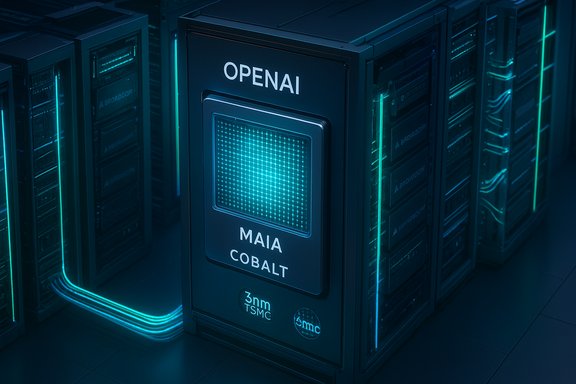
Microsoft’s partnership with OpenAI has moved decisively from software and cloud into silicon: Satya Nadella confirmed that Microsoft will be able to use OpenAI’s custom AI chip designs alongside its own in‑house efforts, giving Azure a legally backed pathway to incorporate OpenAI‑derived hardware ideas into Microsoft’s Maia and Cobalt initiatives.
For most of the last half‑decade Microsoft and OpenAI have operated an unusually close, commercially and technically integrated partnership that covered investment, cloud compute, and exclusive product tie‑ins. That relationship has been recast into a definitive agreement that extends Microsoft’s commercial and IP access windows for OpenAI models and — crucially — provides Microsoft rights to OpenAI’s hardware development work. The new arrangement also installs outside verification for any AGI declaration and reshapes exclusivity over compute provisioning.
This is not an abstract contractual tweak: the practical consequence is that Microsoft can legally inspect, adapt, and incorporate OpenAI hardware designs and system‑level networking ideas as inputs to its own Azure hardware roadmap — an accelerant to Microsoft’s stated objective of running “mainly Microsoft chips” in its AI data centers when and where it makes economic sense.
Key contractual windows also matter to the hardware story: Microsoft retains rights to OpenAI models through 2032 and extended research access through 2030 (or until an independent AGI verification panel deems AGI reached). Those legal timelines give Microsoft multi‑year runway to plan product integrations and to leverage OpenAI designs in negotiating foundry and components deals.
Put simply: Microsoft’s access is a strategic lever. It does not instantly replace external suppliers or mean immediate hyperscale deployment of OpenAI chips across Azure. But it reduces duplication of design effort, improves Microsoft’s negotiating posture with foundries and vendors, and gives the company an optional path to field differentiated inference hardware at scale.
Systolic arrays are a well‑bounded architectural choice for inference‑oriented ASICs: they yield high energy efficiency and predictable throughput for low‑precision tensor math, which makes them attractive for latency‑sensitive, high‑volume inference workloads. That said, they are not a drop‑in replacement for GPUs in large‑scale training, which still demands very high memory bandwidth, flexible precision modes, and mature software ecosystems.
Anticipated uses include:
Independent vendors and systems integrators are likely to seize the opportunity to build:
That said, the pragmatic reality is a multi‑year, mixed‑hardware transition rather than an overnight revolution. Foundry constraints, software ecosystem inertia, capital intensity, and production risks mean Nvidia and other GPU suppliers will remain central to Azure’s high‑end training and many inference workloads for the foreseeable future. Microsoft’s access to OpenAI designs buys optionality, negotiation leverage, and a faster path to iterate on systems‑level ideas — but it does not eliminate the hard, expensive work of shipping a new accelerator fleet at hyperscale.
For IT leaders, the practical play is clear: prepare for heterogeneity, demand reproducible benchmarks, and design software portability now. The winners in this next phase will be the companies that treat hardware as one layer of a managed stack and prioritize cross‑platform runtimes, tooling, and observability that make heterogeneous accelerators an operational advantage rather than a vendor management headache.
Source: Tech in Asia https://www.techinasia.com/news/microsoft-to-use-openai-chip-designs-in-ai-hardware-push/
 Background
For most of the last half‑decade Microsoft and OpenAI have operated an unusually close, commercially and technically integrated partnership that covered investment, cloud compute, and exclusive product tie‑ins. That relationship has been recast into a definitive agreement that extends Microsoft’s commercial and IP access windows for OpenAI models and — crucially — provides Microsoft rights to OpenAI’s hardware development work. The new arrangement also installs outside verification for any AGI declaration and reshapes exclusivity over compute provisioning.This is not an abstract contractual tweak: the practical consequence is that Microsoft can legally inspect, adapt, and incorporate OpenAI hardware designs and system‑level networking ideas as inputs to its own Azure hardware roadmap — an accelerant to Microsoft’s stated objective of running “mainly Microsoft chips” in its AI data centers when and where it makes economic sense.
What Nadella Announced — The Practical Takeaway
Satya Nadella’s remarks (given in a podcast released November 12) clarified how the revised IP deal will play out in operational terms: Microsoft has contractually backed access to OpenAI’s custom chip and networking designs, and will use those designs together with Microsoft’s internal hardware IP to accelerate its own silicon programs.Key contractual windows also matter to the hardware story: Microsoft retains rights to OpenAI models through 2032 and extended research access through 2030 (or until an independent AGI verification panel deems AGI reached). Those legal timelines give Microsoft multi‑year runway to plan product integrations and to leverage OpenAI designs in negotiating foundry and components deals.
Put simply: Microsoft’s access is a strategic lever. It does not instantly replace external suppliers or mean immediate hyperscale deployment of OpenAI chips across Azure. But it reduces duplication of design effort, improves Microsoft’s negotiating posture with foundries and vendors, and gives the company an optional path to field differentiated inference hardware at scale.
Technical Snapshot: What We Know About OpenAI’s Chip Program
Architecture and manufacturing node
Reporting and internal briefings indicate OpenAI’s first custom accelerator uses a systolic array microarchitecture — a tiled, grid‑like arrangement of simple processing elements optimized for repeated matrix multiply‑accumulate operations, which are central to neural network inference. The chip is reportedly being developed for TSMC’s 3‑nanometer (N3) process.Systolic arrays are a well‑bounded architectural choice for inference‑oriented ASICs: they yield high energy efficiency and predictable throughput for low‑precision tensor math, which makes them attractive for latency‑sensitive, high‑volume inference workloads. That said, they are not a drop‑in replacement for GPUs in large‑scale training, which still demands very high memory bandwidth, flexible precision modes, and mature software ecosystems.
Inference‑first focus, not training
Crucially, OpenAI’s early part is aimed at inference — running trained models to serve outputs — not at the heavy, distributed training workloads that require massive FP16/FP8 throughput and huge memory capacity. Inference dominates operational costs for widely deployed services, so inference‑optimized silicon can deliver meaningful $/token savings once integrated at scale. But inference‑specialized chips typically can’t supplant GPUs used for frontier model training.Timeline signals and production cadence
Public reporting places initial mass production for OpenAI’s first custom part no earlier than 2026, with the chip being manufactured on TSMC’s 3‑nanometer node. That timeline is plausible but contingent: custom ASIC projects require multi‑stage validation (tape‑out, test silicon, yield ramp, packaging, system‑level integration), and foundry capacity for bleeding‑edge nodes remains constrained for hyperscale customers. Treat 2026 as a realistic but conditional milestone rather than a firm production date.Systems work: Broadcom and networking
OpenAI’s chip program reportedly includes systems and networking work with Broadcom, indicating the project is being conceived at rack and cluster scale rather than as a single die. That expands the value proposition for Microsoft: network topologies, switch fabrics, and packaging strategies are critical levers when deploying accelerators at hyperscale. Designs that pair compute tiles with optimized interconnect and aggregation can unlock latency, throughput, and utilization advantages at large scale.How Microsoft Will Likely Use OpenAI Designs
Microsoft’s stated approach is pragmatic and modular: it won’t necessarily manufacture an identical OpenAI part. Instead, Microsoft will evaluate microarchitectural blocks, power/clocking techniques, packaging and networking primitives from OpenAI’s designs and selectively adopt elements that complement Maia and Cobalt architectures and Azure’s datacenter systems.Anticipated uses include:
- Adopting specific microarchitectural blocks (e.g., systolic array tiles) into Maia‑class accelerators for inference hotspots.
- Leveraging networking/topology designs for rack‑level orchestration and for optimized placement of inference clusters.
- Using OpenAI designs to improve negotiating leverage with foundries and external vendors when buying N3 wafers and packaging services.
Why This Won’t Replace Nvidia Overnight
Several structural realities make a near‑term, full replacement of Nvidia (or other GPU vendors) unlikely.- Time to volume: Custom ASICs need multi‑stage validation and yield maturation. Initial production runs are often limited in volume and costly — Microsoft will not suddenly gain millions of datacenter units overnight.
- Software ecosystem inertia: Training toolchains (CUDA, cuDNN, mixed‑precision optimizers) and model libraries are heavily optimized for GPUs. Rewriting, validating, and optimizing these toolchains for new ASICs takes months or years and substantial engineering investment.
- Economics of ramp: Each new accelerator generation commonly involves hundreds of millions of dollars — chip NRE, packaging, board and rack redesign, and software stacks. Microsoft’s rights to OpenAI designs reduce duplication but do not eliminate the capital intensity of a hyperscale rollout.
- Different workload targets: The early OpenAI part is inference‑oriented. High‑end training for next‑generation foundation models will likely continue to depend on GPU ecosystems for the near term.
Software and Portability: Where the Ecosystem Fits
A mixed‑accelerator Azure will increase demand for portability layers and vendor‑neutral tooling. Microsoft already backs ONNX Runtime, which enables cross‑platform inference across multiple frameworks and hardware backends. Extending ONNX (and similar runtimes) to support new custom silicon will be a practical avenue for enabling model portability across Maia, OpenAI‑derived silicon, and existing GPU fleets.Independent vendors and systems integrators are likely to seize the opportunity to build:
- Hardware‑agnostic compilers and runtime extensions that translate model graphs to the most efficient backend.
- Vendor‑neutral debugging, profiling, and observability layers that make cross‑hardware comparisons reproducible.
- ISV SDKs and tooling that reduce migration friction for enterprise customers moving from GPU‑only stacks to heterogeneous fabrics.
Economic and Strategic Implications
Microsoft’s access to OpenAI designs delivers three immediate strategic advantages:- Design leverage: Microsoft can learn from OpenAI’s experiments and re‑use proven microarchitectural blocks rather than reinventing them.
- Negotiation power: Having optionality across designs strengthens Microsoft’s hand with foundries and third‑party vendors during procurement negotiations.
- Product differentiation: Azure can offer specialized inference tiers optimized for latency, throughput, or privacy guarantees using a mix of Maia, OpenAI‑derived components, and commodity GPUs.
- Large upfront capital and NRE expenses.
- Integration complexity at the system, rack, and network levels.
- Risk that expected $/inference savings are eroded by yield issues, slower than expected software optimization, or unanticipated integration bottlenecks.
Risks, Fragilities, and What to Watch For
Microsoft’s move unlocks optionality, but several risks deserve attention:- Execution risk: Custom silicon rollouts at hyperscale are historically fraught — yield problems, packaging challenges, and late design bugs can delay rollouts and increase costs.
- Foundry constraints: TSMC N3 capacity is contested among hyperscalers. Any bottleneck or yield issue at N3 could push production timelines beyond 2026.
- Software ecosystem lag: If compilers, runtimes, and model optimizers lag hardware availability, real‑world performance will fall short of theoretical gains.
- Short‑term reliance on third parties: Even with design access, Microsoft will likely continue to lean on Nvidia and AMD for the highest‑end training and for immediate capacity needs. Expect a multi‑year hybrid posture.
- Unverifiable spec claims: Vendor TFLOPS and other marketing metrics should be treated cautiously until independent benchmarks are available; treat raw vendor numbers as indicative rather than definitive.
Practical Guidance for IT Leaders and Azure Customers
Microsoft’s hardware strategy creates both opportunities and uncertainty for enterprise IT. Practical steps to prepare:- Inventory and classify workloads by compute profile. Determine which workloads are latency‑sensitive inference vs. large‑scale training. Prioritize pilots for latency‑critical inference.
- Design for heterogeneity. Build abstraction layers today (ONNX, Triton) so workloads can be routed to the most cost‑effective backend without major code rewrites.
- Insist on reproducible benchmarks. For any cloud offering that advertises Maia or OpenAI‑derived silicon, require workload‑realistic A/B comparisons on latency, throughput, and $/inference.
- Negotiate clarity in procurement. If committing to large Azure contracts, ask for guarantees about hardware mix, placement policies, and SLAs for inference and training workloads. The mixed‑hardware future implies variability in the hardware serving a workload; contractual clarity matters.
- Partner with system integrators early. Enterprises that need turnkey migration from GPU stacks to mixed accelerators should engage integrators to handle benchmarking, sharding, and tuning. This becomes a technical and services opportunity.
Longer‑Term Outlook: What Success Looks Like
If Microsoft successfully integrates OpenAI‑derived designs into Azure’s systems and ecosystems, several outcomes are plausible over the medium term:- Meaningful inference cost reductions for high‑volume services, improving margins for Copilot, Bing, and large enterprise deployments.
- A stronger negotiating position with foundries and vendors, potentially easing supply constraints and lowering component costs over successive generations.
- A broad set of hardware‑agnostic tools and runtimes that allow model owners to treat the underlying accelerator as a managed commodity rather than a permanent lock‑in.
Conclusion
Microsoft’s right to use OpenAI’s custom chip designs is a significant strategic development that materially changes Azure’s optionality in the race for cost‑efficient, low‑latency inference at hyperscale. The revised agreement, with extended IP windows and access to hardware designs, gives Microsoft a legally backed path to accelerate its Maia and Cobalt programs and to orchestrate more sophisticated rack‑level topologies informed by OpenAI’s work.That said, the pragmatic reality is a multi‑year, mixed‑hardware transition rather than an overnight revolution. Foundry constraints, software ecosystem inertia, capital intensity, and production risks mean Nvidia and other GPU suppliers will remain central to Azure’s high‑end training and many inference workloads for the foreseeable future. Microsoft’s access to OpenAI designs buys optionality, negotiation leverage, and a faster path to iterate on systems‑level ideas — but it does not eliminate the hard, expensive work of shipping a new accelerator fleet at hyperscale.
For IT leaders, the practical play is clear: prepare for heterogeneity, demand reproducible benchmarks, and design software portability now. The winners in this next phase will be the companies that treat hardware as one layer of a managed stack and prioritize cross‑platform runtimes, tooling, and observability that make heterogeneous accelerators an operational advantage rather than a vendor management headache.
Source: Tech in Asia https://www.techinasia.com/news/microsoft-to-use-openai-chip-designs-in-ai-hardware-push/