

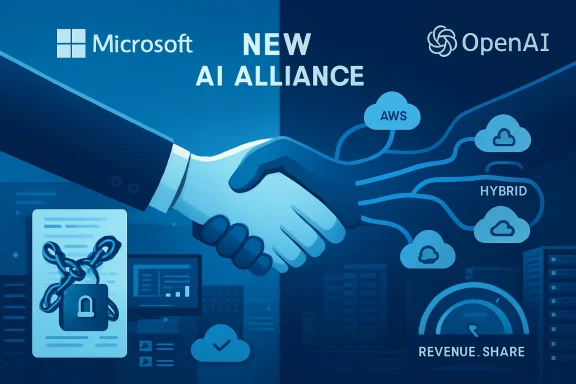
Microsoft and OpenAI have rewritten one of the defining technology alliances of the generative AI era, replacing a tightly controlled partnership with a looser, more market-facing structure. The new agreement preserves Azure’s privileged role but removes key exclusivity provisions, giving OpenAI room to sell and serve products across rival clouds. For WindowsForum readers, the real story is not simply who “won” the negotiation; it is how this reset could reshape AI cloud competition, enterprise procurement, Microsoft’s platform strategy, and the economics of frontier model deployment.
Microsoft’s relationship with OpenAI began as a strategic bet on a research lab that could give Redmond a decisive advantage in the next computing platform. The original logic was simple: Microsoft supplied capital, Azure infrastructure, and enterprise distribution, while OpenAI supplied frontier models that could be embedded into Office, Windows, developer tools, security products, and cloud services. That bargain helped Microsoft move faster than most of its peers when ChatGPT turned generative AI into a mainstream technology category.
Over time, however, the partnership became more complicated. OpenAI’s compute demands grew at a pace that challenged even hyperscale cloud economics, while Microsoft had to balance its role as investor, infrastructure supplier, product partner, and competitor. Azure benefited from the perception that it was the default home of OpenAI workloads, but OpenAI increasingly needed more flexibility to reach enterprises already standardized on AWS, Google Cloud, Oracle, or hybrid infrastructure.
The latest reset follows an earlier phase of restructuring in which Microsoft retained a major stake in OpenAI’s for-profit structure and OpenAI committed to large Azure purchases. That earlier arrangement gave Microsoft significant visibility into OpenAI’s growth, but it did not fully resolve the tension between exclusive infrastructure rights and OpenAI’s need to become a broader platform company. The new agreement moves the partnership from strategic enclosure toward managed openness.
That distinction matters. Microsoft still has deep technical integration, a major investment position, Azure-first treatment, and a continuing license to OpenAI intellectual property through 2032. But the license is now non-exclusive, OpenAI can serve products through other cloud providers, and future revenue sharing from OpenAI to Microsoft is capped through 2030.
But primary is not the same as exclusive. OpenAI can now meet customers where they already operate, which removes a procurement obstacle for enterprises that do not want to shift sensitive workloads to Azure just to access OpenAI capabilities. That change may look subtle on paper, but in enterprise IT, removing a procurement blocker can be the difference between a pilot and a platform commitment.
The enterprise buyer also cares about identity, compliance, auditability, data residency, and vendor accountability. Microsoft can bundle OpenAI-powered experiences into existing licensing structures and procurement channels, which gives it an advantage beyond raw compute. For many CIOs, buying AI through Microsoft is less risky than stitching together separate contracts across multiple vendors.
Still, the strategic picture has changed. Microsoft can no longer rely on exclusivity to make Azure the inevitable endpoint for OpenAI demand. It must prove that Azure is the best home for those workloads, not merely the historically required one.
This is especially important as enterprises move from experiments to production workloads. Early generative AI adoption often happened through chat interfaces and developer pilots, but the next phase involves customer service systems, document workflows, software engineering pipelines, knowledge management, analytics, and agentic automation. These workloads must run close to existing data and business systems.
That bundling could change procurement cycles. Instead of a customer saying, “We need OpenAI, therefore we need Azure,” the decision could become, “We already use AWS, and now OpenAI fits inside our existing cloud strategy.” That shift would be significant because cloud commitments are often negotiated years in advance.
That creates a strategic opening for Google Cloud. It can say to customers, in effect, that they can test Gemini, OpenAI, Anthropic, open-weight models, and specialized models in one environment. This reinforces a multi-model enterprise architecture, which is becoming more realistic as companies realize that no single model will dominate every workflow.
Google also has technical advantages in AI infrastructure. Its TPU history, internal AI research base, and data analytics footprint give it credible claims in training, inference, and AI-native workloads. If OpenAI access becomes more portable, Google can compete on infrastructure quality rather than being blocked by Microsoft’s exclusive channel.
But exclusivity carries a premium. If rivals can also gain commercial access to the same or similar OpenAI products, Microsoft’s differentiation must come from integration, workflow design, security posture, and distribution. That is a more conventional platform battle and a less protected one.
The IP change also fits a broader industry pattern. Frontier AI companies increasingly want to avoid being permanently absorbed into a single cloud ecosystem. They need capital and compute, but they also need optionality. A non-exclusive framework gives OpenAI more room to negotiate with partners while keeping Microsoft close.
From OpenAI’s perspective, the cap is rational. Frontier AI companies burn enormous amounts of cash on infrastructure, talent, research, safety, and product expansion. A perpetual or uncapped revenue burden could weaken margins just as the company tries to prove that its business model can scale.
For Microsoft, the tradeoff may be clarity. A cleaner revenue-sharing structure reduces disputes and makes the partnership easier to explain to regulators, investors, and customers. It may also help OpenAI become a stronger long-term customer, which could benefit Azure even if the revenue-share upside is limited.
WindowsForum readers should also view this through the lens of Microsoft’s broader enterprise footprint. Many organizations will still prefer Microsoft because their users already live in Windows, Microsoft 365, Teams, SharePoint, Outlook, Defender, and Entra ID. In those environments, Copilot remains a natural entry point.
But for data-heavy workloads, the location of the data often determines the architecture. If customer data sits in S3, BigQuery, Snowflake on AWS, or a specialized data estate, OpenAI’s multi-cloud availability reduces architectural gymnastics. That could accelerate real production adoption.
Microsoft’s consumer-facing AI strategy still depends heavily on Copilot integration across Windows and Microsoft 365. Even if OpenAI serves other clouds, Microsoft can continue differentiating through operating system integration, productivity workflows, browser experiences, and device-level AI features. That is where Windows users should pay attention.
OpenAI, meanwhile, may use broader infrastructure access to expand consumer and developer products more aggressively. If it can scale capacity beyond Azure constraints, it may roll out new capabilities faster or support more demanding multimodal workloads. The competitive pressure could also push Microsoft to make Copilot more useful, less intrusive, and more clearly valuable.
Rivals will still question whether Azure-first treatment gives Microsoft an unfair head start. If the most advanced capabilities arrive on Azure before AWS or Google Cloud, customers may still feel pressure to choose Microsoft for time-sensitive AI deployments. The practical details of rollout schedules, technical parity, and support quality will matter more than the headline language.
There is also a broader competition issue: the AI market may become more open at the model layer while remaining concentrated at the infrastructure layer. Only a handful of companies can finance the compute, power, networking, and data center scale required for frontier AI. Multi-cloud access does not automatically create a level playing field if the same hyperscalers control the underlying infrastructure.
AWS wants to be the neutral infrastructure layer for every major model family. Google wants to combine its own models with world-class AI infrastructure and enterprise cloud services. Oracle wants to sell high-performance AI infrastructure and large-scale cloud capacity. Smaller players want niches in compliance, observability, inference optimization, security, and specialized model deployment.
In that environment, exclusivity can be both an advantage and a liability. It creates differentiation, but it can also restrict market reach. OpenAI’s reset suggests that frontier model companies are learning they need broad distribution as much as they need a powerful anchor partner.
Investors will also watch whether Microsoft can replace exclusivity with execution. That means stronger Copilot adoption, clearer Azure AI revenue contribution, more credible first-party model development, and continued enterprise trust. Microsoft does not need to own every layer exclusively, but it does need to prove that its ecosystem remains the most effective place to deploy AI at scale.
Source: Invezz OpenAI-Microsoft reset may reshape AI cloud competition
 Background
Microsoft’s relationship with OpenAI began as a strategic bet on a research lab that could give Redmond a decisive advantage in the next computing platform. The original logic was simple: Microsoft supplied capital, Azure infrastructure, and enterprise distribution, while OpenAI supplied frontier models that could be embedded into Office, Windows, developer tools, security products, and cloud services. That bargain helped Microsoft move faster than most of its peers when ChatGPT turned generative AI into a mainstream technology category.Over time, however, the partnership became more complicated. OpenAI’s compute demands grew at a pace that challenged even hyperscale cloud economics, while Microsoft had to balance its role as investor, infrastructure supplier, product partner, and competitor. Azure benefited from the perception that it was the default home of OpenAI workloads, but OpenAI increasingly needed more flexibility to reach enterprises already standardized on AWS, Google Cloud, Oracle, or hybrid infrastructure.
The latest reset follows an earlier phase of restructuring in which Microsoft retained a major stake in OpenAI’s for-profit structure and OpenAI committed to large Azure purchases. That earlier arrangement gave Microsoft significant visibility into OpenAI’s growth, but it did not fully resolve the tension between exclusive infrastructure rights and OpenAI’s need to become a broader platform company. The new agreement moves the partnership from strategic enclosure toward managed openness.
That distinction matters. Microsoft still has deep technical integration, a major investment position, Azure-first treatment, and a continuing license to OpenAI intellectual property through 2032. But the license is now non-exclusive, OpenAI can serve products through other cloud providers, and future revenue sharing from OpenAI to Microsoft is capped through 2030.
The New Deal Changes the Meaning of Exclusivity
The central shift is that Microsoft no longer controls OpenAI’s commercial path in the way it once did. OpenAI can now distribute products across multiple clouds, including platforms operated by Amazon and Google, while Azure remains the primary partner and first launch venue. That is a meaningful change because cloud exclusivity is not just a contract term; it shapes buying behavior, integration roadmaps, and investor expectations.From locked channel to preferred channel
The phrase “primary cloud partner” still carries weight. Azure will remain the first stop for OpenAI products unless Microsoft cannot or chooses not to support the required capabilities. In practice, that means Microsoft keeps a privileged technical and commercial lane, particularly for enterprise customers already using Microsoft 365, GitHub, Visual Studio, Defender, Entra, and Azure AI services.But primary is not the same as exclusive. OpenAI can now meet customers where they already operate, which removes a procurement obstacle for enterprises that do not want to shift sensitive workloads to Azure just to access OpenAI capabilities. That change may look subtle on paper, but in enterprise IT, removing a procurement blocker can be the difference between a pilot and a platform commitment.
- Azure remains first in line, preserving Microsoft’s technical advantage.
- OpenAI gains multi-cloud reach, improving enterprise flexibility.
- AWS and Google Cloud become realistic beneficiaries, not just theoretical alternatives.
- Customers gain leverage, because OpenAI access no longer automatically implies Azure adoption.
- Microsoft’s moat becomes more execution-dependent, rather than contract-protected.
Azure’s Advantage Is Weaker, Not Gone
The bearish interpretation is tempting: if OpenAI can sell through any cloud, Microsoft’s AI cloud moat shrinks. That view captures part of the truth, especially for investors who valued Microsoft as the only scalable commercial outlet for OpenAI’s frontier models. But it also risks underestimating the strength of Microsoft’s installed base and the operational friction involved in moving AI workloads.Integration still matters
Azure is not merely a rack of GPUs rented to OpenAI. Microsoft has integrated OpenAI models across Copilot, Azure AI Foundry, GitHub Copilot, Microsoft 365, Dynamics, Power Platform, Windows experiences, and security products. Those integrations create switching costs that rival clouds cannot instantly replicate, even if they can now host or distribute OpenAI services.The enterprise buyer also cares about identity, compliance, auditability, data residency, and vendor accountability. Microsoft can bundle OpenAI-powered experiences into existing licensing structures and procurement channels, which gives it an advantage beyond raw compute. For many CIOs, buying AI through Microsoft is less risky than stitching together separate contracts across multiple vendors.
Still, the strategic picture has changed. Microsoft can no longer rely on exclusivity to make Azure the inevitable endpoint for OpenAI demand. It must prove that Azure is the best home for those workloads, not merely the historically required one.
- Microsoft must keep Azure GPU capacity competitive.
- Microsoft must maintain close model integration across Copilot and Azure AI Foundry.
- Microsoft must prevent AWS and Google from offering easier OpenAI deployment paths.
- Microsoft must manage investor expectations around revenue-share limits.
- Microsoft must develop credible model independence in case OpenAI’s roadmap diverges.
OpenAI Gets the Flexibility It Needed
For OpenAI, the agreement is a commercial liberation. The company can now pursue customers that were previously difficult to serve because their cloud strategy did not align with Azure. That matters enormously for large enterprises, regulated industries, and global firms that have already negotiated multi-year cloud commitments with AWS, Google Cloud, Oracle, or regional providers.Enterprise reach becomes the priority
OpenAI’s challenge is no longer brand awareness. It is distribution, reliability, data governance, latency, and cost control at enormous scale. A multi-cloud model helps OpenAI address customers that want AI capabilities without re-architecting their infrastructure around Azure-first assumptions.This is especially important as enterprises move from experiments to production workloads. Early generative AI adoption often happened through chat interfaces and developer pilots, but the next phase involves customer service systems, document workflows, software engineering pipelines, knowledge management, analytics, and agentic automation. These workloads must run close to existing data and business systems.
- OpenAI can pursue AWS-standardized enterprises without forcing cloud migration.
- Google Cloud customers can evaluate OpenAI alongside Gemini models in familiar environments.
- Hybrid and regulated organizations gain more deployment flexibility.
- OpenAI can reduce dependence on a single infrastructure partner.
- Commercial negotiations become more balanced, especially for large AI contracts.
AWS Becomes the Most Obvious Challenger
Amazon Web Services stands to benefit directly if OpenAI demand begins flowing outside Azure. AWS remains the largest cloud infrastructure provider by market share and has deep relationships with enterprises that already run mission-critical workloads on its platform. If OpenAI products become easier to consume through AWS, Amazon gains a powerful new way to defend and expand its cloud footprint.The AWS opportunity is both direct and indirect
The direct opportunity is straightforward: OpenAI workloads require compute, storage, networking, inference optimization, observability, and enterprise support. AWS can monetize those layers if customers deploy OpenAI-powered products or services within its cloud environment. The more interesting opportunity is indirect: AWS can bundle access to OpenAI with its own AI stack, including Bedrock, Trainium, Inferentia, SageMaker, data services, and enterprise governance tooling.That bundling could change procurement cycles. Instead of a customer saying, “We need OpenAI, therefore we need Azure,” the decision could become, “We already use AWS, and now OpenAI fits inside our existing cloud strategy.” That shift would be significant because cloud commitments are often negotiated years in advance.
- AWS can protect accounts that might otherwise drift toward Azure.
- AWS can position itself as model-neutral, offering OpenAI, Anthropic, Amazon models, and third-party options.
- AWS can monetize AI infrastructure without owning the leading consumer AI brand.
- AWS can accelerate enterprise AI adoption among customers reluctant to add Azure.
- AWS can pressure Microsoft on pricing and performance for OpenAI workloads.
Google Cloud Gains a Strategic Opening
Google Cloud may not receive as much immediate attention as AWS, but it could be one of the more interesting beneficiaries of OpenAI’s broader distribution model. Google already competes with Microsoft and OpenAI through Gemini, Vertex AI, TPUs, Workspace AI features, and custom infrastructure. Access to OpenAI products across clouds gives Google another way to keep AI customers within its ecosystem.Rival model, rival cloud, shared customer
The relationship would be inherently competitive. Google wants enterprises to adopt Gemini and Vertex AI, not simply consume OpenAI through Google Cloud. Yet modern cloud platforms increasingly behave like marketplaces: customers want the freedom to select models based on performance, cost, governance, and use case rather than vendor loyalty.That creates a strategic opening for Google Cloud. It can say to customers, in effect, that they can test Gemini, OpenAI, Anthropic, open-weight models, and specialized models in one environment. This reinforces a multi-model enterprise architecture, which is becoming more realistic as companies realize that no single model will dominate every workflow.
Google also has technical advantages in AI infrastructure. Its TPU history, internal AI research base, and data analytics footprint give it credible claims in training, inference, and AI-native workloads. If OpenAI access becomes more portable, Google can compete on infrastructure quality rather than being blocked by Microsoft’s exclusive channel.
- Vertex AI could become a broader model orchestration layer.
- Google Workspace customers may demand OpenAI interoperability.
- Gemini competition could improve pricing and performance discipline.
- TPU and GPU economics may become more visible in enterprise bids.
- Google can frame openness as an advantage against Microsoft bundling.
The IP License Shift Reduces Microsoft’s Moat
The most important non-cloud change is the revised intellectual property structure. Microsoft continues to have a license to OpenAI models and products through 2032, but that license is now non-exclusive. This matters because IP access was one of the pillars supporting Microsoft’s differentiated AI story.Non-exclusive does not mean unimportant
A non-exclusive license still gives Microsoft valuable rights. It can continue building products around OpenAI technology, improve Copilot experiences, and use OpenAI capabilities inside its enterprise stack. For customers, that should reduce fears of a sudden rupture between Microsoft products and OpenAI models.But exclusivity carries a premium. If rivals can also gain commercial access to the same or similar OpenAI products, Microsoft’s differentiation must come from integration, workflow design, security posture, and distribution. That is a more conventional platform battle and a less protected one.
The IP change also fits a broader industry pattern. Frontier AI companies increasingly want to avoid being permanently absorbed into a single cloud ecosystem. They need capital and compute, but they also need optionality. A non-exclusive framework gives OpenAI more room to negotiate with partners while keeping Microsoft close.
- Microsoft retains OpenAI access through 2032.
- The license no longer blocks broader commercial distribution.
- Copilot remains protected but less uniquely sourced.
- Rivals can compete for OpenAI-related enterprise demand.
- Microsoft must invest more aggressively in its own AI capabilities.
Revenue Sharing Now Has a Ceiling
The revised financial terms may be the most important part of the deal for investors. OpenAI will continue making revenue-share payments to Microsoft through 2030 at the same percentage, but those payments are now subject to an overall cap. Microsoft also reportedly no longer has the same reciprocal revenue-sharing obligation to OpenAI, simplifying the financial relationship.Why the cap matters
A cap changes the upside profile. If OpenAI’s revenue explodes, Microsoft participates through cloud consumption, equity ownership, product integration, and capped revenue sharing, but not through an unlimited toll on OpenAI’s growth. That is still meaningful exposure, yet it is less open-ended than some investors may have assumed.From OpenAI’s perspective, the cap is rational. Frontier AI companies burn enormous amounts of cash on infrastructure, talent, research, safety, and product expansion. A perpetual or uncapped revenue burden could weaken margins just as the company tries to prove that its business model can scale.
For Microsoft, the tradeoff may be clarity. A cleaner revenue-sharing structure reduces disputes and makes the partnership easier to explain to regulators, investors, and customers. It may also help OpenAI become a stronger long-term customer, which could benefit Azure even if the revenue-share upside is limited.
- Microsoft keeps revenue participation through 2030.
- OpenAI gains long-term margin visibility.
- The cap limits Microsoft’s upside from OpenAI hypergrowth.
- Azure consumption may become more important than revenue share.
- Investors must separate accounting benefits from strategic control.
Enterprise Buyers Will Welcome the Reset
The biggest winners may be enterprise customers. Many companies want OpenAI capabilities, but they also want cloud neutrality, workload portability, and leverage in vendor negotiations. The revised agreement gives CIOs more room to align AI adoption with existing infrastructure strategy.Procurement friction falls
Enterprise AI adoption has been slowed by security reviews, data governance concerns, compliance constraints, unclear cost models, and fear of vendor lock-in. If OpenAI can operate across more clouds, customers can adopt its products without treating Azure migration as a prerequisite. That matters for organizations with mature AWS or Google Cloud environments.WindowsForum readers should also view this through the lens of Microsoft’s broader enterprise footprint. Many organizations will still prefer Microsoft because their users already live in Windows, Microsoft 365, Teams, SharePoint, Outlook, Defender, and Entra ID. In those environments, Copilot remains a natural entry point.
But for data-heavy workloads, the location of the data often determines the architecture. If customer data sits in S3, BigQuery, Snowflake on AWS, or a specialized data estate, OpenAI’s multi-cloud availability reduces architectural gymnastics. That could accelerate real production adoption.
- CIOs gain more negotiating leverage.
- AI pilots can align with existing cloud commitments.
- Data gravity becomes easier to respect.
- Vendor lock-in concerns decline but do not disappear.
- Multi-cloud governance becomes more important.
Consumer Impact Will Be Less Immediate
For consumers, the deal may not change much in the near term. ChatGPT users, Copilot users, and Windows customers are unlikely to see an immediate shift in interface behavior simply because the cloud partnership changed. The effects will surface gradually through performance, availability, pricing, and feature distribution.The visible changes may arrive slowly
If multi-cloud deployment improves capacity, users could benefit from faster responses, better uptime, and more regional availability. If competition lowers inference costs, subscription pricing and product packaging could become more flexible over time. But those outcomes are not guaranteed, especially because frontier AI remains capital-intensive.Microsoft’s consumer-facing AI strategy still depends heavily on Copilot integration across Windows and Microsoft 365. Even if OpenAI serves other clouds, Microsoft can continue differentiating through operating system integration, productivity workflows, browser experiences, and device-level AI features. That is where Windows users should pay attention.
OpenAI, meanwhile, may use broader infrastructure access to expand consumer and developer products more aggressively. If it can scale capacity beyond Azure constraints, it may roll out new capabilities faster or support more demanding multimodal workloads. The competitive pressure could also push Microsoft to make Copilot more useful, less intrusive, and more clearly valuable.
- ChatGPT availability could improve if capacity diversifies.
- Copilot differentiation will depend more on product quality.
- Subscription bundles may evolve as costs and competition shift.
- Windows integration remains Microsoft’s consumer advantage.
- Users may benefit indirectly from cloud competition.
Regulators and Rivals Will Read This Carefully
The reset also has regulatory significance. Microsoft’s OpenAI relationship has drawn scrutiny because it blurred the line between investment, partnership, infrastructure dependency, and market influence. A less exclusive agreement may reduce some antitrust concerns, but it will not end regulatory interest in AI cloud concentration.Openness can be strategic defense
By allowing OpenAI to serve products across multiple clouds, Microsoft can argue that the partnership is not foreclosing rivals. That argument may be useful in jurisdictions concerned about hyperscaler dominance, AI model access, and cloud bundling. It also gives OpenAI a stronger claim that it is not commercially captive to Microsoft.Rivals will still question whether Azure-first treatment gives Microsoft an unfair head start. If the most advanced capabilities arrive on Azure before AWS or Google Cloud, customers may still feel pressure to choose Microsoft for time-sensitive AI deployments. The practical details of rollout schedules, technical parity, and support quality will matter more than the headline language.
There is also a broader competition issue: the AI market may become more open at the model layer while remaining concentrated at the infrastructure layer. Only a handful of companies can finance the compute, power, networking, and data center scale required for frontier AI. Multi-cloud access does not automatically create a level playing field if the same hyperscalers control the underlying infrastructure.
- The deal may ease some exclusivity concerns.
- Azure-first treatment will remain a focus for rivals.
- Cloud infrastructure concentration remains unresolved.
- Regulators may examine pricing, bundling, and preferential access.
- OpenAI’s independence will be tested by actual commercial behavior.
Competitive Implications for the AI Stack
The revised agreement reinforces a broader shift in the AI industry: customers increasingly want model choice, cloud choice, and deployment flexibility. The old assumption that one hyperscaler would capture an exclusive frontier model and dominate the market is giving way to a more fluid ecosystem. That creates opportunities for platform players, but it also compresses differentiation.The stack is fragmenting
The AI stack now includes chips, data centers, cloud platforms, model providers, orchestration frameworks, enterprise apps, security layers, agent platforms, developer tools, and domain-specific workflows. Microsoft wants to control as much of that stack as possible through Azure, Copilot, GitHub, Windows, and enterprise software. OpenAI wants broad distribution and product autonomy.AWS wants to be the neutral infrastructure layer for every major model family. Google wants to combine its own models with world-class AI infrastructure and enterprise cloud services. Oracle wants to sell high-performance AI infrastructure and large-scale cloud capacity. Smaller players want niches in compliance, observability, inference optimization, security, and specialized model deployment.
In that environment, exclusivity can be both an advantage and a liability. It creates differentiation, but it can also restrict market reach. OpenAI’s reset suggests that frontier model companies are learning they need broad distribution as much as they need a powerful anchor partner.
- Model access is becoming less exclusive.
- Cloud infrastructure remains strategically scarce.
- Enterprise AI platforms will compete on governance and integration.
- Application-layer differentiation may matter more than raw model access.
- The winning vendors will reduce complexity, not merely offer more choices.
Strengths and Opportunities
The reset creates a more flexible AI market without breaking the partnership that helped define the current era. Microsoft keeps major strategic assets, OpenAI gains commercial independence, and rival clouds gain a path to participate in demand that was previously more tightly associated with Azure. The opportunity is not limited to one company; it extends across enterprise buyers, developers, and the broader AI infrastructure ecosystem.- Microsoft retains Azure-first positioning, giving it early access and integration advantages.
- OpenAI gains multi-cloud distribution, improving enterprise reach and long-term scalability.
- AWS can convert OpenAI access into broader cloud retention and expansion.
- Google Cloud can compete as both a model provider and open AI platform.
- Enterprise customers gain leverage, flexibility, and more deployment options.
- The AI ecosystem becomes less dependent on one exclusive commercial channel.
- Microsoft can sharpen Copilot by focusing on workflow value rather than contractual control.
Risks and Concerns
The reset also introduces real risks. Microsoft’s advantage may become less durable, OpenAI’s infrastructure strategy may become more complex, and customers may face a fragmented AI landscape that is harder to govern. The deal reduces one kind of lock-in, but it does not eliminate strategic dependence on a small group of hyperscale infrastructure providers.- Microsoft’s OpenAI moat is less protected, especially in cloud procurement battles.
- Revenue-share caps may limit Microsoft’s long-term upside from OpenAI’s growth.
- AWS adoption may disappoint if Azure-first releases remain materially superior.
- Multi-cloud OpenAI deployments may increase operational complexity for enterprises.
- Regulators may continue scrutinizing hyperscaler influence over AI infrastructure.
- OpenAI could face margin pressure if broader distribution increases support and compute costs.
- Customers may struggle with governance across multiple clouds, models, and data estates.
Looking Ahead
The next phase will be measured not by press statements but by deployment reality. If OpenAI products arrive on AWS and Google Cloud with strong performance, enterprise-grade support, and feature parity close to Azure, the market will treat this as a major opening. If Azure continues to receive the best capabilities first and fastest, the reset may look more like a controlled loosening than a true redistribution of AI cloud power.Investors will also watch whether Microsoft can replace exclusivity with execution. That means stronger Copilot adoption, clearer Azure AI revenue contribution, more credible first-party model development, and continued enterprise trust. Microsoft does not need to own every layer exclusively, but it does need to prove that its ecosystem remains the most effective place to deploy AI at scale.
- Feature parity across clouds will reveal how open the new structure really is.
- Azure AI growth rates will show whether Microsoft’s earnings power is eroding.
- AWS and Google enterprise wins will indicate whether customers are changing procurement behavior.
- Copilot adoption and retention will test Microsoft’s application-layer differentiation.
- OpenAI’s infrastructure costs and margins will shape its path toward broader financial independence.
Source: Invezz OpenAI-Microsoft reset may reshape AI cloud competition
