

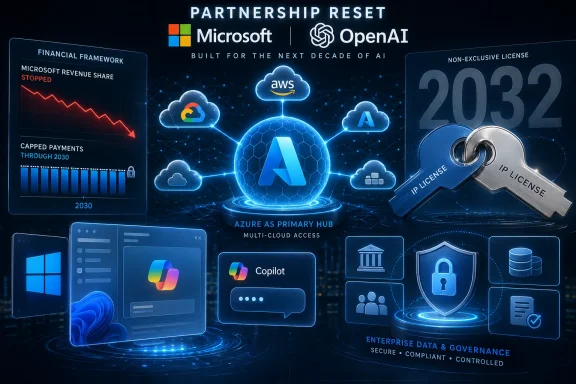
Microsoft and OpenAI have rewritten one of the technology industry’s most important commercial relationships, turning a once tightly coupled alliance into a more flexible, less exclusive partnership. The new terms keep Azure at the center of OpenAI’s deployment strategy, but they also let OpenAI serve customers across other clouds and make Microsoft’s license to OpenAI technology non-exclusive through 2032. Just as important, Microsoft will no longer pay a revenue share to OpenAI, while OpenAI’s payments to Microsoft continue through 2030 under a capped structure. For Windows, Azure, Copilot, and enterprise AI customers, this is not a breakup; it is a calculated reset designed to reduce friction before the next phase of AI infrastructure, model distribution, and competition.
The Microsoft-OpenAI partnership began as a strategic bet on frontier AI at a time when large language models were still a specialist concern rather than the organizing principle of enterprise software. Microsoft’s early investments gave OpenAI access to capital and cloud infrastructure, while OpenAI gave Microsoft a direct line into models that would later reshape search, productivity software, development tools, and consumer AI assistants. That exchange became the foundation for Copilot, Azure OpenAI Service, and Microsoft’s broader repositioning around AI-first computing.
The relationship intensified after the public release of ChatGPT, which turned OpenAI into a household name and forced every major technology company to define an AI platform strategy. Microsoft moved quickly, embedding OpenAI technology into Bing, Microsoft 365, GitHub, Windows, security products, and developer services. For several years, the alliance looked like a near-perfect example of symbiosis: OpenAI needed scale, and Microsoft needed differentiated intelligence.
But scale changed the economics. OpenAI’s model training, inference demand, enterprise ambitions, consumer product growth, and hardware interests created pressure that no single partner could easily absorb. Microsoft, meanwhile, needed to assure shareholders and customers that its AI roadmap would not be overly dependent on one lab, one governance structure, or one definition of future artificial general intelligence.
The October 2025 restructuring already signaled a major shift. OpenAI completed its move into a nonprofit-controlled public benefit corporation structure, Microsoft’s investment was valued at roughly $135 billion for an approximately 27 percent stake, and OpenAI committed to a massive additional purchase of Azure services. The April 2026 amendment now goes further by simplifying revenue-sharing terms, loosening exclusivity, and giving both companies more room to maneuver.
Microsoft’s license to OpenAI models and products continues through 2032, but it is now non-exclusive. That distinction matters because exclusivity was one of Microsoft’s strongest strategic advantages in the first phase of the alliance. A non-exclusive license still gives Microsoft long-term access, but it weakens the idea that OpenAI’s most important commercial outputs automatically belong inside Microsoft’s orbit alone.
The revenue-sharing changes are equally consequential. Microsoft will no longer pay a revenue share to OpenAI, while OpenAI will continue paying Microsoft through 2030 at the same percentage, subject to a total cap. In business terms, that creates more predictability for both sides and reduces the likelihood that future model progress, AGI debates, or product bundling disputes will destabilize the partnership.
Yet the amendment also confirms what the market had already started to understand: AI infrastructure is becoming multi-cloud by necessity. Frontier model companies need huge volumes of GPUs, power, cooling, networking, storage, and geographic reach. They also need specialized capacity for training, inference, national security workloads, regional compliance, and latency-sensitive enterprise deployments.
The practical result is a more nuanced cloud hierarchy. Azure remains the strategic anchor, but OpenAI can now serve all products to customers across any cloud provider. That gives OpenAI leverage with other hyperscalers and gives enterprise buyers more flexibility if their existing architecture is built around Amazon Web Services, Google Cloud, Oracle, sovereign clouds, or hybrid environments.
OpenAI’s continued payments to Microsoft through 2030 keep Microsoft tied to OpenAI’s commercial growth. The cap matters because it limits the uncertainty around an arrangement that could otherwise become awkward if OpenAI’s revenue scales dramatically. In effect, the parties are converting a potentially open-ended dependency into a more predictable financial bridge.
This also reduces the chance that every breakthrough model, enterprise package, or consumer subscription tier becomes a dispute about who owes whom. AI partnerships often fail not because the technology is weak, but because value attribution becomes impossible. When a model, cloud platform, application interface, and customer relationship all contribute to revenue, revenue-sharing formulas can become a source of strategic resentment.
But the license becoming non-exclusive marks a major philosophical shift. Microsoft still has access, but not sole privileged access in the same way. OpenAI can pursue broader commercial deployment, and rivals can potentially compete for OpenAI-linked services without automatically being shut out by Microsoft’s historical rights.
This alters competitive dynamics across the AI stack. Microsoft must increasingly win on integration, reliability, identity, security, developer tooling, enterprise procurement, and Windows ecosystem reach. Access to OpenAI remains valuable, but it is no longer enough by itself to guarantee a lasting advantage.
That matters because Windows is becoming an AI surface rather than just an operating system. Recall-style memory features, on-device language models, app actions, file understanding, accessibility tools, game assistance, and developer workflows all require a careful blend of cloud and local intelligence. Microsoft cannot afford to make every Windows AI feature dependent on one external model pipeline.
The amended agreement may accelerate Microsoft’s push toward model orchestration. In that future, Copilot chooses among different models depending on the task, cost, latency, privacy requirement, and hardware available. OpenAI may remain the premium reasoning layer, but smaller Microsoft models and partner models can handle routine tasks.
However, choice is not the same as simplicity. Enterprises now face a more complex AI procurement landscape where the same or similar OpenAI capabilities may appear through Microsoft, OpenAI directly, other cloud providers, industry platforms, systems integrators, and application vendors. That creates opportunities for cost optimization, but it also introduces governance challenges.
For regulated industries, the central questions remain data handling, auditability, residency, encryption, identity integration, model monitoring, and contractual liability. Microsoft has traditionally used its enterprise trust layer as a major advantage. OpenAI’s broader distribution will need to match that level of assurance if it wants CIOs to treat cloud flexibility as a feature rather than a risk.
Amazon has a particularly interesting opportunity because its Bedrock strategy depends on offering a marketplace of models rather than betting the entire cloud identity on one AI lab. If OpenAI models become more directly available in competing clouds, AWS can position itself as a neutral model access layer. Google can make a similar argument with its AI infrastructure, Gemini models, and long history in machine learning research.
Microsoft’s counterargument is integration. It can say that access to models is only one layer of enterprise AI, while the real value comes from identity, productivity data, security, workflow automation, developer tools, and Windows endpoints. That is a strong argument, but it requires Microsoft to deliver polished experiences rather than rely on OpenAI exclusivity as a shortcut.
The April 2026 update states that OpenAI’s revenue-share payments to Microsoft continue through 2030 independent of OpenAI’s technology progress. That phrase is crucial. It suggests the companies want fewer financial cliffs tied to ambiguous breakthroughs, model benchmarks, or philosophical disputes about what counts as general intelligence.
Microsoft also continues to develop more independent AI capability. That includes its own models, orchestration layers, agent frameworks, and partnerships with other AI providers. OpenAI gains room to diversify as well, creating a more balanced relationship where both sides remain close but less trapped.
Scaling gigawatts of capacity requires long-term planning and huge capital commitments. It also raises questions about grid reliability, water use, sustainability claims, regional permitting, and geopolitical exposure. A more flexible partnership may help OpenAI source capacity from multiple providers while still giving Microsoft a central role in the most strategic deployments.
Silicon collaboration is equally important. If Microsoft, OpenAI, and other partners can tune models, inference stacks, and chips together, they may reduce cost per token and improve latency. That would affect everything from Copilot margins to ChatGPT availability to enterprise agent economics.
That does not mean regulators will lose interest. Microsoft remains a major shareholder, Azure remains primary, and Microsoft products remain deeply integrated with OpenAI technology. Competition authorities may still examine whether rivals have meaningful access, whether enterprise customers face bundling pressure, and whether AI markets are becoming concentrated through investment rather than acquisition.
The optics are especially delicate because AI is now viewed as strategic infrastructure. Governments care not only about consumer choice, but also national security, labor markets, information integrity, and economic competitiveness. Any arrangement that influences access to frontier models will attract attention.
For CIOs, the immediate task is to map AI dependencies before they become invisible. Many organizations already use OpenAI indirectly through Microsoft products, directly through APIs or ChatGPT business plans, and indirectly again through SaaS vendors. The new agreement makes that mapping more important because the same model provider may now appear through more infrastructure and commercial channels.
Source: The National CIO Review Microsoft and OpenAI Update AI Partnership with New Business Terms - The National CIO Review
Source: OpenAI The next phase of the Microsoft OpenAI partnership
 Background
The Microsoft-OpenAI partnership began as a strategic bet on frontier AI at a time when large language models were still a specialist concern rather than the organizing principle of enterprise software. Microsoft’s early investments gave OpenAI access to capital and cloud infrastructure, while OpenAI gave Microsoft a direct line into models that would later reshape search, productivity software, development tools, and consumer AI assistants. That exchange became the foundation for Copilot, Azure OpenAI Service, and Microsoft’s broader repositioning around AI-first computing.The relationship intensified after the public release of ChatGPT, which turned OpenAI into a household name and forced every major technology company to define an AI platform strategy. Microsoft moved quickly, embedding OpenAI technology into Bing, Microsoft 365, GitHub, Windows, security products, and developer services. For several years, the alliance looked like a near-perfect example of symbiosis: OpenAI needed scale, and Microsoft needed differentiated intelligence.
But scale changed the economics. OpenAI’s model training, inference demand, enterprise ambitions, consumer product growth, and hardware interests created pressure that no single partner could easily absorb. Microsoft, meanwhile, needed to assure shareholders and customers that its AI roadmap would not be overly dependent on one lab, one governance structure, or one definition of future artificial general intelligence.
The October 2025 restructuring already signaled a major shift. OpenAI completed its move into a nonprofit-controlled public benefit corporation structure, Microsoft’s investment was valued at roughly $135 billion for an approximately 27 percent stake, and OpenAI committed to a massive additional purchase of Azure services. The April 2026 amendment now goes further by simplifying revenue-sharing terms, loosening exclusivity, and giving both companies more room to maneuver.
From alliance to platform ecosystem
The key historical point is that Microsoft and OpenAI are no longer merely managing a vendor relationship or an investment. They are managing an AI ecosystem dependency that touches cloud capacity, enterprise procurement, developer APIs, consumer apps, model governance, datacenter construction, custom silicon, and competitive positioning. That makes the latest agreement less like a routine contract update and more like a new operating model for the AI economy.The New Terms in Plain English
The headline change is simple: Microsoft remains OpenAI’s primary cloud partner, but OpenAI is no longer boxed into serving all products only through Microsoft infrastructure. OpenAI products will still ship first on Azure unless Microsoft cannot and chooses not to support the required capabilities. That preserves Microsoft’s privileged position while acknowledging the practical reality that OpenAI’s demand for compute, customer reach, and specialized infrastructure now exceeds a single-lane model.Microsoft’s license to OpenAI models and products continues through 2032, but it is now non-exclusive. That distinction matters because exclusivity was one of Microsoft’s strongest strategic advantages in the first phase of the alliance. A non-exclusive license still gives Microsoft long-term access, but it weakens the idea that OpenAI’s most important commercial outputs automatically belong inside Microsoft’s orbit alone.
The revenue-sharing changes are equally consequential. Microsoft will no longer pay a revenue share to OpenAI, while OpenAI will continue paying Microsoft through 2030 at the same percentage, subject to a total cap. In business terms, that creates more predictability for both sides and reduces the likelihood that future model progress, AGI debates, or product bundling disputes will destabilize the partnership.
What changed most
- Azure-first remains, but Azure-only is no longer the practical rule for all OpenAI products.
- Microsoft’s OpenAI license continues through 2032, but it becomes non-exclusive.
- Microsoft stops paying OpenAI a revenue share, simplifying Microsoft’s AI product economics.
- OpenAI keeps paying Microsoft through 2030, but with a cap that limits long-term exposure.
- Microsoft remains a major shareholder, keeping financial upside even as operational exclusivity narrows.
Azure Keeps the Inside Track, But Loses the Wall
Azure is still the first stop for OpenAI products, and that is enormously important for Microsoft’s cloud narrative. The company has spent years positioning Azure as the enterprise-grade home for frontier AI, not merely another hyperscale platform competing on storage, networking, and virtual machines. Keeping OpenAI products first on Azure lets Microsoft tell CIOs that the deepest OpenAI integration still begins in its cloud.Yet the amendment also confirms what the market had already started to understand: AI infrastructure is becoming multi-cloud by necessity. Frontier model companies need huge volumes of GPUs, power, cooling, networking, storage, and geographic reach. They also need specialized capacity for training, inference, national security workloads, regional compliance, and latency-sensitive enterprise deployments.
The practical result is a more nuanced cloud hierarchy. Azure remains the strategic anchor, but OpenAI can now serve all products to customers across any cloud provider. That gives OpenAI leverage with other hyperscalers and gives enterprise buyers more flexibility if their existing architecture is built around Amazon Web Services, Google Cloud, Oracle, sovereign clouds, or hybrid environments.
Why Azure still matters
For Microsoft, the question is not whether Azure has lost OpenAI. It has not. The question is whether Azure can convert first access, deep integration, and enterprise trust into durable AI workloads even when customers have more deployment choice.- Azure can remain the preferred path for Microsoft 365 Copilot, security, Dynamics, and Windows-integrated AI scenarios.
- Azure OpenAI Service can keep appealing to regulated enterprises that want Microsoft’s compliance, identity, and governance stack.
- Microsoft can use first availability to tune performance, developer tooling, and enterprise support ahead of rivals.
- Multi-cloud availability may expand OpenAI’s market while still increasing total demand for Azure-hosted workloads.
- The risk is that Azure’s differentiation becomes less exclusive and more dependent on execution.
Revenue Sharing Becomes a Governance Tool
The end of Microsoft’s revenue-share payments to OpenAI is more than an accounting adjustment. It changes how Microsoft can price, package, and scale AI features across its own products. If Copilot, security agents, developer assistants, or Windows AI services no longer require that outbound share, Microsoft gains more freedom to experiment with margins, bundles, and usage-based offerings.OpenAI’s continued payments to Microsoft through 2030 keep Microsoft tied to OpenAI’s commercial growth. The cap matters because it limits the uncertainty around an arrangement that could otherwise become awkward if OpenAI’s revenue scales dramatically. In effect, the parties are converting a potentially open-ended dependency into a more predictable financial bridge.
This also reduces the chance that every breakthrough model, enterprise package, or consumer subscription tier becomes a dispute about who owes whom. AI partnerships often fail not because the technology is weak, but because value attribution becomes impossible. When a model, cloud platform, application interface, and customer relationship all contribute to revenue, revenue-sharing formulas can become a source of strategic resentment.
The economics behind the reset
The new structure appears designed to create cleaner incentives. Microsoft can focus on building and selling AI experiences. OpenAI can focus on expanding model access and customer channels. Both companies retain financial exposure to the upside without forcing every product decision through the same revenue-sharing lens.- Microsoft gets simpler unit economics for its own AI products.
- OpenAI gets broader distribution flexibility across clouds.
- Microsoft still benefits from OpenAI’s growth as a shareholder and revenue-share recipient through 2030.
- OpenAI reduces long-term uncertainty with a capped obligation.
- Customers may see faster product experimentation as contractual friction declines.
The 2032 IP License Reframes Control
Microsoft’s license to OpenAI models and products through 2032 gives the software giant long-term confidence. That matters for customers making multi-year commitments to Copilot, Azure OpenAI Service, GitHub tooling, and AI-driven security operations. Enterprises do not want to discover that a core AI capability disappears because two vendors renegotiated access to foundational technology.But the license becoming non-exclusive marks a major philosophical shift. Microsoft still has access, but not sole privileged access in the same way. OpenAI can pursue broader commercial deployment, and rivals can potentially compete for OpenAI-linked services without automatically being shut out by Microsoft’s historical rights.
This alters competitive dynamics across the AI stack. Microsoft must increasingly win on integration, reliability, identity, security, developer tooling, enterprise procurement, and Windows ecosystem reach. Access to OpenAI remains valuable, but it is no longer enough by itself to guarantee a lasting advantage.
Control versus access
The difference between control and access is central to this deal. Microsoft appears to have accepted that trying to preserve maximum control over OpenAI could eventually reduce the value of the relationship. OpenAI appears to have accepted that Microsoft’s access and shareholder position remain too important to unwind.- Access gives Microsoft continuity for Copilot and Azure services.
- Non-exclusivity gives OpenAI room to grow beyond one commercial channel.
- Long duration reassures enterprise buyers planning AI deployments through the decade.
- Reduced control forces Microsoft to sharpen its own model, agent, and platform strategy.
- Broader distribution may make OpenAI more valuable, indirectly benefiting Microsoft as a shareholder.
What This Means for Windows and Copilot
For Windows users, the agreement is not likely to produce an immediate visible change in the Start menu, Copilot key, Settings app, or Microsoft Store. The impact will be more gradual and architectural. Microsoft now has clearer room to develop Copilot capabilities that combine OpenAI models, Microsoft’s own models, third-party models, local AI acceleration, and Windows-specific context.That matters because Windows is becoming an AI surface rather than just an operating system. Recall-style memory features, on-device language models, app actions, file understanding, accessibility tools, game assistance, and developer workflows all require a careful blend of cloud and local intelligence. Microsoft cannot afford to make every Windows AI feature dependent on one external model pipeline.
The amended agreement may accelerate Microsoft’s push toward model orchestration. In that future, Copilot chooses among different models depending on the task, cost, latency, privacy requirement, and hardware available. OpenAI may remain the premium reasoning layer, but smaller Microsoft models and partner models can handle routine tasks.
Consumer impact
Consumers should expect more continuity than disruption. ChatGPT and Copilot will continue to overlap, compete, and diverge in subtle ways. ChatGPT may become more broadly available across cloud-backed services, while Copilot may become more deeply tied to Windows, Microsoft 365, Edge, Xbox, and the Microsoft account ecosystem.- Copilot could become more Windows-native, using device context and local acceleration.
- ChatGPT could become more platform-neutral, appearing through more cloud and partner channels.
- Microsoft may use non-exclusive access to combine OpenAI models with its own specialized models.
- Windows AI features may become less dependent on a single backend provider.
- Users may see more differentiation between ChatGPT as a general assistant and Copilot as a productivity agent.
Enterprise Buyers Get More Choice, But More Complexity
Enterprise customers are the biggest near-term beneficiaries of the amendment. The ability for OpenAI to serve products across any cloud provider gives CIOs more room to align AI adoption with existing infrastructure strategy. A company standardized on Azure can stay close to Microsoft, while a company with major AWS or Google Cloud investments may gain more direct paths to OpenAI capabilities.However, choice is not the same as simplicity. Enterprises now face a more complex AI procurement landscape where the same or similar OpenAI capabilities may appear through Microsoft, OpenAI directly, other cloud providers, industry platforms, systems integrators, and application vendors. That creates opportunities for cost optimization, but it also introduces governance challenges.
For regulated industries, the central questions remain data handling, auditability, residency, encryption, identity integration, model monitoring, and contractual liability. Microsoft has traditionally used its enterprise trust layer as a major advantage. OpenAI’s broader distribution will need to match that level of assurance if it wants CIOs to treat cloud flexibility as a feature rather than a risk.
CIO decision points
Technology leaders should not interpret the agreement as a reason to pause AI programs. Instead, they should use it as a prompt to revisit vendor dependency, cloud architecture, and model governance. The AI market is moving from single-vendor enthusiasm to portfolio management.- Review where OpenAI capabilities enter the organization: Microsoft 365, Azure, APIs, SaaS vendors, or direct ChatGPT plans.
- Separate model choice from platform choice in procurement and architecture discussions.
- Require clear data-retention, training, logging, and compliance terms for each AI channel.
- Track whether Azure-first availability creates feature timing differences across clouds.
- Prepare for pricing changes as Microsoft and OpenAI adjust packaging under the new economics.
Competitive Pressure Intensifies Across Cloud AI
The amendment gives rivals an opening, but not a guarantee. Amazon, Google, Oracle, and other infrastructure players can argue that OpenAI’s broader cloud availability validates their role in the frontier AI supply chain. They can also use the change to pitch enterprises on avoiding overconcentration in Azure.Amazon has a particularly interesting opportunity because its Bedrock strategy depends on offering a marketplace of models rather than betting the entire cloud identity on one AI lab. If OpenAI models become more directly available in competing clouds, AWS can position itself as a neutral model access layer. Google can make a similar argument with its AI infrastructure, Gemini models, and long history in machine learning research.
Microsoft’s counterargument is integration. It can say that access to models is only one layer of enterprise AI, while the real value comes from identity, productivity data, security, workflow automation, developer tools, and Windows endpoints. That is a strong argument, but it requires Microsoft to deliver polished experiences rather than rely on OpenAI exclusivity as a shortcut.
The new competitive map
The cloud AI market is increasingly divided between infrastructure scale, model quality, application integration, and governance trust. No single company dominates all four dimensions without challenge. That makes partnerships both more valuable and more unstable.- Microsoft leads in productivity integration and enterprise distribution.
- OpenAI leads in brand recognition and frontier model mindshare.
- Amazon can compete on cloud neutrality and model marketplace breadth.
- Google can compete on research depth, chips, search, and native AI platforms.
- Oracle and specialist clouds can compete on capacity, pricing, and dedicated AI infrastructure.
- Anthropic and other model providers can exploit customer concerns about overdependence on one lab.
AGI, Independence, and Strategic Optionality
The Microsoft-OpenAI relationship has always been haunted by the question of AGI. Earlier terms created tension because a declaration of AGI could affect Microsoft’s rights and the flow of technology. The October 2025 agreement added independent expert verification for AGI declarations, and the latest amendment further reduces the likelihood that technical progress alone will abruptly rupture the commercial arrangement.The April 2026 update states that OpenAI’s revenue-share payments to Microsoft continue through 2030 independent of OpenAI’s technology progress. That phrase is crucial. It suggests the companies want fewer financial cliffs tied to ambiguous breakthroughs, model benchmarks, or philosophical disputes about what counts as general intelligence.
Microsoft also continues to develop more independent AI capability. That includes its own models, orchestration layers, agent frameworks, and partnerships with other AI providers. OpenAI gains room to diversify as well, creating a more balanced relationship where both sides remain close but less trapped.
Why optionality matters
Optionality is the central strategic asset in AI because the field is moving too quickly for rigid dependency. Models change, hardware changes, regulation changes, and customer expectations change. The companies that survive will be those that can adapt without rewriting their entire business model every six months.- Microsoft needs options if OpenAI’s roadmap diverges from enterprise or Windows priorities.
- OpenAI needs options if Azure capacity, pricing, or policy constraints slow its growth.
- Customers need options if one model family becomes too expensive, risky, or unavailable.
- Regulators may prefer less exclusive arrangements in a market with high concentration risk.
- Investors may reward cleaner terms that make OpenAI easier to value and Microsoft easier to model.
Datacenters, Silicon, and the Physical AI Bottleneck
The most understated part of the announcement may be the reference to gigawatts of datacenter capacity and next-generation silicon. AI is often discussed as software, but the current race is increasingly constrained by electricity, land, cooling, chips, networking, and supply chains. The Microsoft-OpenAI deal recognizes that frontier AI is now a physical infrastructure business.Scaling gigawatts of capacity requires long-term planning and huge capital commitments. It also raises questions about grid reliability, water use, sustainability claims, regional permitting, and geopolitical exposure. A more flexible partnership may help OpenAI source capacity from multiple providers while still giving Microsoft a central role in the most strategic deployments.
Silicon collaboration is equally important. If Microsoft, OpenAI, and other partners can tune models, inference stacks, and chips together, they may reduce cost per token and improve latency. That would affect everything from Copilot margins to ChatGPT availability to enterprise agent economics.
The infrastructure reality
The AI boom is no longer limited by imagination. It is limited by how quickly the industry can build and operate reliable, affordable, power-hungry infrastructure. The new partnership terms make more sense when viewed through that lens.- Multi-cloud delivery helps absorb demand that Azure alone may not satisfy at every moment.
- Custom silicon could reduce dependence on scarce general-purpose accelerators.
- Datacenter buildouts will shape where AI services are fast, cheap, and compliant.
- Energy constraints may become as important as model benchmarks.
- Infrastructure diversification may reduce operational risk for both companies.
Regulatory and Market Optics
The less exclusive structure may also help both companies manage regulatory scrutiny. A partnership that ties the leading productivity software vendor, a top cloud provider, and the most recognized AI lab into a single exclusive channel invites questions about competition. By making Microsoft’s license non-exclusive and allowing broader cloud delivery, the companies can argue that the market remains open.That does not mean regulators will lose interest. Microsoft remains a major shareholder, Azure remains primary, and Microsoft products remain deeply integrated with OpenAI technology. Competition authorities may still examine whether rivals have meaningful access, whether enterprise customers face bundling pressure, and whether AI markets are becoming concentrated through investment rather than acquisition.
The optics are especially delicate because AI is now viewed as strategic infrastructure. Governments care not only about consumer choice, but also national security, labor markets, information integrity, and economic competitiveness. Any arrangement that influences access to frontier models will attract attention.
A softer antitrust profile
The new terms appear designed to reduce the appearance of lock-in without eliminating Microsoft’s strategic advantage. That is a difficult balance, but it may be the only sustainable path for a partnership of this size.- Non-exclusive licensing weakens the claim that Microsoft fully controls OpenAI commercialization.
- Multi-cloud serving rights make it easier to argue that customers have deployment choice.
- Azure-first terms preserve Microsoft’s commercial advantage without absolute foreclosure.
- Capped revenue sharing may reduce concerns about indefinite financial entanglement.
- OpenAI’s ability to work with third parties creates a more open innovation story.
Strengths and Opportunities
The revised partnership gives Microsoft and OpenAI a cleaner, more durable framework for growth at a moment when AI demand is expanding faster than infrastructure, governance, and commercial agreements can comfortably absorb. Its strongest feature is strategic flexibility: both companies can keep building together while reducing the contractual bottlenecks that might otherwise slow product launches, cloud expansion, and enterprise adoption.- Microsoft preserves long-term access to OpenAI models and products through 2032.
- OpenAI gains broader cloud reach, improving customer access and infrastructure resilience.
- Azure keeps first-position status, reinforcing Microsoft’s enterprise AI platform.
- Revenue terms become more predictable, reducing the risk of future financial disputes.
- Enterprise customers gain more deployment options across cloud environments.
- Microsoft can sharpen Copilot economics by ending its revenue-share payments to OpenAI.
- The partnership looks more regulator-friendly than a rigid exclusive arrangement.
Risks and Concerns
The biggest risk is that flexibility becomes ambiguity. Customers, developers, and partners may struggle to understand which OpenAI capabilities are best consumed through Microsoft, which are best purchased directly, and which will appear through other clouds. If Microsoft and OpenAI do not communicate clearly, the new structure could create confusion in procurement, support, compliance, and roadmap planning.- Azure differentiation may weaken if rival clouds receive comparable OpenAI access.
- Copilot may face sharper comparison with ChatGPT and third-party AI assistants.
- Enterprise governance may become harder as OpenAI capabilities spread across more channels.
- Revenue caps and non-exclusive rights may shift incentives in ways neither company fully controls.
- Infrastructure constraints remain severe, even with broader cloud flexibility.
- Regulators may still scrutinize Microsoft’s shareholder influence and Azure-first positioning.
- Customers could face fragmented support paths when AI services cross cloud and vendor boundaries.
Looking Ahead
The next phase will be judged by execution, not contract language. Microsoft must prove that Azure-first access, Windows integration, Microsoft 365 context, Entra identity, Purview governance, Defender security, and GitHub developer workflows make Copilot more valuable than a generic AI assistant. OpenAI must prove that broader cloud delivery improves availability and customer choice without weakening trust, safety, or enterprise-grade support.For CIOs, the immediate task is to map AI dependencies before they become invisible. Many organizations already use OpenAI indirectly through Microsoft products, directly through APIs or ChatGPT business plans, and indirectly again through SaaS vendors. The new agreement makes that mapping more important because the same model provider may now appear through more infrastructure and commercial channels.
- Watch whether OpenAI models arrive on rival cloud platforms with feature parity or meaningful limitations.
- Track how Microsoft changes Copilot pricing, bundling, and performance under the new economics.
- Monitor whether Azure OpenAI Service retains governance advantages over direct OpenAI channels.
- Evaluate whether multi-cloud OpenAI access improves resilience or simply adds procurement complexity.
- Look for signs that Microsoft is accelerating its own model development to reduce strategic dependence.
Source: The National CIO Review Microsoft and OpenAI Update AI Partnership with New Business Terms - The National CIO Review
Source: OpenAI The next phase of the Microsoft OpenAI partnership
