

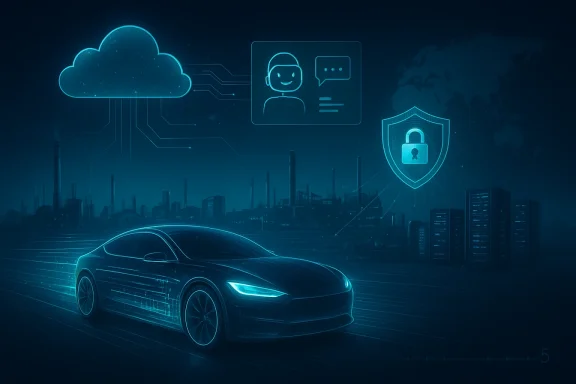
Microsoft’s new five-year collaboration with Stellantis is more than another enterprise software win. It is a clear signal that AI, cloud migration, and cybersecurity are becoming deeply embedded in the operating model of global manufacturers, not just in their customer-facing apps. For Microsoft, the deal strengthens a long-running thesis: the company is increasingly a platform provider for industrial transformation, with Azure, Copilot, and security tools sitting at the center of that shift. For Stellantis, the partnership reflects a push to modernize everything from vehicle engineering to digital services and factory operations. (news.microsoft.com)
The Stellantis-Microsoft alliance arrives at a moment when automakers are under pressure to digitize faster, defend more aggressively, and do both at lower cost. Stellantis said the collaboration is designed to accelerate digital transformation through co-development of advanced AI, cybersecurity, and engineering capabilities, while also pushing a broader cloud modernization program. Microsoft said the arrangement builds on a longstanding relationship, which matters because this is not a greenfield experiment but an expansion of an already established technology stack. (news.microsoft.com)
That distinction matters for investors. A one-off pilot can be interesting, but a five-year strategic collaboration suggests deeper workflow integration and higher switching costs. The more a company ties its product development, customer care, cyber defense, and employee productivity into a single vendor ecosystem, the harder it becomes to unwind later. In practical terms, this is where cloud and AI deals start to look less like software procurement and more like infrastructure commitments. (news.microsoft.com)
The automotive industry is especially fertile ground for this kind of partnership. Modern vehicles are becoming software-defined, connected, and increasingly dependent on secure data flows between factories, engineering systems, mobile apps, and in-vehicle services. That makes cybersecurity and cloud reliability as important as horsepower or battery chemistry, and it explains why large automakers are now treating technology partners as strategic operating allies rather than mere suppliers. (news.microsoft.com)
Stellantis is also in a difficult competitive position where scale alone is no longer enough. Rival automakers and newer EV challengers are racing to improve software experiences, connected services, predictive maintenance, and digital manufacturing efficiency. Against that backdrop, Microsoft’s role is not just to host workloads but to help industrialize the automaker’s entire digital toolchain. That is a meaningful validation of Microsoft’s enterprise narrative. (news.microsoft.com)
At the same time, investors should keep a sober eye on execution. Large industrial AI programs are typically slow to fully monetize, and the benefits often arrive in stages rather than in one dramatic jump. The early phase usually brings migration costs, integration work, governance overhead, and training needs before productivity gains become obvious. That is why deals like this are promising, but not automatically accretive in the near term. (news.microsoft.com)
This matters because Microsoft’s strongest value proposition in enterprise is increasingly stack integration. When cloud, productivity, and security are deployed together, Microsoft can sell a more complete operating layer instead of isolated products. That supports the company’s broader pitch that AI is not a standalone feature but a multiplier across workflows, decision-making, and collaboration. (news.microsoft.com)
The Stellantis deal also reinforces Microsoft’s visibility in a sector where cloud rivalries are still live. Amazon Web Services and Google Cloud are both active in manufacturing and mobility, but Microsoft has carved out a particularly strong position where enterprise productivity and industrial AI meet. If Stellantis becomes a credible showcase for that model, Microsoft gains a high-profile proof point that will resonate far beyond the auto industry. (news.microsoft.com)
The most eye-catching operational target is the plan to reduce Stellantis’ datacenter footprint by 60% by 2029. That is a big structural move, not a cosmetic IT refresh. It suggests the automaker is willing to shift a substantial portion of its legacy computing model into a more cloud-centric architecture, presumably for agility, reliability, and cost efficiency. (news.microsoft.com)
This is where the investor angle becomes more interesting. If Stellantis can translate cloud modernization into faster product cycles, better connected services, and stronger digital operations, Microsoft gets a powerful case study. If the rollout stumbles, the deal still matters, but the broader market will be more cautious about treating automotive AI as an easy template for returns. That tension is central to the story. (news.microsoft.com)
The use cases named in the release are familiar but strategically relevant: AI-powered product development and validation, predictive maintenance and testing, and faster deployment of new digital features and services. These are exactly the kinds of tasks where AI can reduce delays, improve quality control, and help teams move faster across multiple business units. They are also the kinds of workflows that become more valuable as the underlying model and data estate mature. (news.microsoft.com)
What is notable here is the emphasis on engineering and operations rather than pure marketing. Many AI partnerships over-promise customer personalization and under-deliver on core industrial workflows. Stellantis and Microsoft are presenting a more balanced approach, where the technology should affect how cars are designed, tested, delivered, and serviced. That is a more credible path to long-term returns. (news.microsoft.com)
This is the right framing for the software-defined vehicle era. The attack surface now extends far beyond traditional corporate networks to mobile apps, telematics, digital cabins, over-the-air updates, and factory systems. A breach in one layer can cascade into reputational damage, regulatory scrutiny, and operational disruption across the whole enterprise. That is why cyber defense is now strategic infrastructure. (news.microsoft.com)
For Microsoft, security has become one of the strongest parts of the enterprise pitch. The Stellantis agreement gives the company another large, visible reference point for its “secure by design” narrative. For Stellantis, the payoff is not only resilience but also trust, which matters enormously when customers rely on connected services and data-enabled features in their vehicles. (news.microsoft.com)
From Microsoft’s perspective, cloud migration has long been a reliable way to lock in recurring revenue and deepen customer relationships. But in the AI era, cloud is also the substrate for model deployment, data processing, and automation. The more Stellantis moves into Azure, the more Microsoft can attach higher-value services around security, AI, and collaboration. (news.microsoft.com)
The operational logic is straightforward. Manufacturers need more elasticity, stronger resilience, and better integration across distributed systems. Cloud architectures can support that, but only if the migration is well governed and aligned with business processes. In other words, the economic case is strongest when cloud is not just cheaper hosting but a better operating model. (news.microsoft.com)
This is important because enterprise AI adoption often succeeds or fails at the human level. If staff do not use the tools, or if they use them only superficially, the productivity story weakens. Microsoft’s value proposition improves when AI becomes a daily habit inside the enterprise rather than a novelty layered on top of existing work. (news.microsoft.com)
There is also a change-management story here. Stellantis said deployment is supported by a dedicated training program, which is exactly what large organizations need when introducing AI into everyday workflows. Training is often the difference between a successful rollout and a shelfware problem. That part is easy to overlook, but it is crucial. (news.microsoft.com)
The competitive signal is especially important because industrial cloud is not a winner-take-all market. AWS, Google Cloud, and specialist vendors all compete for parts of the stack. What Microsoft is doing well is positioning itself around productivity, security, and AI as a unified offer, which can be persuasive for executives trying to reduce vendor sprawl. (news.microsoft.com)
That said, the market should not assume automatic dominance. Large enterprises often split workloads across platforms, and automotive companies are particularly careful about continuity, compliance, and regional requirements. Microsoft’s challenge is not just winning the deal, but proving that the deal can scale, endure, and remain economically attractive. (news.microsoft.com)
The other key issue is disclosure. If Microsoft begins referencing Stellantis in earnings commentary, customer events, or product showcases with concrete metrics, that would strengthen the investment case. If the partnership stays mostly at the press-release level, then its value will be harder to separate from broader AI marketing. Investors should demand specifics, not just momentum.
Microsoft and Stellantis have not just announced a technology partnership; they have outlined a test case for the economics of industrial AI. The outcome will matter far beyond one automaker, because it will help determine whether the next phase of cloud growth comes from consumer software hype or from deep, patient integration into the systems that run the physical economy.
Source: simplywall.st Microsoft Stellantis AI Alliance Tests Long Term Automotive Cloud Returns
 Background
The Stellantis-Microsoft alliance arrives at a moment when automakers are under pressure to digitize faster, defend more aggressively, and do both at lower cost. Stellantis said the collaboration is designed to accelerate digital transformation through co-development of advanced AI, cybersecurity, and engineering capabilities, while also pushing a broader cloud modernization program. Microsoft said the arrangement builds on a longstanding relationship, which matters because this is not a greenfield experiment but an expansion of an already established technology stack. (news.microsoft.com)That distinction matters for investors. A one-off pilot can be interesting, but a five-year strategic collaboration suggests deeper workflow integration and higher switching costs. The more a company ties its product development, customer care, cyber defense, and employee productivity into a single vendor ecosystem, the harder it becomes to unwind later. In practical terms, this is where cloud and AI deals start to look less like software procurement and more like infrastructure commitments. (news.microsoft.com)
The automotive industry is especially fertile ground for this kind of partnership. Modern vehicles are becoming software-defined, connected, and increasingly dependent on secure data flows between factories, engineering systems, mobile apps, and in-vehicle services. That makes cybersecurity and cloud reliability as important as horsepower or battery chemistry, and it explains why large automakers are now treating technology partners as strategic operating allies rather than mere suppliers. (news.microsoft.com)
Stellantis is also in a difficult competitive position where scale alone is no longer enough. Rival automakers and newer EV challengers are racing to improve software experiences, connected services, predictive maintenance, and digital manufacturing efficiency. Against that backdrop, Microsoft’s role is not just to host workloads but to help industrialize the automaker’s entire digital toolchain. That is a meaningful validation of Microsoft’s enterprise narrative. (news.microsoft.com)
At the same time, investors should keep a sober eye on execution. Large industrial AI programs are typically slow to fully monetize, and the benefits often arrive in stages rather than in one dramatic jump. The early phase usually brings migration costs, integration work, governance overhead, and training needs before productivity gains become obvious. That is why deals like this are promising, but not automatically accretive in the near term. (news.microsoft.com)
What Microsoft Actually Won
The headline is not simply that Stellantis will use Microsoft products. The more important detail is that Microsoft is helping power a coordinated program spanning Azure, Microsoft 365 Copilot, and security tools across a global automaker’s core digital operations. Microsoft said the work will cover more than 100 AI initiatives across customer care, product development, and operations. That breadth is what turns a partnership into a strategic beachhead. (news.microsoft.com)This matters because Microsoft’s strongest value proposition in enterprise is increasingly stack integration. When cloud, productivity, and security are deployed together, Microsoft can sell a more complete operating layer instead of isolated products. That supports the company’s broader pitch that AI is not a standalone feature but a multiplier across workflows, decision-making, and collaboration. (news.microsoft.com)
The Stellantis deal also reinforces Microsoft’s visibility in a sector where cloud rivalries are still live. Amazon Web Services and Google Cloud are both active in manufacturing and mobility, but Microsoft has carved out a particularly strong position where enterprise productivity and industrial AI meet. If Stellantis becomes a credible showcase for that model, Microsoft gains a high-profile proof point that will resonate far beyond the auto industry. (news.microsoft.com)
Why the bundle matters
The strength of the partnership is in the bundle, not the individual products. Azure supplies the infrastructure, Copilot supplies the productivity layer, and Microsoft’s security stack supplies trust and resilience. That combination is more sticky than a standalone cloud migration because it reaches into engineering, operations, and employee workflows at the same time. (news.microsoft.com)- Azure anchors the infrastructure migration.
- Copilot extends AI into day-to-day work.
- Security tools help justify the move to a more connected operating model.
- Cross-functional deployment raises switching costs over time.
- Industrial scale makes the deal a strong reference case for other enterprises.
Why Stellantis Matters
Stellantis is not a niche customer. It is one of the world’s largest automakers, with a global footprint and a complex portfolio of brands, manufacturing sites, supply chains, and connected services. When a company of that size commits to a multi-year AI and cloud modernization program, the market tends to pay attention because the deployment challenges are real and the lessons are transferable. (news.microsoft.com)The most eye-catching operational target is the plan to reduce Stellantis’ datacenter footprint by 60% by 2029. That is a big structural move, not a cosmetic IT refresh. It suggests the automaker is willing to shift a substantial portion of its legacy computing model into a more cloud-centric architecture, presumably for agility, reliability, and cost efficiency. (news.microsoft.com)
This is where the investor angle becomes more interesting. If Stellantis can translate cloud modernization into faster product cycles, better connected services, and stronger digital operations, Microsoft gets a powerful case study. If the rollout stumbles, the deal still matters, but the broader market will be more cautious about treating automotive AI as an easy template for returns. That tension is central to the story. (news.microsoft.com)
Consumer and enterprise effects differ
For consumers, the visible impact may show up in smarter vehicle features, better maintenance alerts, and more reliable connected services. Microsoft and Stellantis highlighted examples such as intelligent driving recommendations, proactive vehicle-health insights, and protected data access in digital vehicle experiences. For enterprise stakeholders, the more important gains may come from engineering productivity, validation workflows, and manufacturing resilience. (news.microsoft.com)- Consumers may notice better in-car and app-based services.
- Engineers may get AI-assisted validation and development tools.
- Operations teams may benefit from predictive maintenance and testing.
- IT leaders may gain a simplified, more scalable infrastructure model.
- Security teams may centralize monitoring and incident response.
AI Projects and Industrial Use Cases
Microsoft and Stellantis said they will co-develop more than 100 AI initiatives across customer care, product development, and operations. That is important because it suggests a distributed AI strategy rather than a single flagship project. In industrial settings, broad deployment usually has a better chance of delivering value than isolated proof-of-concepts, provided governance and data quality are strong. (news.microsoft.com)The use cases named in the release are familiar but strategically relevant: AI-powered product development and validation, predictive maintenance and testing, and faster deployment of new digital features and services. These are exactly the kinds of tasks where AI can reduce delays, improve quality control, and help teams move faster across multiple business units. They are also the kinds of workflows that become more valuable as the underlying model and data estate mature. (news.microsoft.com)
What is notable here is the emphasis on engineering and operations rather than pure marketing. Many AI partnerships over-promise customer personalization and under-deliver on core industrial workflows. Stellantis and Microsoft are presenting a more balanced approach, where the technology should affect how cars are designed, tested, delivered, and serviced. That is a more credible path to long-term returns. (news.microsoft.com)
Product development as a proving ground
Product development is where AI can create some of the strongest leverage. Better simulation, faster validation, and more efficient feature rollout can shorten time-to-market and reduce costly rework. In an industry with razor-thin timing windows, even modest improvements can be meaningful. (news.microsoft.com)- Faster validation can compress development cycles.
- Predictive testing can help catch failures earlier.
- Data-driven design can improve feature decisions.
- Feature deployment can support software-defined vehicle economics.
- Connected feedback loops can improve post-launch refinement.
Cybersecurity Becomes Core Automotive Infrastructure
One of the most consequential parts of the deal is Stellantis’ plan to strengthen a global cyberdefense center with AI-driven analytics. Microsoft said this center will span IT systems, connected vehicles, manufacturing sites, and digital products. That is a notable statement because it treats cybersecurity not as a back-office function but as a core part of the automotive platform. (news.microsoft.com)This is the right framing for the software-defined vehicle era. The attack surface now extends far beyond traditional corporate networks to mobile apps, telematics, digital cabins, over-the-air updates, and factory systems. A breach in one layer can cascade into reputational damage, regulatory scrutiny, and operational disruption across the whole enterprise. That is why cyber defense is now strategic infrastructure. (news.microsoft.com)
For Microsoft, security has become one of the strongest parts of the enterprise pitch. The Stellantis agreement gives the company another large, visible reference point for its “secure by design” narrative. For Stellantis, the payoff is not only resilience but also trust, which matters enormously when customers rely on connected services and data-enabled features in their vehicles. (news.microsoft.com)
Security and trust as brand assets
Automotive cybersecurity is not an abstract IT issue. It influences consumer confidence, regulatory relationships, warranty risk, and the economics of digital services. If connected features are viewed as fragile or intrusive, adoption slows and monetization becomes harder. (news.microsoft.com)- AI-driven analytics can improve threat detection speed.
- Unified monitoring can reduce blind spots across systems.
- Connected-vehicle protection can strengthen customer trust.
- Manufacturing resilience can limit production disruption.
- Data security can support new digital revenue models.
Cloud Migration and the 60% Datacenter Reduction Target
The cloud modernization component may be the most financially important part of the collaboration. Stellantis said it is modernizing infrastructure using Microsoft Azure and targeting a 60% reduction in its datacenter footprint by 2029. That figure suggests more than incremental hosting changes; it implies a substantial re-architecture of digital operations. (news.microsoft.com)From Microsoft’s perspective, cloud migration has long been a reliable way to lock in recurring revenue and deepen customer relationships. But in the AI era, cloud is also the substrate for model deployment, data processing, and automation. The more Stellantis moves into Azure, the more Microsoft can attach higher-value services around security, AI, and collaboration. (news.microsoft.com)
The operational logic is straightforward. Manufacturers need more elasticity, stronger resilience, and better integration across distributed systems. Cloud architectures can support that, but only if the migration is well governed and aligned with business processes. In other words, the economic case is strongest when cloud is not just cheaper hosting but a better operating model. (news.microsoft.com)
What cloud modernization really changes
This kind of migration changes more than server locations. It often reshapes procurement, security operations, application development, and workforce collaboration. For that reason, the real question is not whether Stellantis can move workloads, but whether it can sustain performance while simplifying its digital estate. (news.microsoft.com)- Lower datacenter dependence can reduce hardware and maintenance burden.
- Cloud elasticity can support more dynamic workloads.
- Standardized platforms can simplify governance.
- Centralized security can improve visibility across systems.
- AI readiness increases when data and apps live closer together.
Copilot Inside the Workforce
A particularly revealing detail is Stellantis’ workforce rollout. Microsoft said all employees currently have access to Copilot Chat, with an initial rollout of 20,000 Microsoft 365 Copilot licenses for select roles. That suggests Stellantis is not limiting AI to technical teams; it is testing productivity tools across a broader part of the organization. (news.microsoft.com)This is important because enterprise AI adoption often succeeds or fails at the human level. If staff do not use the tools, or if they use them only superficially, the productivity story weakens. Microsoft’s value proposition improves when AI becomes a daily habit inside the enterprise rather than a novelty layered on top of existing work. (news.microsoft.com)
There is also a change-management story here. Stellantis said deployment is supported by a dedicated training program, which is exactly what large organizations need when introducing AI into everyday workflows. Training is often the difference between a successful rollout and a shelfware problem. That part is easy to overlook, but it is crucial. (news.microsoft.com)
Productivity is the hidden battleground
For Microsoft, Copilot adoption is a key indicator of whether AI is becoming a durable business platform. For Stellantis, the goal is likely to reduce friction in knowledge work, speed communication, and support more efficient collaboration across a global workforce. Those are subtle gains, but over time they can compound. (news.microsoft.com)- Copilot Chat broadens access to AI assistance.
- Microsoft 365 Copilot can support role-based productivity gains.
- Training improves adoption and reduces misuse.
- Knowledge workers may see the fastest benefits.
- Operational teams may need more tailored use cases.
Competitive Implications for Microsoft
This partnership strengthens Microsoft’s identity as a strategic supplier to large industrial groups, not only a software company or consumer cloud vendor. That matters in a market where the biggest long-term battles are often won by platforms that can integrate across industries and functions. Stellantis gives Microsoft a marquee customer in automotive, a sector that sits at the intersection of manufacturing, mobility, and digital services. (news.microsoft.com)The competitive signal is especially important because industrial cloud is not a winner-take-all market. AWS, Google Cloud, and specialist vendors all compete for parts of the stack. What Microsoft is doing well is positioning itself around productivity, security, and AI as a unified offer, which can be persuasive for executives trying to reduce vendor sprawl. (news.microsoft.com)
That said, the market should not assume automatic dominance. Large enterprises often split workloads across platforms, and automotive companies are particularly careful about continuity, compliance, and regional requirements. Microsoft’s challenge is not just winning the deal, but proving that the deal can scale, endure, and remain economically attractive. (news.microsoft.com)
Why rivals should care
Rivals should care because this is the sort of reference account that influences procurement discussions elsewhere. A large automaker willing to commit to a five-year AI and cloud program can shape expectations across manufacturing, logistics, and industrial services. Microsoft now has a concrete story about secure AI embedded in real-world operations. (news.microsoft.com)- AWS remains a major competitor for cloud workloads.
- Google Cloud can still compete on data and AI sophistication.
- Specialist vendors may target niche manufacturing use cases.
- Microsoft benefits from a bundled productivity-security-cloud story.
- Reference accounts can matter as much as raw product features.
Strengths and Opportunities
The collaboration has several strengths that could make it valuable for both companies if execution stays on track. It combines scale, industrial relevance, and a broad technology stack in a way that can support long-term embedding rather than a short-lived pilot. For Microsoft, the opportunity is to deepen its presence in automotive and manufacturing at a time when AI and cloud are converging into a single enterprise buying decision. (news.microsoft.com)- High strategic visibility from a global automaker.
- Broad AI scope across more than 100 initiatives.
- Security-led positioning that matches current enterprise priorities.
- Recurring cloud demand tied to infrastructure modernization.
- Copilot adoption that can expand Microsoft’s footprint inside daily workflows.
- Potential switching costs that may rise over time.
- Reference value for other industrial customers.
Risks and Concerns
The partnership is promising, but it also carries real execution and reputation risks. Large industrial technology transformations are notoriously complex, and the benefits often arrive later than the market expects. Investors should be wary of treating the announcement as immediate evidence of margin expansion or durable revenue acceleration. (news.microsoft.com)- Long implementation cycles can delay returns.
- Integration complexity may slow AI deployment.
- Cybersecurity incidents could damage trust fast.
- Regulatory scrutiny around connected vehicles is increasing.
- Vendor concentration could create dependence risk.
- Migration costs may weigh on short-term economics.
- Productivity gains may prove hard to measure clearly.
Looking Ahead
The most important near-term question is whether this collaboration moves from strategic language to measurable operating outcomes. Investors should watch for evidence that Stellantis is reducing legacy infrastructure, expanding Copilot usage, and deploying AI in ways that affect engineering, service quality, and customer experience. The market will also want to see whether Microsoft can convert this into a broader industrial template rather than a one-off marquee customer. (news.microsoft.com)The other key issue is disclosure. If Microsoft begins referencing Stellantis in earnings commentary, customer events, or product showcases with concrete metrics, that would strengthen the investment case. If the partnership stays mostly at the press-release level, then its value will be harder to separate from broader AI marketing. Investors should demand specifics, not just momentum.
- Copilot seat growth inside Stellantis.
- Azure consumption tied to automotive workloads.
- Progress on datacenter reduction toward the 2029 target.
- Security outcomes such as threat detection and resilience metrics.
- New customer-facing services enabled by AI.
Microsoft and Stellantis have not just announced a technology partnership; they have outlined a test case for the economics of industrial AI. The outcome will matter far beyond one automaker, because it will help determine whether the next phase of cloud growth comes from consumer software hype or from deep, patient integration into the systems that run the physical economy.
Source: simplywall.st Microsoft Stellantis AI Alliance Tests Long Term Automotive Cloud Returns
Last edited:
