

Microsoft’s surprise three‑way tie‑up with Anthropic and NVIDIA is already being framed as a decisive move to diversify Microsoft’s AI supply chain — a strategic pivot away from exclusive dependence on OpenAI that combines multibillion‑dollar investments, a massive cloud‑compute commitment and deep hardware‑to‑model co‑engineering, with implications that stretch from Copilot integrations to global datacenter planning.
Over the last year Microsoft has publicly signaled a multi‑model strategy: combining internal efforts, continued collaboration with OpenAI, and partnerships with other frontier model developers to power Microsoft 365 Copilot, Azure AI Foundry and enterprise offerings. The November announcements formalize that posture into a commercial triangle: Anthropic commits to buy very large blocks of Azure compute, NVIDIA and Microsoft pledge staged investments in Anthropic, and the three parties agree to co‑engineer models and systems for improved performance and distribution. The headlines are simple to recite but complex to execute:
Microsoft’s diversification push is strategically sensible: it buys optionality and product resilience. It also tightens the ties that bind the leading few companies in AI — a development that promises efficiency and scale, but also invites regulatory attention and demands sober, workload‑level validation from enterprise customers.
Conclusion: this alliance reshapes the industrial contours of enterprise AI — accelerating a compute arms race while expanding model choice inside Microsoft’s ecosystem. The immediate winners are customers who demand model flexibility and platform maturity; the long‑term winners will be organizations that treat the headlines as an invitation to test, measure and govern before they commit.
Source: Seeking Alpha Microsoft's partnership with Anthropic helps diversification push: BNP Paribas
 Background
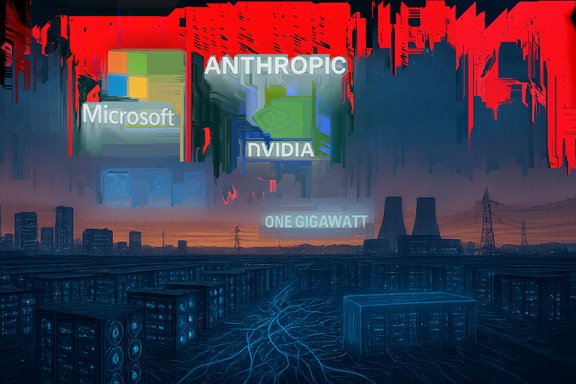
Over the last year Microsoft has publicly signaled a multi‑model strategy: combining internal efforts, continued collaboration with OpenAI, and partnerships with other frontier model developers to power Microsoft 365 Copilot, Azure AI Foundry and enterprise offerings. The November announcements formalize that posture into a commercial triangle: Anthropic commits to buy very large blocks of Azure compute, NVIDIA and Microsoft pledge staged investments in Anthropic, and the three parties agree to co‑engineer models and systems for improved performance and distribution. The headlines are simple to recite but complex to execute:- Anthropic: reported commitment to purchase roughly $30 billion of Azure compute capacity and to contract dedicated capacity at an operational ceiling described as “up to one gigawatt.”
- NVIDIA: reported strategic investment up to $10 billion into Anthropic and a co‑engineering pact to tune models for NVIDIA systems.
- Microsoft: reported strategic investment up to $5 billion and explicit plans to surface Anthropic’s Claude family inside Azure AI Foundry and Microsoft 365 Copilot offerings.
What the deal actually means: the mechanics
$30 billion of Azure compute — what that buys
A multi‑year, reserved compute purchase at the scale of tens of billions of dollars converts future demand into procurement certainty. For Anthropic this promises:- Priority capacity and scheduled windows for large training and high‑volume inference jobs.
- Preferential economics that can lower per‑token inference costs through committed pricing and scale.
- Operational predictability that supports international deployments and enterprise SLAs.
“One gigawatt” — facilities, not GPUs
The oft‑repeated “one gigawatt” figure is an electrical capacity metric — power budget, not a GPU count. Reaching sustained 1 GW of IT load implies:- Multiple AI‑dense data halls with heavy electrical substations and transformers.
- Advanced liquid cooling and rack‑scale thermal design.
- Fiber and high‑speed interconnect fabrics to support tightly coupled training clusters.
NVIDIA’s role: chips + co‑design
NVIDIA’s pledge to invest and co‑engineer locks together hardware and model design in a way seen increasingly as essential to modern LLM economics. The deal names NVIDIA families — notably Grace Blackwell and the next‑generation Vera Rubin systems — as target platforms for Anthropic’s Claude models. The engineering collaboration is expected to focus on:- Kernel and operator optimizations for tensor cores.
- System topologies for sharding and memory capacity.
- Quantization schemes and precision strategies that balance throughput and model quality.
Strategic analysis: why Microsoft is diversifying
Diversification away from single‑supplier dependence
Microsoft has been the largest visible backer and cloud partner of OpenAI. The Anthropic pact signals a deliberate hedge: Microsoft is moving from a near‑exclusive model‑sourcing posture toward a multi‑model Copilot and Foundry strategy. The strategic benefits are tangible:- Product resilience: reduces reputational and operational exposure tied to a single outside model provider.
- Customer choice: enterprises can select models by cost, latency, behavior and compliance needs inside the same Microsoft stack.
- Competitive positioning: owning the orchestration layer (Copilot + Foundry) while surfacing multiple frontier models increases Microsoft’s control of enterprise AI procurement and governance.
The circular investment pattern: benefits and fragility
The arrangement exemplifies a new circular pattern: model developer buys compute from cloud provider; cloud and chip vendors invest in the model developer; the model’s outputs are distributed via the cloud vendor’s products. This loop creates:- Short‑term alignment and guaranteed demand for chip vendors and cloud operators.
- Faster productization and integrated routes to enterprise customers.
- Valuation circularity: investments from customers and suppliers can inflate near‑term valuations without independent demand signals.
- Vendor entrenchment: deep reciprocal commitments make exits or porting harder if product performance, price or governance becomes unfavorable.
- Concentrated market power: regulators are likely to scrutinize arrangements that knit compute, chip supply and model distribution into a tight circle.
Enterprise and product impact
Copilot and Azure AI Foundry
Microsoft announced that Anthropic’s Claude variants will be integrated into Microsoft 365 Copilot workflows and Azure AI Foundry, allowing enterprises to choose Anthropic alongside OpenAI and other models when building agents and services. This is operationally meaningful for:- Developers using Copilot Studio to assemble agent workflows.
- IT teams seeking model alternatives for compliance or behavior differences.
- Procurement teams negotiating long‑term Copilot and Azure contracts.
Real‑world benefits for enterprise adopters
- Shorter latency and better throughput for customers colocated to dedicated Anthropic‑backed Azure capacity.
- Additional model behaviors (safety‑oriented or differently calibrated outputs) useful for specialized business tasks.
- Potential cost improvements for high‑volume inference if Anthropic passes on discounted compute economics.
Financial and valuation considerations — handle with care
Several news outlets and market reports cited large private valuations for Anthropic and projectionary revenue figures tied to the company’s enterprise growth. Those numbers have wide variance across reports and should be read cautiously:- Reported valuation ranges and run‑rate revenue projections are often based on private round terms or market extrapolations, and they can shift rapidly as tranche terms are finalized. Some public reporting suggested valuations as high as the low‑hundreds of billions; other analysis placed Anthropic’s projected revenue run‑rate at different levels. These estimates are inherently uncertain until the investment round’s terms are fully disclosed. Treat specific valuation claims as provisional and subject to change.
Risks, trade‑offs and regulatory angle
1) Lock‑in vs. choice paradox
Although Anthropic intends to remain multi‑cloud in some respects, the partnership increases Anthropic’s operational dependence on Azure and NVIDIA hardware for large swaths of inference and deployment. That creates a paradox:- Microsoft customers gain choice at the model layer inside Copilot and Foundry.
- Yet the industry moves closer to infrastructure coupling where selection of a particular frontier model implies deeper hardware and cloud ties.
2) Circular investments and market concentration
Regulators and competition watchdogs will examine arrangements where cloud providers, chip suppliers and model houses hold mutual stakes. Concentration risks include:- Higher barriers to entry for smaller model startups.
- Potential for anti‑competitive contracting (e.g., exclusivity provisions, preferential pricing that locks customers into a narrow supplier set).
- Complicated cross‑border procurement concerns for public sector customers.
3) Execution and operational risk
The biggest practical risk is execution: permitting large datacenter builds, procuring GPUs and systems on a tight cadence, and delivering commercial SLAs at scale are non‑trivial. If the timeline slips or costs escalate, Anthropic’s model economics and Microsoft’s capacity planning could both be negatively affected.4) Model governance and auditability
Introducing multiple frontier models into enterprise workflows complicates compliance:- Audit trails, provenance, and explainability must be harmonized across models.
- Data residency and cross‑cloud logging differ by provider and region.
- Enterprises should insist on clear governance, model cards and contractual audit rights before embedding any frontier model in regulated workflows.
How IT and procurement teams should react (practical checklist)
- Pilot before committing
- Run parallel tests across Copilot configurations (OpenAI vs Anthropic) with representative workloads and production data samples.
- Insist on measurable SLAs
- Demand clear definitions of latency, regional availability, capacity priority and failover behavior in any long‑term Azure compute commitment.
- Verify portability and exit terms
- Ensure robust contractual exit ramps, data egress pricing caps and portability of fine‑tuned artifacts.
- Benchmark on exact SKUs
- Reproducible performance must be measured on the actual Azure SKUs that Anthropic will use (e.g., Grace Blackwell family or its successors) rather than generic cloud SKUs.
- Update governance frameworks
- Model selection decisions should be incorporated into vendor risk assessments, with additional controls for privacy, bias testing and incident response.
- Model the finance impact
- Work with corporate finance to stress‑test long‑term cost assumptions: compute commitments can change unit economics dramatically, for better or worse.
Strengths and opportunities
- Improved resilience and competitiveness: Microsoft’s ability to host multiple leading models within Copilot and Azure aids enterprise flexibility and reduces the risk of single‑vendor failure.
- Potential cost and performance gains: Co‑engineering with NVIDIA can reduce inference costs and improve latency, benefiting high‑volume enterprise deployments.
- Faster time to market for advanced agentic features: Tight integration across cloud, chip and model layers can accelerate enterprise agent deployments and simplify adoption curves for complex AI workflows.
Weaknesses and blind spots
- Circularity raises valuation and governance questions: Investments by customers and suppliers blur financial incentives and can mask fragile unit economics if revenue per compute dollar does not improve.
- Concentration of power: The market may consolidate around a small number of vertically aligned ecosystems, increasing regulatory risk and reducing choice for some enterprise buyers.
- Execution complexity: Delivering one‑gigawatt‑class deployments at multiple geographies requires heavy lifting in facilities, permits, and supply chains — any slip materially changes the commercial calculus.
Final assessment
Microsoft’s partnership with Anthropic and NVIDIA is a strategic hedge and accelerator rolled into one: hedge against single‑supplier dependence on OpenAI, while accelerating Anthropic’s scale with committed Azure capacity and NVIDIA’s system roadmap. The deal is notable for its scale and circularity — a pattern likely to repeat as frontier labs, hyperscalers and chip vendors seek predictability in an increasingly compute‑intensive industry. However, the headlines should not be conflated with immediate technical or financial deliverables. The dollar figures and the “one gigawatt” ceiling are real but staged commitments; valuation estimates and revenue run‑rate projections remain subject to tranche terms and market adjustments. Pragmatic adopters will treat the announcement as a prompt to pilot, benchmark and harden governance — then decide whether the operational and economic trade‑offs align with their risk appetite.Microsoft’s diversification push is strategically sensible: it buys optionality and product resilience. It also tightens the ties that bind the leading few companies in AI — a development that promises efficiency and scale, but also invites regulatory attention and demands sober, workload‑level validation from enterprise customers.
Conclusion: this alliance reshapes the industrial contours of enterprise AI — accelerating a compute arms race while expanding model choice inside Microsoft’s ecosystem. The immediate winners are customers who demand model flexibility and platform maturity; the long‑term winners will be organizations that treat the headlines as an invitation to test, measure and govern before they commit.
Source: Seeking Alpha Microsoft's partnership with Anthropic helps diversification push: BNP Paribas
