

Today Microsoft issued a formal apology to its Microsoft 365 Personal and Family subscribers in New Zealand, acknowledging that the company “fell short” in how it communicated a pricing and product change introduced in October 2024 — a change that bundled limited access to its Copilot AI assistant with those consumer plans and effectively created a higher‑priced AI-enabled tier while a lower‑priced Microsoft 365 Classic option remained available but was not clearly presented to all customers. Microsoft told affected New Zealand subscribers they may switch to the non‑AI Classic plans and, if they do so by 31 December 2025, will receive a refund covering the price difference dating back to the first renewal after 30 November 2024; the company also laid out the new monthly price points for both AI and Classic plans in its customer email.
For New Zealand subscribers, the immediate priorities are pragmatic: confirm your renewal date, choose the plan that matches your preference on AI and price, keep records of your interactions with Microsoft, and monitor your payment method for the promised refund. For Microsoft and other platform providers, the episode underscores the need to treat AI bundling as a product and communications problem as much as a technical one: when changing the composition and price of a mass consumer subscription, clarity and consumer agency must be baked into the rollout — not added afterward.
Source: Microsoft Source An apology to our Microsoft 365 subscribers in New Zealand - Source Asia
 Background
The change: Copilot in Personal and Family subscriptions
Microsoft’s consumer product roadmap has increasingly centered on delivering generative AI across its productivity suite. In mid‑January 2025 Microsoft publicly confirmed that Copilot would be added to Microsoft 365 Personal and Family subscriptions in most markets, and that the change would be reflected in local pricing. That announcement framed Copilot as an integrated assistant across Word, Excel, PowerPoint, Outlook and other apps, introduced monthly AI credit allocations for consumers, and noted that Microsoft would offer alternative plans for customers who did not want Copilot. The move to bundle AI into mainstream consumer subscriptions not only changed the functional value proposition of the Personal and Family plans but also produced notable price differentials in local markets that attracted consumer scrutiny. In New Zealand, customers noticed their recurring billing amounts increase to new tax‑inclusive monthly levels for the AI‑enabled Personal and Family plans — amounts Microsoft later confirmed in its apology email.Consumer reaction and regulatory interest
The pricing story attracted attention across Australia and New Zealand because of how Microsoft presented — or failed to present — the alternative, lower‑priced “Classic” plans that exclude Copilot. Consumer advocacy groups documented that the Classic plan option often only surfaced when subscribers attempted to cancel their Microsoft 365 subscription, rather than being clearly offered in the initial price‑change communication. That led to claims from consumer groups and at least one high‑profile regulator action: the Australian Competition and Consumer Commission (ACCC) filed proceedings alleging misleading conduct in relation to Microsoft’s communications to Australian customers, and similar complaints arose in New Zealand public debate. Microsoft’s apology is the company’s direct response to criticism that it did not make the suite of subscription options sufficiently clear to all affected consumers in New Zealand. The apology includes concrete remedies and timelines, which are unpacked below.What Microsoft told subscribers in New Zealand
The core message in the apology
Microsoft’s statement to New Zealand customers acknowledged that when Microsoft changed its pricing in October 2024 and introduced AI functionality into the Personal and Family plans, the company “could have been clearer about the availability of a non‑AI enabled offering” — specifically the Microsoft 365 Personal/Family Classic plans. Microsoft said it has begun emailing subscribers to explain options and refund eligibility and apologised for falling short of the company’s standards for trust and transparency.The options on offer
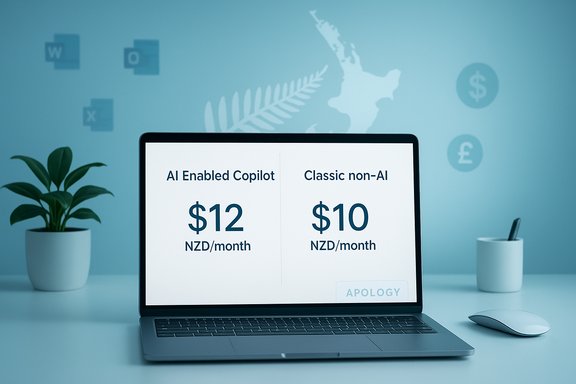
Microsoft laid out two principal choices for affected subscribers:- Option 1 — Stay on Microsoft 365 Personal/Family (the AI‑enabled tier): includes core Microsoft 365 apps plus Copilot and ongoing feature updates. Microsoft stated the AI‑enabled plans renew at NZD $17/month for Personal and NZD $23/month for Family (tax inclusive). No action is required if subscribers wish to remain on this tier.
- Option 2 — Switch to Microsoft 365 Personal/Family Classic (non‑AI): includes core apps and security updates but does not include Copilot and may not receive certain new feature updates. Microsoft stated Classic renews at NZD $12/month for Personal and NZD $18/month for Family (tax inclusive), the prices customers paid before the change. Subscribers who switch to Classic by 31 December 2025 are eligible to receive a refund for the difference in price between plans, starting from their first renewal date after 30 November 2024. Microsoft said refunds will be processed to the subscriber’s payment method within 30 days after the switch is made. The refund option is limited to customers in New Zealand who receive Microsoft’s email and switch by the stated deadline.
What Microsoft promises about Copilot control and privacy
Separately, Microsoft’s product communications about Copilot — issued earlier on the Microsoft 365 blog — emphasised user controls and privacy commitments: Microsoft said it would add settings to allow users to disable or enable Copilot in apps like Word, Excel and PowerPoint when desired, and stated it does not use prompts, responses or file content from Copilot interactions to train its foundation models. Those technical and policy assurances are part of Microsoft’s broader attempt to manage consent and privacy concerns as AI features roll into consumer products.Verification: cross‑checking the key claims
This story hinges on a few concrete facts — timing, pricing, the refund window, and how Microsoft communicated the Classic option. Those claims were cross‑checked against multiple authoritative sources:- Microsoft’s apology and the text of the email Microsoft says it is sending to subscribers are published directly by the company and contain the specific prices and refund deadline. That is the primary source for Microsoft’s stated remedy and wording.
- Microsoft’s product blog post confirming Copilot’s inclusion in Personal and Family plans, and discussing Classic plan alternatives and opt‑out controls, was published earlier and confirms the company’s technical and product roadmap. It also described the plan architecture that later led to differential pricing in various markets.
- Independent consumer advice and reporting in New Zealand documented how the Classic option often only became visible during cancellation flows, and advised subscribers on practical steps to avoid paying more for the same core Office experience. Those reports corroborate users’ accounts and explain why consumer groups and regulators in the region raised concerns.
- Regulatory and news coverage in Australia — including court filings by the ACCC — provide an additional independent validation of the broader pattern and the legal stakes in nearby markets; this coverage also quantifies the depth of the controversy and the regulatory response. While the ACCC action is focused on Australian customers, its public case provides a clear parallel and context for New Zealand developments.
Why this matters to subscribers and what to watch for
The practical consumer impact
For many home users, the Microsoft 365 subscription is an essential recurring expense that bundles Office apps, OneDrive storage, and basic security. A price rise disguised as a value addition — essentially an upsell to include AI features — has real financial impact for households and small users who do not want or need Copilot.- The Classic plans keep the functional core (Word, Excel, PowerPoint, Outlook, OneDrive storage and security updates) at the pre‑increase price points, while Copilot was bundled into the higher tier.
- Some subscribers report the Classic option was not clearly labelled in the initial price-change notices and only appeared when they attempted to cancel or downgrade, creating a perception of obscured choice. Independent consumer advice in New Zealand laid out how to find the Classic option in the subscription management flow.
Legal and regulatory risk
Microsoft’s apology to New Zealand users arrives in the context of ongoing regulatory scrutiny in the region. Australia’s competition regulator has brought a lawsuit alleging the company’s communications were misleading, and that the Classic option was not adequately disclosed. That litigation frames the public policy issue: regulators contend bundling an optional AI feature in a way that hides a cheaper, functionally equivalent alternative may run afoul of consumer law that requires clear disclosures and truthful representations. While New Zealand’s Commerce Commission did not open a formal investigation in the first instance, the matter remains sensitive and could invite future scrutiny or follow‑up actions depending on how Microsoft executes its refund process and disclosures.Trust and reputation
The broader reputational cost is also meaningful. For consumer services that rely on recurring billing and lifetime value, transparency and predictable operations are critical. When a large vendor appears to obscure alternatives or make it hard to avoid an upsell, even if technically options do exist, that erodes trust — a costly consequence for a platform provider that depends on scale and broad consumer goodwill.The refund mechanics and limitations — read the fine print
Microsoft’s apology contains explicit procedural language about refunds; subscribers should pay attention to the conditions Microsoft set:- Eligibility: The refund option applies only to subscribers in New Zealand who receive Microsoft’s email about the option and who switch to Microsoft 365 Personal/Family Classic by 31 December 2025. This makes the remedy time‑limited and tied to the direct notification Microsoft sends.
- Refund window: Refunds cover the difference between plans starting from the subscriber’s first renewal date after 30 November 2024 (that date is the reference point for Microsoft’s calculation). Refunds will be processed to the payment method used to subscribe within 30 days of the switch.
- Billing condition: Microsoft stated that if subscribers want to continue using Microsoft 365 Classic after switching, they must keep recurring billing enabled. That implies Classic remains a recurring paid subscription rather than a one‑off downgrade. Subscribers who cancel recurring billing may be prevented from keeping the Classic option.
- Keep email and account records showing the Microsoft communication and the date you switched.
- Watch your bank or card statement within the 30‑day processing window.
- If a refund is not received in the stated timeframe, document contacts with Microsoft support and escalate within Microsoft’s billing channels.
Unanswered questions and remaining risks
Microsoft’s apology and refund offer address the surface problem — unclear communication — but significant questions remain open:- Scope: The refund program appears to be limited to customers who received Microsoft’s New Zealand email. What about subscribers who canceled long before the email or who were unaware of the Classic option and left the service entirely? Microsoft’s message does not clearly state accommodations for people who already terminated accounts or switched to other providers; those cases may require direct support engagement.
- Discoverability: Microsoft claims it will process refunds for those who switch to Classic by 31 December 2025, but does not change the mechanics by which Classic is surfaced in subscription flows. If the Classic option remains discoverable only via cancellation flows or a buried “manage subscription” page, many users may continue to miss the lower‑priced option. Independent reporting noted this was the core user complaint. Microsoft’s apology promises improved clarity, but the company has not yet published specific UI or communication changes that will prevent recurrence.
- Regulatory follow‑up: The ACCC’s action in Australia signals potential penalties and legal costs for companies whose marketing and price‑representation practices are found wanting. New Zealand’s Commerce Commission previously decided not to launch an investigation in response to early complaints, but a high‑profile apology and refund program may not preclude later review if more complaints surface or if the execution of the remedy proves insufficient.
- Privacy and technical controls: Microsoft’s published assurances about not using Copilot prompts/responses to train models and about adding per‑app toggles for Copilot are positive signals. However, subscribers who are sensitive to AI‑driven data handling should still verify local settings and audit app behavior. The practical visibility of those toggles and their defaults (enabled vs disabled) will determine whether users genuinely have control over Copilot in everyday use.
How New Zealand subscribers should act now (practical checklist)
For New Zealand subscribers who want to evaluate their options, the following short, numbered checklist summarizes the most important and immediate steps to take:- Sign in to your Microsoft account and open the Manage subscriptions page to confirm your current Microsoft 365 plan and renewal date. Note the renewal date — it determines the refund calculation baseline.
- If you do not want Copilot and prefer to keep the pre‑increase price, follow Microsoft’s instructions to switch to Microsoft 365 Personal/Family Classic before 31 December 2025. Keep recurring billing enabled if you intend to maintain Classic long‑term.
- If you switch to Classic, monitor your payment method for the refund, which Microsoft says will be processed within 30 days to the same payment method used for subscription charges. Save screenshots of confirmation messages and any Microsoft correspondence.
- If you want to keep the higher tier but limit AI interactions, review and set Copilot toggles inside Word, Excel and PowerPoint (or follow Microsoft’s in‑app controls) to disable Copilot where it’s not needed. Confirm the app version and settings reflect your preferences.
- Keep documented records of receipts, emails and screenshots. If you do not receive a promised refund within the time window, contact Microsoft support and reference the refund policy detailed in Microsoft’s email. If problems persist, seek assistance from consumer protection groups for guidance about escalation.
Broader industry lessons: bundling AI and consumer trust
This episode is a case study in how companies introduce paid AI features into established subscription products. A few wider lessons for vendors, regulators and consumers are apparent:- Clear opt‑in and opt‑out design matters. When consumers are billed on a recurring basis, introducing new paid functionality — especially AI features that raise novel privacy and trust questions — should be accompanied by explicit, front‑facing choices, not buried alternatives. The optics of discovery matter as much as the legal disclosure text.
- Regulators are sharpening scrutiny. The ACCC case in Australia shows competition and consumer authorities will litigate if they believe sales practices obscure materially relevant information. That raises the cost of rollout missteps for global vendors.
- Product teams must connect legal, marketing and UX. The technical inclusion of Copilot was plausible from an engineering and product perspective; the failure here was in cross‑functional coordination to ensure pricing, billing flows and consumer messaging matched what the user would expect. That operational gap is the immediate root cause of the reputational issue.
- Privacy and data governance remain first‑order. Even where the company promises not to use Copilot interactions for model training, consumers and privacy advocates will insist on transparency and usable controls. Vendors that deliver clear toggles and default privacy‑protective settings will have an easier path to consumer acceptance.
Strengths in Microsoft’s response — and where it falls short
Microsoft’s public apology and the concrete refund mechanism represent important corrective steps. The company did four things that are meaningful:- It publicly acknowledged the communication failure and apologised to affected customers in New Zealand.
- It explicitly described the Classic alternative and the price parity with pre‑increase levels.
- It offered a time‑limited refund policy with a clear processing window (refunds within 30 days) tied to the customer action of switching to Classic.
- It reiterated technical controls and privacy assurances around Copilot.
- The refund and eligibility rules are conditional and limited to “subscribers who receive this email,” potentially excluding customers who cancelled earlier or who did not receive the notice.
- Microsoft did not at the time of apology publish a revised, more discoverable UX or public plan for how the Classic option will be surfaced, leaving open the risk of repeated confusion.
- The company’s promise to “learn from this and improve” is vague absent measurable commitments — for example, UI changes, timelines, or third‑party auditing of communications practices.
Conclusion
Microsoft’s apology to its New Zealand Microsoft 365 subscribers is a significant, if belated, recognition of a communications failure that produced real consumer confusion and prompted regulatory attention in the region. The company’s offer to allow switching to Microsoft 365 Classic at pre‑increase prices — plus a limited refund for the difference dating back to the first renewal after 30 November 2024 — answers some immediate concerns, but the remedy’s time‑limited and eligibility‑based nature leaves unresolved questions about discoverability, coverage for past cancellations, and whether the company’s UI and messaging will change in ways that prevent a recurrence.For New Zealand subscribers, the immediate priorities are pragmatic: confirm your renewal date, choose the plan that matches your preference on AI and price, keep records of your interactions with Microsoft, and monitor your payment method for the promised refund. For Microsoft and other platform providers, the episode underscores the need to treat AI bundling as a product and communications problem as much as a technical one: when changing the composition and price of a mass consumer subscription, clarity and consumer agency must be baked into the rollout — not added afterward.
Source: Microsoft Source An apology to our Microsoft 365 subscribers in New Zealand - Source Asia
